DD
MM
YYYY

PAGES

DD
MM
YYYY

spot_img

PAGES

Home Blog Page 655

Ozak AI Compared to Shiba Inu at $0.00001 Entry: Why This AI-Powered Presale Could Deliver Exponential ROI with a $2 Launch Prediction by 2026

0

A few projects have captured the attention of investors, like Ozak AI, which is positioning itself as a potential game-changer in the realm of AI and blockchain integration. Having a presale in progress, early investors can lock their place in a project that has the potential to reflect the meteoric success of Shiba Inu when the token was initially obtained at its price of 0.00001.

With Ozak AI making its way to the targeted $1 launch price within 2026, analysts have also made projections of the token, with some estimating that it is likely to shoot up to as high as $2 when the market is opened fully.

The Strength of Integration of AI and Blockchain

Ozak AI is not simply another run-of-the-mill speculative token in an oversaturated cryptosphere. Artificial intelligence (AI) and blockchain technology power the project, with the two combined to form a decentralized predictive platform that was tailored for real-life applications.

The project provides data processing security and scalability using its new innovation, DePIN (Decentralized Physical Infrastructure Network), and ensures the services provide tamper-proof, real-time information using the Ozak Stream Network (OSN). This is an industry-driven system applicable in the financial markets, Internet of Things (IoT) solutions, and others, and hence much more than a token.

And as AI moves to an indispensable tool in the decision-making process and financial modeling, the integrated platform that Ozak AI provides promises to deliver strong predictive capabilities, based on machine learning algorithms. The Prediction Agents (PAs) examine data streams both within and without and provide practical and actionable insights to aid in enterprise analysis, market intelligence, and trading decisions.

Steady Presale Progress and Tokenomics

Ozak AI has experienced high levels of presale as the project goes on to raise 2.1 million in Phase 4 alone. The presale will be arranged in levels; the initial price in Phase 1 will be only $0.001, and the presale will advance to Phase 4 at $0.005. This will be followed by an increase in price to the next level, $0.01, in the next phase of the target of $0.01, closer to the final launch price of $1. This slow rise in price has created momentum, and many investors are willing to join now at the current low-level price and surf the wave until the end.

The presale structure allows early investors to buy in at a low price with the opportunity for substantial returns once the token hits its official launch price. The comparison to Shiba Inu’s growth is not unfounded—with Ozak AI’s combination of cutting-edge technology, strong tokenomics, and real-world use cases, investors are eager to lock in their positions early.

Real-World Applications and Market Demand

Ozak AI is not a mere speculative coin. Due to the real-world applications of the platform, it makes it different from other blockchain projects. The OSN has the potential to stream across any other blockchain with a very low amount of latency, which makes it an extremely valuable asset to decentralized finance (DeFi) and AI-related decision-making. Also, the provision of secure data aggregation by the network stands as a potentially useful instrument to industries that need to make quick, dependable decisions.

The Prediction Agent is another feature that the platform is fitted with, as it provides market predictions, albeit relying on a significant amount of data analysis, leaving traders and companies with real-time opportunities to make informed decisions.

Giveaways, Incentives, Partnerships, and Security

Further to promote presale activity, Ozak AI is implementing a $1 million giveaway that incentivizes investors to accumulate at least $100 worth of the $OZ tokens. This referral giveaway also serves as an expansion on the same, since it rewards customers for engagement with the community. Besides such appealing propositions, the initiative is also accompanied by sound security measures, such as CertiK-audited security protocols, which would make the platform safe and secure for the investors.

Ozak AI has been rapidly expanding its ecosystem through key partnerships that strengthen both its technology and usability. Its collaboration with SINT unlocks “one-click AI upgrades,” where features like autonomous agents, cross-chain bridges, and voice tools make Ozak AI’s signals instantly actionable within smart systems.

With Hive Intel (HIVE), Ozak AI gains access to multi-chain blockchain data APIs, including on-chain analytics, NFT and DeFi insights, token performance, and wallet behavior—giving its bots sharper speed and accuracy. Meanwhile, the partnership with Weblume brings Ozak AI’s real-time signals into a no-code Web3 builder, letting creators integrate market intelligence directly into dashboards and decentralized applications without coding barriers. Together, these integrations push Ozak AI beyond just analytics, positioning it as a plug-and-play intelligence layer across Web3.

The Pursued Road

As the presale approaches its close, the future of Ozak AI is shining with the brightest prospects ever. A combination of AI and blockchain, along with the practical application, has placed the project on the course of exponential growth. A target prediction of $2 to be reached by 2026 does not feel very unattainable, and the platform is steadily developing its infrastructure and building partnerships, and incorporating new use cases.

The price of $OZ remains in early stages, but investors looking to invest now are likely to make good returns once the token reaches the 1 dollar mark. The investors might experience geometric returns as the adoption and the positioning of the Ozak AI in the blockchain and AI landscape become established, as SHIB did before.

The presale of Ozak AI presents a rare chance to invest in an AI, but one that is paired with blockchain and has real-world connections. Ozak AI is an ambitious and potentially highly profitable project of 2025 and beyond with its innovative technology, powerful tokenomics, and prospects of outstandingly high ROI.


For more information about Ozak AI, visit the links below:

Website: https://ozak.ai/

Twitter/X: https://x.com/OzakAGI

Telegram: https://t.me/OzakAGI

Solana & XRP Prices Stuck in Consolidation as Market Watches a 100x Runner in the Making

0

Solana and XRP are locked in consolidation, with both tokens struggling to break out of tight trading ranges. While investors wait for clearer signals from these established giants, attention is shifting to a new contender: Layer Brett ($LBRETT).

This Ethereum Layer 2 meme coin is being tipped as a 100x runner in the making. With huge staking rewards, community buzz, and early adoption, $LBRETT is quickly becoming the token to watch in 2025.

Solana consolidates as traders wait for the next breakout

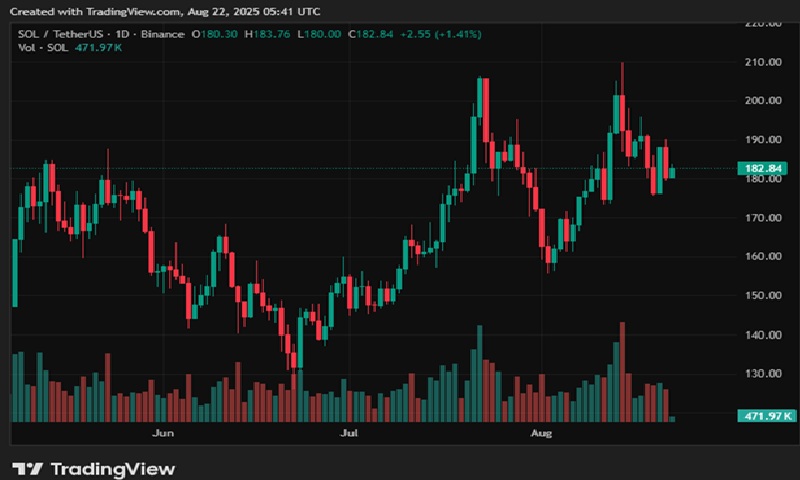
Solana has entered a consolidation zone after reaching its recent peak of $209.86. Solana now trades at $182, showing steady footing above the 30-day moving average. This suggests buyers are still defending key levels, but momentum has slowed compared to the rally seen earlier in August.

Source: TradingView

The $170–180 region has become an important support area where Solana buyers consistently step in. On the other side, sellers are active below $200, capping attempts at a breakout. This back-and-forth has tightened Solana’s range, keeping the market in check for now.

For traders, consolidation signals a period of balance before the next move. A push above $200 could open the way higher, while slipping under $170 risks deeper pullbacks.

XRP holds near $2.85 as traders eye $3 breakout

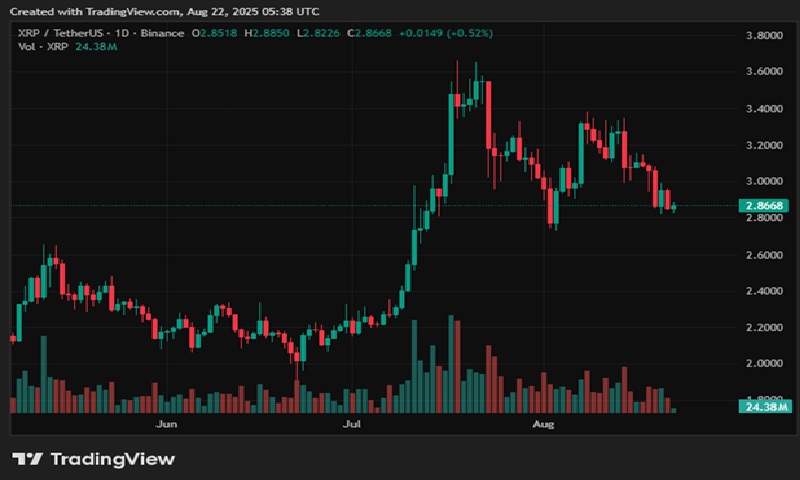
XRP is trading in a consolidation phase after pulling back from its July peak near $3.66. XRP’s price has been bouncing around this region, currently priced at $2.85, and the 60-day moving average is positioned right underneath it, giving it slight support. Buyers are standing their ground at the $2.70 level, and the sellers restrain any up-movement above the $3.00 mark,  putting XRP in the tight between-zone.

Source: TradingView

Trading volumes have been slower than previous rushes, which is an indication that traders are waiting for new developments before investing. Consolidation is likely to dominate until the next breakout.

A breakout above $3.00 may unleash fresh bullish motivation for XRP, while a drop below the $2.70 mark may open up the pathway to further losses.

Layer Brett ($LBRETT): The 100x runner in the making

Layer Brett ($LBRETT) is building momentum as one of 2025’s most ambitious meme coins with real upside. Running on Ethereum’s Layer 2, it combines speed with low fees, making it practical for large-scale use. This strong base gives $LBRETT a chance to climb far higher, with many traders pointing to its potential as a 100x runner in the months ahead.

Unlike meme tokens that rely only on hype, Layer Brett adds tangible features. It offers gamified staking, NFT tie-ins, and cross-chain support, creating more ways for holders to benefit. A no-KYC, self-custodial wallet means users keep control of their assets without depending on centralized exchanges, which adds another layer of appeal.

Staking rewards are drawing early interest, with eye-catching APY figures for those who join ahead of the crowd. Community activity is also rising thanks to a $1M giveaway that’s creating buzz around the project. With its smaller market cap and expanding reach, Layer Brett has the profile of a token capable of explosive growth in 2025.

Here are some key features of Layer Brett ($LBRETT):

  • Self-custodial wallet with no KYC requirements
  • Gamified staking system with rewards tied to community activity
  • Early staking APY opportunities reaching up to 20,000%
  • $1M giveaway driving adoption and community buzz

Layer Brett is still in its early stages, giving early movers a rare window to position before wider exposure. With momentum building fast, missing out now could mean watching one of 2025’s biggest runs from the sidelines.

Layer Brett offers a stronger entry point than Solana and XRP

At just $0.0047, Layer Brett ($LBRETT) gives investors a ground-floor opportunity that Solana and XRP can no longer match. Both established tokens trade at far higher levels, leaving limited room for exponential gains. With its low price, strong utility, and fast-growing community, $LBRETT stands out as a better entry point for those chasing the next 100x crypto in 2025.

Discover More About Layer Brett (LBRETT):

Presale: LayerBrett | Fast & Rewarding Layer 2 Blockchain

Telegram: Telegram: View @layerbrett

X: (1) Layer Brett (@LayerBrett) / X


“Merely Writing Code, Without Ill Intent, Is Not A Crime”— Acting Assistant US AG Galeotti

0

Acting Assistant Attorney General Matthew R. Galeotti stated at the American Innovation Project Summit on August 21, 2025, that “merely writing code, without ill intent, is not a crime.”

This was part of a broader discussion on the U.S. Department of Justice’s (DOJ) approach to digital asset enforcement, emphasizing that developers contributing to open-source projects without specific intent to facilitate criminal activity, such as fraud, money laundering, or sanctions evasion, are not criminally liable. Galeotti clarified that the DOJ will not pursue charges under 18 U.S.C. § 1960 (unlicensed money transmitting) for decentralized software that automates peer-to-peer transactions without third-party control over user assets.

This stance follows a memo from Deputy Attorney General Todd Blanche, signaling a shift from previous aggressive crypto enforcement policies. However, Galeotti noted that developers with proven criminal intent could still face prosecution.

The statement has been welcomed by the crypto community as reducing regulatory uncertainty, though some skepticism remains about its practical impact, especially in light of recent convictions like that of Tornado Cash developer Roman Storm.

Developers contributing to open-source projects, such as decentralized finance (DeFi) protocols or blockchain tools, are less likely to face criminal liability under laws like 18 U.S.C. § 1960 (unlicensed money transmitting) if their work lacks criminal intent. This provides a clearer legal boundary, protecting developers from prosecution for simply creating software.

Shift in DOJ Enforcement Policy

This could lead to fewer investigations or prosecutions of open-source developers, fostering a less adversarial regulatory environment.

However, the caveat that developers with proven criminal intent remain liable means due diligence is still critical. Developers must avoid knowingly enabling illegal activities, such as by designing software explicitly for criminal purposes. By alleviating fears of criminal prosecution, developers may feel more confident contributing to open-source projects.

The clarification may encourage more developers to engage in open-source projects without worrying about unintended legal consequences, especially for tools like mixers or privacy protocols that have faced scrutiny (e.g., Tornado Cash). While the statement is a step toward clarity, skepticism persists due to recent cases like the conviction of Tornado Cash developer Roman Storm.

The clarification is limited to criminal liability under specific statutes and does not address civil or regulatory actions (e.g., by the SEC or CFTC), which could still pose risks for developers. Jurisdictional differences and international regulations may complicate the global open-source ecosystem, as other countries may not adopt a similar stance.

The crypto and open-source communities have largely welcomed this clarification, as it reduces the “chilling effect” of regulatory overreach. It may boost trust in the U.S. as a jurisdiction supportive of blockchain innovation. However, the DOJ’s continued scrutiny of intent means developers must maintain transparency and ethical practices.

Benefits for Open-Source Solutions

Open-source projects thrive on community contributions. With reduced fear of criminal liability, more developers—especially those in the U.S.—may participate in projects like decentralized exchanges, privacy protocols, or blockchain infrastructure, leading to richer, more robust software ecosystems.

The clarification could make open-source blockchain projects more attractive to investors and developers, as the legal risks associated with contributing to or funding such projects are diminished. This could lead to increased funding for open-source initiatives, enabling faster development and broader adoption.

Open-source solutions in DeFi, NFTs, and other blockchain applications often rely on decentralized, peer-to-peer frameworks. The DOJ’s acknowledgment that software automating such transactions (without third-party control) is not inherently criminal validates these models, encouraging their development.

The statement aligns with the view that writing code is a form of expression, potentially strengthening legal arguments that code is protected under free speech principles. This could benefit open-source developers in future legal battles, particularly in cases involving privacy or encryption tools.

Open-source projects can now better structure their development processes to avoid legal pitfalls. For example, clear documentation of intent, adherence to anti-money laundering (AML) best practices, and transparency in code contributions can help projects stay within the DOJ’s clarified boundaries.

The DOJ’s clarification is a significant win for open-source solutions, particularly in the blockchain and digital asset space. It reduces legal risks, encourages innovation, and supports the growth of decentralized technologies by reassuring developers that writing code, absent criminal intent, is not a crime.

Open-source projects stand to benefit from increased participation, investment, and legal clarity, fostering a more vibrant ecosystem. However, developers must remain vigilant about compliance, and the industry should advocate for consistent enforcement and broader regulatory alignment to fully realize these benefits.

Philippine Strategic Bitcoin Reserve Act Could Position The Country as a Pioneer in Asia’s Crypto Landscape

0

Philippine Congressman Miguel Luis “Migz” Villafuerte filed House Bill 421, titled the “Philippine Strategic Bitcoin Reserve Act,” proposing the establishment of a government-managed Strategic Bitcoin Reserve.

The bill directs the Bangko Sentral ng Pilipinas (BSP) to purchase 2,000 Bitcoin (BTC) annually for five years, totaling 10,000 BTC, valued at approximately $1.1 billion at current market prices. The reserve would be held in trust for at least 20 years, with sales or transfers prohibited except for retiring government debt.

The BSP would store the Bitcoin in cold storage across multiple secure facilities and provide quarterly proof-of-reserves reports for transparency. The bill positions Bitcoin as “digital gold,” citing its 40% compound annual growth rate over the past five years and its potential to hedge against economic volatility and rising sovereign debt, which reached 16.09 trillion pesos ($275 billion) by November 2024.

Villafuerte highlighted global trends, noting El Salvador’s Bitcoin adoption, Bhutan’s holdings of 10,565 BTC, and similar proposals in Brazil, Switzerland, and Poland. If passed, the Philippines would be the first Asian nation to legislate a sovereign Bitcoin reserve, surpassing El Salvador’s 6,276 BTC.

The proposal reflects growing global interest in integrating cryptocurrencies into national financial strategies. By holding Bitcoin, valued for its historical 40% compound annual growth rate, the Philippines could diversify its reserves, traditionally dominated by fiat currencies and gold, to hedge against inflation and currency depreciation.

This could stabilize the economy during global financial crises or peso devaluation, given the sovereign debt of 16.09 trillion pesos ($275 billion). The bill’s provision to use Bitcoin only for retiring government debt could reduce fiscal strain, potentially lowering interest rates and freeing up budgetary resources for development projects.

If passed, the Philippines would be the first Asian nation to establish a sovereign Bitcoin reserve, potentially attracting international attention and positioning the country as a forward-thinking financial hub. This could draw foreign investment in fintech and blockchain sectors.

A government-backed Bitcoin reserve could boost confidence in the cryptocurrency market domestically, encouraging businesses and individuals to adopt digital assets, which could stimulate economic activity. Bitcoin’s price volatility (e.g., dropping from $103,332 in 2024 to ~$110,000 currently trading around $116,607) poses risks.

A market crash could reduce the reserve’s value, impacting fiscal planning if not managed carefully. The bill’s requirement for quarterly proof-of-reserves reports and secure cold storage by the Bangko Sentral ng Pilipinas (BSP) could enhance transparency and trust in public institutions, setting a precedent for robust cryptocurrency regulation.

The BSP’s historical caution toward cryptocurrencies due to risks like money laundering may create friction in implementation, requiring clear regulatory frameworks to balance innovation and security. A Bitcoin reserve could attract partnerships with crypto-friendly nations or firms, fostering technology transfers and economic collaborations.

By diversifying away from dollar-dominated reserves, the Philippines could reduce reliance on traditional financial systems, aligning with nations exploring alternatives amid global economic shifts. A government-endorsed Bitcoin reserve could catalyze the development of a domestic blockchain ecosystem, encouraging startups in decentralized finance.

To manage the reserve and related technologies, the government may invest in blockchain education programs, fostering a skilled workforce and positioning the Philippines as a regional tech hub. With 37% of Filipinos unbanked (as of 2023 BSP data), a government-backed cryptocurrency initiative could promote digital wallets and blockchain-based financial services.

The Philippines, a major recipient of overseas remittances ($36.7 billion in 2023), could leverage Bitcoin’s low-cost, fast transactions to reduce remittance fees, increasing disposable income for families and stimulating local economies. To support the reserve, the Philippines could explore Bitcoin mining, leveraging its renewable energy potential (e.g., geothermal and solar).

The bill’s requirement for multiple cold storage facilities could spur investments in cybersecurity and physical infrastructure, enhancing technological capabilities. A Bitcoin reserve could signal the Philippines as a crypto-friendly destination, attracting foreign direct investment (FDI) in tech and finance sectors. In 2023, FDI inflows were $9.2 billion; a crypto-friendly policy could boost this figure.

If Bitcoin appreciates significantly, profits from the reserve could be reinvested into social programs, infrastructure, or education, addressing inequality (the Philippines’ Gini coefficient was 0.41 in 2021). Small and medium enterprises (SMEs), which account for 99.5% of Philippine businesses, could adopt Bitcoin for transactions, reducing costs and accessing global markets.

By leveraging Bitcoin’s potential, the Philippines could attract investment, create jobs, and enhance its global financial standing. However, success hinges on robust regulation, public education, and sustainable practices to mitigate risks. If implemented effectively, this bold move could catalyze long-term economic and technological development, aligning the Philippines with the evolving global digital economy.

Beijing’s Warning Forces Nvidia to Halt H20 AI Chip Production

0
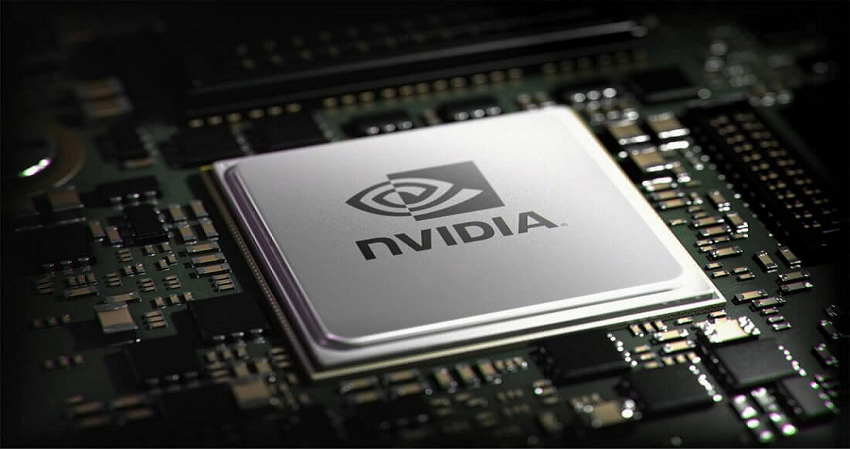
Nvidia chip

Nvidia’s plans to stage a comeback in China’s lucrative AI market seem to have hit a brick wall.

According to The Information, Nvidia has instructed its component suppliers to halt production related to its H20 AI chip, a model specifically designed for China, after Washington’s sweeping export restrictions barred Nvidia from selling its most powerful AI processors to the country.

The production pause reportedly follows a strong warning from Beijing, urging Chinese companies to refrain from deploying the H20 over fears of potential security risks. Authorities in Beijing are concerned the chips could contain backdoors that might allow the U.S. government to access sensitive data. In line with its broader push for technological self-sufficiency, China has been encouraging its firms to switch to domestically developed processors instead.

The setback comes barely a month after Nvidia, alongside other U.S. chipmakers, was given approval to sell AI chips tailored to meet U.S. export rules in the Chinese market. The H20, along with other restricted models like the L20, was Nvidia’s attempt to maintain its presence in the world’s second-largest AI economy while sidestepping Washington’s sanctions.

In a statement to TechCrunch, an Nvidia spokesperson pushed back on Beijing’s allegations, saying: “We constantly manage our supply chain to address market conditions. Cybersecurity is critically important to us. NVIDIA does not have ‘backdoors’ in our chips that would give anyone a remote way to access or control them. The market can use the H20 with confidence.”

Beijing’s skepticism and Nvidia’s attempts at reassurance

Beijing’s concern over the H20 chip stems from growing suspicion that foreign-designed hardware could serve as a conduit for espionage. Chinese regulators, citing warnings from cybersecurity experts, suggested that Nvidia’s AI chips might contain hidden functions capable of transmitting sensitive data back to the U.S. or even shutting down systems remotely. This fear was amplified after Washington placed strict export controls on high-performance chips in 2022 and 2023, aimed at curbing China’s progress in advanced AI and military applications.

The H20, a lower-performance version of Nvidia’s flagship AI chips, was specifically tailored to comply with U.S. export restrictions while still allowing the company to maintain a foothold in China’s lucrative AI market. Nvidia marketed the chip as safe, efficient, and within Washington’s legal framework. However, Beijing’s warnings have cast a cloud over its future, highlighting the delicate balance Nvidia must strike between satisfying U.S. regulators and appeasing Chinese authorities.

Last month, China’s Cyberspace Administration reportedly summoned the company over alleged “serious security issues” in its chips, echoing earlier claims from U.S. AI experts that Nvidia’s hardware contained location-tracking capabilities and remote shutdown features. Although Nvidia has strongly denied these allegations, the skepticism persists in Beijing.

Now, Nvidia is signaling a cautious response to China’s concerns by halting production of the H20, while also buying time to address the political and technical fallout. The move underscores the difficult position the chipmaker finds itself in, with Washington’s restrictions limiting what it can sell to China, and Beijing’s mistrust threatening to shut it out of the very market it has been trying to re-enter.

Additionally, the dispute highlights the increasingly fraught tech rivalry between Washington and Beijing, with semiconductors sitting at the heart of the contest. U.S. officials argue that restricting Nvidia’s most advanced chips is critical to preventing China from achieving military and surveillance capabilities powered by cutting-edge AI. Beijing, in turn, has responded by pushing for greater reliance on local firms such as Huawei, which has already begun rolling out competitive AI chips that are being rapidly adopted across China.

Some analysts believe that Nvidia’s halt is significant because the H20 was expected to be part of its main revenue driver in China for 2025. The company generated over $10 billion annually from Chinese sales before the U.S. export bans, making the market one of its most important globally. With Beijing now tightening its stance, Nvidia risks ceding ground to Huawei’s Ascend series of AI chips, which are quickly gaining traction as domestic replacements.

While Nvidia relies heavily on China for its revenue, China, for its part, is accelerating efforts to cut dependence on U.S. suppliers altogether. That has created a window of opportunity for domestic players who are not just filling the void but positioning themselves as long-term competitors.