DD
MM
YYYY

PAGES

DD
MM
YYYY

spot_img

PAGES

Home Blog Page 6592

African Economies in the Predicted 2020 Global Recession

0

With the less than two months to the end of 2019, businesses, governments and individuals have been counting the gains and losses attained during the year throughout the world. For experts and public affairs analysts, there is a need for celebration and reflection on what has been achieved and what has not been attained in line with the socioeconomic and political goals set earlier in the year.

Four years ago, African leaders joined other leaders in the world and agreed to address a number of problems facing people by 2030. They also wanted to have “Africa we want”, a continent where everyone would be more prosperous by 2063.

To meet the first agenda, existing information indicates that the continent needs to raise an estimated 11 per cent of GDP per year for the next 10 years to close the financing gap. Attaining the second agenda would largely depend on having the political will to implement the goals and targets of the agenda. As espoused by the analysts, the continent needs the will and adequate resources before sustainable solutions could be created and captured from the continent’s market space of about US$3.4 trillion, and a consumer base of 1.27 billion.
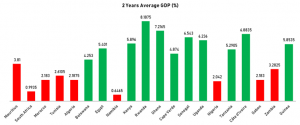
Source: International Monetary Fund, World Economic Outlook April 2019; Infoprations Analysis, 2019


Rumblings of Recession

Though, the governments on the continent have been working out various modalities and initiating programmes towards overcoming numerous socioeconomic challenges hindering its development in the last decade. It, however, appears that the continent would have more issues to contend with in the next decade as trade war continues among some countries, especially between the United States and China, which has been seen as one of the signs of global economic downturn in 2020. Already, the global manufacturing sector is experiencing the heat. The key US manufacturing index hit its lowest point in more than a decade recently. Report has it that the war between the US and China inflicted wound that needs to be healed by the President Donald Trump until his re-election. The failure to get the right solutions would nose-dive the economy early next year because many global companies would continue to have problems in planning their operations with the lowest investment as the main consequence.

The outcome of the consequence would be a global recession in 2020, which has been linked with the weaker growth that would be experienced in advanced and developing countries. The countries such as the United States, Germany, Japan and China with the substantial space acquisition in global manufacturing will experience a slowdown in the sector. China has already reported its worst manufacturing output in 17 years. Hong Kong, the United Kingdom, Italy, Turkey, Argentina, Iran, Mexico, South Korea and Brazil are also expected to have share of the global recession in 2020. According to the United Nations, countries and policymakers need to refocus on jobs, wages and investment. “Finance ministries and central banks should end their “obsession with stock prices, quarterly earnings and investor confidence” and instead focus on job creation, boosting wages and increasing public investment.”
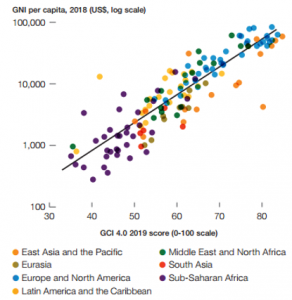
Source: World Economic Forum, World Bank, World Development Indicators, 2019

The lingering question among the experts and public analysts from the Africa and other continents is where would African countries be in 2020. Is the continent ready for the recession? Checks reveal that the continent would not be left out in having the pie of the recession because the countries identified as early places of the recession are the major trade partners of the continent. And that the competitiveness of the economies of most countries remains low since 2015 linked to weaker institutions, ineffective economic policies or programmes and a number of factors.

Resonating with the United Nations’ warning on the recession, the competitiveness landscape as painted by the 2019 Global Competitiveness Index indicates more efforts to restore productivity and growth to lift living standards.

“Led by Mauritius (52nd), sub-Saharan Africa is overall the least competitive region, with 25 of the 34 economies assessed this year scoring below 50. South Africa, the second most competitive in the region, improves to the 60th position, while Namibia (94th), Rwanda (100th), Uganda (115th) and Guinea (122nd) all improve significantly. Among the other large economies in the region, Kenya (95th) and Nigeria (116th) also improve their performances, but lose some positions, overcome by faster climbers.”
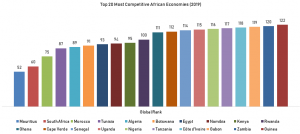
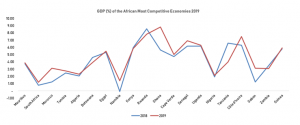
Source: World Economic Forum, 2019


Source: International Monetary Fund, World Economic Outlook April 2019; Infoprations Analysis, 2019

In addition to the United Nations’ proposed remedies to the recession, leaders, businesses and policymakers need to strengthen the global value chain to boost growth, create better jobs, and reduce poverty while robust reforms should not be jettisoned. Africa needs to pursue open and predictable policies, and revive multilateral cooperation. Beyond these, Africa must embrace new technologies within the global value chain to create new products and increase productivity.

The Positive Effects of the Nigerian Border Closure

0
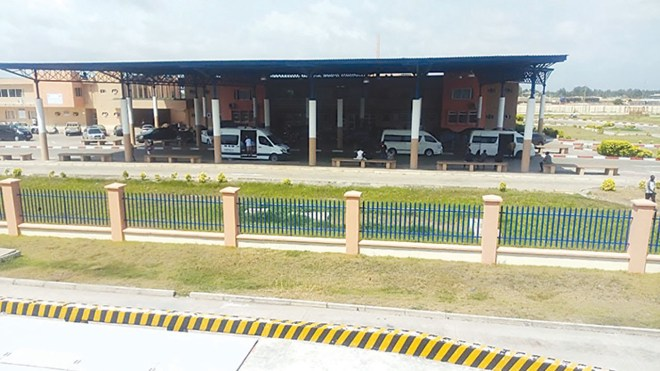
In August, President Muhammadu Buhari ordered closed Nigeria’s land border with Benin, preventing the import of goods. The move significantly affected trade in foodstuffs, which had already been affected by various past import restrictions. In this article we examine the one positive effect the border closure has brought to Nigerians at large.

As part of an on-going effort to tackle smuggling and associated corruption, but also to spur the domestic agricultural industry, on October 14, 2019, Nigeria ordered closed all of Nigeria’s borders with Benin, as well as those with all other countries, for the same reasons. With the market for smuggled food now restricted, domestic food prices, already high, have gone up and the economy of neighboring countries— a staging area for smuggling into Nigeria has been devastated. Imports into Nigeria are to come through sea ports, where customs duties can be imposed more easily than at land borders. Nigeria’s vital oil exports are not affected.

While Nigeria’s borders reflect late-nineteenth century agreements among the British, French, and Germans, most African borders were similarly created by European colonial powers. The point being, the borders rarely reflect indigenous history or culture. In the case of Nigeria, while there are formal border crossings with customs services along the main roads, there are literally hundreds of others along footpaths and minor roads that are unregulated. The practical consequences of closing the land borders is likely to vary from one part of the country to another, based on government capacity to enforce closures.

So, what have been the positive benefits of the Nigerian border closure?

  1. Increased Internally Generated Revenue (IGR): This is a huge fact because Nigeria has imposed customs duties which can be readily imposed more easily at sea ports than at land border. This is a major breakthrough as duties paid by importers are drafted to the IGR. This move is huge because over the years, prior to the border closure there has been no full regulation on duties paid for import. Now, with this strategic yet painful framework deployed by the President there will be accountability from the Nigeria Customs Department in contributing fully their own quota to the Single Treasury, which will best max the IGR for the GDP. To be honest, this move comes with a heavy steep price. This is obvious because many importers will have no other option to send in their goods and they’ll be forced to comply with the directive. It will affect the importers too who do not have enough funding for the duty payment effectively. But to be frank, the increased internal generated revenue will boost due to this.
  2. Increased Consumption of Local Products: Nigerians like we know, love the consumption of foreign products. It’s in the blood really. However, to this effect of the Nigerian border closure, there has been a surge in the consumption of local goods. Take example, the locally made rice Nigerians rejected is now the most consumed commodity. As the cost of foreign products increase there comes the reality of Nigerians to use the available when the preferred is not available. According to locally rice farmers, it has been noted that they sell off their products easily these days compared to other times. It’s essential to note that the border closure was a move by President Buhari not to only tackle smuggling and associated corruption, but also to spur the domestic agricultural industry.

In effect, the move has been strategic and painful to numerous Nigerians, but the reality comes in that numerous nations are taking moves to increase their IGR for the benefit of their GDP. Countries like U.S.A are deploying this medium to tackle foreign nations like China from taking over their trading. It’s strategic and hits hard on the average citizens, but then there must be a future for a country to grow independently.

Why the Rise of Technology Hubs is Facilitating Africa To Crucial Development

0

Just like the saying goes: “Rome wasn’t built in a day”. You will agree to the lone fact that the revitalization of Africa’s economy has been attributed to the leading advance in technology. This crucial factor that has played a prime role in this development can be attributed to the rise of tech hubs, especially in Africa. This is eminent as it is on the rise especially in Nigeria and Africa at large. But then: What are tech hubs? How do they work? How can upcoming startups and developers benefit from this phenomena?

What is a Tech Hub?

Just like the computer network hub, a connection point for devices in a network (Webopedia, 2018), the term ‘tech hub’ is simply a physical space (can be remote), a city, a suburb (like computer village Lagos), or a collective suite of offices whose aim is geared to help technology stay companies succeed, and scale up. Tech hubs create an environment specifically targeting the up-build of young technology companies thrive by encouraging: incubation, fast tracking, helping such firms network and collaborate with like minded individuals or enterprises.

The major goal of a tech hub is to grow ideas.

What Do They Need?

For a tech hub to thrive there are a lot of impeding criteria that must be meet so as to establish its relative productivity. One basic factor is a steady supply of permanent and temporary suitable workers, a means of generating revenue, relatively high speed internet access, robust infrastructure, location, transport, relative proximity of access, friendliness of the hub, and total coordinated organization.

Where Are The Best Hubs Located?

Remember, that the best known tech hub is probably Silicon Valley, based in California USA. Here you can find the big boys (companies) in the tech industry: Facebook, Apple, Netflix, Intel, Tesla, and major startups many of these were founded here.

In Nigeria, there are a numerous tech hubs available. The full list is available here, Prosper Otemuyiwa’s really helped in making this task easy, they include some in pictures:

Focus Hub, Rivers State Nigeria.
Wennovation Hub, Oyo State Nigeria.
MAL Hub, Kwara State Nigeria.
Innovation GrowthHub Aba, Abia State Nigeria

How and Who Can Benefit From Tech Hubs?

While you might feel that only software and web developer are the most prime people to benefit from the establishment of tech hubs, you will be surprised to note that a lot of unskilled individuals are more likely on a ratio of 3:5 to gain immense experience from tech hubs.

Government agencies are really poised to gain knowledge, because tech hubs offer a wide angle of disseminated technologies, backgrounds, work groups, personalities and ideas. The core truth is that even companies seeking for skilled personnel’s to assist their companies can get a handful from reliable tech hubs across the continent.

So its a win-win. Tech hubs are for everyone, and by everyone. As the saying in the introduction of this article: “Rome wasn’t built in a day”, Nigeria has had a decent share of tech advancement due to the increase in tech hub, we have seen more open minded individuals come up in terms of technology challenges and even advocacy groups. The GitHub benchmark is a prime example of how poised and raging Nigeria and Africa is becoming towards the Open Source development and knowledge sharing. In it all, tech hubs are just like the library, you gain resources, experience and exposure.

So next time you think about a tech hub, what comes to your mind? Definitely, you will remark a tech hub as a ‘catalyst’ in crucial development. So find a tech hub around you and innovate!

Nigeria Is OPay Nation, The Fintech Raises Extra $120 Million

0

Nigeria is an OPay nation and numbers cannot lie: “Nigerian payment and ride-hailing app OPay announced this morning it has raised $120 million in a Series B of funding just a few months after raising $50 million.” In short, OPay wallet which can function in its own banking ordinance, outside anything linked to the Central Bank of Nigeria, is a mortal threat to all banks in Nigeria. Yes, when a market woman finishes a day and hails a bike to deposit her money, and when she needs withdrawal, she hails another bike for cash. As she does that, the bike-agents, will debit or credit with SMS confirmations on the spot. No need for a bank trip and no need for CBN stamp duty deduction – OPay is running its own world and disintermediating the banking order. If you do not call that disruption, I do not know what else you have there to suggest!

Here are the stats of this company.

  • OPay launched its mobile payment service in August 2018, with an initial focus on “the massive unbanked population of Nigeria.” Since May, OPay has tripled its active agents to over 140,000 and saw daily transaction volumes double to over $10 million per day.
  • OPay’s ride-hailing service has become the largest of its kind in Nigeria, seeing a more than tripling of daily rides over the past three months

Lagos-based OPay, which was incubated by Norwegian publicly traded internet company Opera, describes itself as a mobile wallet and motorbike ride-hailing provider. (Opera operates a web browser of the same name that is popular in Africa.)

OPay’s services range from mobile payments and transfers to ride-hailing and food/grocery delivery.

In a statement, the company said it plans to use its new capital to “further accelerate its expansion across its multiple verticals, as well as entering new African markets.”

OPay CEO Yahui Zhou said in particular the startup is eyeing expansion in its home country, South Africa, and Kenya, as well as “other African countries… where local regulation is supportive of scientific and technological entrepreneurship in the fintech space.”

“We see ourselves as a key contributor to expanding financial inclusion in Africa, and helping local businesses and workforces to thrive from opportunities created by new, digital business models,” Zhou added.

The Press Release

OSLO, Norway, Nov. 18, 2019 (GLOBE NEWSWIRE) — OPay, one of the fastest scaling growth companies in Africa, announced today that it raised $120 million of series B funding, less than 6 months after it announced its last funding round of $50 million in June. The company, which was incubated by Norwegian based, global consumer Internet company Opera (OPRA), is already Nigeria’s leading mobile wallet and motorbike ridesharing provider, and is rapidly expanding. Series B investors included Meituan-Dianping, DragonBall Capital (The Investment fund backed by Meituan-Dianping), GaoRong Capital, Source Code Capital, SoftBank Ventures Asia, Bertelsmann Asia Investments (BAI), Redpoint China, IDG Capital, Sequoia Capital China and GSR Ventures.

OPay is one of the fastest growing companies in Nigeria, providing consumers with a wide range of services including mobile payments and transfers, ridesharing and food delivery. The company plans to use the new capital to further accelerate its expansion across its multiple verticals, as well as entering new African markets.

“OPay will facilitate the people in Nigeria, Ghana, South Africa, Kenya and other African countries with the best fintech ecosystem that Africa has ever seen, paired with the inclusion of daily use services such as transportation and delivery. We see ourselves as a key contributor to expanding financial inclusion in Africa, and helping local businesses and workforces to thrive from opportunities created by new, digital business models. The capital raised will be allocated to African countries where local regulation is supportive of scientific and technological entrepreneurship in the fintech space,” commented Mr. Yahui Zhou, CEO of OPay.

OPay launched its mobile payment service in August 2018, creating an infrastructure on which the company is now adding new services. The agent-centric mobile payment operation focused on reaching the massive unbanked population of Nigeria. Since its Series A funding, OPay tripled its active agents to over 140,000 and saw daily transaction volumes doubling to exceed $10 million per day, furthering the company’s position as the largest mobile transaction provider in the country. Additionally, OPay’s motorbike ridesharing service has become the largest of its kind in Nigeria, more than tripling daily rides over the past three months, and the company recently launched additional services around food delivery and cashless payments for offline businesses. While still focusing on Nigeria, OPay has the ambition to expand across the African continent.

Mr. Zhou further commented, “OPay has become one of the most important providers of online consumer services in Nigeria, and is recognized widely among other players in the market. We are excited that GaoRong Capital, SoftBank Ventures Asia, BAI and Redpoint China are coming onboard in this round. The additional capital will allow OPay to speed up its expansion in mobile payment services and its growth in new verticals, Further, the strength of Opera’s brand and OPay’s emerging position will continue to benefit both companies and further escalate their ability to take leadership in several internet verticals across Africa.”

About OPay
OPay is a one-stop mobile-based platform for payment, transportation, food & grocery delivery, and other important services in your everyday life. Millions of users in Nigeria rely on OPay to send and receive money, pay bills, obtain transportation and order food and groceries. OPay is focused on making opportunities accessible to everyone and delivering on the promise of financial inclusion in Africa today to safely connect people with the places, opportunities, and experiences that they truly care about.

About Opera
Opera is a leading global internet brand with an engaged and growing base of over 350 million average monthly active users. Building on over 20 years of innovation, starting with our browser products, we are increasingly leveraging our brand as well as our massive and highly active user base in order to expand our offerings and our business. Today, we offer users across Europe, Africa and Asia a range of products and services that include our PC and mobile browsers as well as our AI-powered news reader Opera News and our app-based microfinance solutions.
Opera is listed on Nasdaq under the OPRA ticker symbol.

The Lesson From the Story of Keke Queen – An interview with Okeyi Ojotule Comfort

0

What a man can do, a woman can do, if not better. It is no longer a new thing to see women doing the jobs regarded to be meant for men. After all, everyone can do anything as long as the heart is set on it.

I had a discussion with my good friend, Comfort. She talked about her experience on the Lagos road where she saw a beautiful lady running a ”Keke Napep” business. Comfort sees it as an opportunity for everyone in the country to stand up and do something, especially fresh graduates.

The situation in the country is no longer a joke, the truth remains, Nigeria needs help. Our fresh graduates must definitely stand up to the current situation in the country and pick up whatever job they can find. The story of this Keke Queen is truly an inspiration for many.

Can you tell us more about yourself?
My name is Okeyi Ojotule Comfort.  A graduate of Theater Arts from Kogi State University, Kogi. I served in the Ministry of Culture and Tourism and I have vast interest for the media which includes both print and the mass media.

That’s really great. What do you do currently?
I’m an event manager for a sound and entertainment company – ”The prestigious Shuga Entertainment.”

Where is the company located?
At Ojodu Berger, Lagos State.

I saw your comment on one of my posts about “Keke Queens”. Can you share more about that?
I have been hearing about female tricycle riders until I saw one in October 2018, while I was in another Keke.

I was so excited to see this. Although I was unable to drop that day, I managed to trace her to the place where I saw her the next day. I was directed to her house and I did meet with her.

She welcomed me and we had a great conversation. She talked about her business. It was indeed an interesting one.

After meeting with her, I said to myself that every woman who is into the Keke Riding Business must really have an interesting story.  Since then, It has always been in my heart to do a documentary that will tell the whole world their courageous story because driving Keke is not an easy thing to do. It is mostly regarded as a job for the men.

There I tagged her the “Keke Queen”.

Do you mean she drives keke to earn a living?
Yes, she does.

What did you actually learn from her that has triggered this passion for Keke in you?
The courage to make that decision.

That type of courage is rare and sometimes in life, you just have to take that risk. She told me how she was mocked. She shared how she was in debt.

She told me she didn’t even learn how to ride it before it was leased to her, and she had to pay a certain amount of money in a week.

Her first day at work, she was scared. So many mixed feelings were bottled up. So many unanswered questions.

But despite this, she took the risk and today, she earns a living from it and also contributes to solving transport issues in Lagos state.

That takes a whole lot of guts. Would you ever have done the same?
Yes,  it definitely takes a lot of guts. I learnt from her story and I can do the same now if I find myself in a situation that would warrant that.

We are in a society where women are sometimes restricted from doing some tasks. What do you see to that?
I’m a strong advocate for equal opportunities. The excuse for restricting me shouldn’t be because of my gender, but because I am incapable.

Have you ever had any experience of such at work?
No. I haven’t.

Let’s hope you won’t experience such at your place of work. How many years did it take you to get a job after graduation?
2 months.

What’s your advice for every job seeker out there?
Don’t just pick up anything because you want something. It should be something you enjoy doing.

Finally, don’t give up on your search. You may get frustrated along the line, but never give up. The job that meant for you will come.

And lastly, what will you say to a young girl reading this interview?
Being a young girl in a Nigeria society, be it a student or a job seeker comes with its challenges. They expect you to follow the give and take rule that have already established.

They want you to give out your body in exchange for whatever you want. It occurs most times. But, hey, stay put. Don’t give up. Do not succumb. Do not let them say “she’s just a woman or just a girl”.

Be ready to work your way to success. Don’t stick to the status quo. Don’t let them marginalize you. Bring out the best in you. Together we all can change the world.

Thank you, Comfort. It has been a wonderful time chatting with you. You are indeed a great woman on a great mission. I wish you success in your endeavours.
You are as well Chinedu. It’s a rare privilege and I’m grateful. Thank you for granting me audience.