DD
MM
YYYY

PAGES

DD
MM
YYYY

spot_img

PAGES

Home Blog Page 6646

The Role of SMEs in Job Creation in Nigeria

0

The International Labour Organization (ILO) recently  made a groundbreaking discovery through a study conducted which was  aimed at understanding the relationship between small businesses and employment world wide. The report reveals that seven in ten workers are into what we would call small and medium enterprises, SMEs. The report unveils the hitherto neglected roles of these kinds of businesses in job creation.

According to the report, self-employment, micro and small enterprises play a far more important role in providing jobs than previously believed.

You may wonder where they got this information from.They gathered data from 99 different countries and in the process discovered  that what was previously seen as ‘small economic units’ when summed up, make up 70 per cent of total employment, the most significant economic unit in job or employment creation.

Another important aspect of this study is the part that reveals that an average of 62 per cent of employment, in these countries where the studies were carried out, is in the informal sector, which is where the bulk of our unmeasured GDP lies.

The informal sector in Nigeria represents a large part of the economy though there isn’t sufficient data to put numbers to it,  making it difficult to say exactly how productive the Nigerian economy is.

But we know they exist, in numbers large enough to keep partakers going and sustained. Only a fraction of the businesses in Nigeria for instance is registered with the Corporate Affairs Commision, the rest represents everything from the street corner barber, to the roadside mechanic, or that mobile  cobbler mending your shoes.

The report  is titled; Small Matters: Global evidence on the contribution to employment by self-employed, micro-enterprises and SMEs.

LOCAL IMPLICATIONS:

The question of whether we are actually wealthier than our GDP projects or even poorer is one that has to be genuinely answered. Then the government must do all within its power to encourage these small and medium enterprises driving the economy.

In a capitalist economy the people are supposed to be the drivers of the economy, and all that is expected of the government is to provide an enabling environment where all these can strive.

This shouldn’t be so hard to do. A few of the things to do to make this unit blossom is to

  • Make enterprise friendly laws and stick to it in the long-run
  • Provide a suitable and favorable taxing policy
  • Easy access to loans with payable interest rates
  • Provide basic infrastructure but not limited to roads and power supply.
  • Stop the political sabotage of businesses or undue interference  for local, regional or personal interests.
  • Involve more technocrats and economists in economic decisions and less politicians. Round peg, round hole.

So long as the political will is there and economic know how is present, a lot of the aforementioned can be done before our very eyes. And Nigeria will blossom.

Zenvus Camera IP Gets A New Customer

0

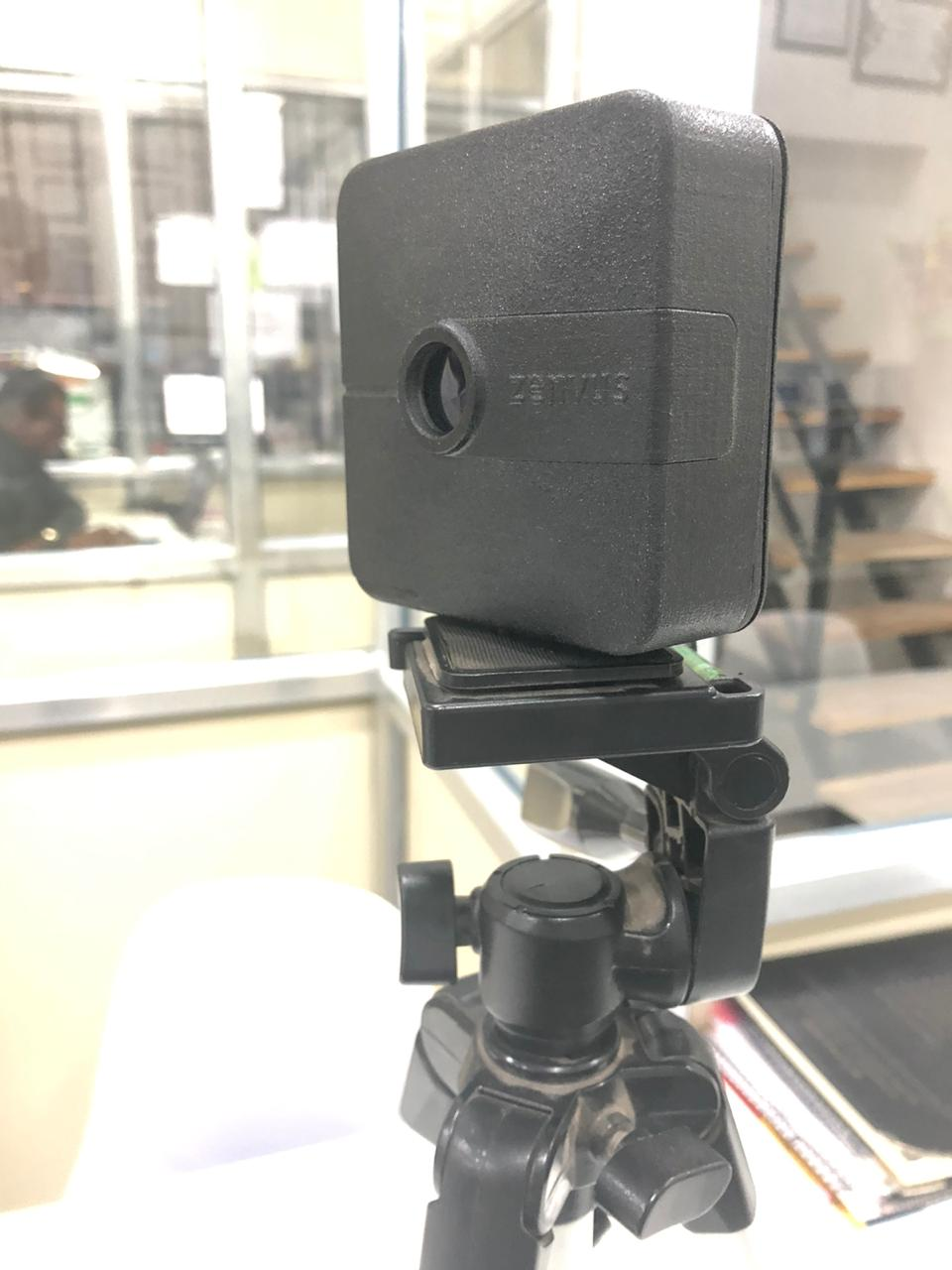
In Zenvus, we develop IPs which are licensed to global corporations for their products. Today, I am very happy that Zenvus’s mission critical camera system has found another territory. We invented a new way of analysing images at 3x cheaper than the competition. In other words, we built a camera from scratch, “injecting” a new protocol in the firmware. The motivation is the emulation of human retina and the event-driven asynchronous parallelism of the central nervous system for neuromorphic computational electronics. The customer feedback after all the tests: “brilliance in engineering”.

Understanding Marginal Cost with Facebook, Nairaland, GE and Dangote Cement

0
Marginal cost

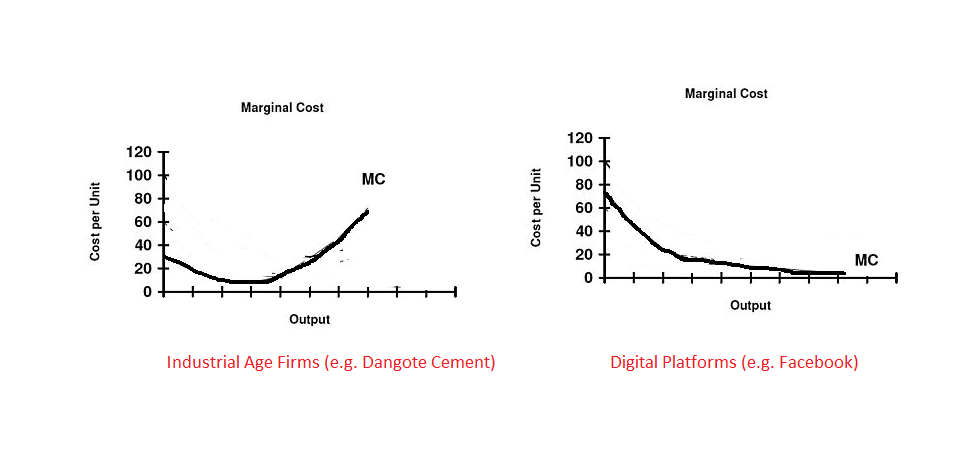
If markets are perfect, the marginal cost of a product will be absolute zero. Yet, online digital platforms are close, meaning that the price of a digital product tends to near-zero. This is the reason why digital platforms like Facebook, Google and Nairaland can make their products free for users: the cost of producing the product for an additional user (the marginal cost) tends to near-zero as output increases. If you studied economics in secondary school, the shape you see is actually the shape of Average Fixed Cost which benefits from economies of scale.

Marginal cost is broadly broken into Transaction Cost and Distribution Cost. If your distribution does not go lower as you grow, your unit economics will struggle online.

Image result for transaction, distribution cost tekedia

This curve differs from the typical U-shaped marginal curve which has been used in the industrial age era microeconomic modelling. Largely, for companies like GE and Dangote Cement, as output increases, the marginal cost would fall first, but over time it will begin to rise. Because of that eventual increase in the marginal cost, these firms are bounded and constrained on how far they can grow. That is why GE and Dangote Cement cannot be in every local government in the world because unbounded outputs will harm them as their marginal costs rise!  Digital platforms do not have this limitation as increasing output takes marginal cost to near absolute zero. With that, Facebook can be technically available anywhere. This video explains deeper on how to use this in your growth strategy.

Join me in Vanguard Executive Masterclass next month for more.

[Register ] Vanguard Executive Masterclass by Prof Ndubuisi Ekekwe

Depression is Real, Before You Give Up on Yourself, Read This…

1

I felt empty most of the time.

Deep inside my soul, I sensed a vacuum. Soon, I started feeling like a plastic which air moves out of. Sadness, demotivation, and fear seem to have agreed to torment my soul. Happiness became a concept I saw in movies and read in books. Suddenly, like the lexicon figure of the word itself, “happiness” was abstract, but this time, I couldn’t even feel it at all. The universe had to be against me because something was not right.

Often, I would sit, looking depressed and tiredly tired. Other times, I would try suppressing my sadness by faking happiness. Cracking demeaning jokes and sarcasm was my new cocaine. At least, it temporarily relieved me from my misery. Instead of being truly happy, I tried to act happy, distracting myself from sadness.

For the first time in my entire life, I understood what it means to be depressed. Before my depression, I thought I understood how depression felt. After all, I’d seen movies capturing the depression experience. Memes about depression were not new to me. At a point, people had claimed to feel depressed to gain cheap clout.

Nevertheless, I didn’t realise how hurtful being depressed felt. But can you blame me? I grew up in a society that perceives depression as a thing for the “oyinbos”. To make matters worse, I’m a male in a toxic patriarchal society, so, it’s expected I “man up” and show no emotions.

My depression started before my birthday this year. While growing up, I had hastily written my life dreams. I listed all the things I wanted to do at different ages. Unfortunately, when I reviewed these plans before my birthday, the reality left me sad. Soon after, I became miserable as days passed by, especially when I scrolled through Instagram. Seeing those perfect pictures, guys, my age with Benz and people living their best lives, left me heartbroken. However, I tried to hide my depression by being the usual “funky and funny” Jerry.

A few weeks after my birthday, Carmel’s back broke. This time, I could not handle it anymore. After three failed attempts at relationships and constant body-shaming; my writing career soon became shambles overnight. It seemed like the universe perfectly ganged up against me as I disappointed my parents by not scoring excellent. My world crumbled before my eyes. “I can’t possibly continue this journey.” I thought to myself. I was at the brink of giving up. If I had committed suicide at that point, I wouldn’t have written this blog post.

Notwithstanding the suicidal thoughts, I thought of the consequences of my suicide on my loved ones and family ones – what my death will cost them. Likewise, reading the biographies of successful people who defied the odds despite their challenges, restored hope to my soul. Ever since, I have been trying to be happy, genuinely, this time. This does not mean my problems have miraculously disappeared; I just learnt the simple truth many depressed individuals may not realise.

Writing this blog post sets my mind back to 3rd August 2019. It was a sunny afternoon when I read the news regarding the death of one Opeyemi Grace Dara, an Obafemi Awolowo University student. She reportedly killed herself due to her academic failures. The announcement of the young lady’s death spurred up different comments.

  • “Why will we kill herself for ordinary academic performance?”
  • “That girl is foolish o, no matter how bad things are, I can never commit suicide.”
  • “She just wasted her time as she is going to suffer twice.”
  • “The school is to blame; everything is just unnecessarily hard in this system.”

Most of the comments depicted the level of insensitivity in Nigeria. Consequently, this insensitivity is one of the causes of the sporadic rate of depression in the country. People have lost a sense of empathy. They judge and see events and happenings from solely their point of view. This insensitivity makes people suffering from depression ashamed to talk about their problems to others.

  • “What if he condemns me for this?”
  • “What if I mistakenly cast?”

These are questions most depressed people ask themselves. Unfortunately, their fears are often confirmed. This explains the high rate of suicide in the country. The Western world is known for a high percentage of suicidal related death. However, for a continent like Africa, where religion is a means of escapism from problems, it comes as a rude shock that suicide rate is skyrocketing. Surprisingly, that is the reality in modern Africa, the sad thing about all these is that no one seems to be talking about the increasing rate of suicide in the continent. Everyone seems to be living in denial, secretly fighting demons behind closed doors.

As someone who has once suffered from depression, I can vividly see things from most suicidal people’s point of view. In the case of Opeyemi, it could be the pressure from the society and family that forced her to take her life. Perhaps, she could no longer endure the shame her academic failure was attractive to her. It could also be that her input efforts into her outstanding courses were not commensurate with the results. Whatever the reason for her suicide, it must have been a burden that she could no longer bear.

Undoubtedly, the reasons for the depression rate in Nigeria are often tied back to money as the root factor. However, this does not happen all the time. I believe the reason for most people’s depression, myself included, is because they are illusioned that the world expects a lot from them. Some people want their lives to be better than others. Subconsciously, they enter an unnecessary rat race with others. Often than not, they get hurt in the process. This is inevitable, because, the bitter truth is that NO ONE IS SPECIAL.

The reasons for depression in Nigeria falls back to money as the root factor.

For every unique talent you possess, there are several millions of other people who possess such ability, sometimes, even better than you. Another reason for some people’s depression is the fear of disappointing people who have placed high hopes on them as their “saviour”.

Similar to the case of Opeyemi, there are several thousands of people that attempt taking their lives daily. Back in 2017, a man committed suicide by jumping into a lagoon from third mainland bridge. According to W.H.O, about 800,000 persons die from suicide. By implication, suicide accounts for the death of a person every forty seconds. This fact depicts how worse things are becoming. We live in a generation where there is different technological development available to make our lives easier, yet, depression and suicide rate seem to be skyrocketing. People are becoming more depressed by the day, and it is high time we acted against it.

The paradox about suicide is that it does not solve your depression or your problems at all. Instead, suicide creates more problems for the survivors of the deceased. Suicide is paradoxical as it is the end to someone’s struggles with issues that they didn’t finesse. This is why living and traumatised victims of suicidal efforts suffer lifelong sadness and regrets.

Suicide is paradoxical as it is the end to someone’s struggles with problems that they didn’t finesse.

I am not entirely against suicide; arguably, everyone has the right to take away their lives. But I believe there is more to life than running away from life issues.

If you feel like giving up on yourself at the moment, you should know that:

You’re bigger than your problems: Let no one deceive you. You are more prominent than whatever problems you are facing. Well, if you believe in the negative, then go back down the memory lane and think about the different times you had experienced little victories in the past. “Those were next to nothing” you might say, small or big; it proves that you are capable of conquering big problems. Like the famous David-Goliath fight, you can defeat that Goliath-sized problem of yours that seems unbeatable.

Things will get better: In my country’s colloquial language; ‘e go better,’ hence, try to focus on the positive things in life. Even if you think there is nothing positive in your life, look deeply, there is. Always remember that even the darkest hour merely has 60 minutes in it.

You should not end your story early: Have you ever gone to the bookshop or an online store to buy a book half-completed or downloaded a half-completed song? No right? Similarly, your life is one masterpiece that you shouldn’t end early. You need to stick through the tough times and push through. Fight to finish your story and write it to the best of your ability.

You are someone’s role model: Whether you like it or not, you are someone’s role model. Someone is watching you, looking up to you. Wouldn’t it be a sad tale to let such people down? You may be their reason for trying; how would you feel if you gave up, so they did too?

Your thoughts about yourself may be wrong, after all: The mind has a funny yet powerful way of playing tricks on us. The more you affirm a feeling, the more it is embedded inside of you, and thus, it becomes difficult to get rid of. The beauty of such a scenario is that it is always not true; your negative thoughts are not real. Yes, you didn’t score the perfect CGPA, but that doesn’t mean you are not intelligent. You have physical flaws, but that doesn’t mean you are ugly. You didn’t get achieve things at the ‘normal’ age, but that doesn’t mean you won’t be successful. Learn to challenge negative thoughts in your mind. The more it stays, the lasting its effects.

If you are ‘normal’ or not suffering from any form of mental challenges, try to check up on other people. We all have our respective strengths. Some people are better fighting personal demons than others. In your dealings with people, be less judgemental in your approach. Learn empathy and the art of listening; it will make you more approachable. People with mental issues or depression fear opening up to people because of the fear of being judged. No one should ever leave your presence feeling judged. Instead, they should feel loved and better than they were before they came to you. It is high time depression awareness becomes aggressive in Nigeria. No one is talking. I am confident that many people would ignore this post. Only 10% of the people who clicked on this post will read to this point.

There are more ways to solve your problems and taking your life should not be an option. You were not born a coward. You are a winner. Now, stand up, take note of your problems, and strive hard to conquer them. Above all, try to be happy. You matter — your existence matters. You are valued! Try to surround yourself with good vibes, and let bad energy stay far away.

N.B. If you are feeling depressed or suicidal and you have no one to talk to, kindly reach to someone at the Nigeria Suicide Prevention.

  • Address: Suite 8,2nd Floor Peace Plaza Mbora EFAB Estate, Nigeria
  • Phone: +234 705 059 1082

Nigeria’s 2020 Budget – From The Lens of a Democratic Spectacle

0

Nigeria is officially identified as a democratic state. Simply implying that we are a nation defined and governed by democratic tenets.

There is a timeless definition of democracy that most people are aware of and would probably never forget. That definition was given by Abraham Lincoln in his famous Gettysburg address which was given in honour of soldiers who sacrificed their lives for the greater good of a unified prosperous United States of America.

Abraham Lincoln defined democracy as ‘’that government of the people, by the people and for the people’’.  He further stated – ‘’as I would not be a slave, so I would not be a master. This expresses my idea of democracy”.

It is that second quote by Abraham Lincoln in reference to his understanding of democracy that profoundly unsettles when looking at the 2020 Nigerian budget and the general state of affairs in the nation.

As I would not be a slave, so I would not be a master.

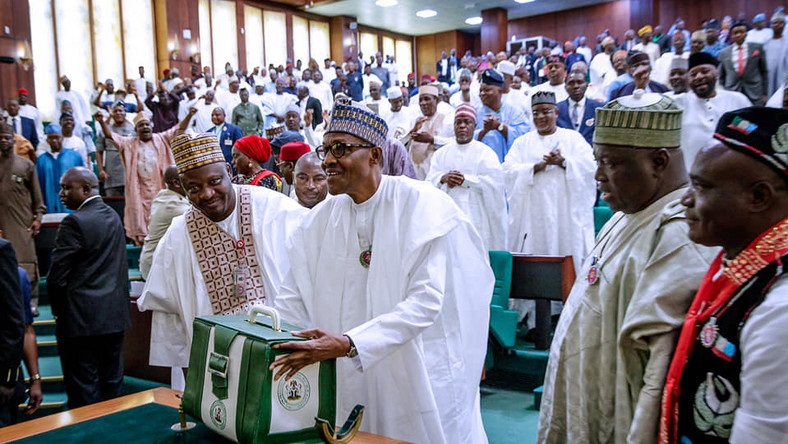
Looking through some details of the Nigeria 2020 budget as presented before the National Assembly by Muhammadu Buhari, the President of the Federal Republic of Nigeria, I see a recurring phenomenon present in national budgets of Nigeria for decades now.

The political elites, always assuming the position of a master, properly and excessively caters for their personal and positional needs as leaders no matter the national financial constraints. It doesn’t matter the vacuum of desperate needs in critical sectors of the socio-economic strata, it doesn’t matter that the population of poor Nigerians has so much swell that the country has been officially declared as the poverty capital of the world.  No matter how bad the situation of things are in the Nigerian state, her political leaders always find a way to comfortably cater for their luxurious needs with the limited national cake.

The 2020 national budget has put total expenditure at 10.33 trillion naira. 2.45 trillion will be expended on debt servicing, 2.14 trillion on capital expenditure, 4.88 trillion naira on recurrent expenditure and 556.7 billion naira goes to statutory transfers.

A noticeable feature that stands out in the 2020 budget is the 50% increase in the Value Added Tax (VAT) from 5% to 7.5%.  The VAT increase was premised on the increase in government expenditure for 2020 due to the increase in minimum wage from 18,000 naira to 30,000 naira amongst other reasons.

A 60% increase in minimum wage has therefore led to a 50% increase in VAT. 

Everyone should certainly look forward to a further increase in the price of goods and services. Cost of transportation will definitely increase and the average worker/trader who travels long distances to work every day will feel a painful bite in income. In the end, the working class Nigerians will have to wonder how an increased salary refused to change their living standard. The millions of unemployed Nigerians will experience deeper agonies of living without a source of income in a costly society.

While I leave the technical analysis of the 2020 budget to the data pundits, I was more interested in how that budget provides for personal and positional needs of the political elites. 

I gathered this little information out of what I believe would be numerous provisions for the Nigerian political leaders:

  • Out of the Statutory Transfers, 125billion naira goes to the National Assembly while 110billion naira goes to the Judiciary. Do not forget the stupendous monthly paycheck of an average Nigerian lawmaker.
  • 3.327billion naira goes to the President and Vice President for foreign and local trips in 2020.
  • 4.062billion naira will be expended on annual routine maintenance of mechanical/electrical installations in the state house.
  • 1.492billion naira to be spent on the upgrade of some of the aircraft in the Presidential fleet.
  • For the President and VP, 149million will be spent on foodstuffs and catering materials while 43million naira will be spent on refreshment and meal. 135.668million was also budgeted for same refreshment and meal in the budget of the State House headquarters.
  • For the President and VP, honorarium and sitting allowance is budgeted at 183.438million naira. 478.313million naira was allocated for same honorarium and sitting allowance in the budget of the state house.
  • 526.234million naira allocated for the phased replacement of vehicles, spares and tires in the presidential, CVU security/police escort and State House operational fleets.
  • 389.64million for outstanding liabilities on routine maintenance and other services in 2016.
  • 91.681million for the purchase of vehicle tyres in the state house.
  • 32.199million for fuel and lubricants, 32.5million for wildlife conservation and 45.4million naira for sewage charges.

These figures are just an excerpt of budgeted allocations for political officers and appointees. They do not include the salaries and allowances of the President, Vice President and political appointees in the executive arm.

The figures in the provisions above contained in the 2020 budget totals approximately 246billion naira. That is a budgetary allocation solely for the benefit of less than 0.00005% of the Nigerian population.

246billion naira splashed on personal and positional needs of less than 0.00005% of the population is 5 times more than the budgetary allocation for Education (which is 48bn), 3 times more than the budgetary allocation for Agriculture (which is 83bn) and more than 5 times the budgetary allocation for health (which is 46bn). 

Yet, these are critical sectors that are meant to serve the health, education and agriculture needs of more than 200 million Nigerians. The sum of the budgetary allocation to these three sectors is not even up to 246bn.

Ali Ndume, a senate leader, recently asserted that there is no solution on ground to alleviate the hardship being experienced by a large percentage of the population. But it is noteworthy there is always a solution on ground year in year out to provide for the sumptuous wealthy lifestyle of the people in power who are supposed to represent the interest of the rest of us. What a travesty!

How can my representative be stupendously rich off the national wealth while I am wretchedly poor? What sort of democracy is that?

That nobody should be a slave has a ring of truth in the democratic practices of the Nigerian state. However, to say nobody should be a master is the second half of the Nigerian democratic tenets that has been well resisted by the Nigerian political leaders.

Leaders in this part of the world do not lead by example. The citizens must make the necessary sacrifices where the nation’s progress is concerned while the leaders continue to forcefully live in the affluence that power provides.

That is the truth of the 2020 national budget as with preceding annual budgets. It is a budget that makes allocation for the master and his subjects, it is a budget that ensures that the political elite continue to live in abundance no matter the dire state of the Nigerian economy. It is a budget that is far more dictatorial than democratic.

When you consider the hundreds of billions of naira that will inevitably be lost to corruption in order to further satisfy the unending masterful desires of individuals in the corridors of power, you would understand why decades of huge budgets coated with big grammars couldn’t translate to clear developmental progress for Nigeria.

Representative democracy must be clearly seen in national budgetary allocations for positive sustainable development that impacts the lives of the greatest number. It must show that there are neither slaves nor masters. 

Annual national budgets must allocate national resources in such a manner that everyone benefits without sharp widened differentials that ends up making the rich dishonestly richer and the poor unjustly poorer.