DD
MM
YYYY

PAGES

DD
MM
YYYY

spot_img

PAGES

Home Blog Page 6708

How To Boost Your Solar Business With Referrals

0

There is no doubt that boosting sales is not an easy task especially in the renewable energy business. The nature of the industry makes it almost impossible to have repeat customers within a short period of time. It takes money, patience, and effort to win over a new client since people are still hostile to change; switching to solar and other forms of sustainable energy. However, with the right strategy, your existing clients can become your ambassadors and begin to win new clients for you via word-of-mouth.

Ask yourself, would you go for a product your friends and family recommend to you or will you just buy anything randomly and hope that it works? I guess you will go by what your friends have tested and trusted. Interestingly, did you know that referral marketing results to 5x more sales than a paid media impressions and people are 90% more likely to trust and buy from a brand recommended by someone they know? With this in mind, enabling your customers to do some of the marketing should be a priority for you and your team. It saves you the stress of having to convince new leads that your systems work, you simply reassure them of what they already know.

There are probably 3 to 5 competitors within a 15 km radius vying for the same deals as you and utilizing the same advert channels, but whoever wins the referral game will ultimately make more sales with less effort. This is a no-brainer, get the consumer on your side and focus on prompt and professional service delivery.

It also comes with other benefits that include:

  • Reduction in sales and marketing budget, which allows you to channel your funds and energy towards other aspects of the business.
  • It snowballs (referrals breed more referrals). When someone makes a purchase based on a recommendation, they are more likely to recommend others too, and the cycle goes on and on.
  • It significantly increases your closing ratio. According to a renowned sales trainer, Tom Hopkins, the closing ratio for non-qualified leads is 10% versus a 60% closing ratio for qualified leads.
  • Most importantly, it serves as a pointer that you provide a tremendous service. When new clients are referred to you, it is a testament that you are reliable and trustworthy.

CAVEAT: Before you go all-in on implementing a referral strategy, think about your customer service, the quality and efficiency of your batteries, inverters, panels etc. If your customers are not satisfied with any of these, forget about referrals. As a matter of fact, expect them to discourage others from dealing with you.

Most times, you can easily get caught up with working in your business, but it pays better to work ON the business. Take the time to create an efficient referral strategy, outsource if you must. Randomly asking people to refer you is not a strategy. If results matter to you, ensure you have a system in place. 

“Nigerian Scientist Develops” Syndrome: A Growing Misnomer In Public Communicating Of Research Findings

0

Scientists are trained to solve societal problems through innovative research. Various transferable skills are however needed to achieve the aim of any research. Aside critical thinking, project management and time management skills, ability to effectively communicate the findings of research to various stakeholders is of great importance to any research scientist.

Effective research findings communication entails conveying the findings of research to the appropriate audience using appropriate methods. For example, research findings can be communicated to professionals via conferences (local or international), scientific publications in peer-reviewed journals. Technical jargons are allowed and are easily understood by the professionals in such field of research. However, the above-aforementioned methods cannot be used to communicate research findings to the public except the findings are communicated in layman’s language devoid of technical jargons. Although scientists are encouraged to communicate their research findings to the public and professional colleagues as this will help to showcase the impact of their research activities, there is a growing misnomer in how scientists are doing this, especially in Nigeria.

In the last few years, headlines such as “Nigerian scientist develops so and so” is becoming rampant. For example, August 29, 2019, it was reported in one of the major newspapers in Nigeria that a “Nigerian scientist develops cancer drugs from African plants”. While this could be a laudable achievement, there is a misnomer in how it was reported. The original report was an interview with the female scientist in one of the Universities in Nigeria by a freelance journalist. The original interview that was held in Abuja was published on 23 August 2019 by a reputable foreign publishing firm. The title of the interview was “Developing cancer drugs from African plants” in which the research scientist discussed her research activities involving plants. A thorough review of the original interview shows that the scientist never claimed to have developed a drug to cure cancer but rather she stated that her research aims at:

“identifying potent, safe and effective anticancer agents from Nigerian plants. We have screened and confirmed the cytotoxic activities of extracts of the drumstick (Moringa oleifera) and soursop (Annona muricata) trees as well as the native Nigerian shrub Peristrophe bicalyculata on cervical carcinoma and fetal lung carcinoma cell lines. We also studied what anticancer mechanisms these plants exhibit. We found that these plants act in the body through” One of the studies involving P. bicalyculata was published in the Romanian Biotechnological Letters in 2013. It was concluded in the study that “methanolic ethylacetate fraction of Peristrophe bicalyculata is a potential source of chemotherapeutic agent”

Early August 2019, various news outlets in the country reported that a “Nigerian Research Fellow develops anti-tuberculosis metal drugs in India”. The Indian mentor to the Nigerian researcher stated in the original interview that “When we compared the metallodrugs with the original anti-TB drugs, the metallodrugs were more effective. We did an in-vitro test against bacteria. The metals we have chosen are non-harmful to human beings. Also, we found that of all the metallodrugs, the copper complex of ciprofloxacin is most effective”. One of the online news outlets stated that “she has been able to create medicine like ciprofloxacin HCl, ofloxacin, pyrazinamide and moxifloxacin HCl”. However, the Nigeria scientist never claimed to have “create ciprofloxacin HCL”.

Stages of drug discovery in brief

Drug discovery involves three major stages, namely, pre-clinical, clinical and post clinical.

The pre-clinical stage involves laboratory investigation (also known as in-vitro or test tube) of various sources of potential drug agents that could have inhibitory or destructive (anti-bacterial, anti-viral, anti-cancer, anti-malaria e.t.c) effects. It is the preliminary stage of the expensive drug discovery journal that could last for several years. While there could be a lot of success in this stage, this does not guarantee success at the next stage. Successful results at the stage then proceed to the second step, which is the clinical stage. Depending on the funding source(s), the confidentiality of the potential of a drug is usually maintained. Secondly, the results could be published in scientific journals to enable scrutiny by other research scientists who are expert in that field. This stage could also involve patenting of the results, especially the “novel active substance”.

The clinical stage involves testing of the positive results obtained in stage one on live animal or human subjects (in-vivo). This process aims to investigate the behaviour of the “potential drug” in animals or humans as the behaviour could be completely different from that of in-vitro. This stage also helps to identify any potential side effect of the “potential drug”. This stage cannot proceed without adequate approval of various government agencies. Once, the approval is obtained, then the clinical study (called trial) would be carried out in comparison with control. If successful after various trials, the last stage – post clinical sets in. The last stage is the public announcement of the “new drug”. The drug could then be mass-produced and made available to the public.

In conclusion, as could be seen from the brief explanation of how drugs are developed, the Nigerian scientist has not developed cancer drugs from African plants but rather, she has extracted and characterized (pre-clinical stage) active African plant phytochemicals that could be a potential cancer drug if successful at the other stages of drug development especially the clinical stage. The newspaper title would have been” Nigeria scientist identified active ingredients in African plants that could be a potential anti-cancer drug” of Nigeria scientist was successful in the first stage of developing a new potential anti-cancer drug. This will help avoid public confusion and misnomer in communicating research findings. While scientists are the best to describe and interpret the results of their research, the service of experienced research/science communicators could be employed. Newspaper outlets need to confirm directly from the original source(s) before publishing reports on “Nigerian scientist develops” so and so as this could be misleading the public and lastly, public communication of research findings could also be carried out through the researchers’ institutions.

African Commission Moves to Sue South Africa, First Batch of Nigerians Returning

0

The number of Nigerians who have decided to leave South Africa for Nigeria is increasing. In the wake of new wave of attacks that came with more people, weapons, and government support, more foreign nationals are left with no option other than run for their dear lives.

About 400 Nigerians are set to return in 3 days, while several others will come subsequently. The Sowetan Live, reported that protesters from various hostels in eastern Johannesburg have been unleashed into the streets with weapons, singing “foreigners must go” songs, and looting every shop within their reach.

The police said that at least one person has been killed as security forces try to stop the mob from looting shops belonging to migrants.

The recent attacks are believed to have been emboldened by South African Government’s support for the xenophobia. Notable government officials have been noticed excusing it. The former president, Thabo Mbeki told the press:

“Attacks in South Africa are not targeted at legitimate Nigerians but against Nigerian criminals.”

When summoned by the Nigerian Government, the South African high commissioner to Nigeria denied there is xenophobic attacks against Nigerians, and later claimed that it’s all because Nigerians are drug dealers.

Nigeria’s relationship with South Africa has deteriorated as a result of the recent events. And the Nigeria’s Government’s plan to repatriate willing Nigerians through volunteered plane of AirPeace Nigeria, is underway, as many Nigerians are already undergoing registration and other necessary documentations are being carried out.

The Nigerian Commissioner to South Africa, Kabiru Bala, said:

“We are documenting them. Those without travel documents, we shall provide them with emergency travel certificates.

“There are other governmental procedures that we must observe. Relevant government agencies in Nigeria must be informed and must be ready to receive the returnees.

“Hard work is now going on at High Commission and Consulate in this regard. As soon as all procedures and relevant protocols are observed, the return is assured and guaranteed.”

The first batch of returnees is expected to leave South Africa on Wednesday.

Meanwhile, the Socio-Economic Rights and Accountability Project (SERAP), has urged the African Commission to sue the South African Government for enabling the xenophobic attacks that has resulted in loss of many lives and property. The group asked the African Commission to press for $10 billion in damages.

The chairperson of the Commission, Ms Soyata Maiga, in response to the request, has agreed that the African Commission will take appropriate actions on SERAP’s request to get justice for the victims, which includes adequate compensation for the victims at the tune of $10 billion. In a response email to SERAP today, Maiga wrote:

“Thank you for your open letter requesting our commission to take action to court. I have just shared the letter with Ms Jamesina Essie King, the chair of the Working Group on Economic, Social and Cultural Rights, for follow up and appropriate actions.”

Ndubuisi Ekekwe To Deliver FUTO Alumni 2019 Biennial Lecture [Register, FREE]

2

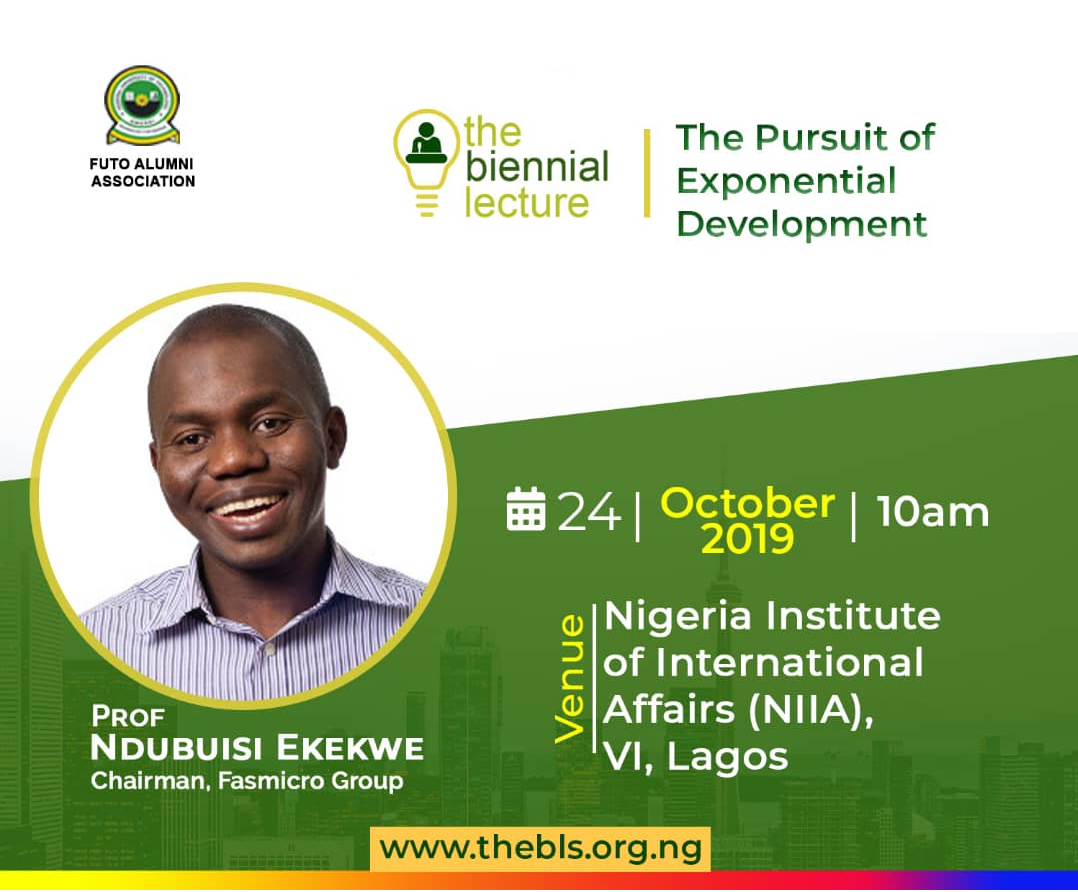
On behalf of our elders and legends of our alumni community, and the junior ones coming after people in my range, I invite you to Federal University of Technology Owerri Alumni Biennial Lecture in Lagos next month. I will deliver the Keynote and my topic will be The Pursuit of Exponential Development.

Event: The Biennial Lecture

Date: Oct 24, 2019

Time: 10.00 AM

Venue: Nigeria Institute of International Affairs, Lagos

This is a free event – click to register here.


Jumia Reveals Its Future With New Job Postings – And It is Amazing

3

“We remain focused on all aspects of our growth strategy, particularly JumiaPay, as we continue to drive its usage in our markets,” Jumia noted in its quarterly report with U.S. SEC.

That was a very powerful observation because no ecommerce company in emerging markets like India and China has done well without  building a great paytech company. China’s Alibaba has Alipay, India’s Flipkart has PhonePe. Jumia needs to make JumiaPay big.

Did you notice a pattern? The PhonePe is the double play for FlipKart. Yes, no matter what is happening in the ecommerce space, the payment arm will be doing just fine [commissions on transactions are assured]. Also, it turns out that successful ecommerce companies like Alibaba (with Alipay) in emerging markets have always have payment units.

To execute this and build a really great fintech business, Jumia has jobs for loan officers. Simply, Jumia wants to build a Lending Business and through that structure will deepen its JumiaPay. This fintech will bring unification of payments, lending and transaction processing at scale.

Our Junior loan officer will assist the development of Jumia Lending in Kenya by presenting our solution to our sellers. He/she will be helping our sellers to apply for a loan, and with the help of the loan officer will review the data collected and the applications. The Junior loan officer will be part of the JumiaPay team in Kenya and work side by side with the loan officer.

Did you notice a parallel with OPay’s amalgam of services like ORide, OTrike, OBus, etc? Yes, Jumia does have properties it can use to stimulate  transactions volume for JumiaPay. Those include  logistics services, hotel and flight booking, food ordering and drink delivery platform.

I expect JumiaPay to become the most important component in the Jumia Group in coming years as it morphs all these pieces to feed transactions into it. Possibly, it can spin it off to give huge payday to its investors. Yes, the ecommerce can struggle but the paytech will win markets and territories – and profits. That makes this super-focus on payment a great move.

And as that happens, a double play is born at scale in Jumia.