DD
MM
YYYY

PAGES

DD
MM
YYYY

spot_img

PAGES

Home Blog Page 671

Figure’s IPO Filing Signals Blockchain Lending Mainstream Acceptance, Testing Investor Appetite for Hybrid Fintech-DeFi Models

0

Figure Technology Solutions, a blockchain-based lending company, publicly filed for an initial public offering (IPO) with the U.S. Securities and Exchange Commission (SEC) on August 18, 2025, aiming to list on Nasdaq under the ticker symbol “FIGR.”

The New York-based firm, co-founded in 2018 by Mike Cagney (formerly of SoFi), reported a 22.4% revenue surge to $191 million for the first half of 2025, with a profit of $29 million, compared to a $13 million loss in the same period the previous year.

Figure leverages its Provenance Blockchain to streamline lending, trading, and real-world asset (RWA) tokenization, having originated over $16 billion in home equity loans with more than 160 partners. The IPO, underwritten by Goldman Sachs, Jefferies, and Bank of America, is part of a broader wave of crypto-related firms, including Circle and Gemini, tapping public markets amid a crypto-friendly regulatory environment.

The IPO signals confidence in blockchain’s ability to enhance efficiency, transparency, and security in lending, which could attract institutional investors and traditional banks to explore decentralized finance (DeFi) solutions. The filing comes amid a crypto-friendly regulatory shift, potentially influenced by a pro-crypto administration following Donald Trump’s 2024 election win.

This environment could bolster investor confidence in blockchain-based companies, positioning Figure’s IPO as a bellwether for other crypto firms like Circle and Gemini pursuing public listings. A strong IPO performance could drive increased capital inflows into the crypto sector, particularly for companies bridging traditional finance and DeFi.

Figure’s reported 22.4% revenue growth to $191 million and a $29 million profit for the first half of 2025 demonstrate financial resilience, making it an attractive investment compared to other crypto firms with less consistent profitability. This could set a precedent for how blockchain companies are valued in public markets.

Figure’s success could pressure traditional lenders and fintechs to integrate blockchain or risk losing market share. Its $16 billion in originated home equity loans and partnerships with over 160 institutions underscore its competitive edge in scaling blockchain-based lending.

The IPO may spur innovation in RWA tokenization, as Figure’s Provenance Blockchain supports digitizing assets like real estate and securities, potentially reshaping capital markets. As a blockchain-based lender, Figure’s public listing will likely face intense regulatory scrutiny from the SEC and other agencies. Its ability to navigate compliance could set a precedent for how regulators view blockchain firms, influencing future IPOs in the sector.

Figure as a Basis for Comparison

Figure’s expected $400 million raise and Nasdaq listing will provide a public valuation benchmark for blockchain lending platforms. Investors will compare its price-to-earnings (P/E) ratio, revenue growth (22.4% in H1 2025), and profit margins ($29 million profit) to other fintechs and crypto firms like SoFi, Block, or Coinbase.

Unlike pure crypto exchanges, Figure’s focus on lending and RWA tokenization offers a hybrid model, making it a unique comparator for both fintech and blockchain sectors. Figure’s Provenance Blockchain, used for loan origination and asset tokenization, sets a standard for operational efficiency.

Competitors will be judged on their ability to replicate or surpass Figure’s blockchain-driven cost savings and scalability, especially in home equity lending ($16 billion originated). Other blockchain firms pursuing IPOs, such as Circle (stablecoin issuer) or Gemini (crypto exchange), will be compared to Figure on how effectively they integrate blockchain into real-world financial applications.

With over 160 partners, Figure’s collaborative model contrasts with more insular crypto platforms. Future blockchain IPOs will be evaluated on their ability to build extensive partner networks, as Figure’s partnerships demonstrate market trust and scalability. Figure’s IPO timing, amid a crypto-friendly regulatory environment and post-election optimism, positions it as a test case for market appetite.

Figure’s focus on tokenizing real-world assets like real estate and securities positions it as a leader in this emerging field. Competitors will be measured against Figure’s ability to scale RWA tokenization, which could disrupt traditional capital markets by enabling fractional ownership and liquidity.

As a basis for comparison, Figure will influence how investors, regulators, and competitors assess valuation, technology adoption, partnerships, and market timing in the rapidly evolving intersection of blockchain and finance. If successful, Figure could catalyze further innovation and public listings in the sector, solidifying its role as a trailblazer.


Understanding Equity Dilution As Companies Raise Capital [video]

0

This presentation is designed to provide a deep understanding of equity dilution, a concept critical for business founders and investors. It explores how a company’s ownership structure changes when new capital is raised and how this affects the percentage of ownership for existing shareholders, including the founders.

Initial Company Structure and Valuation

The video begins with a hypothetical scenario of a startup founded by three individuals: Founder A, Founder B, and Founder C. Their initial ownership is based on their respective contributions to the business.

  • Founder A: 60% equity
  • Founder B: 30% equity
  • Founder C: 10% equity

At this early stage, the company is valued at its pre-money valuation, which is the company’s worth before receiving new investment. In this case, the pre-money valuation is $800,000.

First Round of Funding

The company has successfully operated for a few months but now needs to raise more capital to expand operations, hire more employees, and grow faster. They decide to raise $200,000 from a new investor.

  • Pre-money valuation: $800,000
  • New capital raised: $200,000
  • Post-money valuation: $800,000 + $200,000 = $1,000,000

The new investor’s ownership is calculated as the new investment divided by the post-money valuation.

  • New Investor Ownership: ($200,000 / $1,000,000) = 20%

The original founders now collectively own the remaining 80% of the company. Their individual ownership percentages are diluted proportionally.

Second Round of Funding

The company continues to grow and, at a later stage, decides to raise more money. The company is now much more valuable, with a pre-money valuation of $9 million. They seek to raise $1 million from a new investor.

  • Pre-money valuation: $9,000,000
  • New capital raised: $1,000,000
  • Post-money valuation: $9,000,000 + $1,000,000 = $10,000,000

The new investor’s ownership is calculated as the new investment divided by the post-money valuation.

  • New Investor Ownership: ($1,000,000 / $10,000,000) = 10%

The existing shareholders, including the founders and the first investor, now share the remaining 90% of the company. Their ownership percentages are further diluted. For example, the first investor’s 20% stake is now 18% of the new, larger company (20% of the remaining 90%).

The Paradox of Dilution

The most important takeaway is what the presenter calls the “paradox of dilution.” While an individual’s percentage of ownership decreases with each new funding round, the actual value of their stake often increases because the company’s overall valuation has grown significantly.

For example, Founder A’s initial 60% stake was worth $480,000 (60% of $800,000). After the second funding round, their ownership percentage has been diluted to 43% of the company. However, the company is now valued at $10 million, making Founder A’s stake worth $4.3 million (43% of $10 million).

Conclusion

In conclusion, equity dilution is a key mechanism for business growth and a natural consequence of attracting investment. It is not something to be feared but rather understood as a way to increase the overall value of the company and, consequently, the value of each shareholder’s stake. The key is to evaluate each funding round on its own terms and recognize that an increase in company valuation can far outweigh the decrease in ownership percentage.


Tekedia Daily podcast: Sign-up at Blucera and check under Training module.

Ethereum (ETH) and Solana (SOL) Eye New ATHs By September as Little Pepe (LILPEPE) Holders Look Forward to 7000% ROI in Just 3 Months

0

There’s something electric in the air right now. Ethereum and Solana are gathering bullish momentum that could carry them to new all-time highs by September. While meme coin enthusiasts keep an eye on LILPEPE’s presale, there is chatter about purported returns of 7000% in a mere three months. Let’s see what is going on and how things might intertwine.

Little Pepe (LILPEPE): The Meme Coin with a Wild 7000 % ROI Whisper

Okay, let’s get the hype out of the way first. Little Pepe is not just another meme token. It’s the native utility token baked into a next-gen Layer 2 blockchain built for meme culture—think ultra-low fees, speed that laughs in the face of congestion, and finality faster than Elon’s next tweet. In short, it doesn’t just scale Ethereum—it out-memes it. Here’s what’s happening as of writing: the presale is in Stage 11, with tokens priced at $0.002. As of today, August 13, 2025, they’ve raised almost $20 million out of a $22.33 million goal, selling 13.07 billion LILPEPE of the total 14.25 billion. That’s 91.72 % filled—almost done, folks. Early presale stages already gave investors a clean 100 % return. But here’s where it gets juicy—the listing price is set at $0.003, and analysts are whispering about 7000 % gains in just three months after the exchange launch.

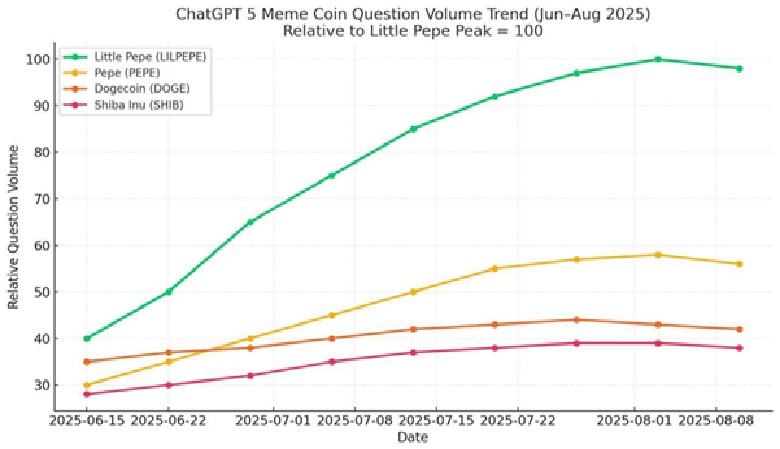
On top of that, the tokenomics are solid. Liquidity, presale, chain reserves, DEX stash, marketing war chest, and staking rewards are smartly distributed, with 0% tax on trades. The roadmap is charmingly bold: from “Pregnancy” hype to “Birth” listing, then “Growth” into the Top-100 Market Cap. Vesting is smart too—cliff periods, gradual unlocks, and locked liquidity to prevent dumping. The hype? Real. LILPEPE is on CoinMarketCap, audited by Certik, trending on ChatGPT5 meme-trackers, and even more buzzed than PEPE, SHIB, and DOGE from June to August. A whale just dropped $100K in the presale.

Plus, they’re running a $777K giveaway—ten lucky souls will score $77K worth of tokens. Over 220,000 entries already. Just $100 gets you in, and entries climb with social tasks. It feels like meme magic and smart structure met and hit it off.

Ethereum (ETH): One Dare from New Heights

Switching gears— Ethereum is electric as of writing. It’s racing toward its all-time high—trading above $4,400, just a few percent below the $4,865 peak. Institutional demand is off the charts. Treasury buyers like BitMine and SharpLink have been gobbling up ETH. The SEC is warming to ETH ETFs. The stablecoin-friendly GENIUS Act just passed. These are all serious tailwinds. Standard Chartered raised its target to $7,500 by September, citing ETF inflows, regulation, and scalability improvements. Tom Lee’s Fundstrat sees Ethereum as a long-term macro play, betting toward $10,000 by year’s end. Charts? You’ve got inverse head and shoulders—a breakout. Cathie Wood’s doubling down. Some cheeky patterns even target $22,000. If ETH breaks that $4,900 resistance cleanly, we’re looking at a potential spree—$5K, $6K, maybe higher.

Solana (SOL): Quiet Strength, Big Potential by September

Meanwhile, Solana is buzzing. It’s recently popped above $200 as of writing, flirting with $203, and building real momentum. Technically, it’s punching through Bollinger Band resistance and printing higher lows—classic breakout behavior.  On institutional interest, SOL ETFs have pulled in about $137 million since mid-July—a steady accumulation laying a foundation for price moves.  Some forecasts see SOL climbing to $270–$280 by September, potentially marking its highest level of the year.  Others are even bullish enough to suggest a breakout could push toward $500 by November—but let’s be realistic: for September, $270–$300 seems the sweet zone.

Why You’re Seeing This Right Now

Here’s where the story becomes personal. ETH and SOL are charging. Blue chip moves in motion. Institutions are piling in. Regulators are nudging crypto legitimization forward—we’re not dreaming anymore. And on the other hand, you’ve got an early opportunity in LILPEPE. Smart tokenomics, roadmap execution, audit, presale nearing close, viral buzz, whale interest, and that insane 7000 % whisper. It’s the kind of combo that only occurs once in a cycle.

Final Thoughts—Catch It While It’s Hot

If you’re here trying to figure out how to be part of something big, something real, LILPEPE may be your ticket. ETH and SOL rallying guarantees that crypto’s big gears are turning upward. LILPEPE gives you upside, structure, story, and fun. Grab MetaMask or Trust Wallet, load ETH or USDT, head to the official website, invest $100, join the presale, do the giveaway tasks, and you’re in the arena with everything aligned. Remember, this is excitement, not advice—but sometimes momentum is chemistry, not logic. Let’s ride this wave—see you on the other side.


For more information about Little Pepe (LILPEPE) visit the links below:

Website: https://littlepepe.com

Whitepaper: https://littlepepe.com/whitepaper.pdf

Telegram: https://t.me/littlepepetoken

Twitter/X: https://x.com/littlepepetoken

Google’s First Generative AI Team Founder Says AI Talent Frenzy Shouldn’t Push People To Pursue Ph.D.s

0

The global battle for AI talent is intensifying, with tech giants like Meta offering bonuses worth hundreds of millions of dollars to lure top researchers. But Jad Tarifi, the man who founded Google’s first generative AI team, says the frenzy should not push people into pursuing Ph.D.s for the wrong reasons.

In an interview with Business Insider, Tarifi warned that the AI landscape is evolving so fast that by the time someone finishes a doctorate, the technology could already be obsolete.

“AI itself is going to be gone by the time you finish a Ph.D. Even things like applying AI to robotics will be solved by then. So either get into something niche like AI for biology, which is still in its very early stages, or just don’t get into anything at all,” he said.

Tarifi, 42, earned his Ph.D. in AI from the University of Florida in 2012. That same year, he joined Google, where he spent nearly a decade before founding his own startup, Integral AI, in 2021. Having lived through the demands of doctoral study, he cautions that the journey is not for everyone.

“Doctoral studies are an ordeal that only weird people — much like I was — should undertake, because it involves sacrificing five years of your life and a lot of pain,” he said. “I don’t think anyone should ever do a Ph.D. unless they are obsessed with the field.”

Tarifi added that the current pace of technological change makes real-world experience more valuable than years of academic pursuit. “If you are unsure, you should definitely default to ‘no,’ and focus on just living in the world,” he said. “You will move much faster. You’ll learn a lot more. You’ll be more adaptive to how things are changed.”

He extended his criticism beyond AI to other fields, arguing that degrees requiring many years, such as medicine and law, are also vulnerable.

“In the current medical system, what you learn in medical school is so outdated and based on memorization,” he said. “People might end up throwing away eight years of their lives for their advanced degrees.”

Instead, Tarifi believes thriving in the AI age will depend less on mastering technical minutiae and more on developing human-centered skills. He emphasized that emotional intelligence and social skills are crucial because much of AI work — from effective prompting to applying tools creatively — requires what he calls “emotional attunement” and “good taste.”

“The best thing to work on is more internal. Meditate. Socialize with your friends. Get to know yourself emotionally,” he said. “I have a Ph.D. in AI, but I don’t know how the latest microprocessor works. For example, you can drive a car, but you might not know every single thing about the car. But if you know what to do if something goes wrong, that’s good enough.”

Tarifi is not alone in this assessment. Paul Graham, the co-founder of Y Combinator, echoed similar concerns about AI’s impact on careers. Writing on X on August 5, Graham noted that low-level programming jobs are “already disappearing” because AI excels at repetitive work.

“So I think the best general advice for protecting oneself from AI is to do something so well that you’re operating way above the level of scutwork,” Graham said. “It’s hard to do something really well if you’re not deeply interested in it.”

The warnings come as competition for AI experts reaches unprecedented levels. Industry reports suggest that salaries for top AI researchers can rival those of professional athletes, with offers from Silicon Valley firms sometimes exceeding $1 million a year in base pay alone — not including stock grants and bonuses. But for veterans like Tarifi, the real key to survival in an AI-dominated world may lie not in chasing degrees or inflated paychecks, but in cultivating adaptability, passion, and the uniquely human qualities that machines cannot replicate.

U.S. Senator Opens Probe Into Meta Over AI Policies Allowing Chatbots to Sensually Engage Children

0

U.S. Senator Josh Hawley has launched a formal investigation into Meta Platforms, the parent company of Facebook, over its artificial intelligence policies.

The move follows revelations from an internal Meta document—first reported by Reuters—that suggested the company’s AI chatbots were once permitted to “engage a child in conversations that are romantic or sensual.”

The disclosure sparked bipartisan concern in Congress, with lawmakers warning of serious risks to child safety. Hawley, a Republican senator from Missouri and one of Silicon Valley’s fiercest critics on Capitol Hill, said the probe would examine how such rules were drafted, who approved them, and how long they remained in effect.

“We intend to learn who approved these policies, how long they were in effect, and what Meta has done to stop this conduct going forward,” Hawley said in his letter to Meta.

He demanded that the company hand over not just the final versions of the rules but also earlier drafts, internal risk assessments, and reports dealing with minors and possible in-person meetups facilitated by AI.

Meta declined to comment on Hawley’s letter but said in a previous statement that “the examples and notes in question were and are erroneous and inconsistent with our policies, and have been removed.” The company has insisted that its safeguards around generative AI prohibit inappropriate interactions with children and limit advice on sensitive areas such as medical issues.

Hawley’s request also extends to communications between Meta and regulators, including what the company may have disclosed about AI protections for young users. This adds pressure on Meta at a time when it faces heightened scrutiny globally over child safety, misinformation, and its race to dominate the AI sector.

The senator has long positioned himself as a leading opponent of Big Tech’s influence. Earlier this year, he convened a hearing into Meta’s alleged attempts to secure access to the Chinese market—efforts that were referenced in a book by former Facebook executive Sarah Wynn-Williams. Hawley has also spearheaded several legislative proposals aimed at curbing the power of large technology firms and imposing stricter accountability on their business practices.

What happened — and why it blew up

  • The internal document: The materials, described in reporting as internal guidance for generative-AI interactions, appeared to allow (or insufficiently prohibit) bot responses that could become “romantic or sensual” even when the user is a minor. That framing triggered alarms among lawmakers and safety advocates because it suggests gaps in age-appropriate guardrails—an area where Big Tech faces mounting legal exposure.
  • Immediate reaction: Lawmakers in both parties demanded answers. Hawley sent a records request seeking the full policy history, drafts, authorship, internal risk assessments (including for minors and in-person meetups), and disclosures to regulators.

Why this touches a nerve

  • Child safety and AI: The controversy lands at the intersection of two hot-button issues—youth protection online and generative AI safety. It echoes broader concerns about deepfakes, grooming risks, and the difficulty of reliably age-gating AI interactions across Facebook, Instagram, WhatsApp, and Messenger.
  • Regulatory tripwires: The dust-up invites scrutiny under existing and emerging regimes (e.g., COPPA in the U.S., state minors’ online safety laws, and the EU’s DSA). Even if Meta’s current policy prohibits such content, the mere existence of contradictory internal examples can create evidentiary risk in investigations or lawsuits.

The revelations around AI’s potential to blur ethical boundaries with minors are likely to remain a focal point in Washington. Analysts suggest this could be a turning point, not only for Meta’s AI ambitions but for the wider regulatory environment around generative AI, which lawmakers across the political spectrum are beginning to view with deeper suspicion.