DD
MM
YYYY

PAGES

DD
MM
YYYY

spot_img

PAGES

Home Blog Page 6742

Why No Job Is Permanent

0

While growing up, I started hearing people say things like, “This is not my permanent job”, “I am looking for a permanent job”, “I’m just doing this job to while away my time until I get a permanent one”. And so many things like that. Statements like these never made sense to me then. You know, what do they mean by a permanent job? And which job is a temporary one? That was too hard for my young mind to comprehend, I’ll say.

As I started my university education, these statements began to make a little sense. The way I saw it then was that if you have a well paid job, you can comfortably say that you have landed a permanent job. But if it is a low paid job, for sure you’ll keep looking for something else, right? So, well-paid jobs are permanent jobs while low-paid ones are temporary jobs. Simple and short.

Well, the journey continues. I went for my NYSC and realised that landing a well paid job doesn’t mean that you have a permanent job because you can get sacked anytime. As a result, my view changed and the only permanent job I know turned out to be a government paid job. Ok o.

Finally, I joined the Nigerian labour force and started my own journey towards finding a permanent job. My first post-graduate job happened be in a school. People wondered what I was doing there. This may sound funny, but in Nigeria, once people consider you intelligent, visionary, and ambitious, the school system isn’t the place for you. You should be working for oil companies, banks, telecom companies, rich conglomerates, or even leave the country (because it is a common knowledge that your skills will not be appreciated here). As far as Nigerians are considered, you have no business working in schools, where you bring in ideas that seemed to come from the moon and make the management uncomfortable (Lol. Don’t mind me, please). Well, that sure wasn’t my permanent job.

I left there and moved to Ibadan where I picked up another job, in a school too. This school doesn’t allow its workers to go for further studies. You know, if you want to go for further studies, you have to resign and re-apply when you are done. If there is still an opening, you can have your job back, but as a beginner. Well, that sure wasn’t my permanent job either (even though it was paying way higher than my first job). I didn’t even last up to one year there.

My journey to finding a permanent job continued.

I shifted base from Ibadan to Koroduma (popularly known as One-Man-Village) in Nasarawa State. I landed another job there, in school as well. The pay wasn’t so high but the responsibilities were exciting. I had job fulfilment and all, but that wasn’t my own school, so it can’t be a permanent job. I mean, I can’t last long there considering that my position can’t cross a certain level. I was too ambitious to be locked in one position for long. So I had to move.

I started searching for something more exciting, challenging and, of course, more financially rewarding. Finally I landed a federal government paid job, a job that means that I can carry out exciting researches and work my way to the top tomorrow – in a very, very far tomorrow. A lot of people congratulated me for finally finding a ‘permanent job’. Some said, “Ozioma, now you can rest and keep that your brain in one place.” But, have I landed a permanent job? Nope, not at all; I’m still on my journey because even this one isn’t permanent.

Before you start wondering what my problem is and what I’m trying to do here, I want to explain why I said that I haven’t seen a permanent job yet.

When we say ‘permanent’, we mean something or someone that can never go; something that will always be there in the future; something that has come to stay, forever. Believe me, no job can ever take up this position, not government paid job, not your private businesses. Every job can come and go at will.

Ok, I’ll do my best to explain how our different jobs are not permanent.

1. Private Sector Employments: One thing that is known about working in the private sector is that our jobs can go anytime. Job security is a term that doesn’t exist there. I know some of us relax so much because we believe that since the company is making much profit or that it is a plc, we are safe. But a simple restructuring and creation of new policies can decide otherwise for us. Besides, private sector is out to make profit. This means that when an employee is considered more of a liability than an asset, the management will not hesitate to show him the door. In other words, if you fail to generate much profit for your employer for any reason whatsoever, you are already a goner.

Mistakes can also cost us our jobs. Not all employers condone the slightest mistakes from employees. This is also the same thing with customers’ complaints. I know people that lost their jobs just because one or two customers complained about them. So, no matter how big your employer is, don’t relax, you don’t have a permanent job yet.

2. Public Sector Employments: Hmmm. I know the people that fell under this category are getting the guillotine ready for my neck. The truth is that every civil servant believes his job is permanent until he retires. He hardly considers changes in government policies that could cost him his job. I could remember when some lecturers from a federal polytechnic in the northern part of the country were relieved of their duties because they didn’t acquire higher certificates after employment. I also remember when some lower cadre civil servants were let go of their jobs because the government outsourced the employment of people of the cadre. I have met some workers from government parastatals who were retrenched because of one restructuring or another. Most civil servants don’t think of these until it happens.

I could remember when I asked a colleague of mine what he felt could be the reason most civil servants retire as poor people (no offence meant, I’m just stating my observations). He told me, and I quote, “The problem with Nigerian civil servants is that once they get the job, they relax and keep waiting for their salary.” This is so true. Nigerian civil servants are so relaxed that they don’t bother improving on their professional outlooks. They see their jobs as permanent because nobody can sack them. But I want them to understand that government can wake up and decide that one Parastatal or a Ministry should be removed and that some certain types of workers be retrenched. So, if you are a government worker, don’t relax, anything can happen. Even that job of yours shouldn’t be treated as permanent. So, get up and work on yourself. Besides, you need extra source of income.

3. Business Owners: This is the only group I believe that will truly understand what I mean by saying that no job is permanent. Have you ever seen a business owner that takes his business for granted? I haven’t anyway, except maybe those that shut down shortly after opening their businesses. What I respect about business owners is that they understand the fact that they have to keep seeking for new jobs in the form of new areas to venture into, new customers to attract, ways to keep old customers, how to expand their businesses, and so many others. So, if you want to go into a private business, remember that you are a job seeker for life.

Anyway, if you ask me, I will say that there is only one job that is permanent, and that is the job of finding different ways we can improve on ourselves. When we make out time to work on ourselves, we will find out that there are better things out there. And trust me, a knowledge like this will keep you searching for better things. And when you are looking for those things, you are actually seeking for new jobs. Now you understand why I haven’t landed a permanent job yet.

So, don’t relax, get up and keep seeking for new jobs because no job is permanent.

Keep the hustle real.

Spinoff : JumiaPay Is A Better Business Than Jumia

2

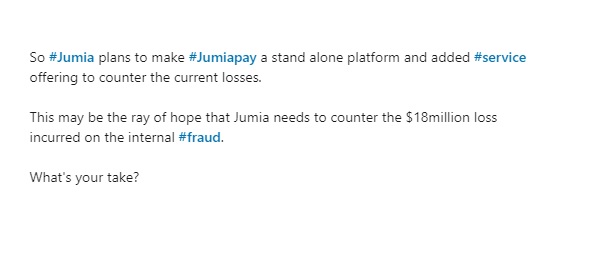
There is a “rumour” that Jumia may spin off JumiaPay. Possibly, it can unlock more value by doing so. Of course, Jumia is a public company which makes spinoff really hard. Unless it can list JumiaPay on the exchange, the vehicles are limited. You do not break a NYSE traded company like akara and moi moi.  Yet, let us do the academic analysis.

A LinkedIn user wrote thus:

I commented – and below, I am expanding that comment.

I am not sure Jumia has a lot of  “trusts” in the financial “trustbank” to play that game. I do not believe that it was fraud that the management did not know. Nigeria is a very small economy for $18m to be under the table without top management knowledge. But if people do still believe Jumia, the spinoff will unlock more value for shareholders. JumiaPay with about 5 million “users” [the estimated Jumia users] will be one of the largest non-bank fintech players in Africa. Largely, JumiaPay can get at least $200m valuation there. Currently, the fintech unit is largely discounted by markets in the NYSE – few care about that JumiaPay component, mainly focusing on the ecommerce GMV, PL, etc.

So, spinning off JumiaPay will be a win for Jumia. It can help it get more value. Think of how PayPal ($125 billion market cap) has become bigger than eBay ($33 billion market cap). I can tell you that JumiaPay will be bigger than Jumia in Africa. 

Marginal cost will continue to affect Jumia (i.e. the ecommerce business) ability to become profitable. JumiaPay will not have that problem. Of course JumiaPay will have to compete in the world of Paystack, Flutterwave, etc. If Jumia spins off JumiaPay, on day 1, JumiaPay will have a really great client in Jumia and will be making money. That is why it will be a great business – makes money and becomes profitable fast.

The Most Important Cost To Understand As A Web Entrepreneur


FBI’s Arrest of Nigerians: The EFCC Should Have Done More

0
Some of the suspects

It’s disappointing but not surprising: As the US Department of Justice released a statement on a coordinated investigation by the FBI on aggravated cyber fraud and money laundering. The 80 names sound familiar, just as the others on the ever resonating list of wire fraud. Just a week ago, we read the story of Invictus Obinwanne Okeke, whose glory was short-lived when the FBI took a close look at his activities and discovered cyber fraud amounting to millions of dollars. The numbers are likely going to increase, it’s only a matter of time and another criminal syndicate based in Nigeria will be busted.

It’s no longer news, we see it, we know it, we live it, it’s a way of life. That’s the only way to explain the gravity of financial crimes perpetrated under the nose of the Economic and Financial Crime Commission (EFCC), Independent Corrupt Practices Commission (ICPC), the Department of State Security Services (DSS), the Nigerian Police, and every other agency that has a stake in Nigeria’s financial trust and image. That’s how most Nigerians have reacted to the development.

That it took the FBI to uncover what it described as “the biggest cybercrime in the US history” which originated in Nigeria, questions not only the credibility of Nigerian financial crime institutions, but also their reason for existence.

The dent of cyber fraud has been escalating in Nigeria with little attempt from these agencies to quell it. The connecting factors that enable it are too evident to be excused. From bank managers (who help fraudsters fence their money) to bureau de change who help them convert it. And then there is extravagant lifestyle that cannot be justified through legit means of living.

The FBI followed these traces from the Business Email Compromise (BEC), (a sophisticated technique applied by the criminal syndicate to divert funds from companies or their clients to accounts designated by the fraudsters), with the help of other agencies from around the world to uncover the international base of the criminals in Nigeria. The funny thing is, the EFCC isn’t part of it, they probably saw it in the news like everyone else, and are yet to make any statement about it.

That has prompted Nigerians to ask: “Could it be that the FBI doesn’t trust the EFCC enough to share such intelligence with them”?

In May, the EFCC issued a statement to discredit another EFCC that was mounting roadblocks in highbrow areas of Lagos, extorting people on the allegation of internet fraud. The EFCC’s spokesman, Tony Orilade told the general public:

“For the avoidance of doubt, it is not part of our operational practice to mount roadblocks and we do not hire agents. The criminal elements that mount the Lagos roadblocks are not our staff and we have no connection whatsoever with their criminal activities.

“Similarly, the Commission wishes to disown a letter of invite, purportedly emanating from one DSP Dorcas Bukola, via an email address: {drealhelen@gmail.com}, inviting unsuspecting members of the public to our office.

“While the said DSP Dorcas Bukola claims to be acting on behalf of the EFCC, we strongly urge the general public and particularly those who have received the email to ignore the invite as such a character is not in the employ of the Commission and has no authority to act on our behalf.”

The statement and the events surrounding it seem to justify what many believe: that in a country where there is a fake version of antigraft agency, and there is nothing the original agency could do other than warn the public, no sane person would expect them to pull the needed strings on a sophisticated cyberfraud syndicate. And that could be the reason why the EFCC was totally ignored by the FBI.

Others say that although the EFCC have secured some convictions in cybercrime, the agency seems to give more concentration on government related corruption.

However, there is a perceived void that the EFCC’s action and inaction has created, and it has undermined its international position in the fight against financial crimes.

Nigerians believe that the story would have been different if the investigation was initiated in Nigeria by any of the agencies, and collaborate with their international counterparts to bust the syndicate. “It would have made a better image for the country, and the rest of the world would have seen a government committed to rid itself of criminal elements.” They said.

While there has been a total condemnation of these crimes that have swindled billions of Americans’ hard earned dollars, voices out there are calling for more effective financial crime agencies in Nigeria that will shun partisanship and do their jobs with integrity.

Useful Tips for Employees’ Salary Negotiations

1

Salary Negotiation:

What’s your current salary?

This is a big question many employees who are trying to change jobs always struggle to answer during job interviews.

Of course, you are going for a job interview, and there are chances that you will be asked about how much you are currently earning (in salary), in order to decide your paycheck. Salary negotiation can be very scary. But that’s not a good reason for any employee to avoid it.

This is a contentious situation, and I understand both sides of the argument (to tell or not to tell). But at the same time, I believe that it is a straightforward question that requires a straightforward answer.

I often hear the opposition parties (i.e. employees) screaming that why is it relevant?

Employees feel the Hiring Manager should just talk about the position he/she is recruiting for and the paycheck that goes with it. Then he can decide if it is right for both parties.

But, it is a very important aspect of the recruitment exercise. Here’s the problem, you have been asked a direct question – so what is stopping you from answering it?

Or are you scared of blowing up your chances? Perhaps, you don’t want to get a response like –  we are sorry but we can’t afford your service.

But do you really have to hide your current earnings from the Hiring Manager?

Or don’t you trust the interviewer to the point that you can’t be honest?

If you have actually done an outstanding job at an interview, provided you did well, then the hiring company frankly won’t want to lose you – irrespective of what you are currently earning. So just tell them!

There’s nothing like being sincere. And starting off the relationship at a place of trust and openness will be a massive step in the right direction.

However, here are a few tips employees need to know before going into salary negotiation:

  • Know your worth: Companies will pay you for your worth irrespective of their payroll. However, be realistic with your self-evaluation because there are thousands of professionals in your role.
  • Make enough research: This will give you a range of figures to work with instead of going into the interview with no prior knowledge of the salary.
  • Ask for a specific amount: It works better when employees work with specific figures.
  • Talk to recruiters: This gives you the much-needed insight you need to negotiate.

Good luck with your next interview.


Co-written with Michael Leonard.

Michael Leonard is a certified leadership and executive NLP coach, CEO and entrepreneur  with over 20 years in partnering with you to reach your true potential.

Contact: http://linkedin.com/in/michaelleonard3

A Letter to the Nigerians in Diaspora

0

Dear Nigerians in Diaspora,

I’ve been looking for a way to tell you this without making it look like we do not appreciate all that you’ve been doing for us over here in Nigeria. Honestly, we truly appreciate your wonderful gifts of clothes, phones, laptops, cash, and even cars. We know that things are not so rosy over there as some Nigerians think, but you still share from the one you have. I want to say a big ‘Thank You’ on behalf of all of us here, who have been benefitting from your generosity in one way or the other.

I know you must be wondering what I want this time. Oh well, you have been giving us so much already, but Oliver wants some more. This time, we want both the fishes and the lessons on how to catch them.

Please, don’t blame us for wanting to learn how to catch fishes. You know how bad things are in Nigeria. Our education system is poor, NEPA is still doing blink-blink (even though they are now privately owned), the rate of unemployment is increasing, recession is still hitting us badly, our population is growing out of proportion, corruption is still dealing with us, and insecurity is getting out of hand. See, there is hunger in the land (even kidnappers are accepting yams and palm oil as ransom. Lol). I’m not saying all these to discourage you from coming home; I’m only trying to make you see that we still have plenty of works to do. We need your help before hunger and frustration send all our young intelligent ones out of the country.

I know you must be wondering what I wanted you to do. Don’t worry, I have a comprehensive list of some of the things you can do to help alleviate our pitiable conditions and heal the country. The list is not too much, so there’s no need to fear. Some of the things I have in mind that you can do for us are:

1. Bring Home the Knowledge from the Global North: You know, the Igbo people always say: “Onye nje nje ka onye isi-awo mara ihe”. This means that a traveller is wiser than the elderly that hasn’t travelled out of his locality. Your journey to the land of the wise man has exposed you to the wise man’s knowledge. Because of this, you are wiser than those of us here, irrespective of age, education and social standing. We, therefore, need you to come home and teach us those wisdoms.

We want to know how they do their things there. We want to know how they plan and manage their education system. We need knowledge of their technological advancement. Their medical discoveries are also important to also. Tell us how they do their security stuffs. In fact, come home and teach us everything you have learnt over there. If you are wondering how you can achieve this, then continue reading because we will get to that.

2. Invest in Start-Up and Established Local Industries: There are so many local industries that are trying to raise their heads above the sea level. Examples of such Nigerian companies are the textile and fashion industries, shoe manufactures, plastic manufacturers, hi-tech, crop and animal farming, and so many others. You can invest in them to make them come up a little bit closer to the international standard.

Our start-ups also need a lot of touches. They need partners, loans and grants. They also need supervision and mentoring. Most of them do not really understand the intricacies of running a sustainable business. You can decide to take some of them under your wings and nurture them. Trust me, there are so many people with wonderful innovative ideas that need people like you to help them put these ideas to reality.

3. Exporting our Products: I know that some of our products are not up to the international standard, but I believe that the story will change if the producers know that they will compete with international companies. So you can decide to be the exporter of our local products.

We have so many things that will be profitable out there. One of them is our food. I heard that Nigerian foods are ‘hot cake’ there. You can help our local farmers by buying from them and then selling them out there to make your own profit. Even our fashions make good sales there. Anyway, just ask around, I believe Nigerian Export Promotion Council can help you with the right information.

4. Establishing Companies: This will be very wonderful, especially if the companies will also help in bringing home the knowledge acquired from the Global North. The advantage of this can never be overemphasised considering that it will reduce unemployment and, hopefully, insecurity in the country. Some of our brothers and sisters in the diaspora have already taken up this venture, but we need more. And please, don’t bring down the quality of goods and services because you are in Nigeria. Make your products and services to be of the international standard. We need good things in Nigeria, and our local companies also need to learn from you.

5. Awarding Scholarships: We have a lot of brilliant young ones who couldn’t afford to sponsor themselves through primary and secondary education. There are also those who would love to go for courses that are not available in Nigerian universities. You can, please, organise yourselves and find ways to sponsor these people.

6. Pick-Up Jobs in Nigeria: I have noticed that most successful establishments in Nigeria have people like you at their managerial levels. We need more of this, even if it’s on a temporary basis. Come to Nigerian and pick up some jobs. You can go for the private sector or the public one. But if you ask me, I’ll say you should go for the public sector because a lot of changes need to be made there. But if that proves difficult, you can then consider the private sector. Whichever one it is, just give us the privilege of working with you.

Ok, I think I’ve given enough ways through which you can help us here in Nigeria. Please, I’m not saying that the cash and other gifts brought home don’t solve problems. The truth is that we need to find ways to earn from here other than waiting for you to send almost everything we need.

More so, we need to rebrand Nigeria and make it a safe haven for all of us. Nigeria can be healed if we act now, and fast too. As far as I can tell, this will not be possible without the combined efforts of all Nigerians, whether home or in diaspora.

So, keep the gifts coming, but please consider my ideas.

With love from,
Ozzy.