DD
MM
YYYY

PAGES

DD
MM
YYYY

spot_img

PAGES

Home Blog Page 6748

Protecting Your Customers and How You Can Get New Ones

0

You may not believe what I’m about to tell you but it’s the whole truth and nothing but the truth which lots of people do not know. Perhaps they don’t just understand the rule of consumer/audience behavior.

This is the secret: “You don’t need more customers more than the one you’ve got”

It has a context anyways and it simply applies to the customer retention principle which I’d explain. If you’re running a company and chances are your customers are more likely to jump onto other products due to the seasonal use of the product, then this method works.

What I’m simply saying is that you should focus more of your efforts in protecting the few customers you have than searching for new ones. I have not said don’t search but your major focus should be on how to make the few ones become part of your tribe, your business, your community, loyal to your brand. Customers are scarce, new brands emerge daily. New writers emerge daily, new artists emerge daily, new small businesses are built every second and if you’re not careful enough, you will lose the few ones you have if you don’t do the necessary thing to keep them.

Well, it’s not all customers that you’re expected to keep. I mean the ones that are not bringing value to your business, rather a headache; you shouldn’t bother about keeping them. But the relevant ones should be part of your community. This is the 21st century and I’ll tell you the whole truth, customers are scarce. I’ll let you know the big mistakes people make when they need customers for their products, when they need audiences for their skills, they actually seek a crowd. I mean they seek millions of people. Fine, you could get that in the 90’s but not anymore. The marketplace is over saturated.

I will teach you what you need to do and how you need to go about it but I have to let you know where you’re missing it. A typical example are those who sell watches. They are in a haste to sell all the watches in their stores to anybody who wants to buy. They make all the shouting, the advertising, they tell friends and they get people to come buy those watches from them. But do those people eventually return a second time? Do they see a need to buy another watch? And even if they do, do they see a reason to return back to buy from you or even tell a friend about you?

Most times, the answer is no and that is because you are only focused on selling than the value that you will add to them to retain them. Yes, you sold, they bought, deal ends. So you begin the whole process of looking for another new set of people, another new way to market, another new sets of friends.

By the time you’re doing this the third time, there are no customers anywhere and you don’t have anyone attached to your brand. So this takes us back to what I said earlier that your focus should be more on protecting your customers than searching for new ones.

A bird in hand is better than 100 in the forest applies when it comes to long term businesses. If it’s a short term business, you don’t need any loyal customers. Perhaps you want to sell ice cream or even shoes for three months, you really don’t need to work on protecting any customer. You should rather focus on getting as many as possible to come and go. However, if it’s a long term business, then you need to create a community of loyal customers.

Why is this important

  • They help advocate for your brand anywhere and anytime
  • They help spread your idea among friends
  • They come back to get more products and more products so you keep selling even though you’re not doing so much marketing
  • They are always the first to try out your new products, services, books and all.

If on the other hand you don’t have and you want your business to be a long term business then you’d suffer from not having all these. So the next question to ask is how do you protect them. Mind you, I’m not throwing away the fact that you need new customers so I’d teach you on how to get new customers as you’re also protecting your customers.

How To Protect Your Customers

  1. Build a community: When I’m saying build a community, this can be done offline if your customers are within a location, or not too far from themselves. However, if they are not then the best place to get it done is online. You need to form a community online. It is a psychology. People get to interact more if they see others interacting. Remember, I said that you need to create contents that are either educative, informative or entertaining. But you need to create content whichever way. What will eventually happen is that they will help you spread your idea or business faster than you can even imagine. And they will always want to come around your brand because they know there’s a value you’re offering.
  1. Build Trust: This is very important. This doesn’t work online alone, it works offline as well. There’s no way you can get referrals if your clients do not trust you. You should under-promise but over deliver. It works well here. One thing clients or audience or customers or consumers love is to be surprised. Why do I stick to one barber, I expected less of him just like every other barber. But he spent over an hour on my hair and gave me the best haircut. He won my trust. I have for over one year stuck to his brand.
  2. Offer Quality: Well, it’s easy to scale when you don’t have quality as well. But there would be a time when you come in contact with another brand with high quality. Your consumers who love more quality stuff would change base. This is why the race should be more on how to convert all the strange customers to friendly customers so that you’d be safe.
  3. Offer extra value: Now this is as important as having a brand itself. The extra value you offer is what should make you stand out. It could be an extra care to them. It could be weekly mails of how you appreciate their patronage or SMS. It could be small cards to them monthly as a thank you card. They don’t forget easily. I mean we don’t forget easily, we’re customers at one point in time or another. It could be a question and answer time out, it could even be free prizes inside the product. It could be extra consultancy and all. I bet you, these would keep your customers glued to you so you don’t have to stress yourself on keeping them rather on getting new ones.

Full list of Nigerian Federal Ministers and their Portfolios

0

Nigeria’s President Muhammadu Buhari has created five new ministries. The new ministries are:

  • Humanitarian Affairs, Disaster Management and Social Development
  • Police Affairs
  • Special Duties and International Affairs
  • Aviation
  • Power.

Find below full list of Nigerian Federal ministers and their portfolios.

  1. President Muhammadu Buhari – Minister of Petroleum

  2. Mohammed Musa Bello – Adamawa State – Minister of Federal Capital Territory, FCT

  3. Godswill Akpabio – Akwa Ibom State – Minister of Niger Delta

  4. Chris Ngige – Anambra State – Minister Labour and Employment

  5. Sharon Ikeazor – Anambra State – Minister of State, Environment

  6. Adamu Adamu — Bauchi State – Minister of Education

  7. Ambassador Maryam Katagum – Bauchi State – Minister of State Industry

  8. Timipre Sylva – Bayelsa State – Minister of State for Petroleum

  9. George Akume – Benue State – Minister of Special Duties

  10. Mustapha Baba Shehuri – Borno State – Minister of Agriculture and Rural Development

  11. Goddy Jedy Agba – Cross River State – Minister of State, Power

  12. Festus Keyamo – Delta State – Minister of State, for Niger Delta

  13. Ogbonnaya Onu – Ebonyi State – Minister of Science and Technology

  14. Osagie Ehanire — Edo State – Minister of Health

  15. Clement Ike – Edo State — Minister of State for Budget

16. Richard Adeniyi Adebayo – Ekiti State – Minister of Industry, Trade and Investment
  1. Geoffrey Onyeama – Enugu State – Minister of Foreign Affairs

  2. Ali Isa Pantami – Gombe State – Minister of Communication

  1. Suleiman Adamu – Jigawa State – Minister of Water Resources

  2. Zainab Ahmed – Kaduna State – Minister of Finance

  3. Muhammad Mahmood – Kaduna State – Minister of Environment

  4. Sabo Nanono – Kano State – Minister of Agriculture and Rural Development

  5. Bashir Salihi Magashi – Kano State – Minister of Defence

  6. Hadi Sirika – Katsina State – Minister of Aviation

26. Abubakar Malami – Kebbi State – Minister of Justice/Attorney General of the Federation
  1. Ramatu Tijjani – Kogi State – Minister of State, Federal Capital Territory (FCT)

  2. Lai Mohammed – Kwara State – Minister of Information and Culture

  3. Gbemisola Saraki – Kwara State – Minister of State, Transportion

  4. Babatunde Fashola – Lagos State – Minister of Works and Housing

  5. Adeleke Mamora – Lagos State – Minister of State for Health

  6. Mohammed H. Abdullahi – Nasarawa State – Minister of State, Science and Technology

  7. Zubair Dada – Niger State – Minister of State, Foreign Affairs

34. Olamilekan Adegbite – Ogun State – Minister of Mines and Steel Development
  1. Tayo Alasoadura – Ondo State – Minister of State, Labour and Employment

  2. Rauf Aregbesola – Osun State – Minister Interior

  3. Sunday Dare – Oyo State – Minister of Youth and Sports

  4. Paulen Tallen – Plateau State – Minister of Women Affairs

  5. Rotimi Amaechi – Rivers State – Minister of Transportation

  6. Maigari Dingyadi – Sokoto State – Minister of Police Affairs

  7. Sale Mamman – Taraba State – Minister of Power

  8. Abubakar D. Aliyu – Yobe State – Minister of State, Works and Housing

  9. Sadiya Umar Faruk – Zamfara State – Minister of Humanitarian Affairs, Disaster Management

  10. Dr. Ikechukwu Ogah – Abia State – Minister of State Mines and Steel

Never Celebrate Too Early!

0

Don’t celebrate too early!

I know you would be wondering what I meant by that. Yes, I mean when you hit the jackpot, be cautious on how you celebrate. Of course, I know that success can be intoxicating. It could push you into taking unplanned action.

Got some unfortunate news yesterday which got me upset. A close relative who worked in a real estate firm had the nerves to resign from his job when he was yet to sign an offer letter from a new employer. What’s more, he upgraded his wardrobe with new office-worthy wears just after his final interview, thanks to a loan shark.

He had negotiated a 1.4x his current net pay, a 40% increase in his previous salary, only to be offered a net pay of 0.6x, 40% less of his previous salary.

Mathematically, this doesn’t stack up and it is sane to reject such offer, ceteris paribus. So he did what a sane person would have done without considering his actions carefully. He rejected the offer and started afresh as a job seeker.

In his words, ‘Sis, I’ll tell you what…they didn’t stick to the agreement, besides, I was given a supposedly unrealistic monthly/quarterly target which is not fairly commensurate with the salary. Also, I have over 6 years of work experience and will not debase myself to earning what is deserving of a fresh graduate. By the way, it’s a marketing job in an unpopular microfinance bank and I don’t even find it befitting bla bla bla’’….He was saying gibberish as it was evident that he was all kinds of discombobulated.

Anyway, he is now jobless and also in a huge debt that will take a miracle to come out of it.

What do you have to tell him?

Well, I will say this to everyone out there, especially the employees, before you tender your resignation letter, be sure you have been given the appointment letter that states your salary expectations. So that your decision would be based on what you have at hand. It’s like a bird at hand that’s worth than thousands in the bush.

It reminds me of my time as a job seeker, I attended an interview and passed it. I was sent a congratulatory message. Out of excitement, I told every cat and dog in my community.

I packed my bags and prepared for the new destination (Lagos). When I arrived at the company, I tendered the printed congratulatory message, but I was told to wait for a week. The recruiter said they were getting my new office ready. I waited for a week. A week turned to five months. Till date, I heard nothing from them.

I regretted celebrating too early. I regretted having to wait endlessly without doing nothing. But I appreciated the lesson it taught me.

Until you have resumed into the office, never assume you’ve been hired because the decision could still be reversed. Yes, you cannot be like Usain Bolt – not many are that lucky to celebrate before the finish lines.

Credit: Sarah Funmi Ajayi

The Challenge Of YouTube Ads Targeting Kids

0
A picture shows a You Tube logo on December 4, 2012 during LeWeb Paris 2012 in Saint-Denis near Paris. Le Web is Europe's largest tech conference, bringing together the entrepreneurs, leaders and influencers who shape the future of the internet. AFP PHOTO ERIC PIERMONT (Photo credit should read ERIC PIERMONT/AFP/Getty Images)

The Federal Trade Commission (FTC), seems to have accepted the challenge of their counterparts in Europe, to sit up in their regulatory responsibilities, and tech companies are not finding it easy. In July, Facebook was handed a $5 billion levy for the Cambridge Analytica data privacy breach, the highest sum ever levied against a tech company. And it appears it is going to be a one case too many.

On Tuesday, the FTC reached a settlement with YouTube over their targeted ads on videos meant for children in their platform. A verdict stemming from a complaint by consumer groups back in April 2018. It was alleged that YouTube has been collecting information about minors to use in targeted ads. Although the amount of money levied against it is not known since YouTube and FTC are not saying anything, but it apparently took a chunk off YouTube coffers.

The consumer group has suggested to the FTC that every kid’s content on YouTube be moved to YouTube kids, the app designated for children. But the FTC had another plan: “What if every kid’s content is ad disabled, will you be content with that”? They asked the group. It was based on this question that the regulatory body made its decision. YouTube must not serve ads on any children related content. A decision that will cost it over $500 to $750 million in revenue.

YouTube has long maintained that its main site is not for kids and urged children to use the alternate app for kids. But the amount of children’s contents on the primary site is making it inexcusable. From nursery rhymes to cartoons that are commanding billions of views.

There is another problem, YouTube serves two different types of ads: one matches the context of a video with a commercial service: the other is targeted ads, using an array of digital signals, marketers who aim at a particular group or demographics can reach them using Google’s vast data troves, websites people visit, their searches and many of their interests as indicated by cookies.

So there have been thousands of targeted ads cut across different products and services, and YouTube share some video ad sales with other websites. How it is going to implement the regulatory policy is a puzzle since it cannot clearly distinguish between videos directed at children and the ones that are not.

It is a challenge that the FTC itself acknowledged. Removing the ad feature from children’s select videos does not guarantee that YouTube is going to stop tracking web habits when children visit other websites or watch non kid related content on YouTube.

The complainants also expressed pessimism that the FTC’s measures will unlikely solve the problem. Josh Golin, one of the complainants from Campaign for Commercial Free Childhood asked: “Is Google still going to be collecting all the data and creating marketing profiles?

“That wouldn’t be satisfactory.”

Another complainant, Jeff Chester, executive director of the Center for Digital Democracy, has vowed to challenge the decision if it only means that YouTube will curb ads targeted at children not eliminating it completely.

Chairman Babatunde Fowler’s Response

5

The Presidency queried the Chairman of Nigeria’s tax agency on the nation’s “recent” lackluster performance on our tax receipts. The Chairman, Mr. Babatunde Fowler, responded explaining what everyone had already known: Nigeria’s has no sustainable economy. Yes, we are in a stage with the pendulum controlled by oil prices. His response was believable if you remove the alternative situation [Nigerians do not believe their leaders anymore].

In 2015, FIRS set N4.7 trillion target but was only able to make N3.7 trillion in the actual collection. In 2016, 2017 and 2018, the target collections were N4.2 trillion, N4.8 trillion and N6.7 trillion but the actual collections were N3.3 trillion, N4.0 trillion and N5.3 trillion, respectively.

Worried by the variances, the presidency asked Mr Fowler for an explanation.

“Accordingly, you are kindly invited to submit a comprehensive variance analysis explaining the reasons for the variances between the budgeted collections and actual collections for each main tax item for each of the years 2015 to 2018,” Mr Kyari wrote.

In Mr. Fowler’s response, you will weep for Nigeria; Premium Times captured it thus: ‘He associated the general lower collection since 2015 to oil market crisis which has seen a fall in commodity price compared to the period under Mr Jonathan, and recession “which slowed down economic activities.”’ Of course that recession was also tethered to oil price. So, at first and secondary levels, oil prices dominate everything in Nigeria despite all the noise since 1999 to redesign the architecture of the economy! Chairman’s letter is a solid testament that we have not made real substantial progress in Nigeria since telecoms, banking, and other sectors cannot absorb any shock from crude oil.

IMG-20190819-WA0043

Why is this an issue? Simply, our current tax receipts cannot cover our recurrent expenditure. That means, Nigeria cannot pay workers, settle common bills, etc even if it stops investing in infrastructure or broad capital projects. There is no economy in the world that has created meaningful human wellbeing under that redesign.

Yet – this is not any President’s fault. The President, the Senators, the House members, the citizens, and indeed every Nigerian is a victim. But we need to find answers fast as if this trajectory continues with our population growing faster than economic opportunities, our nation will hit a severe inflection point where it will experience turbulence.

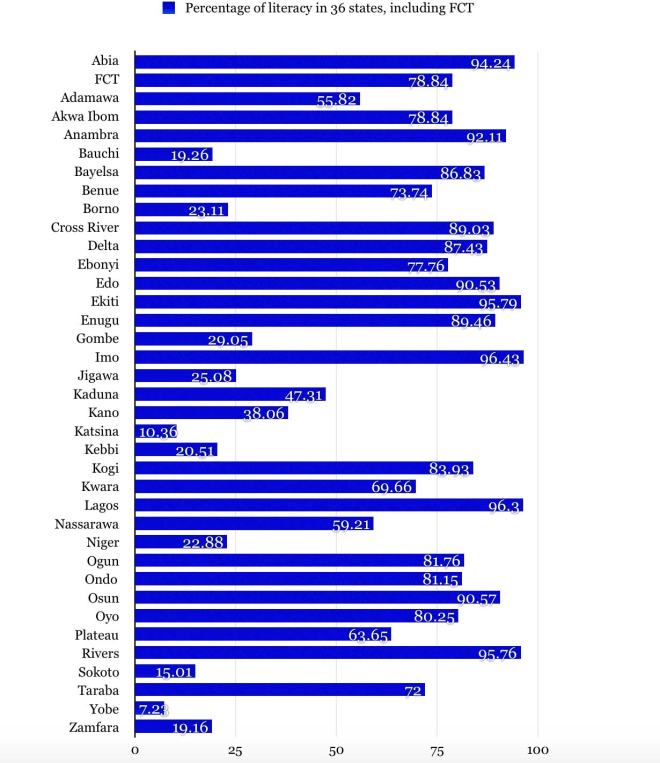
Yobe State has a literacy rate of 7.23%. Yet, if you run the numbers of the funds given to the state many years ago from the Universal Basic Education fund, it is at parity with Imo State (#1 with literacy rate of 96.43%). Has someone asked the successive governors in Yobe state what happened to all the money the federal government sent them to send kids to schools? Nigeria needs to ask fundamental questions to make progress in this age. Things are not just working!

I have noted that we have only 30 million people as the core addressable market. But it seems the oil sector is really what matters (I have updated this number to 32 million people). If oil price drops, even the 32 million people become meaningfully irrelevant to a large extent. That is very unfortunate and needs to change.

In most of my analyses when it comes to people that actually have money to spend or pay for (technology) solutions in Nigeria, I use 30 million people. Yes, despite 198 million human population, the effective addressable market in Nigeria is less than 30 million people. In Fasmicro Group model, these are people with decent incomes for anyone to craft solutions to their personal and business-related frictions. The remaining 168 million people are opportunities, nevertheless [they have to eat, shower, etc].  But we see them from the track of the core 30 million people who have the money to pay for tech things. For most technology solutions (think gaming, apps purchase & digital subscriptions and the platforms like smartphones, computers and connectivity required for them) where the buyers are usually the direct beneficiaries, the 30 million is rock solid. (Of course, on largely non-tech areas like food where everyone has to eat, the 198 million people become the addressable market.

Source: NBS