DD
MM
YYYY

PAGES

DD
MM
YYYY

spot_img

PAGES

Home Blog Page 675

Former Waymo CEO Dismisses Tesla’s Robotaxi as “Not a Real Robotaxi”

0

John Krafcik, the former CEO who steered Waymo from a Google research project into a commercial autonomous ride-hailing company, has cast doubt on Tesla’s much-hyped Robotaxi service, arguing that it falls far short of industry standards for autonomy.

In comments to Business Insider, Krafcik, who led Waymo from 2015 until 2021 and now sits on the board of Tesla rival Rivian, dismissed Tesla’s Robotaxi launch in the Bay Area as little more than a rebranded Uber-style service.

“If they were striving to re-create today’s Bay Area Uber experience,” Krafcik said over email, “looks like they’ve absolutely nailed it.”

Tesla quietly began offering Robotaxi rides in San Francisco in July, about a month after piloting the service, but with a major caveat: every ride includes a Tesla employee in the driver’s seat as a safety monitor. California regulators confirmed that Tesla has not yet applied for the permits required to test or deploy fully driverless vehicles, a step taken by competitors like Waymo and Cruise years ago. CEO Elon Musk has nonetheless promised that the service will be opened to the public by next month.

Krafcik was blunt in his assessment. “Please let me know when Tesla launches a robotaxi — I’m still waiting,” he said. “It’s (rather obviously) not a robotaxi if there’s an employee inside the car.”

In Texas, where Tesla also operates Robotaxi rides in Austin under looser rules, a human monitor sits in the passenger seat rather than behind the wheel. Even so, Krafcik said he has no interest in trying the service, pointing out that its reliance on human oversight makes it no different from an enhanced ride-hailing model.

The Standard for Autonomy

The debate highlights the absence of an agreed definition of a robotaxi. The Society of Automotive Engineers (SAE) categorizes autonomous driving on a scale of 0 to 6. Levels 4 and 5 qualify as fully autonomous, where no human is required to take over. Tesla’s Robotaxi, however, appears to fall short of even Level 3 autonomy, which requires a driver to intervene when requested.

Tesla has not secured a permit from the California DMV to test driverless cars at Level 3 or above, raising further questions about Musk’s promise of widespread rollout.

Waymo, by contrast, has steadily moved through these levels. It began its “early rider program” in Arizona in 2017, when safety drivers were present and participants signed nondisclosure agreements. In 2019, when select riders tested the service, some noted that while rides were generally smooth, safety drivers occasionally had to take over.

By the end of 2020, Waymo was offering fully driverless, paid rides in Phoenix, becoming the first company to do so in the United States. The company has since expanded to San Francisco, Los Angeles, and Austin, with more than 1,500 robotaxis on the road.

Krafcik stressed that during its early testing phase, Waymo never marketed its service as a “robotaxi” — reserving that label only once safety drivers were no longer required.

“I think the AV industry would be delighted if Tesla followed Waymo’s approach to launch a robotaxi service,” he said, “but they are not doing that.”

Tesla’s Gamble vs. Waymo’s Patience

The skepticism from Krafcik underscores the broader divide between Tesla’s aggressive, promise-driven rollout strategy and Waymo’s more methodical, regulation-heavy approach. While Tesla has long touted its vehicles’ “Full Self-Driving” (FSD) capability, regulators and safety experts argue the company has blurred the line between advanced driver assistance and true autonomy.

Waymo, meanwhile, has endured setbacks of its own. Despite billions in funding from Google parent Alphabet, the company has struggled to prove a sustainable business model, with expansion slowed by costs and regulatory hurdles. Krafcik’s leadership between 2015 and 2021 marked the transition from experimentation to limited commercialization, but it has often been noted that Waymo’s cautious pace has allowed Tesla to dominate the headlines, if not the road.

As Tesla pushes its Robotaxi narrative, industry veterans like Krafcik remain unconvinced that Musk’s vision matches reality. To them, Tesla’s Robotaxi looks less like a technological leap forward and more like a rebranded Uber — with a company employee still firmly in the front seat.


Overview of Bitcoin’s Current Market Performance, and How Retracement is Attracting Bargain Hunters

0

Based on recent market analysis, Bitcoin is trading around $113,775.44, with downside momentum contained near $114,600 after losing a bullish trendline from April lows.

The Coinbase premium indicates U.S. investors are adding buying pressure, as the price difference between BTC on Coinbase and Binance has remained positive since Friday, signaling bargain hunters stepping in. Glassnode’s Supply by Investor Behavior metric also shows fresh demand entering the market, potentially stabilizing prices.

However, technical indicators suggest short-term bearish sentiment, with a possible correction toward $110,530 if support levels break. Despite this, institutional interest and ETF inflows remain strong, supporting a longer-term bullish outlook.

The implications of bargain hunters emerging while Bitcoin remains under pressure suggest a dynamic where short-term bearish momentum is being countered by strategic buying at lower price levels. This creates a potential setup for a price recovery or rally once the retracement phase stabilizes.

Glassnode’s Supply by Investor Behavior metric indicates fresh demand, suggesting new or existing investors are viewing the dip as a buying opportunity, which could stabilize prices and set the stage for a reversal. Technical indicators, such as the loss of the bullish trendline from April lows and bearish signals from tools like the Bollinger Bands, suggest a possible further retracement to levels like $110,530 if support fails.

Strong institutional interest and consistent ETF inflows (as noted in recent market analyses) provide a bullish backdrop. These larger players often have longer investment horizons, which could anchor Bitcoin’s price and fuel a rally once short-term selling subsides.

The current pressure reflects profit-taking or risk-off sentiment, possibly driven by macroeconomic factors or overleveraged positions unwinding. However, the presence of bargain hunters indicates underlying confidence in Bitcoin’s long-term value, which could shift sentiment bullish post-retracement.

How a Market Rally Could Push Prices Upward Post-Retracement

Retracements often test key support levels, such as the 50-day moving average or Fibonacci retracement levels (e.g., 38.2% or 50% from recent highs). For Bitcoin, $110,530 is a noted potential downside target. Once this level holds or shows signs of rejection (e.g., strong volume or candlestick patterns like a bullish engulfing), it signals exhaustion of sellers.

A rally often begins when technical indicators turn bullish, such as a breakout above the 20-day or 50-day moving average, or when the Relative Strength Index (RSI) moves out of oversold territory (below 30). If Bitcoin holds above $114,600 or rebounds from $110,530, momentum indicators could signal a trend reversal.

Increased buying volume, especially from institutional players or ETF inflows, would amplify this momentum, pushing prices toward prior highs (~$120,000) or new resistance levels. A successful defense of key support levels can restore market confidence, triggering FOMO (fear of missing out) among retail and institutional investors.

External catalysts, such as positive regulatory news, macroeconomic easing (e.g., lower interest rates), or increased adoption signals, could further fuel a rally. For instance, continued ETF inflows or corporate treasury allocations to Bitcoin could act as a tailwind. If Bitcoin breaks above the recent high of ~$120,000, it could target the next psychological level at $125,000 or higher, depending on momentum.

Fibonacci extensions (e.g., 161.8% from the retracement low) or historical resistance zones could provide precise targets. The Coinbase premium and institutional demand suggest strong U.S.-led buying, which could drive prices faster in USD-denominated markets. A rally in Bitcoin often correlates with positive sentiment in broader crypto or risk-on assets. If altcoins or related markets also rally, this could amplify Bitcoin’s upward move.

The current retracement is attracting bargain hunters, setting the stage for a potential rally once selling pressure exhausts. A successful defense of support levels (~$114,600 or $110,530) combined with sustained institutional demand and positive technical signals could drive Bitcoin’s price upward, potentially testing $120,000–$125,000 or higher.

X Struggles on Android as Downloads Plunge, Revenue Growth Stalls

0

Elon Musk’s social media platform X is facing renewed struggles on Android devices, as fresh data reveals a sharp decline in new installs.

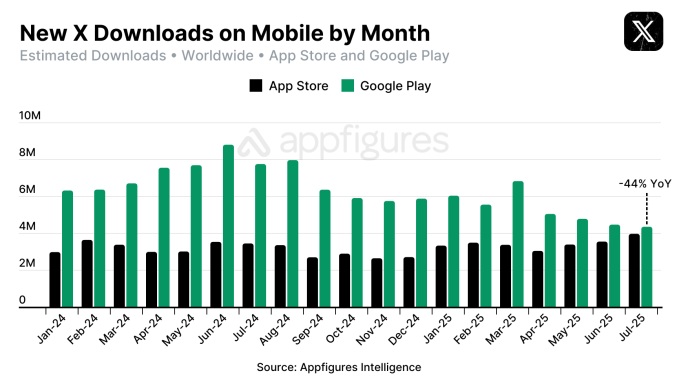
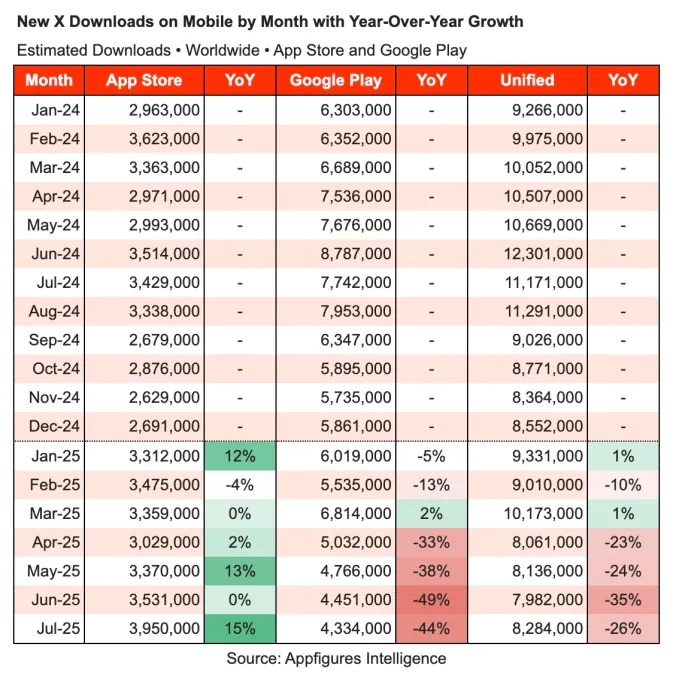
According to app intelligence provider Appfigures, X downloads on Google Play plunged by 44 percent year-on-year worldwide in July 2025, even as Apple’s App Store recorded a 15 percent increase in downloads during the same period.

The contrasting figures underscore a widening gap in user adoption across mobile platforms. While X continues to attract new users on iOS, the steep drop in Android installs is pulling down the platform’s overall performance. Total mobile downloads fell by 26 percent year-on-year in July, a slight improvement compared to June, when downloads had plummeted by 35 percent after Android installs nosedived by nearly half (49 percent).

Appfigures stopped short of fully explaining the decline on Android, but analysts have long flagged the poor state of X’s app on Google Play. The Android version is notorious for being buggy, unstable, and prone to frequent crashes, making it a sore point for the company.

In response, X’s recently appointed head of product, Nikita Bier, has hinted at major changes aimed at fixing the Android problem. Bier, best known for “growth hacking” social apps like Gas and TBH before selling them, announced that X was building what he called an “Android Dream Team” to completely rebuild the app. In a recent post on the platform, he claimed X’s iOS app had just recorded its best-ever week of installs, a move many observers interpreted as an effort to deflect attention from the Android slump.

The decline has also sparked questions about where disaffected Android users are going. Rival Bluesky, another Twitter alternative, has not capitalized meaningfully, as its own growth has slowed. Its Google Play app recorded just 119,000 downloads in July—tiny compared to the millions of monthly installs that X still attracts across platforms. However, Meta’s Threads appears to be gaining momentum, with its daily active users closing in on X’s figures, particularly on mobile. Some analysts suggest that a portion of Android users abandoning X may be moving to Threads.

Beyond user growth, X is also struggling to expand its subscription-based revenue. Appfigures data shows that in July, the company earned $16.9 million in net revenue from its premium services, down from $18.8 million in March 2025, though marginally up from $16.8 million in June. The stagnation underscores X’s difficulties in convincing users to pay for extra features.

A key factor in this revenue challenge is the rise of Grok, the AI chatbot built by Musk’s xAI startup and tightly integrated into X. While Grok was initially bundled into X’s subscription tiers, it now has its own standalone app that is drawing away users who had previously subscribed to X primarily for AI perks. This development has left X more reliant than ever on advertising for the bulk of its revenue—a business line that has been under pressure since Musk’s 2022 takeover, as advertisers pulled back over concerns about content moderation and brand safety.

The numbers paint a stark picture: X is enjoying growth among iOS users but is failing to capture or retain Android users at the same pace. The company’s hopes now rest on Bier’s team successfully revamping the Android app, even as it faces mounting competition from Meta and other emerging platforms.

With Musk’s ambitious push to transform X into an “everything app” still in motion, the latest figures highlight the structural hurdles the platform faces in its bid to remain central to online conversation.

Secret Gems for Big Returns: 4 Top Cryptos to Join in 2025 While They’re Still Under the Radar

0

Can the right meme coin in 2025 be the difference between watching wealth multiply or watching opportunities slip away? The surge of meme-driven assets has shown time and again that community-backed tokens can spark unbelievable momentum. The challenge is no longer about whether meme coins matter. It is about which ones deserve attention before the market makes its next big move.

This year, MoonBull ($MOBU), Turbo (TURBO), Memecoin (MEME), and Ponke (PONKE) are positioning themselves as the top cryptos to join in 2025. Among them, one project is already igniting a whitelist buzz that is drawing investors into an exclusive opportunity. That project is MoonBull, with its whitelist now live. Early entry ensures access to secret staking rewards, bonus allocations, and the lowest token price before public launch. For investors considering meme coins as a path to growth, the timing could not be more decisive.

1. MoonBull ($MOBU)

MoonBull is not just another addition to the meme coin arena. It is a project designed from the ground up to reward early participants with premium opportunities. Built on Ethereum for unmatched security and DeFi compatibility, MoonBull aligns viral meme energy with the reliability of one of the most trusted blockchains.

At the center of its strategy lies the MoonBull whitelist, which is live at this very moment. This first-come, first-served chance delivers a clear advantage to anyone who acts quickly. Whitelist members do not just join early. They gain:

  • The lowest possible entry price
  • Access to secret staking rewards
  • Exclusive bonus token allocations
  • Private hints about the roadmap ahead

Spots are extremely limited, and once filled, they will not reopen. Unlike the open presale stage, whitelist approval grants advance notification of the exact launch date, providing a head start before the public gains access.

Why did this coin make it to this list? MoonBull earned its place among the top cryptos to join in 2025 because it embodies everything that makes meme coins explosive: community excitement, viral branding, and early-mover rewards. By blending Ethereum’s secure foundation with exclusive whitelist benefits, it positions itself as a standout project for investors seeking growth and innovation in the meme coin sector.

Guide to Entering the MoonBull Whitelist

Getting on the MoonBull whitelist is simple but time-sensitive. Visit the official whitelist page, submit your email, and confirm registration. Once approved, you will receive a private notification with the exact Stage One date and time. When presale opens, act immediately, as spots are limited and operate on a first-come, first-served basis. Whitelisted users gain the lowest entry price, bonus allocations, and access to secret staking rewards before anyone else.

2. Turbo (TURBO)

Turbo has emerged as a fascinating case in meme coin history. Created with the help of AI-driven design principles, this token was born from an experimental approach that combined community creativity with advanced digital tools. That background gave Turbo a unique identity, attracting both technology enthusiasts and traditional meme coin traders.

Market performance has also highlighted its appeal. Turbo became known for its ability to rally support rapidly, with surges driven by viral content and social media engagement. Its branding and positioning capture attention, while its AI-influenced origin story sets it apart from countless other meme coins.

Behind the community appeal, Turbo has built traction by balancing humor with innovation. It is not only a playful asset but also a symbol of what happens when creative thinking meets blockchain accessibility. Traders who seek both cultural relevance and potential value find it a natural fit.

Why did this coin make it to this list? Turbo claimed its spot among the top cryptos to join in 2025 because it represents how AI innovation and community energy can combine to generate market momentum. Its continued presence in discussions about emerging meme coins proves its ability to sustain relevance and attract interest as new waves of investors enter the scene.

3. Memecoin (MEME)

Memecoin is the project that wears its identity openly in its very name. Designed to embody the meme culture of cryptocurrency, it has grown into a recognizable symbol of the movement itself. What sets Memecoin apart is not just its branding, but its rapid adoption and community-driven energy.

The appeal of MEME lies in its straightforward yet powerful narrative: it celebrates the humor, creativity, and viral spirit of online culture. The project quickly captured attention by turning the idea of meme coins into something tangible, establishing itself as both a commentary on and a participant in the sector’s explosive growth.

Tokenomics also play a significant role in its journey. By emphasizing fairness and transparent distribution, Memecoin built trust at a time when skepticism often surrounds meme-based projects. Its early support and market traction helped it transition from novelty to serious contender in the meme coin space.

Why did this coin make it to this list? Memecoin secured its place among the top cryptos to join in 2025 because it stands as the cultural anchor of the meme token landscape. Its strong community foundation and commitment to representing meme culture directly have allowed it to remain relevant and influential in a crowded market.

4. Ponke (PONKE)

Ponke has positioned itself as one of the most promising meme tokens rising into 2025. Known for its bold branding and unique approach, it has quickly gained a loyal following across online communities. The project thrives on creativity, turning playful engagement into serious traction on trading platforms.

What sets Ponke apart is its ability to foster excitement without relying on imitation. Instead of copying predecessors, Ponke crafted its own identity, building a story that resonates with investors seeking originality. This differentiation has been key in driving its recognition among a new generation of traders.

Community activity also supports its momentum. Ponke has become a fixture in online discussions, with its following driving hype cycles that often translate into measurable growth. Its market presence and rising attention are clear indicators of its staying power.

Why did this coin make it to this list? Ponke earned its place among the top cryptos to join in 2025 because it demonstrates how originality and strong community engagement can carve out a unique space in the meme coin arena. Its rising visibility and distinctive branding make it a project worth following closely.

Conclusion

Based on the latest research, the top cryptos to join in 2025 include MoonBull, Turbo, Memecoin, and Ponke. Each offers its own narrative and potential for growth, but MoonBull stands out because of its live whitelist and presale advantages.

Whitelists remain one of the most effective entry points for investors aiming to multiply wealth in the crypto sector. By joining at the earliest stage, participants position themselves at the front of new trends and gain access to benefits unavailable later. Meme coins are riding that wave of adoption, and MoonBull is showing how exclusivity, staking rewards, and community-driven design can lead to explosive growth.

For investors considering which meme projects to monitor in 2025, the time to act is now. The opportunity to secure a Moon Bull whitelist spot will not wait, and history has shown that missing early stages often means watching from the sidelines as value rises.

For More Information:

Website: https://www.moonbull.io/

Telegram: https://t.me/MoonBullCoin

Twitter: https://x.com/MoonBullX

FAQs

  1. Which meme coin will explode in 2025?
    MoonBull is emerging as the front-runner, with massive community buzz and early investor interest suggesting it could be the breakout meme coin of 2025.
  2. Which meme coin to buy?
    With its whitelist now open and offering exclusive early perks, MoonBull is currently the best meme coin to grab before the big run begins.
  3. How does MoonBull differentiate itself from other meme coins?
    MoonBull combines Ethereum’s secure foundation with exclusive whitelist rewards such as staking programs, bonus allocations, and secret token drops.
  4. What makes 2025 an important year for meme coin investments?
    With more countries adopting crypto into reserves and market growth accelerating, 2025 is seen as a pivotal year for meme projects that combine community and innovation.
  5. Which meme coin has the most immediate opportunity right now?
    MoonBull, with its live whitelist, offers the most immediate opportunity for early investors seeking exclusive access and rewards.

Glossary of Key Terms

  • Whitelist: A list granting early access or special privileges to select users before a public launch.
  • Meme Coin: Cryptocurrencies that originate from online memes or internet culture.
  • Staking: Locking up crypto assets to earn rewards over time.
  • Ethereum: A decentralized blockchain platform that supports smart contracts.
  • Presale: A token sale phase before public launch, often at lower prices.
  • DeFi: Decentralized Finance, a blockchain-based financial system without intermediaries.
  • Roadmap: A crypto project’s future plans and development timeline.

Implications of Qubic’s uPoW Model on Monero Network Security

0

The Qubic mining pool, led by IOTA co-founder Sergey Ivancheglo, executed a 51% attack on the Monero network, achieving control over more than half of its hashrate by August 11, 2025.

This was framed as an “economic demonstration” to showcase Qubic’s “useful proof-of-work” (uPoW) model, which incentivizes Monero mining to fund Qubic’s token economy. By offering higher payouts (up to $3.13/day compared to $0.64/day from standard pools), Qubic attracted enough miners to surpass 51% hashrate, peaking at 52.36% or higher, enabling potential blockchain reorganization, transaction censorship, or double-spending.

A six-block reorganization was reported, discarding 60 blocks, though some developers, like SeraiDEX’s Luke Parker, argued this could be due to luck rather than a definitive attack. The attack faced resistance, including an alleged DDoS attack on Qubic’s pool in late July, reducing its hashrate from 2.6 GH/s to 0.8 GH/s.

Monero’s community countered with miner boycotts, slashing Qubic’s share to under 15% at times. The attack’s cost was estimated at $75 million daily, raising questions about its economic viability. Monero’s price dropped 8-17% amid the turmoil, while Qubic’s token rose 4%.

Despite Qubic’s claim of not intending harm, the event exposed vulnerabilities in Monero’s proof-of-work model, sparking debates on mining centralization and network security. Qubic’s rapid accumulation of hashrate (from 2% to over 40% in two months, peaking at 52.36%) demonstrates how a single entity can centralize a supposedly decentralized network.

This contradicts Monero’s core value of privacy through decentralization, as a 51% hashrate allows control over transaction validation, block production, and potentially protocol changes. A centralized hashrate enables attack vectors like: The attacker can rewrite the blockchain to spend the same coins multiple times.

The attacker can reject or delay specific transactions, undermining Monero’s privacy guarantees. Non-Qubic miners’ blocks can be rejected, reducing their rewards and further incentivizing migration to Qubic’s pool. Qubic’s uPoW, which repurposes mining for tasks like Monero mining or AI training, frames the attack as an “economic demo” to highlight PoW vulnerabilities.

By achieving a 51% hashrate, Qubic proved that PoW networks are susceptible to entities with superior economic resources, challenging the assumption that strong cryptography alone ensures security. This exposes PoW networks to “soft” attacks driven by economic incentives rather than technical exploits.

Unlike traditional hacks, these attacks are harder to detect and counter, as they exploit miner greed rather than software flaws. The Monero community’s response (e.g., boycotts and pool migrations) shows resistance is possible but requires significant coordination, which may not always succeed.

The attack caused Monero’s price to drop 8-17%, reflecting market concerns over network stability. A successful 51% attack could erode trust in Monero’s privacy and security, potentially driving users and miners away permanently. Conversely, Qubic’s token rose 4-70% during the period, suggesting market approval of its model.

The Qubic-Monero conflict serves as a warning for all PoW blockchains (e.g., Bitcoin, Ethereum Classic). If economic incentives can override decentralization, other networks may face similar threats from entities with significant capital. This incident has reignited debates about PoW’s long-term viability compared to proof-of-stake systems.

The uPoW model highlights a systemic attack vector in PoW: the ability to redirect hashrate for profit-driven motives. This could inspire copycat attacks on smaller or less secure PoW networks, as seen in past cases like Ethereum Classic (2019-2020) or Bitcoin Gold (2018-2020).

How uPoW Exposes Monero to Attack Vectors

Qubic’s uPoW model, which uses mining resources for practical tasks (e.g., Monero mining, AI training) while rewarding miners with QUBIC tokens, creates unique attack vectors by blending economic incentives with computational efficiency.

uPoW incentivizes miners by offering higher profits through QUBIC token rewards and Monero mining proceeds, which are converted to USDT to buy and burn QUBIC tokens. This deflationary loop makes Qubic’s pool more attractive, drawing miners away from Monero’s ecosystem.

The rapid hashrate accumulation (from 2% to over 50% in months) shows how uPoW can centralize a network by luring miners with better economics. This creates a 51% attack risk without requiring Qubic to own the hardware, as miners “voluntarily surrender” hashrate for profit.

Qubic’s plan to stop reporting hashrate after August 2, 2025, makes it harder for Monero to monitor threats. This “stealth mode” obscures Qubic’s true influence, delaying community responses. Reduced transparency increases the risk of undetected attacks, as Monero cannot easily track Qubic’s hashrate share.

uPoW’s high hashrate enabled a reported six-block reorganization, discarding 60 blocks, which demonstrates the ability to rewrite Monero’s blockchain history. While some argue this could be due to luck, the potential for deliberate reorgs remains. Reorgs enable double-spending and block orphaning, directly threatening Monero’s integrity.

uPoW’s ability to concentrate hashrate makes such attacks feasible, especially if Qubic rejects non-Qubic blocks to centralize rewards. uPoW’s integration with real-world tasks (e.g., AI training, Monero mining) makes it economically sustainable to maintain high hashrate shares.

Qubic’s pool faced an alleged DDoS attack, reducing its hashrate from 2.6 GH/s to 0.8 GH/s, which it attributed to Monero’s community. This highlights how uPoW’s centralized pool structure can be a target for counterattacks, but also how Monero’s decentralized nature struggles to coordinate defenses.

While uPoW exposes Monero to hashrate-based attacks, it also makes Qubic’s infrastructure a single point of failure. However, Monero’s reliance on community-driven defenses (e.g., boycotts, pool migrations) is slow and less effective against well-funded, coordinated attacks.

Qubic’s uPoW model exposes Monero to attack vectors by leveraging economic incentives to centralize hashrate, enabling 51% attacks, reorgs, and transaction censorship at a low cost. The implications include weakened decentralization, eroded trust, and price volatility, with broader concerns for all PoW networks.