By Samuel Nwite
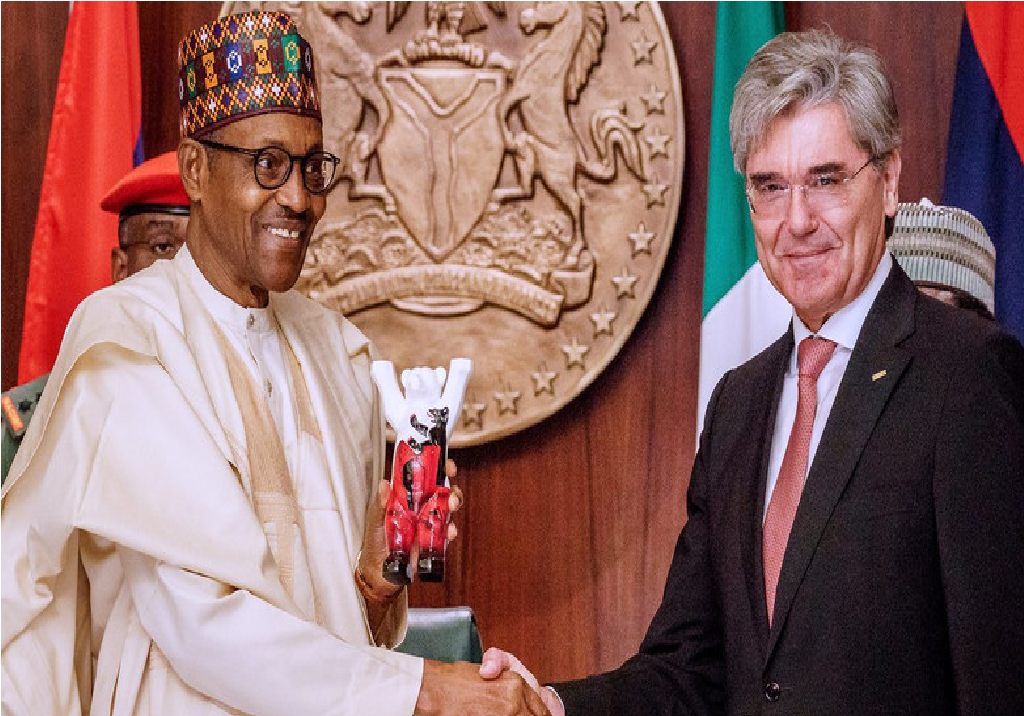
The Federal Government of Nigeria has signed a partnership deal with the German Government and Siemens AG. The presidency announced the partnership this afternoon as a step in addressing the epileptic situation of power supply in Nigeria. The deal, which is designed to take effect in 2 phases, has a target of 7, 000 megawatts of power generation by 2021, (the 1st phase) and subsequently, 11, 000 megawatts by 2023, (the 2nd phase). President Muhammadu Buhari stated that the initiative has become necessary in the face of helplessness of Nigerians with current power supply infrastructure.
Siemens is investing in distribution companies, the TCN and NERC, and has been tasked to apply German and European standards in their service delivery. President Buhari went further to explain how they plan to achieve service efficiency. He said.
“Our intention is to ensure that our cooperation is structured under a Government to Government framework. No middlemen will be involved. So that way, we can achieve value for money for Nigerians.”
The Global CEO of Siemens, Joe Kaeser, was on ground to sign the deal that is believed will make a significant difference in the power sector. The unending excuses from power stake holders have given enough reason for the government to look for practical alternative. This initiative is expected to pave the way for other investors to come in.
The monopoly that has been maintained by the government for about two decades now has done nothing but aggravate the situation. About $2 billion have been spent annually since 1999, by successive governments, and there is nothing to show for it. In 2010, when President GoodLuck Jonathan launched the Power Sector Reform Roadmap, it was in a bid to shift power investment to private sector.
When the privatization actually took place in 2013, and all the generating companies (Gencos) were sold, there was high expectation from consumers that was never met. Ever since then, power generation has been wobbling from 4, 000 to 5, 000 megawatts, when Nigeria needs about 180, 000 megawatts to generate stable power supply, and there is no clear plan to get around that figure except that Electricity Operators wanted to increase the cost of consumption, and by so doing, attract investors by showing them how lucrative the electricity business could be in Nigeria.
Well, the attempt to increase revenue by overcharging consumers was resisted. But the Central Bank of Nigeria (CBN) came with a plan: it launched in 2015, the $1.1 billion Nigeria Electricity Stabilization Facility to provide soft loans to operators. And the government also raise tariff through the Multi Year Tariff Order (MYTO) which was introduced in 2012, to subtly raise consumers tariff. Consumption price was raised by a 45 percent average. That means that, from 2015 – 2024, low residential power users will pay N24 per Kwh, and high domestic consumers will pay N29 per Kwh.
That’s more like extortion and was resisted by civil society groups and labor congress, even the National Assembly called it “retrogressive.” So the implementation did not take place. However, the operators found another means of raising tariff – estimated billing. The need to distribute prepared meters to consumers has been stymied by one excuse or the other. Even when the Metering Equipment Provider (MEP) was initiated, and the National Electricity Regulatory Company (NERC) ordered Discos to supply them to consumers who are willing to pay, there has not been any significant improvement in the number of people who use prepared meters.
In view of these exigencies, the federal Government’s initiative to partner with Siemens and the German Government could be the alternative that the Nigerian power sector has ever needed.