DD
MM
YYYY

PAGES

DD
MM
YYYY

spot_img

PAGES

Home Blog Page 6817

Here’s how LinkedIn can fast track your job search

6

By Chinedu J. Ihekwoaba

The life of a job seeker can be frustrating.

Now that the era of traditional recruitment is almost over, how will our qualified graduates get a job that matches their abilities?

I know many graduates with MSc getting peanuts as monthly salaries. In this era of the minimum wage, not all graduates would earn the new $90/month. Many would even earn below $50/month. That is very unfortunate for Nigeria.

I have been there before. I once earned $20/month and was even protective of my job. I know how difficult it is to get a job in Nigeria, so losing a job that pays peanut is not always an option to some Nigerians.

These days, jobs that pay peanuts are very hard to come by, leaving many graduates unemployed for a long period of time. What makes it uninteresting, the longer you stay unemployed, the lower your chances of getting jobs.

But do you know that a platform like LinkedIn can fast track your job search?

Here are ways LinkedIn can fast track your job search:

  • Connecting with professionals

I always advise graduates to build connections with professionals in their fields. Remember, traditional recruitment is almost over and graduates must build connections to stand a chance of being referred for jobs or favoured in job interviews. LinkedIn provides that opportunity.

  • Sharing your knowledge

I was the last person who would believe that you can be paid to write. However, LinkedIn proved me wrong in many ways. I have been writing since 2017 and I can tell you one truth, writing changed my life. LinkedIn made me.

In 2017, I didn’t get a job which I felt I passed the interview. I almost cried because I had invested a lot of time and resources into it.

A few months after, I made money from writing. The funniest part, the money was many times the salary of the job I missed.

I didn’t do anything special to earn that salary, the only thing I did was to share my expertise.

There are many graduates who are actually holding their breakthroughs in their heads, why not let it out with your pen. The world is waiting to read from you. 

  • Sharing your profile

I had a friend who told his uncle he needed a job. His uncle requested his CV to be forwarded to his email. However, my friend forgot and didn’t send it.

Two days after, he messaged his uncle on WhatsApp. His uncle thought he wanted to remind him of their previous discussion, he quickly told my friend, ”Dami I got your CV. Don’t worry, I have sent it to some companies.”

My friend was gutted. He wondered how true that was because he has not even forwarded his CV to him. That’s how most people play with your emotions and personal life!

You can make your journey easier by sharing your own profile on your LinkedIn page at your own wish, ease or time.

Remember, LinkedIn is a professional platform and every message shared, is a step closer to your dream job.

  • Getting Ranked

One thing LinkedIn does better, it gets you ranked. The higher you are ranked, the better your visibility. You also stand a chance of being found by amazing professionals. I have written for companies who found me through LinkedIn.

This is simply because I was ranked by LinkedIn. My profile is rated an all-star by LinkedIn, therefore, that makes it possible to be found by professionals in my niche.

My conclusion, in a world where everything is in excess, you will need to be extraordinary to get anything meaningful out of it. 

Always remember that life is not fair, it wasn’t meant to be. It’s your responsibility to make it work for you. Life will not give you what you want but everything you want in life has been given to you. 


Interested in taking my Digital Skill Course, reach out to me on LinkedIn or send an email to chinedu@bamf.media

Time for #PropertyTech in Nigeria

2

Let me say it clearly, Nigeria can easily grow our economy and reduce unemployment within 12 months. If you pay attention to the recent drivers of our GDP growth, you will notice that digital technology (and startups) sector is critical.

If all the houses in Nigerian villages are moved from their dormant states to dynamic assets, you will create more than five million jobs in three years. In the books, those houses in villages are dormant assets with no (significant) monetary value. They are not tradable and investable which means someone cannot easily create value on them, by buying and reselling them. Dormant assets kill growth.

As a nation, we can change that through public private partnership.

Yes, government does not need to be directly involved but government must recognize new species of startups – PropertyTech – to transform those dormant assets into investable assets. Add farmland to the real estate, you will see Nigeria hitting great numbers.

How can that man whose father left 100 hectares of rural farmlands tap into that asset to expand his business in the city? Today, the land worth nothing and the man is looking for $10,000 to put in his business when he has control of 100 hectares of land somewhere. No luck on bank loan because the dormant asset has no value before banks and insurers.

A property with cameras. The real tech is the formalization of property ownership.

Unlocking those assets by using digital companies will improve the wealth of Nigeria. To execute that, I will vote for-profit digital companies, giving them vouchers to work with the property owners who will pay them to capture the values towards formalizing the assets and unlocking better futures across villages.

If you model at the impacts, you can have 5 million jobs created in three years. There are so many things we can fix in Nigeria to be at parity with developed world. And most of those things cannot be leapfrogged upon. Yes, not using property rights to unlock expansion of the economy is a failure in our political and economic leadership.

We need to overlay technology in the real estate sector to have PropertyTech just as we have technology on financial services to have Fintech.

Like Nike Said: Just Do It!

0

By Chisom Nwosu

I cannot be the only person who has listened to motivational speeches and read Feel Good articles or books about finding one’s purpose and following one’s passion. There are a million and one videos on the internet telling me to, “Make no Excuses”, “Accept challenges” and “Believe in myself”.

Truth be told, I am tired of the rhetoric. Talk is cheap. Give me practical examples; real life stories.

Finding one’s purpose has got to be one of the most elusive things to achieve in life. For some people amazingly, finding purpose comes quite easily. Some actually stumble onto it by chance. For the rest of us, sadly, it is one painstaking process that can take place over the entire course of our lifetime.

It is also often quite a lonely one as well.

For me, I have done some introspection and made a decision:  I’ll take Nike’s advice. I’ll just do it.

I am just going to live. I am just going to do the things that I enjoy doing, for example, writing down my thoughts and telling stories. I am going to be kind, look for opportunities to serve others. I shall keep asking questions and thinking about ways to solve the problems I encounter in my daily interactions both at work and in my personal life. I shall continually seek improvement in my processes, skills and relationships.

I want to leave a positive trail of value-adding in my wake wherever I go.

Who knows, along the way, I may finally realise that I have been living my purpose all along.

How to Overcome Recognition Gap in Nigeria’s Facilities Management Industry

0
Source: LinkedIn, Infoprations Analysis, 2019

By Mutiu Iyanda

Despite its primary purpose of ensuring a healthy environment and facilities for healthy living of human and materials, the recognition of the facilities management (FM) industry remains low in most developing countries. Placing the industry at the strategic position of developing and maintaining infrastructure or facilities has been a herculean task for users of FM solutions, especially government establishments.

Recent researches have shown that the issue remains due to the inability of the FM providers to appropriate proven strategies for awareness creation and maintenance. Among other consequences, the facilities management industry has been misconstrued as asset and property management in the last 5 years. Previous analysis has shown that the misconception is on the rise because of the simple description of solutions being employed by the players in the industry. Analysis indicates that the companies prefer simple description of the solutions to the classical structure, which allows categorisation of solutions based on their similar features or benefits.

Check has equally shown that FM companies in Nigeria pay little attention to the customer reviews on the Internet, most importantly, those expressed on Google Business and online communities or forums.  Analysis shows that a negative connection exists between the number of reviews received by 10 FM companies between 2017 and 2018, and average ratings given by the reviewers. Specifically, analysis reveals -10.4% connectivity and 1.1% of the reviews determined the average ratings. Based on these insights, this piece offers thought leadership as an emerging strategy to bridge Nigeria’s Facilities Management sector recognition gap.

A 2019’s report reveals that thought leadership is more powerful than marketers think. It is a tool that has helped and still helping businesses and individuals to generate leads and convert them to sales. It gives the desired results when it is not seen as an avenue for the mere description of a company’s products or services. This position reminds us of the simple description of FM solutions in the country which must be overhauled by the marketing and communications personnel of the players.

Thought leadership, when used appropriately, will assist FM brands deliver perspectives beneficial to their clients and prospective ones. Companies that develop insights are most likely to solve problems on facilities analytically, proceeding through the problem using step-by-step approach.

Beyond blogging, thought leadership would be effective when the companies employ formats such as research report, videos, essay, white paper, thought piece, webinars and presentations. These formats have been used and found effective in reaching B2B and B2C categories of clients in many industries in the last 5 years.

Source: LinkedIn, Infoprations Analysis, 2019

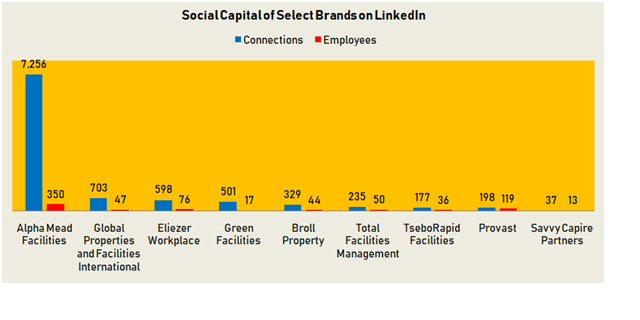
Producing though pieces is not enough. Efforts should be made for effective dissemination and evaluation of the pieces. For the maximum value derivation from thought leadership strategy, businesses need to improve their social capital, most importantly the presence of their employees on LinkedIn. Analysis reveals less than 50% connection of followers on LinkedIn with the number of employees (past and present) of select brands.

The main implication is that it would be difficult for businesses that need FM solutions to gain insights on facilities issues through the platform.  Apart from the presence, players also need to encourage their employees to engage in thought piece production and dissemination on the platform. This is important because analysis establishes low contributions in terms of articles sharing and comments on FM issues by employees.

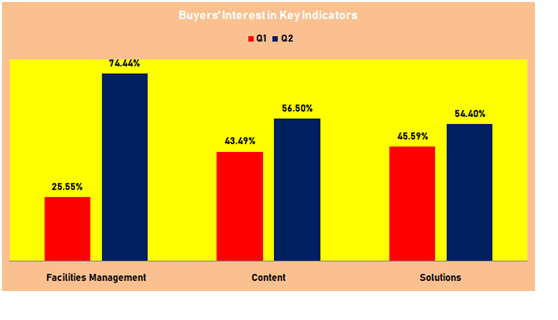
For instance, buyers’ interest in facilities management, content and solutions has been on the increase since Q1 2019. This signifies that players in the industry need to develop content that align with their solutions and disseminate them via LinkedIn and other channels. When the dissemination is done using LinkedIn and the employees share the content with the members of their network, analysis indicates that the social capital (employees’ presence) has the capability of increasing buyers’ interest in FM solutions by 26.3%, while the current brands’ connections can ensure 38.6% interest.

Our Model is That 5G Will Arrive Nigeria by 2025

1
5G network, adaptable business model

By Olayinka Oduwole

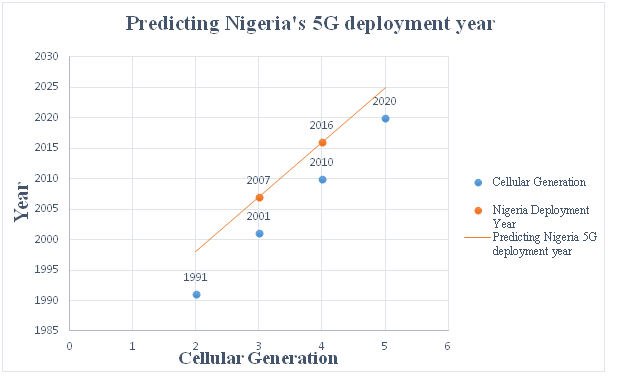
Every ten years, there is always a shift from previous generation onto a newer generation. In 1991, the development of GSM made voice calls to become reliable and cheaper and encouraged the widespread adoption of SMS (short message service) and MMS (multimedia messaging service). 1n 2001, 3G ushered in an era of data services and allowed workers access to emails from any location, and this increased work productivity. 1n 2010, 4G led to the development of mobile internet and video based applications which triggered the development of many sectors like online shopping, e-banking etc. 2020 promises to usher in a revolutionary era of high speed connectivity, ubiquitous coverage and low latency, which promises to transform industries, societies, enterprises, and nations due to the deployment of 5G.

When should we, as Nigerians, expect to witness this global digital transformation, that is even causing great rift between the US and China? All things being equal, and if we ignore demand and supply considerations and other market forces, assume we continue at the same rate of deployment, 5G should be upon us in Nigeria by 2025, as depicted below. This result obviously ignores the commencement of GSM in Nigeria in 2001 (an obvious outlier) and depends on the past deployment rate of cellular technologies in Nigeria.

Interestingly, GSMA in their 5G outlook for Sub Saharan Africa, recently interviewed respondents asking them when they expect to witness 5G in their markets and 67% of respondents revealed that would expect 5G in their sub Saharan African markets after 2025. Therefore, based on the result above and GSMA’s interview results, we should expect 5G in Nigeria by 2025.

As developed markets commence the launch of their 5G networks in 2020, Nigerians, MNOs (mobile network operators), MVNOs (mobile virtual network operators), internet giants, verticals, regulator, policy makers, Nigerian Government, investors, and other interested stakeholders can hold their breath till 2025, and patiently await the arrival of 5G, assume Nigeria continues at the same rate of deployment.

If we however, wish to deploy 5G in Nigeria before 2025, we can definitely borrow a leaf from the Chinese Government’s handbook, who made an amb

itious plan to dominate this space through its ‘Made in China 2025’ policies.

P.S: If we consider demand and supply forces and other market forces, the above result can be made much more accurate. This simple study can be repeated and used to predict the 5G deployment timeline for other developing countries.