A sage said that good numbers make you a great presenter before a company Board. Yes, irrespective of the presentation skills, if you are bleeding market share and losing customers here and there, no master-presentation skill will save you. But if you have great numbers, even if you stammer, you will be a great presenter! That is why I tell founders to do one thing to become good Board presenters: have GREAT numbers. Once your numbers are good, few will care how you present.
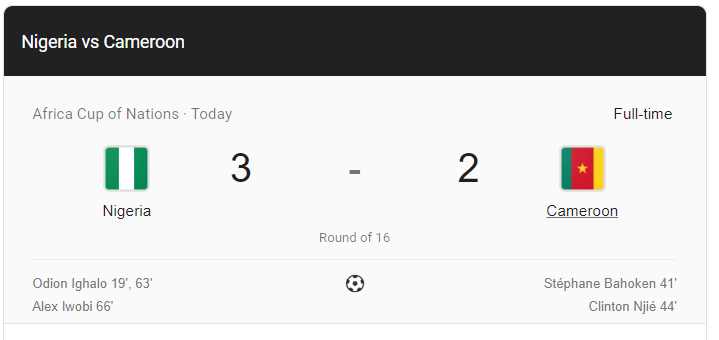
On that parallel, Nigeria moves to Quarter Final of the African Cup of Nations. They are dancing well because the numbers are there: the highest level in the competition right now is quarter final and Nigeria is there. I congratulate our boys for rising to the moment. When Cameroon was up 2-1, I felt it was over. The Indomitable Lions do not have a history of imploding especially in Africa.
I mean, I want many people to be happy in Nigeria at least for some few hours. Now, all the way to the Finals.
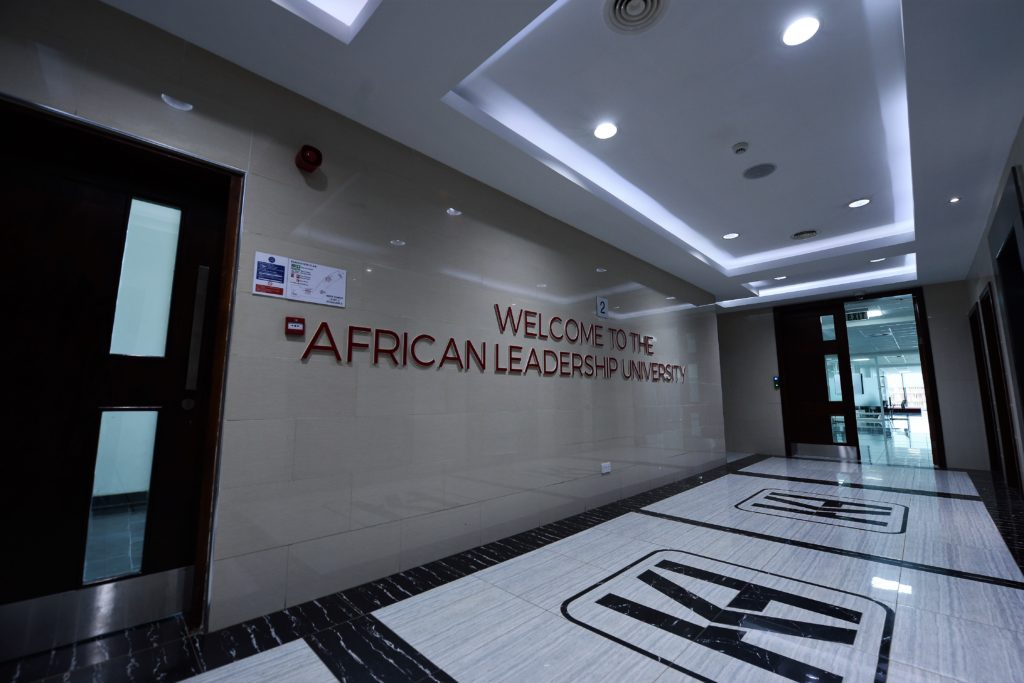
The African Leadership University founded by Fred Swaniker, a Ghanaian social entrepreneur, who wanted to fix the leadership paralysis is redesigning education in Africa. The program goes with an innovative approach to 21st century education with undergraduate and postgraduate experiences to develop Africa’s next generation of leaders. It prepares its students not just to excel, but also to lead. It prioritizes students that have key skills that are widely applicable and transferable across disciplines.
In its Year 1 Leadership Core, students build 4 fundamental skill areas necessary for every job. They develop the quantitative reasoning skills and data analysis abilities needed by entry level employees and industry executives, gain critical thinking skills and problem solving experience working on real life projects with its employer partners. In the process, the students develop core skills and best practices to communicate effectively in the professional world, and discover the skills and mindset needed to unlock their leadership potentials. Students begin their career development journey from day 1 with internships and student venture opportunities integrated throughout their undergraduate program.
For its undergraduate program, it offers 8 accredited degree programs in its Pamplemousses campus in the northern region of Mauritius which include BA Business Management, Bsc Computing, BEng Electrical Power Systems Engineering and BA Social Sciences. In its Kigali, Rwanda campus, it offers Bsc Computer Science, BA Entrepreneurship, BA Global Challenges, and BA International Business & Trade.
The learning process helps its undergraduates to discover the gaps in their knowledge, exchange knowledge with their peers, learn at their own pace and extend their learning to other contexts.
The African Leadership University School of Business MBA program is unique compared to other programs from different tertiary institutions across the continent in the sense that its cases are written in the context of African business with Faculty having extensive, diverse and respected experiences of doing business on the continent. There is a 20 month work-study program which blends six weeks of in person learning in Kigali with interactive online learning, allowing students to stay in work, grow as leaders while applying learning on the job.
Another unique program which African Leadership University offers which sets it apart from its peers is the MBA for Conservation Leaders offered by its School of Wildlife Conservation. This program is designed for emerging leaders in sectors that impact or depend on wildlife and natural landscapes or those in traditional conservation organizations, combining its School of Business 20 month MBA program with a specialization in Conservation Leadership for full time working professionals.
The African Leadership University wants to develop 3 million leaders that will be the pillars of Africa’s transformation by 2035. Its vision and mission are audacious, bold, and with a continent-centric view in modeling these young leaders of tomorrow. The knowledge base of the 21st century in this continent looks hopeful.
I just sent a piece to my editor in Harvard Business Review on the single African currency policy, trade treaty, and African development, linking all to China of about 40 years ago. Yes, a writing that actually takes my time because every word matters. When CEOs, students, policy makers, etc read the world’s most trusted business publication, they want clarity from authors. With translations into languages and many reading, with some swearing that Harvard explained it this way, and it must be true, you have no margin for error.
Three months ago, I went into a Board meeting to help on strategy only to see a whiteboard with a cut-out of my article on perception demand. The Chairman said, forget the PowerPoint, let’s discuss this paper for this company! Then, we went into the mechanics of growth and the engineering of the acceleration of customer perceptions bounded within industries and territories.
To be a leading economy and providing sustainable public goods to citizens, countries need a set of policies and programmes with the right political will for effective implementation. Some countries in the developing continents are competing with those in developed regions utilising available human resources and knowledge. The ongoing trade war between the United States of America and China is being fought on both sides with the appropriation of knowledge. Since 2017, the two countries have reaffirmed the need for countries to pursue a knowledge economy rather than resource-based economy. China does not stop developing innovative science and technology products, challenging the hegemony of the US and some countries in the world.
For a knowledge economy to materialise and make significant contributions to a country’s growth, adequate attention must be paid to research and development programmes or initiatives within academia, security and agriculture circles. These circles are essential for enabling business environment. Problems or frictions in processes, people, product or solution and technologies in private and public sectors cannot be resolved absolutely without using research findings. In fact, the Global Knowledge Economy Index evolved on the basis of measuring countries in terms of innovation that strengthens the components –processes, product or solution and technologies–towards sustainable economic growth.
Nigeria, like other countries in the developing world, has been ranked low in the Global Knowledge Economy Index over the years because of its attitude and lack of political will to research and development in academic, security and agriculture. With over 200 universities, the country can only celebrate 44% of the “scholarly output” of South Africa and 32% of Egypt. This is what Nigeria earned after 8 years of establishing the Tertiary Education Trust Fund (TETFund), an agency set up by the Federal Government to manage and disburse to public tertiary institutions funds gained through the imposition of a 2% tax on company profits.
A few years after the establishment, the argument among the academics has been that the agency is failing local universities. According to the scholars, by investing in postgraduate studies of Nigerians in other countries, the agency is still essentially enriching universities abroad instead of investing in higher education in Nigeria. With this approach, Nigeria will continue to have low “scholarly output” and contribution to the GDP growth every year. The position of the academics is further reinforced through the latest Journal Citation Reports. Out of the numerous journals being published across the universities and other institutions in the country, only 4 met the international standards –African Journal of Library, Archives and Information Science, African Journal of Reproductive Health, Nigerian Journal of Clinical Practice and Tropical Journal of Pharmaceutical Research.
Considering the high level of insecurity occasioned by the terrorist attacks, kidnapping, herdsmen and farmers crisis, among others, expectation among the experts and public analysts is that adequate spending on research and development will be the priority of the government. A year after the emergence of the Boko Haram in the northern region, available statistics shows that Nigeria spent only 1% of its Gross Domestic Product on its military compared with 4.8% by the United States of America.
When it was obvious that the attacks from the terrorist group seemed too difficult to contain, the government increased its defense budget by 32% in 2011. Eight years after, it took the intervention of the National Assembly before ‘adequate’ funds could be allotted to the security in the 2019 budget. The poor funding and other issues such as insufficient equipment and materials have been the factors contributing to the poor ranking of the country’s military. For instance, 2019 Global Military Rank report places Nigeria in 44th among 137 countries. In terms of the military strength, Egypt (12), Algeria (27) and South Africa (32) are the leading countries in Africa.
Source: Global Fire Power, Infoprations Analysis, 2019
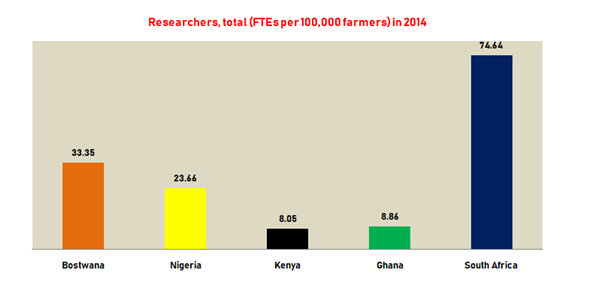
From Operation Feed the Nation to the current Economic Recovery Plan, Nigeria has always had good plans for the agriculture sector, but the lack political will to implement them. As the population increases every year, agricultural production decreases, especially the production of the most consumed stable foods. In 2014, 6 million metric tonnes of rice were produced and increased to 6.2 million metric tonnes in 2015. Since 2016, the production has been on decline status, according to available statistics. Despite being the most important in the country, employing about 70% of the workforce, the sector is suffering because of the low output occasion by poor funding and adequate personnel. There is no doubt it would be hard for Nigeria to feed its growing population without addressing these challenges. Latest statistics from ASTI indicates that Nigeria has 2,975 national agricultural researchers working full time with the farmers across the country. Comparing this figure with the countries such as South Africa (811), Kenya (1,168), Ghana (587) and Botswana (108), Nigeria is on a good pedestal. But, Nigeria is really lagging behind when researchers per 100,000 farmers becomes a yardstick. In terms of researchers per 100,000 farmers, South Africa and Botswana are better than Nigeria.
Source: ASTI, Infoprations Analysis, 2019
Does It Pay Off to Research Nigerian Economy?
Developed and some developing countries spend a lot of money on research and development towards innovation. They spend on it because innovation remains one of the key drivers of economic growth. In most developed countries, expenditures on research and development exceed 2% of GDP. And about 70-75% of R&D expenditures are covered by private business corporations. The big question is what have been the impact of inadequate funding and lack of enabling environment, including resources in research and development sector on the Nigerian economy from 2015 to 2018?
The Global Competitiveness Index, the country’s GDP growth and GDP per capita provide the answers. According to the World Economic Forum, the publisher of the GCI, “a higher competitiveness ranking (in lowest score) shows the higher productivity of the country’s economy, which should lead to higher and more sustainable economic growth.” This signifies that countries with the lowest score on the Index should produce faster GDP growth rates year on year. The total GDP per capita from 2015 to 2018 was $8,906, while total GDP growth was 3.8%. The average GDP growth rate was 0.95%, while the average GDP per capita was $2,227.
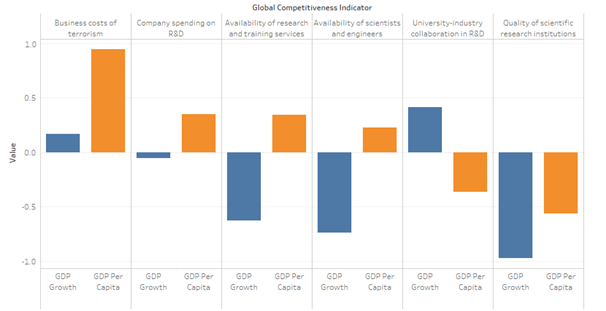
To understand the impact, quality of scientific research institutions, university-industry collaboration in R & D, availability of scientists and engineers, availability of research and training services and company spending on R & D were selected for the analysis along with the GDP growth and per capita.
The poor ranking of these indicators had varied impact on the Nigerian economy between 2015 and 2018, analysis reveals. The impact was more severe on the GDP growth rate than GDP per capita. Four out of the 6 indicators connected with the GDP growth negatively, while 2 only had negative links with the GDP per capita. From the analysis, it is clear that the availability of research and training services, availability of scientists and engineers and the quality of scientific research institutions carpeted Nigeria’s GDP growth during the years. Business costs of terrorism and university-industry collaboration rankings did not established significant impact on the GDP growth.
Source: Country Economy, National Bureau of Statistics, Infoprations Analysis, 2019
Can Nigeria Be Resilient to Economic Crisis?
Analysis of each indicator along with the GDP growth and GDP per capita has revealed different results. But, there is a need to be curious about the severity of all the indicators on the two measurement criteria. In the first analysis leading to the severity analysis, availability of scientists and engineers, company spending on R and D and university-industry collaboration in R and D had highest values followed by quality of scientific research and institutions, and business costs of terrorism. This suggests that the indicators with the highest values caused biggest havoc on the GDP growth and GDP per capita.
This is clearly established from the analysis by one percent of the Severity of the GCI (SGCI) decreasing the real GDP growth by 11.2%. For the GDP per capita, analysis reveals that the SGCI decreased it by 62.6%, signifies $5,575 reduction in the country’s GDP per capita during the years.
Further analysis indicates that Nigeria survived the influence of the poor ranking on the GDP per capita in 2017 and 2018 by 66.7% and 33.3% respectively. However, the stakeholders in the Nigerian project need to address the poor positions on the GCI. This is imperative as analysis suggests the possibility of the indicators impacting the country’s quest to increase its current GDP per capita ($2,028=2018) and GDP growth (1.9%=2018).
Strategic Options
Increasing Nigeria’s competitiveness on the global space and averting severe consequences of poor ranking on the economy require collective efforts. Stakeholders identified in the analysis cannot not come together and devise the right strategies and plans for adequate funding of research and development programmes, equip personnel with the needed skills and knowledge, and improve workforce through strategic recruitment of competent hands. Nigeria needs to key into an innovative research mantra towards better industries, life for citizens and change the world.
Mustapha Adeitan made significant contribution to this piece by providing statistical support using relevant methods, especially regression analyses and summarising insights towards forming coherent themes.
There are so many waves and billows of innovation, sweeping across the globe. From social and demographic changes to shifts in global economic power. However, one noticeable wave – namely, technological breakthroughs – is having a disruptive effect on financial services.
Financial service providers in Nigeria have made tremendous achievements in building digital infrastructure and leading digital transformation in recent years. Many companies have invested heavily in new technologies to improve efficiency and catalyse game-changing innovation, while at the same time, reducing operational costs. They are adopting technologies that will advance the capacity to collect and analyse data, while paying attention to risk management, cybersecurity and governance practices.
This has ushered in a great level of convenience and consumer experience, thereby increasing customers’ expectations from other sectors. Customers are now demanding improved services, smooth experiences, independent of the channel or interface. They want to experience the same flexibility, simplicity and convenience that come with digital services, while banking.
One technology supporting this digital transformation is the use of APIs by financial service providers, as they drive speed and cost effectiveness, compared to traditional processes. API is the dominant technology used by Fintechs in Nigeria. It is used by over 98 Fintechs in Nigeria, and have cumulatively raised about $56million in investment. Top use cases include aggregation of financial functionalities, banking platforms and trading infrastructure.
An API, which stands for Application Programming Interface, is a set of pre-packaged instructions and protocols that support developers to seamlessly exchange data and requests for data in real time back and forth between their own platform and another. While the short-term vision for APIs is to make existing technology, flexible to use and more efficient to access, the ultimate value of APIs will be the engine for the next wave of financial innovation.
Nevertheless, for APIs to reach that ultimate destination, there is a need for an open banking system, supported by common API standard. Open banking has attracted a lot of attention in Nigeria in the last few years. According to NIBSS,
Open Banking involves the use of open APIs (Application Programming Interface) which were earlier on seen as propriety, intellectual properties of financial institutions (Deposit Money Banks), to power digital financial transactions processed by other banks and licensed non-bank financial services providers.
It is simply unbundling the customer data and the financial services that solely belong to the banks, and making them available via APIs to a broader ecosystem of financial services providers. It is similar to standards like SMTP which drives email, making it easy to swiftly deliver emails irrespective of the email service provider. The same can be said of debit cards. It is issued by a Nigerian bank, but it is globally accepted at any ATM/POS terminals around the world. Other examples include the successful implementation of the Nigeria Uniform Bank Account Number (NUBAN), Bank Verification Number (BVN) and NIBSS Instant Payment (NIP).
With Open Banking, financial data will be shared collaboratively through secure open APIs such that customers, be it individuals or businesses, can effectively manage their accounts from a centralized location. Open APIs would further allow third party developers to build services and applications around financial institutions.
Take for instance, many small and medium-sized enterprises use commercial software for financial records. In most cases, these businesses have to add their transaction data manually. With Open APIs, it would give both customers and businesses the ability to access all bank data in real-time, eventually giving them more accurate and up to date information on finances. Additionally, customers will have increased access to better loan terms from third-party lenders, who can now have access to historic transactional data to determine a borrower’s credit risk profile.
This is already happening in the United States of America (USA), where, Wells Fargo Bank partnered with Xero (Financial Software Provider) to allow the accounting software to access all transactions performed in the bank account. Another example is Mint, a Fintech company in the US. It pioneered the system of independent financial apps that aggregate various bank accounts and credit cards to provide consumers with a 360-degree financial view and the ability to compare various banking products. 18 months after launching, there were adding 4,000 to 7,000 new users every day. Other potential benefits of open banking include: broader choice of providers, increased competition, financial inclusion and development of new value propositions.
Open Banking, however, comes with risks. The reaction to this, always borders around data protection, cybercrime, private breaches and fraud. Open banking has the possibility to amplify the breach and cybersecurity risks when they occur. On the other hand, both the Payment Services Directive 2 (PSD2) and the recently introduced General Data Protection Regulation (GDPR), posit that customers should have control of their data.
The financial services sector would need to give huge security considerations to data security, authentication, and compliance ownership. Likewise, the bank must implement the required Non-Disclosure Agreement, Service Level Agreement with operative insurance clauses that safeguard the bank from unintended consequences arising from security breaches through third parties.
This new landscape will require financial institutions to develop digital infrastructures to securely share data with accredited and pre-authorized third parties with the customer’s consent. The key components needed are an API management platform and a robust identity and access management (IAM) platform. While ensuring secured access to data, the bank must also pay attention to providing a great customer experience. To meet these demands, banks need a real-time data analytics platform which can easily collect, correlate, and analyse the data, and provide notifications and outputs in real time.
Open Banking Nigeria (OBN), an advocacy group is playing an important role in bringing together critical stakeholders in the financial ecosystem, to support this drive. Their activities are targeted at unlocking growth potentials, to build the next generation of API standards for the Nigerian banking and financial sector. Currently, they have successfully on-boarded 65 APIs, 22 banks and 14 Fintechs in Nigeria. A roadmap was developed by OBN, to lay out plans on how to keep up with the momentum.
All together
Open Banking strengthens the role of technology in finance, and it’s a big step for both banks and consumers. There is a strong global acceleration towards open banking. It has the capacity to open up the digital financial market to exciting moments. In 2019, Nigeria successfully moved up by 24 places to the 146th position out of 190 countries in the annual Ease of Doing Business Ranking by the World Bank. There is still a long way to go, and studies have also shown that a 10 per cent increase in the efficiency of the National Payments System will grow the GDP by at least one per cent, ceteris paribus. Open banking will accelerate that efficiency in the payment system. It will play a critical role in improving the ease of doing business and the influx of foreign investment in the country.