This Feb. 27, 2018, photo shows a quantum computer, encased in a refrigerator that keeps the temperature close to zero kelvin in the quantum computing lab at the IBM Thomas J. Watson Research Center in Yorktown Heights, N.Y. Describing the inner workings of a quantum computer isn’t easy, even for top scholars. That’s because the machines process information at the scale of elementary particles such as electrons and photons, where different laws of physics apply. (AP Photo/Seth Wenig)
U.S. hits Chinese Supercomputing big players, giving them Huawei treatment: ‘The Commerce Department on Friday took its broadest swipe yet at China’s supercomputing industry, imposing new export restrictions that effectively bar five major Chinese developers of next-generation, high-performance computing from obtaining U.S. technology”.
The Commerce Department blacklisted five more Chinese entities yesterday, all of which are involved in the production of supercomputers. By total number of units, China is the world leader in supercomputing, with 227 supercomputers compared to 109 in the U.S. – however the U.S. has the world’s two fastest units. Supercomputers can perform over a billion-billion computations a second and are used in weapon design and advanced encryption. Like much China tech, China’s supercomputers are built using U.S. components from suppliers like AMD, Advanced Micro, Intel and Nvidia. (Fortune)
Meanwhile, the ‘U.S. Chamber of Commerce has petitioned the Office of the U.S. Trade Representative to revoke tariffs imposed on Chinese imports over the past two years and warned the White House against implementing further levies. “Tariffs are hidden, regressive taxes that are being paid by U.S. businesses and consumers,” the Chamber said. Last week, 600 U.S. companies urged President Trump not to proceed with threats to submit another tranche of tariffs”‘, summarizes Fortune.
This is simply confusing: government is adding tariff while the companies it wants to offer competitive advantages to compete are saying “No, thanks”. The 2020 U.S. election will be interesting indeed.
Apple CEO, Tim Cook, has been spending time with Trump hoping to give it time to move some of its production out of China. That will be a redesign if Trump wins re-election. Yet, it is evident that Trump has changed many things in China. Take for instance, it is now possible for foreign companies to list in Chinese exchange. That has come as U.S. has pushed for China to open its market.
The manufacturing sector in Nigeria is faced with a whole lot of challenges which has affected its productivity and prevented it from being globally competitive. According to data on Global Competitiveness of Emerging Economies from the World Economic Forum 2018 and Business Day Nigeria, Nigeria was ranked 10th at 47.5 percent with India first at 62 percent, followed by South Africa 60.8 percent, Brazil 59.5 percent, Algeria 53.8 percent, Kenya 53.7 percent, Egypt 53.6 percent, Ghana 51.3 percent and Rwanda 50.9 percent.
The Manufacturers CEO’s Confidence Index survey conducted by the Manufacturers Association of Nigeria in the first quarter of 2019 showed that CEO’s confidence in the economy was 51.3 points as the lending rate, foreign exchange rate, government capital implementation, multiple taxation, over regulation and difficulties in accessing raw materials, poor infrastructure and port congestion have prevented Nigerian industrialists to compete with their peers globally.
The recent refusal of President Buhari to sign the African Continental Free Trade Agreement (ACFTA), expected to create a single and the largest market in Africa, worth about $2 trillion, is to prevent Nigerian manufacturers from being at a disadvantage. The broad fear is that the country could become a dumping ground due to its large economic size, necessitating demand for products from other African countries which will be cheaper than those produced in Nigeria, even when it lacks competitiveness.
According to the National Bureau of Statistics, the manufacturing industry sectoral contribution to national GDP was 8.86 percent, unmoved since 2017. While Nigeria’s total non-oil export revenue in 2018 was $3.3 billion, Bangladesh earned $33 billion same period from its readymade garment industry.
The Following Solutions will make Nigerian Manufacturers Globally Competitive
Provision of a Single Digit Lending Rate and Easy Access to Funding: According to MAN data, lending rate to the manufacturing sector averaged 22.21 percent in 2018 and 22.84 percent in 2017. Compared to South Africa where the lending rate to customers is 10 percent, Kenya 9 percent, Zambia’s benchmark lending rate 9.75 percent and Ethiopia 7 percent, the Central Bank of Nigeria monetary policy rate is 13.5 percent while Nigerian banks lend between 20 to 30 percent. Clearly, it is obvious Nigerian manufacturers can’t compete with their African, and global peers, if a single-digit rate is not fixed for lending. The Development Bank of Nigeria and Bank of Industry should be recapitalized to enable them offer long term funding to manufacturers.
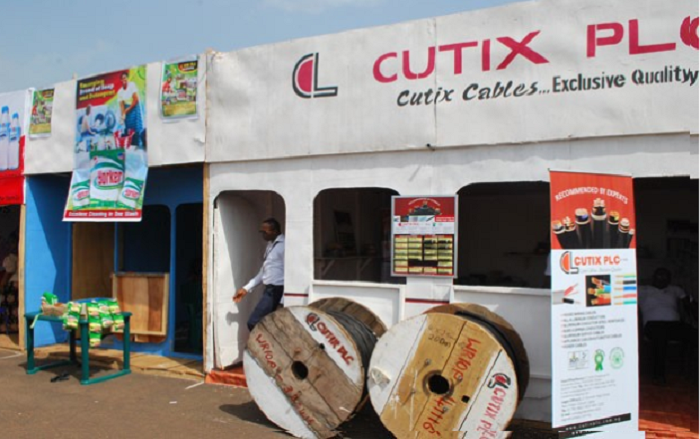
Tax Harmonization and Incentives: Multiple taxes affect the cost of production by Nigerian manufacturers today. The Federal Government and States Inland Revenue Services should harmonize all taxes and digitize tax collection to eliminate touts and offer industrialists tax waivers to encourage them to invest more in the real sector and grow the economy with job creation.
Nigerian made car (source: Innoson)
Curtailing Smuggling with Smart Technology: The Nigerian Customs and Immigration Services should invest in cutting edge technology like Artificial Intelligence, Blockchain, Cloud and Internet of Things and train its officers deployed at the nation’s borders to utilize them in preventing smugglers from Benin Republic, Togo, Niger, etc who smuggle products worth billions of naira, hurting the competitiveness of domestic products by local manufacturers.
Apapa Ports De-congestion and Ports Automation: The Nigerian Port Authority should decongest the Apapa and Tin Can Ports which contribute about 20 billion naira to the nation’s GDP daily as the gridlock has raised cost of production as a result of demurrages because of the delays in moving containers in and out of Apapa. A lot of manufacturers like NASCON, the salt manufacturing subsidiary of Dangote Group, are moving their operations out of Apapa due to the gridlock. Other ports in Warri, Calabar, and Port Harcourt should be dredged for manufacturers in the Eastern Region to utilize in importing raw materials and exporting their finished products. Also the Nigerian Customs Service should learn from Togo who just developed an ultramodern port and are deploying automation to make its operations efficient.
Provision of Stable Power Supply to Manufacturers: According to MAN, manufacturers in Nigeria spent N93.1 billion on alternative power sources in 2018. MAN should set up distributed decentralized renewable energy solutions to help manufacturers cut down costs on gas, diesel and other fossil fuels or power.
Embrace Design Thinking For Product Innovation: Nigerian manufacturers need to embrace design thinking to design the process which will lead to them developing world-class products that will meet and exceed the expectation of their customers, as this is the key to competing with global products in the world today.
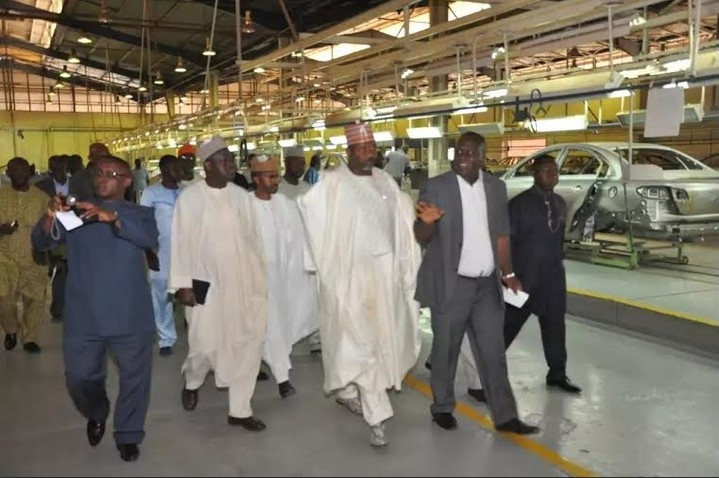
Tour of Manufacturing plant by Nigerian leaders
Local Patronage of Indigenous Products: The recently issued executive orders to boost local manufacturing capacity and competitiveness will not come to fruition if the Federal Government doesn’t take the lead in promoting MADE In Nigeria products.
Adoption of Technology For Manufacturing Efficiency: Nigerian manufacturers should learn and utilize advanced technologies like 3D Printing, Artificial Intelligence, Internet of Things, Blockchain and Robotics which are helping their counterparts in developed countries to engage in predictive maintenance, real time production floor analytics, curb plant floor waste and improve efficiency for profit maximization. Also, these technologies will help them to replace worn out parts in real time besides producing products cheaper and faster with 3D Printing.
Three big global banks, Bank of America, Chase and Santander, have reported that each of them will spend at least $10 billion on IT on the year ahead [Chase specifically is $11.4 billion]. To put that in perspective, Nigeria’s total national budget is about $25 billion. If you remove wages, debt servicing, what Chase spends on IT is more than double what Nigeria spends on infrastructure and broad capital projects.
JPMorgan landed at No. 1 with an $11.4 billion technology budget for the year ahead. That’s a 5.6 percent increase from 2018 figures, with researchers finding nearly half of its technology budget last year was spent on disruptive technology to implement within the institution.
Bank of America has a $10 billion IT spending budget, with 30 percent used for its “technology initiative investment spend,” reports said.
Coming in at No. 3 and No. 4 are Wells Fargo and Citigroup, at about $9 billion and $8 billion in technology budgets, respectively.
Yes, take a look at the 2019 Nigeria budget below and use the black market rate, JP Morgan Chase now spends nearly twice Nigeria’s total capital expenditure on IT. How are you going to argue we are making real progress when one U.S. bank spends double what we put on capital infrastructure? Of course, when you model that we do not even end up funding the whole budget, you will get into the reality that this bank could be spending at least 3 times what we put on bridges, roads and other critical infrastructures in the nation.
Before you begin to throw digital fire, this is not a political hack. Simply, our private sector does not have depth as national budget is always funded by corporations, via taxes. That was a key part of my Platform presentation. Of course, government needs to make the environment enabling.
This is for you to know how much space we need to cover in Nigeria.
Source: Deloitte Nigeria
*My analysis has not considered purchasing power parity.
TensorFlow is an open source machine learning library. According to Google, many companies, nonprofits, researchers and developers have used TensorFlow in many brilliant ways. One use case is detecting cassava disease at scale.
PlantMD’s machine learning model was inspired by a dataset from PlantVillage, a research and development unit at Penn State University. PlantVillage created an app called Nuru, Swahili for “light,” to assist farmers to grow better cassava, a crop in Africa that provides food for over half a billion people daily.
Though cassava is tolerant to droughts and capable of growing with minimal soil–making it an ideal crop in harsh weather conditions—it’s also susceptible to many diseases and pests. The symptoms of a diseased plant develops slowly, so it can be difficult for farmers to diagnose these problems in time.
PlantVillage and the International Institute of Tropical Agriculture (IITA) developed a solution using machine learning that could help farmers better identify and manage these diseases quickly. They annotated thousands of cassava plant images, identifying and classifying diseases to train a machine learning model using TensorFlow. Once the model was trained to identify diseases, it was deployed in the app. Farmers can wave their phone in front of a cassava leaf and if a plant had a disease, the app could identify it and give options on the best ways to manage it.
Nigeria’s medtech startup, MDaaS, builds network of diagnostic and primary care facilities. It just raised $1 million from Consonance Investment Managers, Techstars, and FINCA Ventures. It will use the money for expansion across Nigeria and broad Africa.
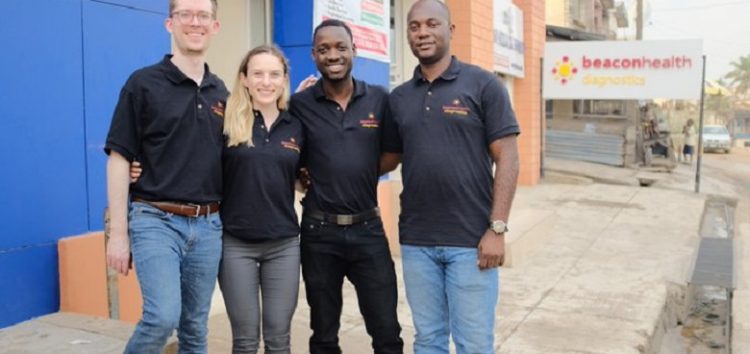
MDaaS Global provides all patients with the diagnostics they need to identify health issues earlier, gain access to treatment, and ultimately, live happier, healthier lives. Through its patient-facing brand BeaconHealth Diagnostics, MDaaS Global offers a wide range of services including imaging services such as digital x-ray, ultrasound, & and mammography, cardiac services such as ECG and echo, and lab services, ranging from chemistry analysis and immunoassay to hematology. MDaaS Global is the centralized diagnostic department for surrounding hospitals and clinics in the community, currently partnering with over 60 referring health facilities at its flagship center in Ibadan, Nigeria.
MDaaS, which operates locally in Nigeria as BeaconHealth Diagnostics, creates affordable and accessible diagnostic services in clinically underserved communities. It builds and runs centers that offer radiology, cardiology, and laboratory services targeted at the populations least reached by existing health services?—?the low- to middle-income populations outside of major cities. Its facilities serve as outsourced diagnostic centers for surrounding clinics and secondary (state) hospitals.
Core to MDaaS’ strategy is minimizing operational and acquisition costs in order to offer quality but affordable services to its clients. Tech-enabled centers and the economies of scale of running a chain of centers allow MDaaS to centralize core functions, including radiology. An intense focus on sourcing low-cost refurbished equipment has driven MDaaS to develop in-house procurement expertise that can acquire and ship such equipment to Nigeria for a price that is 60 percent below local rates. The equipment is reliable and high performing, achieving 99 percent uptime with minimal maintenance costs. The result of this strategy is that MDaaS can offer a much higher quality of service than is available locally, while also guaranteeing the lowest possible price.
Female lab technician at work at BeaconHealth Diagnostics in Ibadan, Nigeria.
The press release
Healthtech company MDaaS Global, which is building a network of tech-enabled diagnostic facilities in Nigeria, has closed on seed funding totaling US$1 million. Led by Consonance Investment Managers, with participation from Techstars, FINCA Ventures, an investment initiative of FINCA International, the Fund for Africa’s Future, a fund led by Iyinoluwa Aboyeji and Nadayar Enegesi, Greentree Investment Company, and others, the round will see MDaaS scale and replicate its innovative diagnostic center business model, as the company seeks to open 100 additional centers in Nigeria and West Africa over the next five years.
MDaaS was created to address the lack of high-quality, affordable diagnostic services available for low- and middle-income sub-Saharan Africans, starting with Nigeria’s 130 million low- and middle-income patients. Where available and up-to-date, health services are unaffordable for most of Nigeria’s population, and expensive out-of-pocket costs discourage patients. MDaaS leverages its vertically-integrated supply chain, technology platform, and patient-centered design to provide modern, convenient services at a price point patients can afford. It offers a wide array of high-impact diagnostic procedures from simple malaria tests to echocardiograms and pap smears. And MDaaS’ affordability is helping change the healthcare narrative, with basic procedures, like obstetric ultrasounds, starting at just US$4.
Founded in 2016 by Oluwasoga Oni, Opeyemi Ologun, Genevieve Barnard Oni, and Joseph McCord, MDaaS was incubated at MIT’s Legatum Center for Development and Entrepreneurship and was part of the inaugural Techstars Impact class of 2018. The company launched its flagship diagnostic center in Ibadan, Nigeria’s 3rd most populous city, in November 2017 under its patient- and physician-facing brand BeaconHealth. To date, the company has served over 9,000 low- and middle-income patients, speedily identifying health issues and connecting them with a variety of medical specialists and affordable treatment options.
Having partnered with over 60 referring health facilities, MDaaS serves as the centralized diagnostic department for surrounding hospitals and clinics within Ibadan. MDaaS also partners globally with corporates, Health Maintenance Organizations (HMOs), and developmental organizations seeking top-tier diagnostics for their employees and beneficiaries.
Speaking on the funding, MDaaS Global’s CEO and Co-Founder Oluwasoga Oni said, “This funding round fuels our next phase of growth, allowing us to continue providing modern, connected healthcare for Africa’s next billion. With diagnostics as the bedrock of modern medicine and key to the treatment of diseases like cancer, heart disease, and diabetes – which are on the rise within the continent – unbridled access to quality healthcare is crucial. We are immensely proud of our brick-and-mortar presence; merging physical patient care with state-of-the-art technology enables us to reach more patients with the care that they deserve.”
It is estimated that 40% of the medical equipment in sub-Saharan Africa is currently obsolete or out of service. On a continent where public healthcare is chronically underfunded – receiving less than 5% of GDP, MDaaS presents the opportunity to bolster poorly-equipped hospitals and clinics in what is evaluated to be a $1.6 billion market in Nigeria alone.