DD
MM
YYYY

PAGES

DD
MM
YYYY

spot_img

PAGES

Home Blog Page 6871

My Experience With ‘Subtle Racism’ In The UK

4

By Adaku Efuribe

I had an encounter with a lovely gentleman on a sunny afternoon;

I had just finished the half shift for the day and quickly went to the grocery store next door to get myself some cool crunchy salad as the weather was very hot and I wanted to stick to vegetables that  afternoon after I had a massive bowl of Icelandic low fat yourghort the previous day.

The UK hot weather is quite different form the Nigerian weather I must say,

Although I was born in the UK but having lived a great chunk of my life in Nigeria I can relate with the Nigerian hot weather. I can’t remember ever using sun screen lotion in Nigeria, but I never had a sun burn.

A few years ago when we had another incredibly hot summer month in the UK, I noticed I had sun burns and a bit of black patches on my body, that was when I heed to the advice of NHS choices to use sunscreen, A few Nigerian friends of mine who also grew up in Nigeria like me said they have been using sun screen as well whilst in the UK as the UK sun tends to be a little bit different and not so kind to their skin,

I can remember those days in Abuja ,Nigeria fresh from the university when I used to board commercial motor bikes also known as ‘ okada’  with the temperature around 45 degrees ,I could feel the hot air blowing across my face which made me feel so uncomfortable.

I had a Samsung AC split unit nano air technology in my flat which I bought with my first salary as a pre-reg pharmacist starting an independent adult life. I would always rush back home after work to put on my AC to catch a quick nap, we did have better electricity supply at that time in the Abuja and the prepaid meters were installed.

Back to 2018 on a ‘ very hot ‘afternoon in July in the UK as I approached the entrance to the very busy  grocery store, an elderly white man shouted at me —‘I bet you’re enjoying this hot weather aren’t you ’ I shouted back, yes of course I’m used to it!.

But was I really enjoying the hot weather- I don’t think so, my  response was out of impulse ,I don’t know why I responded the way I did  ,maybe I just wanted to sound nice.

A minute later as I was trying to make up my mind between a bowl of classic salad or Mediterranean salad, one of the staff at the grocery approached me and said he wants to apologise to me because of what the elderly man said to me earlier.

It was then I realised it must have been a racist remark, did he say it because of the colour of my skin, I asked? I think so the young man replied.

So he just assumed I was enjoying the very hot unpleasant weather just because I was black; I thought.

I have never said to anyone …hope you’re enjoying the weather when it’s -10 or 0 degrees, because I know no one enjoys that. Everyone covers up in long coats, hats, gloves etc. irrespective of their complexion or race.

For me I didn’t take the elderly man’s comment seriously, I have had a lot of things said to me in the past which I usually ignore.

Again in the same area about seven years ago, I was walking through a crowded town centre to pick up a quick lunch during my break. I wore a long braided hair style. I heard a young gentle man singing a Bob Marley song whilst invading my personal space, calling me ‘Rasta man’. I just smiled at him and walked past

Sometimes I believe people talk randomly in public to attract attention, perhaps they have not spoken to anyone all day and need a chat so talking to strangers loudly in public is the only way they can talk to someone.

I don’t usually take unpleasant remarks seriously; I just walk away because I feel people are usually rude and nasty because of their personal struggles.

I love Nigeria and I really miss the food and weather sometimes, one thing I cannot comprehend is the impunity and bad leadership going on there.

Sometimes I miss my boiled organic sweet yellow corn and local pear-ube, I also miss my okpa wawa, Rivers native soup and a host of other delicacies I’m used to.

I would love to live in a world devoid of racism, but is this possible?

More questions than answers!

‘I refuse to accept the view that mankind is so tragically bound to the starless midnight of racism and war that the bright daybreak of peace and brotherhood can never become a reality… I believe that unarmed truth and unconditional love will have the final word’. Martin Luther King, Jr.
U.S. Bans Chinese Supercomputing Firms

0
This Feb. 27, 2018, photo shows a quantum computer, encased in a refrigerator that keeps the temperature close to zero kelvin in the quantum computing lab at the IBM Thomas J. Watson Research Center in Yorktown Heights, N.Y. Describing the inner workings of a quantum computer isn’t easy, even for top scholars. That’s because the machines process information at the scale of elementary particles such as electrons and photons, where different laws of physics apply. (AP Photo/Seth Wenig)

U.S. hits Chinese Supercomputing big players, giving them Huawei treatment: ‘The Commerce Department on Friday took its broadest swipe yet at China’s supercomputing industry, imposing new export restrictions that effectively bar five major Chinese developers of next-generation, high-performance computing from obtaining U.S. technology”.

The Commerce Department blacklisted five more Chinese entities yesterday, all of which are involved in the production of supercomputers. By total number of units, China is the world leader in supercomputing, with 227 supercomputers compared to 109 in the U.S. – however the U.S. has the world’s two fastest units. Supercomputers can perform over a billion-billion computations a second and are used in weapon design and advanced encryption. Like much China tech, China’s supercomputers are built using U.S. components from suppliers like AMD, Advanced Micro, Intel and Nvidia. (Fortune)

Meanwhile, the ‘U.S. Chamber of Commerce has petitioned the Office of the U.S. Trade Representative to revoke tariffs imposed on Chinese imports over the past two years and warned the White House against implementing further levies. “Tariffs are hidden, regressive taxes that are being paid by U.S. businesses and consumers,” the Chamber said. Last week, 600 U.S. companies urged President Trump not to proceed with threats to submit another tranche of tariffs”‘, summarizes Fortune.

This is simply confusing: government is adding tariff while the companies it wants to offer competitive advantages to compete are saying “No, thanks”. The 2020 U.S. election will be interesting indeed.

Apple CEO, Tim Cook, has been spending time with Trump hoping to give it time to move some of its production out of China. That will be a redesign if Trump wins re-election. Yet, it is evident that Trump has changed many things in China. Take for instance, it is now possible for foreign companies to list in Chinese exchange. That has come as U.S. has pushed for China to open its market.

How To Make Nigeria’s Manufacturing Sector Globally Competitive

0

By Nnamdi Odumody

The manufacturing sector in Nigeria is faced with a whole lot of challenges which has affected its productivity and prevented it from being globally competitive. According to data  on Global Competitiveness of Emerging Economies from the World Economic Forum 2018 and Business Day Nigeria, Nigeria was ranked 10th at 47.5 percent with India first at 62 percent, followed by South Africa 60.8 percent, Brazil 59.5 percent, Algeria 53.8 percent, Kenya 53.7 percent, Egypt 53.6 percent, Ghana 51.3 percent and Rwanda 50.9 percent.

The Manufacturers CEO’s Confidence Index survey conducted by the Manufacturers Association of Nigeria in the first quarter of 2019 showed that CEO’s confidence in the economy was 51.3 points as the lending rate, foreign exchange rate, government capital implementation, multiple taxation, over regulation and difficulties in accessing raw materials, poor infrastructure and port congestion have prevented Nigerian industrialists to compete with their peers globally.

The recent refusal of President Buhari to sign the African Continental Free Trade Agreement (ACFTA), expected to create a single and the largest market in Africa, worth about $2 trillion, is to prevent Nigerian manufacturers from being at a disadvantage. The broad fear is that the country could become a dumping ground due to its large economic size, necessitating demand for products from other African countries which will be cheaper than those produced in Nigeria, even when it lacks competitiveness.

According to the National Bureau of Statistics, the manufacturing industry sectoral contribution to national GDP was 8.86 percent, unmoved since 2017. While Nigeria’s total non-oil export revenue in 2018 was $3.3 billion, Bangladesh earned $33 billion same period from its readymade garment industry.

The Following Solutions will make Nigerian Manufacturers Globally Competitive

Provision of a Single Digit Lending Rate and Easy Access to Funding: According to MAN data, lending rate to the manufacturing sector averaged 22.21 percent in 2018 and 22.84 percent in 2017. Compared to South Africa where the lending rate to customers is 10 percent, Kenya 9 percent, Zambia’s benchmark lending rate 9.75 percent and Ethiopia 7 percent, the Central Bank of Nigeria monetary policy rate is 13.5 percent while Nigerian banks lend between 20 to 30 percent. Clearly, it is obvious Nigerian manufacturers can’t compete with their African, and global peers, if a single-digit rate is not fixed for lending. The Development Bank of Nigeria and Bank of Industry should be recapitalized to enable them offer long term funding to manufacturers.

Tax Harmonization and Incentives: Multiple taxes affect the cost of production by Nigerian manufacturers today. The Federal Government and States Inland Revenue Services should harmonize all taxes and digitize tax collection to eliminate touts and offer industrialists tax waivers to encourage them to invest more in the real sector and grow the economy with job creation.

Nigerian made car (source: Innoson)

Curtailing Smuggling with Smart Technology: The Nigerian Customs and Immigration Services should invest in cutting edge technology like Artificial Intelligence, Blockchain, Cloud and Internet of Things and train its officers deployed at the nation’s borders to utilize them in preventing smugglers from Benin Republic, Togo, Niger, etc who smuggle products worth billions of naira, hurting the competitiveness of domestic products by local manufacturers.

Apapa Ports De-congestion and Ports Automation: The Nigerian Port Authority should decongest the Apapa and Tin Can Ports which contribute about 20 billion naira to the nation’s GDP daily as the gridlock has raised cost of production as a result of demurrages because of the delays in moving containers in and out of Apapa. A lot of manufacturers like NASCON, the salt manufacturing subsidiary of Dangote Group, are moving their operations out of Apapa due to the gridlock. Other ports in Warri, Calabar, and Port Harcourt should be dredged for manufacturers in the Eastern Region to utilize in importing raw materials and exporting their finished products. Also the Nigerian Customs Service should learn from Togo who just developed an ultramodern port and are deploying automation to make its operations efficient.

Provision of Stable Power Supply to Manufacturers: According to MAN, manufacturers in Nigeria spent N93.1 billion on alternative power sources in 2018. MAN should set up distributed decentralized renewable energy solutions to help manufacturers cut down costs on gas, diesel and other fossil fuels or power.

Embrace Design Thinking For Product Innovation: Nigerian manufacturers need to embrace design thinking to design the process which will lead to them developing world-class products that will meet and exceed the expectation of their customers, as this is the key to competing with global products in the world today.

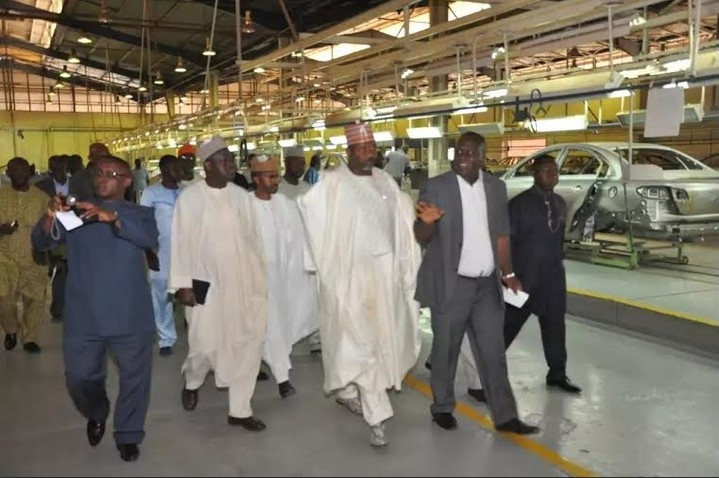
Tour of Manufacturing plant by Nigerian leaders

Local Patronage of Indigenous Products: The recently issued executive orders to boost local manufacturing capacity and competitiveness will not come to fruition if the Federal Government doesn’t take the lead in promoting MADE In Nigeria products.

Adoption of Technology For Manufacturing Efficiency: Nigerian manufacturers should learn and utilize advanced technologies like 3D Printing, Artificial Intelligence, Internet of Things, Blockchain and Robotics which are helping their counterparts in developed countries to engage in predictive maintenance, real time production floor analytics, curb plant floor waste and improve efficiency for profit maximization. Also, these technologies will help them to replace worn out parts in real time besides producing products cheaper and faster with 3D Printing.

JP Morgan Chase’s IT Budget Now Twice Nigeria’s Federal Capital Expenditure

0

Three big global banks, Bank of America, Chase and Santander, have reported that each of them will spend at least $10 billion on IT on the year ahead [Chase specifically is $11.4 billion]. To put that in perspective, Nigeria’s total national budget is about $25 billion. If you remove wages, debt servicing, what Chase spends on IT is more than double what Nigeria spends on infrastructure and broad capital projects.

JPMorgan landed at No. 1 with an $11.4 billion technology budget for the year ahead. That’s a 5.6 percent increase from 2018 figures, with researchers finding nearly half of its technology budget last year was spent on disruptive technology to implement within the institution.

Bank of America has a $10 billion IT spending budget, with 30 percent used for its “technology initiative investment spend,” reports said.

Coming in at No. 3 and No. 4 are Wells Fargo and Citigroup, at about $9 billion and $8 billion in technology budgets, respectively.

Yes, take a look at the 2019 Nigeria budget below and use the black market rate, JP Morgan Chase now spends nearly twice Nigeria’s total capital expenditure on IT. How are you going to argue we are making real progress when one U.S. bank spends double what we put on capital infrastructure? Of course, when you model that we do not even end up funding the whole budget, you will get into the reality that this bank could be spending at least 3 times what we put on bridges, roads and other critical infrastructures in the nation.

Before you begin to throw digital fire, this is not a political hack. Simply, our private sector does not have depth as national budget is always funded by corporations, via taxes. That was a key part of my Platform presentation. Of course, government needs to make the environment enabling.

This is for you to know how much space we need to cover in Nigeria.

Source: Deloitte Nigeria


*My analysis has not considered purchasing power parity.

Google’s TensorFlow Goes Into African Farms

0

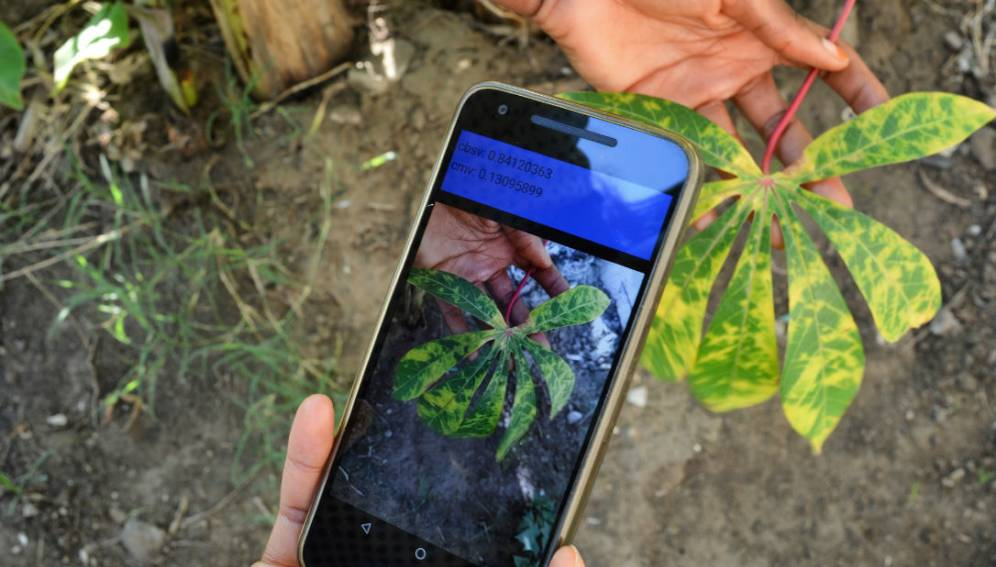
TensorFlow is an open source machine learning library. According to Google, many companies, nonprofits, researchers and developers have used TensorFlow in many brilliant ways. One use case is detecting cassava disease at scale.

PlantMD’s machine learning model was inspired by a dataset from PlantVillage, a research and development unit at Penn State University. PlantVillage created an app called Nuru, Swahili for “light,” to assist farmers to grow better cassava, a crop in Africa that provides food for over half a billion people daily.

Though cassava is tolerant to droughts and capable of growing with minimal soil–making it an ideal crop in harsh weather conditions—it’s also susceptible to many diseases and pests. The symptoms of a diseased plant develops slowly, so it can be difficult for farmers to diagnose these problems in time.

PlantVillage and the International Institute of Tropical Agriculture (IITA) developed a solution using machine learning that could help farmers better identify and manage these diseases quickly. They annotated thousands of cassava plant images, identifying and classifying diseases to train a machine learning model using TensorFlow. Once the model was trained to identify diseases, it was deployed in the app. Farmers can wave their phone in front of a cassava leaf and if a plant had a disease, the app could identify it and give options on the best ways to manage it.