DD
MM
YYYY

PAGES

DD
MM
YYYY

spot_img

PAGES

Home Blog Page 6879

Eliminate These Issues Before Capping Estimated Billing in Nigeria’s Power Sector

0

By Mutiu Iyanda

From generation to distribution, Nigeria has not had it good in terms of sustainable electricity for economic growth in the last two decades. Despite various reforms since 1999, Nigerians and businesses are still struggling to power their electrical equipment through the national grid. Power infrastructure and capital paucity were the two challenges pinpointed and ensured privatization of the Power Holdings Company of Nigeria (PHCN) after the liberalization policy of the government.

More than 5 years of the privatization, the identified issues remain unsolved. The public expectation that the estimated billing of the PHCN will not surface after the privatization seems difficult to disentangle by the stakeholders. Since January, 2019, media reports have shown that Nigerians in Imo, Enugu, Abia, Edo, Delta, Lagos, Abuja, Anambra, Kogi, Akwa Ibom, Oyo, Osun, Rivers, Kwara, Bayelsa, Ondo and Ekiti are not happy about the outrageous bills being issued by the electricity distribution companies in their territories. In cities such as Lagos, average estimated bill for residential consumers is N44, 000 monthly while medium and large companies are paying N1, 250,000.

Across the country, the inability to get the prepaid meter has been the significant factor contributing to the monthly estimated bills. Reports indicate that the DISCOs are playing sharp practices. These practices range from overcharging the consumers to delay in delivering the meter to the customers who have paid. A house or company that possesses a prepaid meter will only pay for energy used. This is the main benefit to the consumers, which electricity users have seen as the main threat to the bottom line of the DISCOs and core reason for not making the meter available to the users. It is like using airtime on a prepaid mobile line. Electricity users will control what they use.

In November 2013, DISCOs vowed to close the metering gap and set a target of supplying 4.92 million meters within three years. More than 5 years of making the commitment, only 3,547,129 out of 7,973,867 registered active electricity customers have been metered. That is a shortfall of 4,426, 738 meters. As the outcry on the estimated billing rages on, the Nigerian Electricity Regulatory Commission has been conducting public consultation in select cities since 29th May, 2019 with a view of getting public inputs towards capping estimated billing.
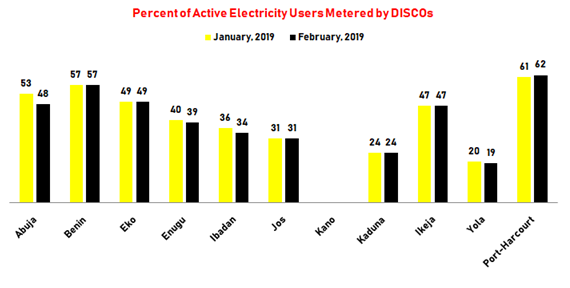
Source: Nigerian Electricity Regulatory Commission, 2019

However, capping the estimated billing does not mean that consumers will not continue paying for what they do not use. The capping regime will only have minimal impact on the estimated billing not total elimination of the problem. By capping, consumers without prepaid meters and DISCOs will agree on the specific amount to be paid every month. Instead of capping regime, the NERC and DISCOs need to address poor electricity supply, sharp practices of the DISCOs on the delivery of the electricity meter such as overcharging the consumers and poor electricity infrastructure in most DISCOs’ coverage territories. Analysis shows that the poor power supply since January, 2019 connect with the public interests about sustainable electricity generation and distribution by 54.5%, while the outrageous billing link with the interest about electricity bill defrayment by 61.4%.  Analysis suggests that electricity users want to know factors preventing GENCOs and DISCOs from providing electricity and the reasons for paying the outrageous bills despite the poor power supply.

The more the emerging issues, the more public interests about electricity diminishes. This is an indication that electricity users do not have faith in power sector, especially getting power supplies through the national grid. On the metering, the argument from the 11 licensed electricity distribution companies that demand is higher than the supplies from the electricity meter manufacturers seems not to be acceptable to the consumers as analysis shows that the challenge and others being communicated to the public by DISCOs from January, 2019 do not dissipate public outcry over the estimated billings across the country.
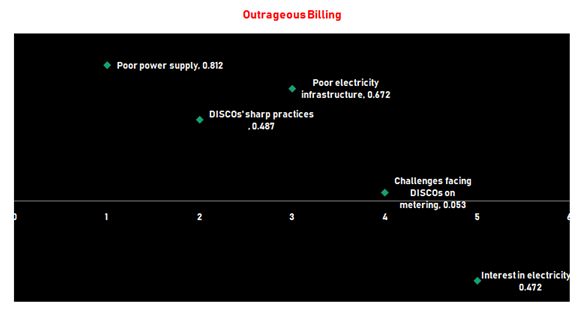
Source: Newspapers’ Report, Infoprations Analysis, 2019


LinkedIn Comment on Feed

The kind of capital investment we need in the power sector is huge, so the major challenge there has to do with capital, everything else is just cosmetic.

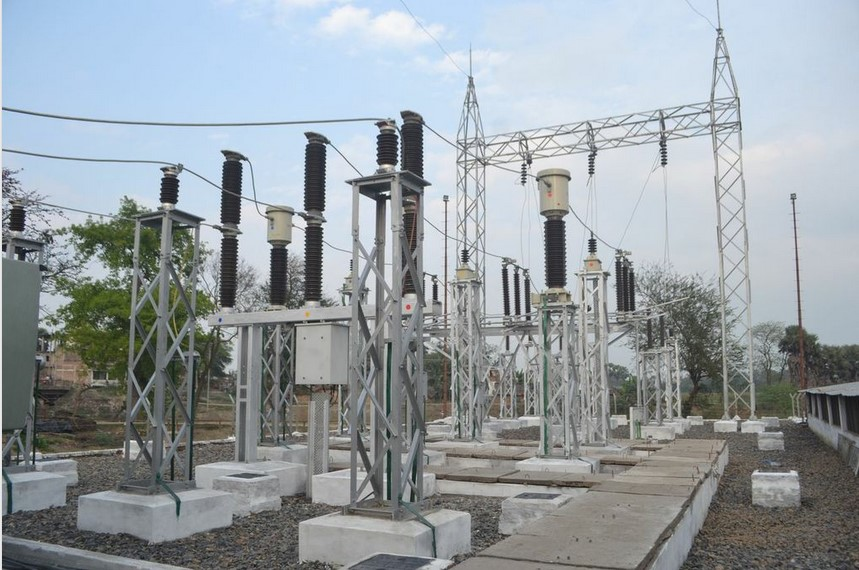
The distribution network is largely dilapidated or obsolete, requiring massive upgrade; DISCOS don’t have the capital.

The transmission has its challenges, and it’s inadequate to evacuate the current generating capacity, huge capital is needed there.

The generation end of it has two issues: that of capacity and gas pricing regime that is not competitive, that needs to be addressed too.

No amount of talking and stakeholders meetings can guarantee regular power supply in Nigeria, until we do the needful and then start pouring in the billions of dollars needed there.

Investment in that sector is not for the faint-hearted, we must be very realistic and act responsibly too.
President Buhari Must Consider MAN Position on ACFTA, Fixing “Rule of Origin” Prerequisite for Nigeria

4
Buhari New Appointments
Mr. Buhari, President of Nigeria

President Trump has waged trade wars with China, Mexico, and Canada. His mission: protect the American people economically. Nigerian government has refused to join the African Continental Free Trade Agreement (ACFTA) because most manufacturers in Nigeria hate the agreement. For them, with Nigeria’s lack of infrastructural competitiveness, opening the market to Rwanda, Ghana, etc will destroy manufacturing.

Yes, the opportunity is asymmetric: I am not sure what most Nigerian producers will benefit from shipping to Botswana. But Botswana producers will surely benefit from having access to Nigerian market at largely zero tariff.

I have made my opinion on ACFTA known: “Nigeria should SIGN but must make sure the “rule of origin” clause is strong. We cannot afford goods produced outside Africa to be repackaged in a treaty member state and then shipped to Nigeria at a low tariff that is exclusive to member states.”

The position of MAN (Manufacturers Association of Nigeria) should be considered but it would hurt Nigeria if the country isolates itself in the era when Africa is looking for ways to integrate. As I noted in an African Union Congress lead paper, prior convergence of regional integration must happen first before the continental level integration. If we do not have such a strategy, we would open countries to trade shocks which would result to welfare loses. As MAN noted, no one consulted them because this was not started at the regional level, but at the continental level making it harder for stakeholders to model the impacts. With that kind of change, chaos arises in mainly heterogeneous markets.

Yes, Nigeria should sign only if Morocco and some other countries first un-ratify or update some treaties with Europe. If not, European companies will move factories to Morocco (not Nigeria) and then flood products into Nigeria at low tariff used by member states. If you take away those duties, Nigeria’s economy will struggle and welfare losses will skyrocket. Today, Nigerian Customs generates N5.5 billion (about $17 million) daily. No one wants that revenue to disappear.

The Nigeria Customs Service said on Thursday in Lagos that, its revenue generation has increased to the region of N5.5 billion daily.

The Comptroller-General, Col. Hameed Ali (rtd) made this known during a working visit to the headquarters of the National Association of Government Approved Freight Forwarders in Lagos.

Mr. President, do not allow anyone to bully you into signing ACFTA. After all, you are a General and understand how to manage battalions. Nigeria cannot just disarm and put our people into economic paralyses. You must ask them to strengthen “Rule of Origin” clause or give Nigeria 24/7 electricity before you put that pencil on ACFTA. Yet, we cannot afford to be isolated from Africa. That means, Nigeria must also push for ACFTA to fix whatever it thinks that must be fixed.

Our President Should Sign AfCFTA Free Trade after Strengthening “Rule of Origin” Clause

Demystifying IT Business Continuity

0

By Olowu Modebola Anne

The frequency at which cutting-edge technological trends are emerging has been historically noted this century to be on an 87.5% rise; what I would term, ‘Technology, as never seen before’. It has degraded lots of popular IT infrastructures, adapted, upgraded and even birthed a new bulk of IT must-haves. I am glad to tell you one of the new sweep of necessities it has brought into the heart and muscle of every franchise and enterprise is what is called Business Continuity.

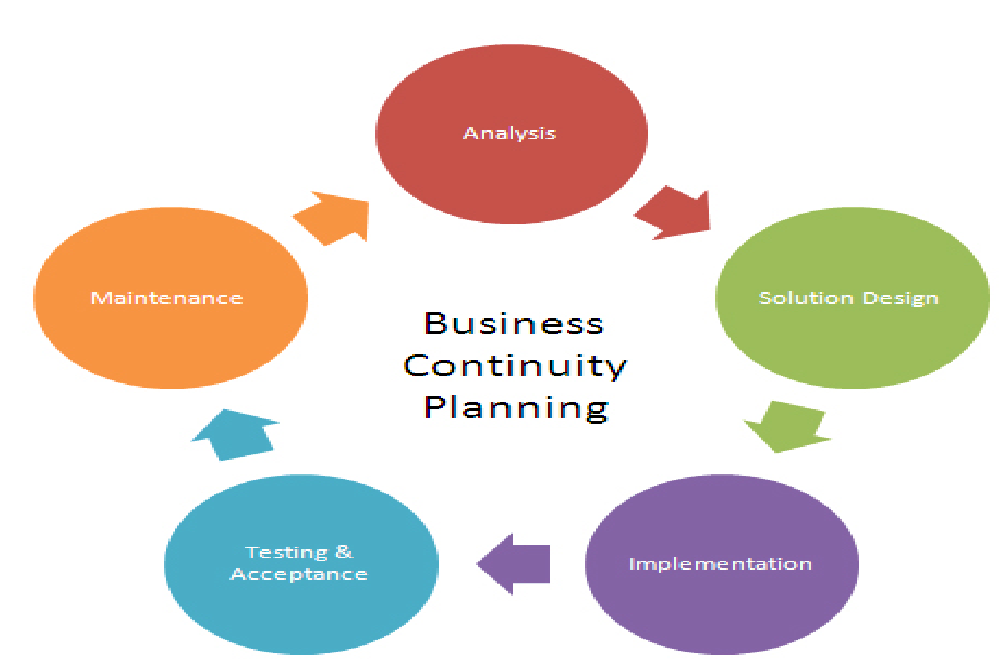
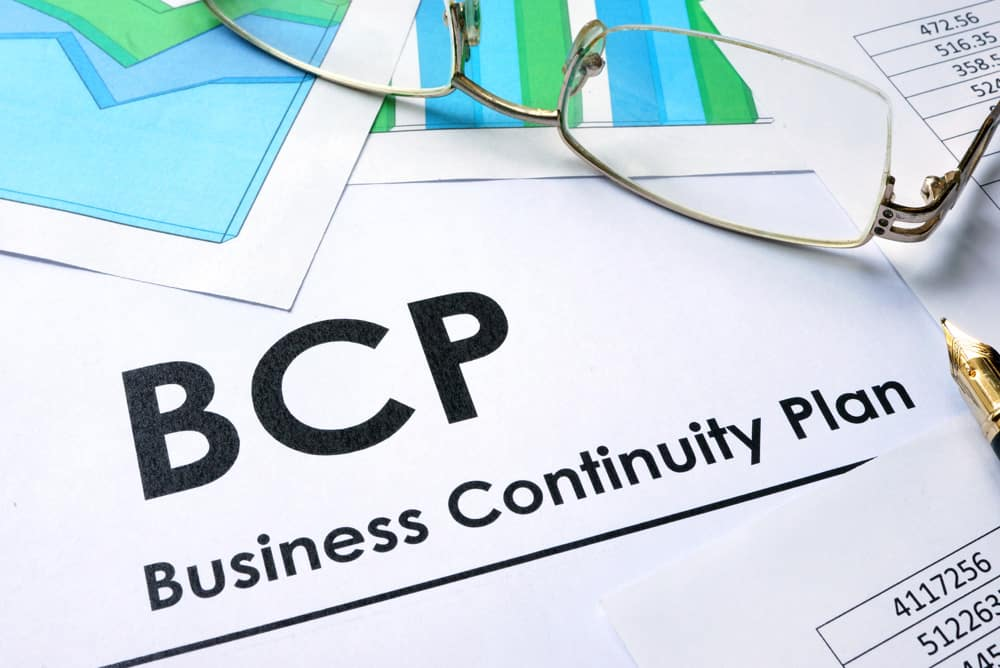
Business Continuity is the ability of an organization to continue the delivery of its services and products at an acceptable and predefined level following a disruptive incident. {Source: ISO 22301}  Simply put as, the phenomenon that ensures business continues as usual, no matter the situation of the organization i.e. come rain, come shine you are still very much in business. It is implemented and guided by the International Organization for Standardization ISO 22301 Business Continuity Management System (BCMS) standard.

Business continuity proudly boasts of upholding the resilience strategy of any organization from financial institutions, to health institutions, FMCGs, Oil and Gas etc. As a continuity, resilience and risk management professional I would say business continuity is particularly crucial to the survival of any organization in tempestuous times, it helps to prepare the enterprise ahead of the unknown, disruptions which could be from technology, people, processes, the environment etc., ( either man made or natural disasters).

It is thus, quite important for organizations that want to remain a going concern to envisage, get prepared and respond to stern issues and incidents as they relate to their businesses; especially the one we term the critical business functions and processes, which are the core of the organization itself.

Source: i2k2.com

According to the Business Continuity Institute (BCI), organizations with BCP’s (Business Continuity Plans) have rapid and articulate responses to incidents; as disruptions to business operations can upshot into sombre consequences for an organization; but an organization with a robust Business Continuity Plan can predict the unexpected and afford timely response to protect its business, their customers and reputation.

Let’s see Business Continuity in IT

While a lot as gone into having plan B’s, business continuity can be termed the mother of all plan B’s, as it contains the master sheet of all scenarios in which a plan B can be activated and an effective continual improvement plan, that is why I am not surprised most business investors seek out the ISO 22301 certificate from any organization they intend to invest in.

Business continuity covers technology, people, process and premises, with a special preference given to external factors, especially natural disasters.

In this article milieu we will be looking at IT Disaster Recovery (DR), since a bulk of all what we do today seats and relies on the support from our IT departments and units, we can’t help but proactively consider something going wrong with this structure. As such, IT Business continuity is an indispensable subset of Business continuity, which solely emphasizes on reducing business down time and accomplishing prompt IT functions resumption in the shortest possible time following an incident or disruption.

IT business continuity or disaster recovery is the capability of an organization to effectively reinstate its hardware(h/w), software(s/w), humanware(h/w), network and data i.e. it’s acute IT Infrastructures behind the success of its business to par or above , during and after a crisis or incident.

Here the recovery objectives are essential, as the response and restoration sequence must be in sync with the optimal performance of the business, while some organizations only focus on IT disaster recovery as only recovering the IT infrastructures (h/w &s/w) alone, they forget the human ware is also very important and can be fatal, if the loss of talents and professionals in this field, is not looked into by business continuity in the form of what we call succession planning. The IT professionals are needed for business continuity planning and for business to continue to run as usual; many organizations have suffered losses and disruptions due to the exodus of key IT personnel.

Why have an IT Business Continuity Plan?

Which we also call the IT DR plan, it contains all the scenarios and instructions on how the IT functions and business processes relying on IT can be restored promptly back to normal, it provides information and methods to curtail the effects of a disruption, what the IT personnel’s should do, the IT vendors to be contacted etc.

BCI’s IT resilience report stated 95% of organizations without disaster recovery/IT business continuity plans, face fatal business loss and don’t last a year; that’s like going under with a bang.

Every organization that depends on IT for one function or the other needs to have a tailored IT business continuity plan, that is stout enough to provide procedures to guarantee incessant delivery of critical IT functions and the use of Business Impact Analysis (BIA) to identify all necessary resources required to maintain a unique and resilient IT infrastructure. A resilient IT infrastructure that covers data, network and all the wares will give a resilient business, which will always exist to proffer solutions to its customers.

Is there any benefit to having an IT BC plan?

Finally, the benefits of Business continuity and IT business continuity as a whole cannot be over emphasized, it’s popular among organizations to hang their thoughts and gateways around insurance, but what say you, when a clause puts you out and we all know insurance may not necessarily protect your reputation, as seen under strategic and reputational risk.

Irrespective of the type of enterprise, the unexpected can always happen, it now depends on how well prepared you are to face the challenges and pull a September 11 on the disaster; that’s to bring to our notice some organizations despite the terrible effect of the world trade centre’s fall on 09/11/2001, still carried out their businesses successfully on that fateful day.

An IT business continuity plan needs to be developed and tested regularly, as one of my favourite BC quotes states, ‘an untested plan is as good as no plan at all’ so it is not enough to just have a plan, it needs to be effectively tested and improved on.

Not only does the IT BC plan helps to create familiarity with common or expected incidents and how to combat it, but it also helps the organization to recover from a disruption and also largely reduce its impact.

It will go a long way to boost the brand and reputation of the organization,

It will be a sustainable guide and ensure redundancies of IT processes and functions,

Reduces the loss of revenues and protect stakeholders’ interests,

Most importantly effects the fulfilment of the organizations statutory legal and contractual obligations,

And my personal favourite, it gives the organization a competitive advantage and great sense of confidence.

Enterprises no matter how small or big must have the drive to ensure they remain a going concern, it’s like having a will in place to protect your heritage and that is what the Business Continuity Management System is all about, asides having a robust BC plan for your IT departments, Finance or HR departments etc., it also provides procedures for managing crisis, emergencies and many more.

Business continuity will not only protect your critical IT functions or other processes but it will also create for you a chain reaction of opportunities that you never saw before, as most challenges when looked into also brings in solutions that can help you grow your organizations.

Where is Africa in the age of AI?

2

By Samuel Nwite

In 2016, when an Artificial Intelligence (AI) developed by Google’s DeepMind, beat the European Champion of the Chinese game Go, it set an unprecedented record that paved the way for a future where humans will have to compete for activities with machines. Although this future has been anticipated by many, it’s coming faster than we think.

In April 2019, Dr. Camilo Ortiz tweeted an amazing video of his Tesla car driving him all the way home from work, with no input from him: ” Changing lanes, merging on and off 3 highways, in rush-hour, in the rain, in New York City!” He ended the Tweet with one word, “Stunned.”

It was something that many people could have dismissed from their imagination in the 90s. But that’s just a segment of the proliferating Artificial Intelligence in North America. Other sectors like the medical field have long been enjoying their bits before now. And that’s what we see in Europe and Asia as well. Mouth gaping tech breakthroughs of machines acting in the stead of humans!

In May 2019, in Tijiani China, Titan, a human sized robot set the atmosphere of the third World Intelligence Congress (WIC) on fire when it started singing the theme song of “The Transformers” moving its lips and dancing to the beats. Awed jaws dropped in amazement, not only for the wonderment, but also for how far Asia has leapfrogged in AI science with China taking the lead: from smart homes to smart manufacturing, to autonomous vehicles, to health checks to education, and city management. And that begs the question: Where is Africa in the age of AI?

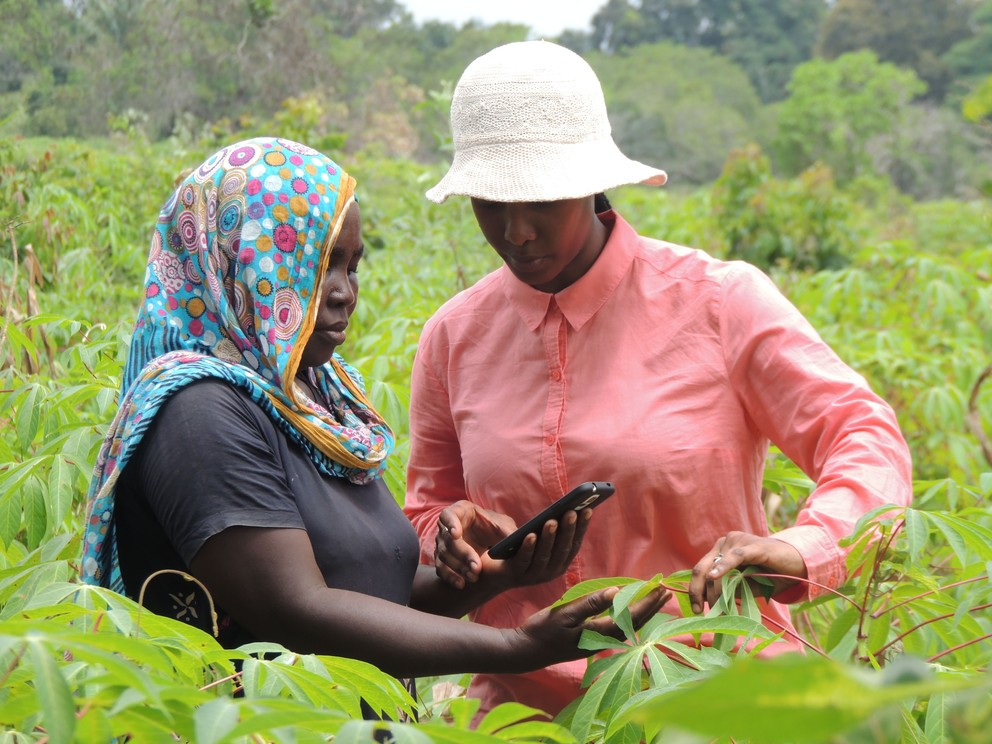
When Google opened the first AI lab center in Africa, in April, headed by the Senegalese Mustapha Cisse, it was widely welcomed as the impact of such development could be felt by the case of a Tanzanian farmer who diagnosed the problem with her cassava farm by merely hovering her phone over wilting cassava plant. The TensorFlow app, a Google AI machine,  detected the problem and proffered solutions. That means, Africa needs Artificial Intelligence, not only to solve her farm problems, but also to curtail deficiencies in tech, healthcare and efficient labor. But the fact that Google, an American company, has to set up the first AI lab center in Africa, in 2019, tells so much about the continent’s lackluster perception of tech developments and how she could benefit from it: a problem that could be traced to poor education foundations, mental laziness and zero visionary leadership.

Most African schools don’t have the capacity of technological mental development. Talk of STEM and ICT, there are few basic schools in Africa that could present such a syllabus. We are talking about a continent with one of the most vibrant median age (19) in the world. So a youngster with a knack for tech will most likely lose his chances to develop, due to lack of tech supportive functional system. But that’s not all.

Some Africans have found a way to scale through the fundamental basic education hurdles and develop themselves in the science and technology world. For instance, Mustapha Cisse, taught himself AI, and developed to the point of being the head of the only AI center in Africa. There are few others like him in Nigeria, South Africa, Rwanda etc. people who need fund for research, coaching and AI development. Alas, Africa has learned nothing from their counterparts, like the EU that dishes out grants for research and tech development. The FP7 is one of those, with many branches like the ERA. One of its projects, the PROSYD, was funded with 2.1 million Euro, in a bid to find a solution to errors in silicon chips. The research was a success.

In 2008, when Elon Musk, proposed the expensive shift from building sports cars to more family-friendly Sedans, thereby widening its all electric vehicles project. The US government responded with $465 million loan, through the Advanced Technology Vehicle Manufacturing (ATVM) loan program. And so came the birth of Tesla’s self-driving cars.  In Africa, apart from countries like Mauritius that is fostering tech ideas through the Mauritius Africa FinTech Hub, (MAFH) and Rwanda that is showing innovative spirit recently, others are more or less interested. So tech startups in Africa have to be privately funded, although companies like Google have been increasing their tech grants for Africa recently, the insouciant attitude of African governments is posing another problem.

One of the worries expressed by Mustapha Cisse is the inability of African nations to forge ties with their local AI expertise. Just like countries like China and France did and it resulted in huge success. So there is a problem of acceptance by African nations. Maybe due to lack of vision, or the fear that AI may do more harm than good. Considering the fact that it could, among other things, generate fake videos, thereby discredit the long held “seeing is believing” notion. This concern cannot be dismissed, and at the same time, shouldn’t be a threat when legislation is vibrant and swift. Other continents know that such dangers exist yet they embrace and nurture AI, seeking ways to contain ‘the would be’ excesses.

The following recommendations have been made as a way to curtail AI concerns:

  1. Being ahead of technological developments and encouraging uptake by public and private sectors.
  2. Prepare for socio-economic changes brought about by AI.
  3. Ensure an appropriate ethical and legal framework.

But these aren’t before our mindset is prepared to accept the technological and scientific realities that are leaving prints of obsolescence on African soil. Cisse gave a practical advice on how to achieve this. He said: “we need to develop a coordinated plan to encourage AI education across the continent, incentivize entrepreneurship in the AI sector, and facilitate collaboration between AI researchers and experts in healthcare, agriculture and other sciences. We need a pan-African strategy, a set of ambitious goals for AI education, research, development and industrialization.”

The disregard of this advice will only mean one thing: that Africa will still be crawling when the rest of the world is flying with AI.

Take That Kid To Mathematics Camp, Forget the Coding Camp Yet

3

First, I am not a licensed counselor. But because I get many emails from people on their children, I think I can share my insights nonetheless. Do not be fixated on sending your under-12-year old kids to computer coding camps. I see in Lagos they have even coding classes for 6-year old kids. People, you are not helping that child.

Coding is a “language” mechanism and it has basic alphabets. Those alphabets are numbers (yes, mathematics). It is highly unlikely a child will thrive on real coding without affinity to numbers no matter how many coding classes you have exposed him or her. It is like teaching a child English writing when you have not explained what A, B, C … and Z stand for.

During this long vacation, take the child where they teach algebra (I know few exists now! That is unfortunate) over those coding classes.  Time for coding camp will come when he/she can read very well and have basic mathematics from  the12th birthday.  Sure, the child can be introduced to coding but not making it everything.

There is a great difference between copying html codes online to make a website, and having mathematical capacities to solve huge business frictions with software solutions. Yes, mathematics is what solves extremely complex business issues, and if you cannot break those business frictions into mathematical elements, no coding can save you. And most of the people breaking the frictions understand what made them better – it was the number, not really the coding [sure, coding was not mainstream when they grew up].

Koduri and Shahi represent a new kind of Silicon Valley parent. Instead of tricking out their homes with all the latest technology, many of today’s parents working or living in the tech world are limiting — and sometimes outright banning — how much screen time their kids get.

The approach stems from parents seeing firsthand, either through their job, or simply by living in the Bay Area — a region home to the most valuable tech companies on Earth — how much time and effort goes into making digital technology irresistible.

In my business, 80% of the main software works are mathematics while the 20% is just the coding translation. You bring in series, calculus, trigonometry, etc to solve the problem before you can translate into codes. There is no way on this earth a kid without good foundation of mathematics will thrive in coding, on game changing ideas, unless you want him/her to be making static website which does not even require taking a class!

Sure – it could be that you want the camp as a form of socialization as well as a mechanism to expose the kid to technology. Go for it – it can inspire. (I take mine to Dave and Buster to expose the amazing emerging technologies coming in Augmented Reality, Virtual Reality, and more. But I did make sure to explain that mathematics and love of it is how those things come. That mathematics is physics, chemistry and the hard sciences.)  But make sure the program curricula capture that the kid must still like mathematics. It is not a binary – if you want great success on coding, you must like numbers. I am yet to see any software successful entrepreneur (real entrepreneur, not the one making static websites) who is not a mathematical mind.

Try it on your child, you will be surprised that solving mathematics or learning sciences becomes like gaming. How do I battle to reach level 2? The battle here is mastering algebra or understanding photosynthesis, and because they have used the same motivation typical in video games, the child will not even know he or she is learning addition and multiplication.

A kid wins on mathematics lessons on early development, not coding classes. It is not a binary: you cannot hate mathematics and code world-changing solutions. The algebra of today is the Facebook of tomorrow.

The Best Gaming for Kids Now is Khan Academy

LinkedIn Comment on Feed

COMMENT #1

Life is all about learning and understanding the fundamentals, no amount of manoeuvring can save you from this reality; you will always fall short, when the moment of truth arrives.

Just like Philosophy, it does not matter whether you are science or art inclined, if you fail to appreciate it, your understanding of human dynamics and things around you will always be shallow.

Mathematics doesn’t sound or look fanciful enough, but coding sounds cute, so you will see people congregating to learn coding, but when real life issues that require complex understanding of relationships and combination of natural phenomena are presented to them, they now want you to explain everything, before they can do the coding!

To be a great writer, you first learn the alphabets, then the meaning and use of words, then syntax rules; by the time you now fuse everything with your natural ability to draw relationships and combine things intelligently, the output is a masterpiece.

Yes, the castles will be up there in the sky, but without first putting the foundations on the ground, they cannot be seen up there. You cannot run away from your shadow, so it’s better to embrace mathematics, in order to make sense of your coding adventures.

COMMENT #2

Prof Ndubuisi Ekekwe this is absolutely true and it is a pity that our priorities are gradually changing. In fact parents are rushing the development of their kids.

This is what I tell parents of my student, ” I will not teach your ward Robotics in a month but I will teach them what they need to know to build their Robot in my absent”. What they need to know loops around sciences.

LET ME SHARE MY EXPERIENCE.
During my robotics workshop, I asked the student a simple mathematics question – “what is the angle on a straight line?”
They found it difficult to answer until I dissected a circle into halves.
At another time, I asked Newton’s first law of Motion.
I ended up answering my question myself.
Parents these are some of the basic knowledge for building a Robots aside Coding.

FINAL WORD
1. Teachers please place more emphasis on important Issue.

2. To anyone reading this, do you know that to kickstart a career in Artificial Intelligence, the knowledge of mathematics is a prerequisite ? Don’t be deceived.

3. Parent let your children grow mentally as they ought to because if they are cheated by not knowing mathematics and other science subjects, they might struggle with the emergence of new technology.

All thoughts are Mine.