DD
MM
YYYY

PAGES

DD
MM
YYYY

spot_img

PAGES

Home Blog Page 691

Trump-Putin Summit Ends Without Ceasefire, Rekindles Debate Over U.S. Role in Europe’s Security

0

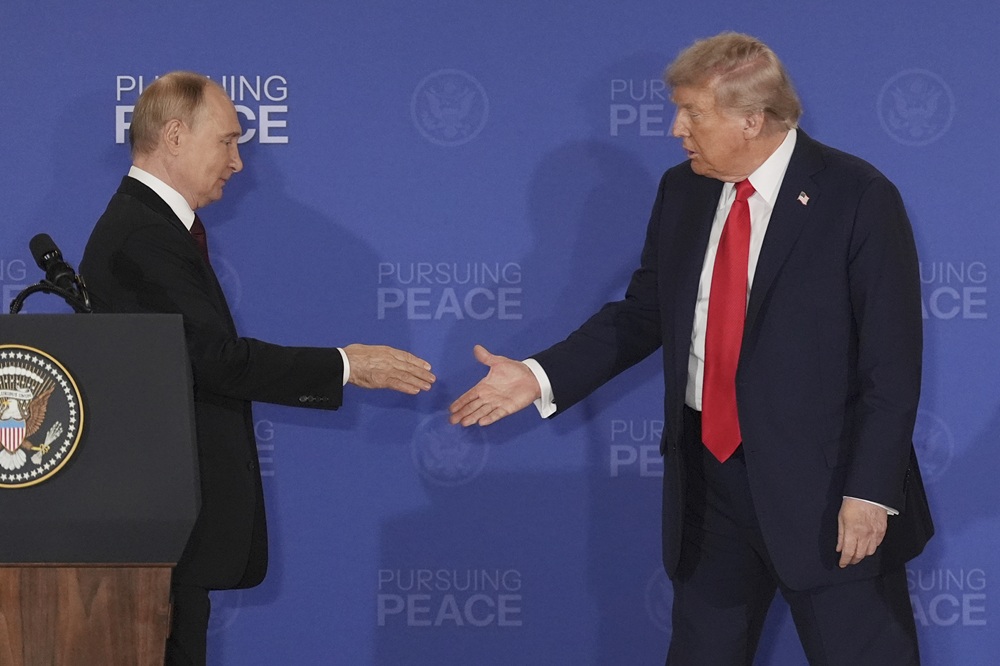
U.S. President Donald Trump’s long-anticipated summit with Russian President Vladimir Putin ended Friday without a ceasefire deal in Ukraine, setting off unease in European capitals and sparking renewed debate over America’s role in the war.

Trump struck a confident tone after the hours-long meeting, telling his supporters on social media that the talks “went very well.” But his refusal to push for a ceasefire immediately, opting instead to emphasize a broader “Peace Agreement,” underscored the fault lines between Washington, Kyiv, and European leaders.

“It was determined by all that the best way to end the horrific war between Russia and Ukraine is to go directly to a Peace Agreement, which would end the war, and not a mere Ceasefire Agreement, which often times do not hold up,” Trump wrote.

The framing marks a sharp contrast with Ukraine and its allies in Europe, who view a ceasefire as an urgent necessity to stop the bloodshed while paving the way toward longer-term peace. European leaders released a joint statement insisting that “it will be up to Ukraine to make decisions on its territory” and warning that without a ceasefire, Russia retains the upper hand on the battlefield.

Ukrainian President Volodymyr Zelenskyy, excluded from the summit, responded cautiously but said he plans to meet Trump in Washington on Monday to “discuss all the details regarding ending the killings and the war.” Trump, in turn, suggested that if progress is made with Zelenskyy, he would then move toward a second meeting with Putin.

The summit also reignited a familiar debate in Europe about Trump’s approach to Russia. Since his first term in office, Trump has been accused by critics of showing unusual deference to Putin. His questioning of NATO’s value, coupled with repeated threats to reduce U.S. commitments to the alliance, has unsettled European leaders who see Washington as indispensable in countering Moscow’s aggression.

At the same time, Trump has often argued that Europe relies too heavily on American defense spending and has pushed allies to shoulder more of the burden. His latest diplomatic overture to Putin deepens the perception among some European capitals that the U.S. president is willing to cut side deals with Moscow, even if it sidelines NATO unity or Kyiv’s priorities.

Moscow seized on this moment to project victory. Putin described the talks as “very frank, meaningful and, in my opinion, this brings us closer to the necessary decisions.” Russian senator Andrei Klishas went further, declaring that “a new European and international security architecture is on the agenda and everyone must accept it.”

For Trump, the summit fits into his longstanding pattern of pursuing personal diplomacy with strongmen—whether with Putin, North Korea’s Kim Jong-un, or China’s Xi Jinping—arguing that direct leader-to-leader engagement can achieve breakthroughs where traditional diplomacy stalls. His critics, however, warn that such a strategy risks legitimizing adversaries while undermining alliances built over decades.

The stakes are particularly high in Ukraine. Without a ceasefire, Russia retains room to expand its territorial grip and test the resolve of Europe’s sanctions regime. European leaders vowed to keep the pressure on Moscow: As long as the killing in Ukraine continues, we stand ready to uphold the pressure on Russia, they said, promising to strengthen sanctions until “there is a just and lasting peace.”

The outcome of the summit means the war continues for now. Trump is betting that his personal brand of dealmaking can deliver what months of Western pressure and battlefield struggles have not: a negotiated peace. Whether that gamble pays off or deepens divisions within the West will become clearer after his meeting with Zelenskyy in Washington.

The great illusion of Vibe Coding

0
The Vibe Coding Journey begins in the LLM (Large Language Model) Experience 

When AI is asked about the number of Rs in “cranberry”, “elderberry” or “barberry”, different answers might be given each time, ranging from two to four, and only sometimes three. This inconsistency isn’t a glitch, but rather a fundamental aspect of the transformer architecture that underlies language models.

Unlike humans, these models don’t count letters; instead, they rely on probability distributions to sample tokens. So, an inquiry about the number of Rs in a word prompts the system to predict the typical token sequence that follows that question pattern, without examining the word letter by letter.

The predictions are sometimes correct and sometimes not, as there’s no symbolic reasoning or mental model of the word as a sequence of characters at play. The transformer architecture compresses words into embeddings that capture semantic relationships and contextual token patterns, but these embeddings don’t preserve structural information about spelling.

As a result, the model can’t “see” individual letters the way humans do when spelling out a word like C-R-A-N-B-E-R-R-Y. To the model, two Rs are simply a token, not two distinct letters. This limitation has significant implications, as humans can count letters with perfect accuracy every time, simply by holding the word in mind as a sequence and counting systematically. In contrast, large language models (LLMs) require careful orchestration, step-by-step prompting, and external tools, as well as human guidance for every symbolic operation. While it’s possible to work around these limitations using techniques like chain of thought prompting and retrieval systems, these workarounds are essentially patches that cover up fundamental gaps in the models’ capabilities.

The economic promise of general intelligence breaks down when every simple task demands complex scaffolding. The reality is that LLMs excel at pattern matching, but they need constant supervision to perform basic symbolic operations accurately. Moreover, these models tend to prioritize likelihood over truth and are inherently brittle.

Like simple spell checker and calculator technology before them, the user MUST have an instinctive ‘feeling’ for the suggested data, otherwise  ‘invested’ may be accepted, when the word needed is ‘invented’ or 2047 instead of 20,047.

But this broader grasp of rudimentary language or mathematics being ‘right’ is something we have mastered leaving primary school.

Coding is something completely different. In 2025, most people finishing secondary school may have done some very basic programming, perhaps in Python.

Serious programming for most people is a professional pursuit they follow afterwards.

Vibe coding is an AI-assisted software development method where users describe their desired software in natural language, and the AI generates the corresponding code. While it makes coding more accessible, it also presents several significant challenges.

They begin by creating prompts in an approach that’s similar to using LLM. In most cases, the inherent skills they have to proof read for a spell check result, or do a quick ‘rough’ mental arithmetic to check a calculator result, is replaced by overview and interrogation skills beyond most vibe-coders.

Software design is a less exact science, and because something looks great, and seems to work, doesn’t mean it’s secure, free of malicious things, efficient, or even right all the time.

Add that many vibe-coders have no clue how to discover and fix subtle or nuanced problems.

Vibe coding places the challenges AI models have in ‘LLM’, ‘on steroids’.

Repeat problems experienced with vibe-coding.


Security.  The most concerning risk with AI-coded software is security vulnerabilities due to the code’s learning from public repositories, including insecure patterns. AI models suggest code with known vulnerabilities, such as malicious code, SQL injection, and insecure file handling, as they are an average of all developers’ shared work, including their security failings.

Maintenance and Scaling. AI-generated code from vibe coding can be hard to maintain or scale. It often passes initial tests but is brittle and poorly organized, with inconsistent structure, minimal comments, and ad-hoc logic. This lack of documentation and organization makes the software difficult to understand or extend. The codebase quickly accrues technical debt due to inefficient or overly complex solutions. AI-introduced inconsistencies in naming, coding styles, or logic flows make the codebase harder to navigate. Scaling applications created with vibe coding tools is challenging, as adding new features or handling more users may require a costly and time-consuming rewrite due to the underlying system design.

A Triumph of Style over Substance. AI may over-engineer simple features, introducing unnecessary complexity, convoluted patterns, or extra components. This results in a more complicated app that’s harder to understand or slower to load. Flashy design doesn’t replace well-thought-out user experience design, and relying on vibe coding can prioritize appearance over substance, requiring human judgment to ensure the design serves the product’s goals without unnecessary complexity.

Inadequate and insufficient training content. Vibe coding platforms are optimized for common use cases and standard tech stacks. Their training is often pre 2021 and they struggle with much that’s exotic. This includes much in Web 3.

Tools like Lovable and Bolt have limited integrations and building blocks. If a feature is outside their environment, custom code is required. Integration with less-common frameworks may be limited or impossible.

We’ve seen many people make interesting posts with them on platforms like LinkedIn, but other than an interesting looking support image or video for the post, there’s no evidence any of these things actually work.

There’s probably some good stuff out there, but we’re not yet finding anything we can endorse.

The Verdict on Vibe Coding.

At the moment, Vibe Coding has limited application due to:

  •  Limited and aged training library
  •  Insufficient security scrutiny by content selection algorithms
  • Insufficient intuitiveness for efficiency and eloquence of code assembly and expression
  • Overblown expectations of being an easy tool for everyone
What it can be used for:
  •  Static and Simple constructs that lack evolving back-ends, interoperability, bridges, integrations,  handling personal or valuable data, such as:  – Simple Websites, Html Email footer design, Code-rich Social Media visual data, virtual presentations, some testing, some educational.
  • ‘Heavy Lifting’ by experienced coders who are authoring AI components in sandboxes and integrating them with manual steps in a project they manage end-to-end.
What to be careful of:

Just like from 2021 we had the bitcoin grafters and 2022 began the Web 3 grafters, we now have these software engineer/product design grafters who have appeared out of thin air claiming they can code anything. Experienced technicians will have a portfolio with credible referees. Validate that they have a substantial body of work pre-2023 (pre vibe-coding), especially if the arrangement will be remote.

It will get better, but ‘we’re still early’

Credit : Veronica Bridgewater, 9ja Cosmos Ambassador focusing on LinkedIn presence – Cocktail of Social Media extracts.

Glideapps Article.

9ja Cosmos is here…

.det0x Domains

Detoxant 3 Tokenized Artworks

Detoxants – FiendYard Fruit & Veg

Opaque Emotion Pathways Tokenized Artworks

Preview our Sino Amazon/Sinosignia releases (Ente)

Visit 9ja Cosmos LinkedIn Page

Visit 9ja Cosmos Website

The Nakamoto-KindlyMD Merger Exemplifies How SPACs Are Reshaping The Crypto Market

0

David Bailey’s Nakamoto Holdings Inc. completed its merger with KindlyMD, Inc. (NASDAQ: NAKA) on August 14, 2025, forming a publicly traded Bitcoin treasury vehicle.

The combined company, operating under the KindlyMD name, raised $540 million through a private placement in public equity (PIPE) financing and closed a $200 million convertible note offering, totaling $740 million. These funds are primarily intended for Bitcoin purchases to build a substantial treasury, with a long-term goal of acquiring one million BTC.

Currently, KindlyMD holds 21 Bitcoin, but plans to add approximately 4,544 more at current market prices, positioning it among the top 20 Bitcoin treasury firms. David Bailey, a Bitcoin advocate and former advisor to Donald Trump, serves as CEO and Chairman, with Tim Pickett, former KindlyMD CEO, now Chief Medical Officer.

SPACs provide a faster route for crypto firms to go public compared to traditional IPOs, which can take over six months and involve extensive regulatory scrutiny. The Nakamoto-KindlyMD merger, completed in weeks, exemplifies this speed, raising $740 million to fund Bitcoin purchases.

SPAC mergers like Nakamoto’s create publicly traded vehicles that offer investors indirect exposure to Bitcoin without the complexities of self-custody or direct crypto volatility. This is particularly appealing to institutional investors wary of unregulated crypto markets.

The Nakamoto-KindlyMD deal, backed by a $540 million PIPE and $200 million convertible note, demonstrates how SPACs attract institutional capital from firms like Galaxy Digital and Pantera Capital, broadening the investor base. SPACs bridge crypto and traditional finance by creating regulated equity vehicles that hold digital assets.

Nakamoto’s strategy mirrors MicroStrategy’s (now Strategy) model, which saw its market cap soar to over $120 billion by leveraging Bitcoin as a treasury asset. The SEC’s “Project Crypto” and its classification of Bitcoin and Ether as cash equivalents in 2025 have reduced regulatory barriers, encouraging more SPAC-driven crypto treasury firms.

Crypto treasury SPACs often trade at premiums over their net asset value (NAV), as seen with Strategy’s 200% premium. Nakamoto’s aim to build a one-million BTC treasury could similarly drive speculative investor interest, potentially inflating valuations. However, this premium is vulnerable to market downturns.

Critics like Jim Chanos and Nic Carter warn that these premiums may erode during bear markets, leaving retail investors exposed if token values drop. SPAC structures, including Nakamoto’s, involve significant shareholder dilution due to sponsor fees (often 20% of equity) and PIPE financing.

High redemption rates (95% in 2025 SPACs) can strain funding, as seen in broader market trends. The crypto market’s volatility, combined with speculative SPAC models, poses risks. Past crypto SPACs, like those targeting miners or exchanges, often underperformed, with 85% of SPACs trading below IPO price post-merger.

A more crypto-friendly regulatory environment under SEC Chairman Paul Atkins and pro-crypto policies from the Trump administration have boosted SPAC activity. Nakamoto’s merger benefits from this shift, as the SEC’s relaxed stance on Bitcoin as a cash equivalent eases treasury strategies.

How SPACs Are Shaping the Crypto Market

Unlike 2021 SPACs that targeted crypto exchanges or miners, 2025 SPACs, like Nakamoto-KindlyMD, focus on Bitcoin treasury strategies. This shift, inspired by Strategy’s success, emphasizes holding digital assets as a core business model, offering investors high-beta exposure to crypto price movements.

Examples include ProCap BTC’s $1 billion SPAC merger to buy 3,724 BTC and Cantor Equity Partners’ merger with Twenty One Capital, both prioritizing Bitcoin accumulation. The SPAC market raised $11 billion in 2025, with crypto-linked SPACs driving significant activity.

Nakamoto’s $740 million raise aligns with this trend, as boutique banks like Cohen & Co. and Cantor Fitzgerald lead deals, filling the gap left by major banks like Citigroup. This resurgence follows a “crypto winter” and SPAC bust, with 2025 deals matching 2024’s total capital raised, signaling renewed investor confidence.

SPACs enable crypto firms to use Bitcoin as collateral for loans, insurance, or other financial products, as seen in broader trends with companies like Bitcoin Standard Treasury Company. Nakamoto could adopt similar strategies to generate yield from its Bitcoin holdings, enhancing treasury stability.[](k SPAC boom, including deals like Nakamoto’s, may mirror the 2021 speculative frenzy.

Overexuberance could lead to inflated valuations unsupported by fundamentals, with 75% of 2025 SPAC mergers trading below IPO price. The Nakamoto-KindlyMD merger exemplifies how SPACs are reshaping the crypto market by enabling rapid public listings, attracting institutional capital, and legitimizing Bitcoin as a treasury asset.

This trend fosters integration with traditional finance, drives speculative premiums, and introduces innovative financial products. However, risks like dilution, volatility, and regulatory uncertainty persist. For Nakamoto, disciplined management of its $740 million war chest and transparent governance will be critical to sustaining investor confidence and avoiding the pitfalls of past SPAC failures.

Why Ozak AI Could Surpass XRP’s 250% Gains in the Next 12 Months

0

XRP has had its moments in the spotlight, pulling in staggering gains and shaking up investor confidence. Now, Ozak AI steps into the arena, already in its fourth presale stage, selling at $0.005 per token. The project’s mix of AI innovation and blockchain tech has turned more than a few heads.

This is not just another presale. The $OZ token sale has already brought in over $1.8 million in Phase 4, with the token price now at $0.005—a 400% increase from its starting price of $0.001. Over 129 million $OZ tokens have been sold, hitting 81% completion of this phase, and the $1 million giveaway continues to lure in early supporters.

Add in its Decentralized Physical Infrastructure Network (DePIN) design and a partnership with AI heavyweight SINT, and suddenly, this isn’t just hype—it’s a calculated build for the long haul. The next stage will see the price rise to $0.01.

Ozak AI Blockchain Integration Is More Than an Excitement

Some projects slap AI and blockchain together like mismatched puzzle pieces. Ozak AI’s setup actually fits. Its DePIN backbone combines blockchain with IPFS, allowing secure, fail-resistant data storage across multiple nodes.

No single point of failure. No silent downtime. For industries that need real-time analytics and rapid response, that’s gold. Smart contracts handle permissions, ensuring every data transaction remains untampered.

Strategic Alliances Fuel Growth Potential

The tie-up with SINT is where the platform sharpens its edge. SINT’s neural processing models aren’t just plugged in, they’re woven into the system, upgrading automation and analytics speed. Then there’s the push for open-source SDKs. When third-party devs join in, use cases multiply. That means a self-growing network, driven by builders who see the potential and want a piece of it.

Ozak AI’s $1 million giveaway is more than a marketing hook. It’s bait for grassroots energy. Over 100, with six-figure prizes for the top spots, keep chatter alive and engagement steady. The presale terms, $100 in $OZ to qualify, don’t just raise funds, they filter for committed holders who will likely stick around. That stickiness is worth watching.

Why the Next 12 Months Could Tilt in Ozak AI’s Favor

XRP’s 250% surge was powered by adoption waves and legal clarity. Ozak AI has different fuel: AI’s accelerating demand and blockchain’s need for scalable, secure data solutions. It sits right where those two lines cross. If partnerships deepen, developer adoption grows, and real-world use cases stack up, the stage could be set for returns that make even XRP’s rally look tame.

For more information about Ozak AI, visit the links below:


Website: https://ozak.ai/

Twitter/X: https://x.com/OzakAGI

Telegram: https://t.me/OzakAGI

Equity Investing: Cap Table, Valuation, MFN And SAFE

0

Join me in 5 minutes as we discuss Equity Investing: Cap Table, Valuation, MFN And SAFE. The cap table is the definitive truth of a company’s ownership. It is not merely a spreadsheet but a living document that records every share and every shareholder, from the founders to the earliest investors. Without this clarity, a startup is like a house built on sand.

When a startup goes for funding, valuation is the point of negotiation. It’s the price tag on the company’s promise, a calculated consensus influenced by market dynamics, growth trajectory, and a founder’s vision. A disciplined founder understands that valuation is an outcome of the business model, not just a number to chase.

For early-stage financing, a SAFE (Simple Agreement for Future Equity) has become the pragmatic tool for founders and investors. It provides a simple path to convert capital into equity at a future date without the immediate friction of a priced round. Paired with this, the MFN (Most Favoured Nation) clause is a silent but powerful safeguard for the first believers.

It ensures that if a future investor gets more favourable terms, the original investor automatically benefits. In the spirit of equitable partnership, this clause protects the integrity of the deal and builds trust for the journey ahead.

Tekedia Min-MBA >> we explain markets.

Sat, Aug 16 | 7pm-8.30pm WAT | Equity Investing: Cap Table, Valuation, MFN And SAFE – Ndubuisi Ekekwe, Tekedia Capital | Zoom link https://school.tekedia.com/course/mmba18/


Lecture VideoSign-up at Blucera and check under Training module.