DD
MM
YYYY

PAGES

DD
MM
YYYY

spot_img

PAGES

Home Blog Page 693

Cold Wallet’s Measured Strength & $6M Presale Outshines XRP and SHIB in 2025

0

Crypto in 2025 is shifting toward real utility and quick adoption over pure speculation. XRP’s outlook improved after the SEC dropped its case against Ripple, clearing legal hurdles and opening a path toward $12.6 based on a multi-year breakout. Shiba Inu could see its market cap climb to $28 billion, a 300% rise if supply stays steady.

Cold Wallet (CWT) enters from a different angle. It rewards users with measurable cashback for every blockchain action, integrating Plus Wallet’s existing 2 million+ users for immediate activity and liquidity from launch.

With over $6.1 million raised in presale and Stage 17 pricing at $0.00998, its 3,400% ROI potential is supported by active usage data. Among upcoming bullish crypto coins 2025, Cold Wallet combines adoption readiness with a pricing window that may not stay open long as demand grows.

XRP’s Case Closure Fuels $12.6 Price Ambition

The U.S. SEC’s decision on August 11 to end its case against Ripple has given XRP’s outlook new momentum, removing years of uncertainty. This has lifted market sentiment, with analyst Ali Martinez forecasting a climb to $12.6 based on a breakout from a long-standing triangle pattern identified in November 2024. The recent rise to $3 is viewed as the early stage of this move, since historical patterns show such breakouts often lead to extended price advances.

Technically, the projection comes from measuring the height of the triangle and applying it to the breakout point. The end of the case also raises the possibility of U.S.-listed spot XRP ETFs, which could draw institutional buyers. With ETFs already running in Canada, Europe, and Brazil, plus U.S. futures in place, expanded market access could fuel stronger inflows, making XRP a serious contender among bullish crypto coins in 2025.

Shiba Inu’s 300% Jump Could Reshape the Meme Sector

Shiba Inu (SHIB) is currently valued at around $7.3 billion, but forecasts point to a potential $28 billion market cap in this cycle. That scale of growth would equal roughly a 300% price jump from where it stands now. If SHIB’s circulating supply stays steady, the numbers suggest real room for gains.

Such a rise would put SHIB among the cycle’s top movers and could bring fresh energy into the meme coin market. Crypto history shows that strong rallies in one coin often spill over into others in the same category, and SHIB’s dedicated community could amplify that effect. This projection rests on clear market cap math rather than pure speculation, making SHIB one of the more watchable picks for bullish crypto coins in 2025.

Cold Wallet’s 34x Potential Backed by Live User Base

Cold Wallet is changing how blockchain wallets work by giving users cashback on every activity instead of charging fees. Sending funds, paying gas, or making swaps all return CWT to the user, creating a feedback loop where activity builds value and keeps engagement steady.

The integration of Plus Wallet’s 2 million+ users means it launches with instant transaction flow and liquidity, avoiding the slow ramp-up most new projects face. With $6.1 million raised before launch, the team is fully funded to scale without depending on post-launch capital.

At the current Stage 17 price of $0.00998, the gap to the confirmed listing price offers an over 3,400% upside at launch. The blend of an existing audience, a working cashback model, and a below-market entry price delivers a clear, data-supported opportunity. For those entering now, Cold Wallet aligns market readiness, functional utility, and accessible pricing, making it one of the most strategically timed entries for bullish crypto coins in 2025.

Why Cold Wallet’s Setup Tops the 2025 Picks List

XRP’s cleared legal path brings solid growth potential, and SHIB’s market cap target suggests a strong speculative wave. But neither pairs ready adoption, built-in liquidity, and a self-sustaining model quite like Cold Wallet. Its cashback system turns every blockchain move into tangible value, keeping participation high.

With Plus Wallet’s 2 million+ users already in place and $6.1 million secured before launch, it enters the market fully equipped to scale. At $0.00998, it still sits far below the confirmed listing price, leaving more than 3,400% room for growth. In 2025’s bullish crypto coins race, this is one of the rare plays where infrastructure, audience, and economics meet from day one.

Explore Cold Wallet Now:

Presale: https://purchase.coldwallet.com/

Website: https://coldwallet.com/

X: https://x.com/coldwalletapp

Telegram: https://t.me/ColdWalletAppOfficial
Cardano Bullish, DOT Rebounds, BlockDAG’s $375M, Sports Deals & 2.5M Miners Lead

0

The crypto market is seeing renewed momentum, with Cardano (ADA), Polkadot (DOT), and BlockDAG (BDAG) dominating discussions. Each project is capturing attention in its own way. Cardano’s chart shows technical signals of strength, supported by accumulation from large holders.

Polkadot has regained its footing after defending a key support range, showing improved structure and trading volume. BlockDAG, on the other hand, has outpaced expectations for a presale project, raising $375 million, building a 2.5 million-strong X1 mobile mining base, and forming high-profile sports partnerships.

While ADA and DOT lean on proven performance in price action and ecosystem development, BlockDAG is actively shaping a launch-ready network with strong community traction. The real question is which of these will offer the clearest path to sustained gains heading into 2025.

Cardano Bulls Push Momentum Higher

Cardano has gained over 11% in the past week, now trading around $0.82 after bouncing from strong support near $0.70 earlier this month. Futures Open Interest has surged to $1.44 billion, the highest since late July, signaling heightened market activity.

Technical indicators support the bullish tone: the RSI reads 61, the MACD shows a crossover favoring buyers, and a golden cross has formed between the 50-day and 100-day SMAs.

Whale behavior reinforces this structure. Large wallets holding between 100 million and 1 billion ADA scooped up 200 million coins in just two days. If ADA can close above $0.84, resistance at $0.93 and $1 could come into play, with some analysts pointing to longer-term projections of $5–$10 during the next major cycle. Upgrades like the upcoming Midnight Upgrade are also being closely followed as potential catalysts.

Polkadot Continues Its Recovery Path

Polkadot has posted a 4% climb to $4.12 after holding firm at its $3.84–$3.86 support range. A breakout above $3.92 on high volume gave the move credibility, with activity topping 7 million trades during the push.

Technical structure is shaping into an ascending channel, with support between $4.00 and $4.02 acting as a solid base. Fibonacci extension levels suggest $4.15–$4.20 as the next upside targets if momentum continues.

Development activity remains a major driver of sentiment. DOT currently ranks 8th in core development and 2nd in ecosystem development, behind only Ethereum.

Strong technicals backed by high developer engagement provide a solid case for further growth. On the downside, $3.92 is the level to watch as a safety net, while sustained momentum above $4.15 could extend the recovery.

BlockDAG’s $375M Raise, 2.5M Miners, and Sports Partnerships

BlockDAG has crossed the $375 million milestone in its presale, pricing at $0.0276 with a confirmed launch level of $0.05. Unlike many presale ventures that wait until listing to prove utility, BlockDAG is actively delivering engagement and accessibility ahead of time.

Its X1 mobile mining app now counts over 2.5 million users worldwide, enabling mining through a Proof-of-Engagement model without expensive hardware. For those seeking higher output, the app integrates seamlessly with BlockDAG’s X-Series miners, ranging from entry-level to professional-scale devices. This dual structure creates both accessibility for casual participants and scalability for advanced operators.

Partnerships in sports add another dimension to BlockDAG’s reach. As the official blockchain partner of the Seattle Seawolves (Major League Rugby) and Seattle Orcas (Major League Cricket), the project is introducing fan experiences through NFTs, community coins, and digital rewards. These integrations open blockchain exposure to new audiences in established global sports markets.

Transparency is also a core principle. Dashboard V4 allows presale participants to track balances, referral rewards, and leaderboard competitions in real time, while the BlockDAG Explorer makes network operations visible and verifiable. With confirmed listings on 20 exchanges already in place, BlockDAG is ensuring market liquidity from day one.

By combining a large miner community, strong sports alliances, interactive dashboards, and guaranteed exchange rollouts, BlockDAG is setting a foundation for adoption well beyond its presale stage.

Three Paths, One Clear Standout

Cardano’s bullish indicators and whale accumulation, along with Polkadot’s strong rebound and consistent developer activity, show why these networks remain core names in the crypto conversation. Both are delivering price structure that aligns with further growth potential.

BlockDAG, however, is crafting an entirely different path. With $375 million already secured, a discounted $0.0276 entry point, 2.5 million active miners, and integrations into mainstream sports, it is building traction before listing. Coupled with real-time transparency tools and guaranteed exchange liquidity, it is positioning itself as a launch-ready ecosystem rather than a speculative presale.

For those weighing today’s best-performing crypto projects, ADA and DOT show technical strength, but BlockDAG’s blend of funding, adoption, and pre-launch execution is hard to overlook.

Presale: https://purchase.blockdag.network

Website: https://blockdag.network

Telegram: https://t.me/blockDAGnetworkOfficial

Discord: https://discord.gg/Q7BxghMVyu

Solana (SOL), Little Pepe (LILPEPE) Show Bullish Signals While BlackRock Accumulates Ethereum (ETH) in 2025

0

The crypto market in 2025 has been anything but quiet. Fresh contenders are striking notes of disruption, and big pockets are reconfiguring money flows. Ripple (XRP) keeps flickering across the news cycle thanks to its string of court wins. Still, the real story this summer has been a trio of movers: Solana (SOL), Ethereum (ETH) under BlackRock’s watchful eye, and the fast-climbing meme coin phenomenon, Little Pepe (LILPEPE). Each has its bullish signals, but one offers returns that could leave the others in the dust.

Little Pepe (LILPEPE) – Stage 10 Live, $14.74 Raised, and 92% Sold Out

Now in Stage 10 of its presale, LILPEPE has raised a staggering $147.4 million, with 92% of the available tokens in this stage totaling $0.0019. That’s an 80% climb from the earliest rounds, and demand shows no signs of slowing. Built on its fast and efficient Layer 2 network, Little Pepe handles heavy transaction loads effortlessly, making it practical for everyday use while keeping fees low. The project also features an integrated Launchpad that lets creators launch tokens directly on the network, backed by an anti-sniper system to keep early trading fair.

Momentum has been helped by its high-profile $777,000 giveaway, where ten lucky winners will walk away with $77,000 in LILPEPE each. The campaign has generated massive buzz, helping to draw over 168,000 entries so far. LILPEPE’s market cap sits under $10 million at its current presale price. A move to just $1 billion, a level reached by meme coins like PEPE and Floki at their peaks, would put the price near $0.19, representing a 100x gain from today’s levels.  Adding to investor confidence, LILPEPE’s smart contracts have not only been reviewed by FreshCoins.io, earning a trust score of 81.55, but have also been reviewed by Certik Audit, a leading blockchain company with a 95% score. This third-party audit is a crucial signal in the often chaotic meme coin space, giving LILPEPE a legitimacy edge over many of its rivals.

Solana ($SOL) – High-Performance Blockchain Giant Behind MemeCoin Mania

In July, Solana surged more than 34% in a week to around $190 per coin, hitting its highest level in five months and confirming a bullish revival. This rebound isn’t just a technical bounce. SOL has broken out of a long-term symmetrical triangle pattern, ending its downtrend and setting the stage for a possible run to $400, a move that would double its current price and give it a market cap north of $160 billion. With initial resistance at $218 and $250, clearing those levels could accelerate the rally. Additionally, Solana recently hosted a record-breaking on-chain fundraising event through Pump.fun, which pulled in $600 million in just 12 minutes, with over 75% of the capital flowing directly through Solana’s network. Combine that with ongoing developer adoption and whispers of institutional interest in SOL-based products, and the stage is set for further upside.

BlackRock’s Growing Appetite for Ethereum (ETH)

Institutional interest in Ethereum has been equally eye-catching. US-listed spot Ethereum ETFs have posted three straight days of net inflows, with $222 million recorded daily. Between July 2 and July 31, these funds quietly stacked ETH, pausing only briefly amid macro uncertainty before resuming accumulation. At the center of this activity is BlackRock’s iShares Ethereum Trust (ETHA), which now manages more than $11 billion worth of ETH as of August 7. ETHA hit the $10 billion milestone faster than almost any ETF in history, ranking among the top five funds for inflows over the past month. Corporate treasuries are also adding ETH to their balance sheets, with BitMine Immersion holding $3 billion and SharpLink Gaming around $2 billion. This kind of institutional commitment lends Ethereum long-term stability, which few projects can claim, but it also means ETH’s growth is more likely to be steady than explosive.

Conclusion

Solana could very well revisit its all-time highs. Ethereum will likely keep building value through steady adoption and institutional trust. But for traders chasing asymmetric gains, the math speaks for itself: LILPEPE offers the steepest potential climb. At under $10 million market cap today, with a plausible path to $1 billion, the 100x narrative is not just a fantasy, it’s a calculated possibility.


For more information about Little Pepe (LILPEPE) visit the links below:

Website: https://littlepepe.com

 Whitepaper: https://littlepepe.com/whitepaper.pdf

 Telegram: https://t.me/littlepepetoken

 Twitter/X: https://x.com/littlepepetoken

Solana’s Bullish Signals & LINK’s Momentum Versus BlockDAG’s 2.5M Global Mining Network and Referral Rewards

0

Solana is advancing with strong technical setups, and Chainlink is riding accumulation-driven momentum, but another project is beginning to outshine them both: BlockDAG.

With a $375 million presale already in hand, a $0.0276 entry price before its $0.05 launch, and millions engaged through mobile mining, BlockDAG is turning early participation into long-term strength.

Let’s break down how SOL and LINK are progressing and why BlockDAG’s approach is creating a different kind of presence in 2025.

Solana (SOL) – Technical Patterns Strengthen the Bullish Case

Solana is trading around $200.50 as of August 2025, a 9% gain over the past month and 40% above its yearly low. Institutional activity is boosting this climb, with Bit Mining, Upexi, and DeFi Development Corp all adding SOL to reserves. Bit Mining alone has outlined plans to raise $300 million for further Solana exposure.

Beyond treasury moves, Solana is expanding into real-world asset tokenization through its partnership with R3, whose clientele includes HSBC, Euroclear, and Bank of America. From a charting perspective, SOL is supported by a golden cross and a cup-and-handle structure, both historically bullish continuation indicators.

Analysts suggest that, if these signals confirm as they did last October, SOL could push toward $240–$248. However, a break below $156 would call this scenario into question.

Chainlink (LINK) – Building Pressure Toward $30

Chainlink is stabilizing near $21.33 after a pullback, holding above its $18–$20 support zone. Analysts describe this range as an accumulation phase, where steady buying could prepare LINK for a run toward $30, a nearly 50% move from current levels. Key resistance sits at $22.70, while short-term support is firm around $19.50–$20.

Trading activity remains active, with daily volume at $1.15 billion. The Chaikin Money Flow reading at +0.17 confirms consistent inflows, while LINK’s push above its upper Bollinger Band ($22.22) highlights strong momentum despite consolidation risks.

If LINK clears $22.70 with volume, targets at $24 and eventually $30 appear within reach. A failure to hold $20, however, risks testing $18.37 before another potential upward attempt. LINK’s importance as the leading decentralized oracle provider remains its key driver, ensuring demand across blockchain ecosystems.

BlockDAG – $375M Raised, 2.5M Miners, and an Engaged Ecosystem

BlockDAG has become one of 2025’s most talked-about presale projects, already raising over $375 million with BDAG priced at $0.0276 in Batch 29 ahead of its $0.05 launch target. Its success isn’t based only on funding but also on delivering usability and engagement before going live.

At its core is the X1 mobile miner app, which has registered over 2.5 million global users. Powered by a Proof-of-Engagement model, the X1 enables mining directly from smartphones without expensive setups. For those seeking greater returns, the X-Series hardware miners — from the compact X10 to the high-capacity X100 integrate seamlessly, offering daily earnings ranging from $10 to $100 at launch pricing. This layered approach balances accessibility with scalability, creating entry points for both casual participants and large-scale operators.

Transparency underpins the network through the BlockDAG Explorer, which provides real-time transaction data, miner activity, and visual mapping of the DAG structure.  Combined with educational tie-ins through BlockDAG Academy’s credential system, the Explorer brings clarity and learning opportunities into the experience.

Finally, Dashboard V4 enhances presale participation by introducing live charts, wallet balances, order books, referral tracking, and leaderboards. These gamified and data-rich tools make engagement both interactive and transparent. Coupled with a referral program that offers 25% rewards for referrers and 5% bonuses for new participants, BlockDAG has built both a financial and social incentive structure around growth.

Together, these features show BlockDAG’s focus on being launch-ready with community engagement, visibility, and multiple earning pathways already active before listing.

Final Takeaway: Three Different Paths Into 2025

Solana is climbing on strong technical formations and institutional demand. Chainlink is preparing for a push higher with accumulation and steady network relevance. Both are delivering clear bullish narratives.

BlockDAG, on the other hand, is approaching 2025 from another angle: creating adoption and interaction before launch. With 2.5 million miners already engaged, a transparent Explorer, Dashboard V4, and referral-driven growth, it is laying out a framework for both functionality and expansion. Add in $375 million raised and a discounted $0.0276 entry price before its $0.05 launch, and the project has secured a strong early position.

For those weighing short-term patterns against long-term preparation, BlockDAG’s ecosystem makes a compelling case as one of the best crypto projects to watch in 2025.

Presale: https://purchase.blockdag.network

Website: https://blockdag.network

Telegram: https://t.me/blockDAGnetworkOfficial

Discord: https://discord.gg/Q7BxghMVyu

On Peller and the Politics of Taxing Content Creators

0

The story of Peller, a TikTok creator who recently revealed that the Lagos State Internal Revenue Service (LIRS) demanded N36 million in income tax from him, shines a spotlight on a growing debate in Nigeria. In this piece, our analyst asks how should digital earners be taxed, and under what framework can such taxation be seen as fair? His outcry reflects more than personal frustration. It exposes the tensions between platform owners, self-made digital entrepreneurs, and a government aggressiveness for revenue.

Peller insists he has not earned directly from Nigeria, that his income flows from social media platforms, and that his infamous interview where he claimed to earn huge sums was mere “packaging.” Yet LIRS claims he owes millions in taxes, most likely based on estimates of his digital success and lifestyle visibility. The clash is emblematic of a larger issue because the Nigerian state applying a traditional revenue model to a new digital economy. In many ways, this story is less about one creator and more about how Nigeria chooses to adapt to the realities of digital work.

Platform Owners and the Gatekeeping of Earnings

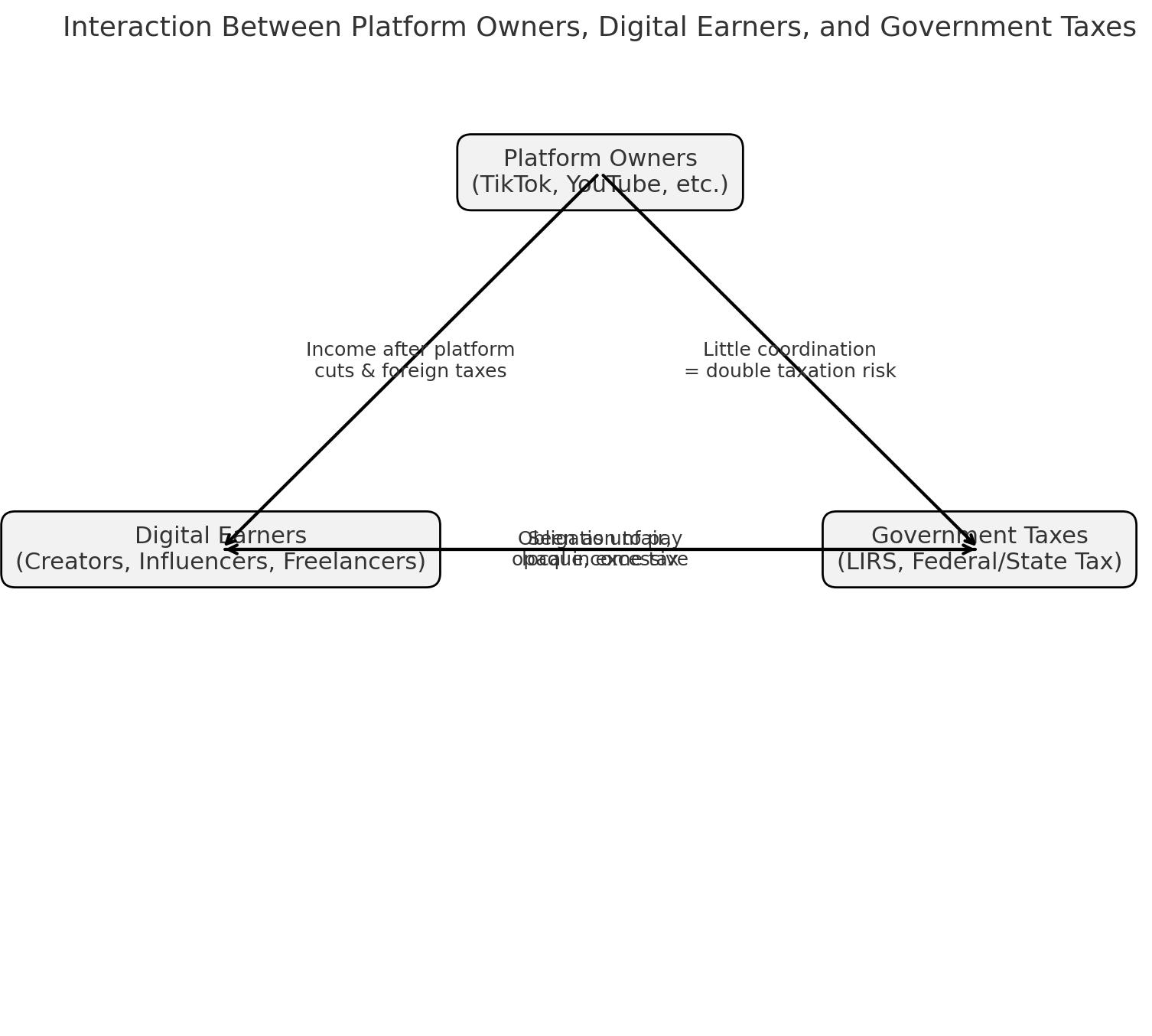
Digital platforms like TikTok, YouTube, and Instagram already deduct taxes in their home jurisdictions. Creators are often taxed at source before receiving their income, which means that by the time revenue reaches them, it has already been trimmed. This places creators in a difficult position, squeezed between platform cuts and government demands. Without coordination between platform taxation systems and local tax regimes, digital earners face the threat of double taxation. What governments see as untapped revenue streams, creators often see as unfair duplication.

The challenge is also structural. These global platforms are not primarily accountable to Nigeria. They collect revenue in dollars or other currencies, apply their own deductions, and remit payments across borders. A Nigerian creator like Peller is therefore taxed first by a foreign jurisdiction and then expected to comply with local rules that take little account of the deductions already made. Without an international framework or bilateral agreements that protect digital workers, local tax authorities will continue to estimate aggressively, creating resentment and confusion.

The Vulnerability of Digital Earners

Creators like Peller represent a new economic class. They are self-made, often without formal employment, thriving on digital skills, charisma, and community. Their incomes are inconsistent. A viral video may bring windfalls one month while another may yield nothing. Yet traditional tax models treat them like salaried employees with predictable incomes. This mismatch fuels the perception that government taxes are blunt instruments, unable to capture the realities of creative digital work.

Source: TVC YouTube Channel,2025; Infoprations Analysis, 2025

For many digital earners, taxation feels less like civic duty and more like punishment for visibility. Government attention rarely arrives when creators are struggling, but the moment success is flaunted, tax authorities appear. Peller’s admission that his claims of high income on television were “packaging” underscores how dangerous visibility can be. In a society where legitimacy is tied to lifestyle displays, creators are often judged on appearances, and tax assessments follow accordingly.

This raises deeper questions about fairness. Should taxation be based on evidence of actual income or on estimates driven by visibility? If creators are to be integrated into the tax system, then transparency, dialogue, and accurate assessment are essential. Otherwise, digital earners will remain wary, seeing taxation as arbitrary extraction rather than a shared responsibility.

Government Taxes and the Trust Deficit

Taxation, at its core, is a social contract. Citizens give up a portion of their earnings in exchange for infrastructure, healthcare, security, and social safety nets. In Nigeria, this contract is deeply frayed. Citizens face poor roads, unreliable electricity, and underfunded hospitals, even as billions are collected in revenue. In this environment, a ?36 million tax bill looks less like civic responsibility and more like predation. The trust deficit makes compliance difficult because taxpayers doubt that their contributions will be put to collective use.

The politics of visibility also plays into this. By boasting of large earnings, Peller drew the gaze of the taxman. Many other creators, freelancers, and influencers earn without scrutiny, but the moment income is flaunted, tax authorities move in aggressively. This inconsistency undermines the legitimacy of the system. Taxation is indeed mandatory by law, but compliance depends on fairness, transparency, and credibility.

If Nigeria wishes to tax its digital earners fairly while also expanding its revenue base, three shifts are necessary. First, Lagos and the federal government must engage global platforms to design systems that recognize taxes already paid at source, reducing double taxation risks. Second, taxation models must reflect the volatile nature of digital earnings. Flat or estimated figures are inappropriate, and flexible, transparent assessments are needed. Third, citizens must see tangible benefits from taxes. Roads, healthcare, power, and social services should visibly improve if government expects compliance from digital workers.

The demand placed on Peller is not just about one TikTok star. It is also about how Nigeria integrates the digital economy into its tax framework. To tax without trust is to fuel resentment. To tax without coordination is to risk suffocating a growing industry.