Partech Africa has released its yearly startups funding report for Africa. African startups broke record book in 2018 – 146 of them raised US$1.163 billion in equity funding over 164 rounds. That is a 108% year-on-year growth in funding when compared with 2017 numbers. From the report, Nigerian startups attracted US$306 Million (+167% YoY) in funding over 26 deals (+53% YoY) with a total of 12 startups raising 13 rounds equal to or higher than US$5 Million.
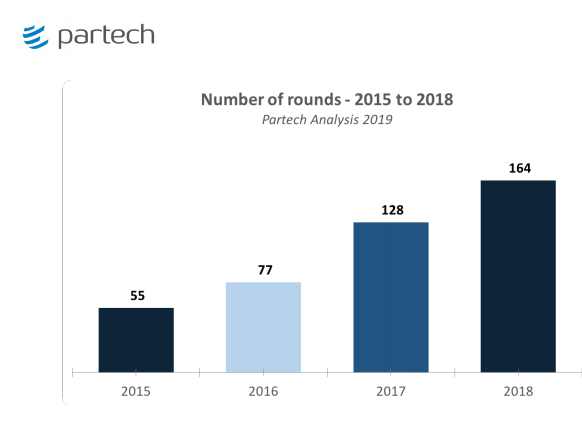
In 2018, 146 African start-ups raised a total of US$1.163 Billion in equity through 164 rounds, this is a +108% growth YoY, compared to +33% in 2016 and +53% in 2017. This represents x4.2 growth multiple over the last 36 months.
[…]
The three countries received 78% of the total funding with Egypt close behind, an exact repeat of last year. Kenya took the lead attracting US$ 348 Million (+136% YoY) in funding over 44 deals (+76% YoY), Nigeria has attracted US$ 306 Million (+167% YoY) in funding over 26 deals (+53% YoY) and South Africa slowed down compared to Kenya and Nigeria, with US$ 250 Million (+49% YoY) in funding over 37 deals (-12% YoY).
In the rest of Africa, there were 19 countries with at least one equity tech deal above US$ 200K this year, compared to 13 countries in 2017. So, it is clear that the rest of the continent is actually growing as fast as the top 3 markets and now attracts decent attention. It’s important to note though that Egypt takes the lead here with 19 deals, nearly catching up with South Africa in activity. Regarding French-speaking Africa, Senegal confirms itself as the leading hub with US$ 22 Million raised in 4 deals.
As typical, the data collation remains challenging – this number is different from what Weetracker published for 2018. Weetracker had reported that $726 million was invested in African startups. Sure, everything depends on metrics used by the tracking companies.
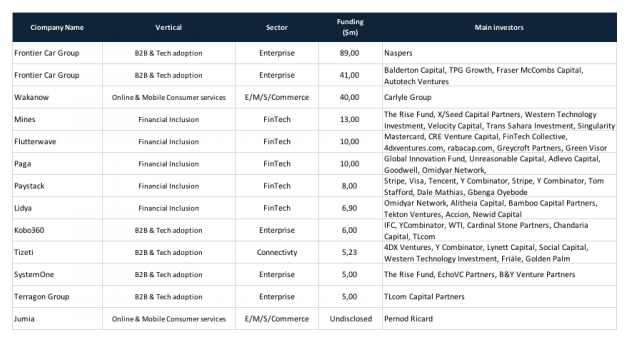
Nigerian firms in the report
Full Press Statement
Partech Africa publishes its annual report on the financing of African Startups and the numbers confirm the attractiveness of African entrepreneurs and their ability to transform the continent into a global powerhouse.
Cyril Collon and Tidjane Dème, General Partners from the Partech Africa Fund, published today their annual report on African tech start-ups and the numbers confirm their enthusiasm for the continent: US$1.163 billion was raised in equity funding in 2018, i.e. a 108% YoY growth.
The report, which is the third the team have produced, is based on the same methodology as the previous years: it covers equity deals in tech and digital spaces, and funding rounds higher than US$200K and lower than US$100 Million. Deals covered are both disclosed and undisclosed and the report only includes African start-ups i.e. companies with their primary market in Africa itself (i.e. in terms of operations and revenues).
The numbers show the growing attractiveness of Africa
In 2018, 146 African start-ups raised a total of US$1.163 Billion in equity through 164 rounds, this is a +108% growth YoY, compared to +33% in 2016 and +53% in 2017. This represents x4.2 growth multiple over the last 36 months.
“It’s quite simply astonishing. When we started our journey to create the Partech Africa Fund in 2015, we had anticipated the $1 Billion mark to be broken by 2020. We are now already 2 years ahead of our projections”, says Cyril Collon.
The Partech Africa report tracks a total of 164 rounds raised by 146 start-ups compared to 128 rounds from 124 start-ups last year, a +28% growth YoY. What is interesting is that the number of Series A & B stage start-ups attracting funding are massively accelerating with 70 rounds (+46% YoY), and that the number of large venture growth deals have increased as well, with 14 rounds (+100% YoY), totaling US$ 602 Million (+120% YoY). Regarding investors, PE investors and major corporate players are now joining the game earlier, investing early & growth stage tickets in African tech start-ups.
Kenya, Nigeria and South Africa still leading the race!
The three countries received 78% of the total funding with Egypt close behind, an exact repeat of last year. Kenya took the lead attracting US$ 348 Million (+136% YoY) in funding over 44 deals (+76% YoY), Nigeria has attracted US$ 306 Million (+167% YoY) in funding over 26 deals (+53% YoY) and South Africa slowed down compared to Kenya and Nigeria, with US$ 250 Million (+49% YoY) in funding over 37 deals (-12% YoY).
In the rest of Africa, there were 19 countries with at least one equity tech deal above US$ 200K this year, compared to 13 countries in 2017. So, it is clear that the rest of the continent is actually growing as fast as the top 3 markets and now attracts decent attention. It’s important to note though that Egypt takes the lead here with 19 deals, nearly catching up with South Africa in activity. Regarding French-speaking Africa, Senegal confirms itself as the leading hub with US$ 22 Million raised in 4 deals.
Sector breakdown: outstanding rise of Enterprise/B2B platforms
Driven by Fintech, financial inclusion remains the main investment sector in the continent, attracting 50% of the total funding. However, Cyril Collon and Tidjane Dème witness a shift in the second most popular sector with 30.4% of funding (vs 13% in 2017) now being invested in B2B & Tech adoption, while Consumer Services account for 19.6% (vs 42% in 2017). “B2B models are naturally attractive for entrepreneurs. At a time where monetization is at the heart of the challenges, enterprise clients can pay and enable to present unit economics that can converge more quickly than B2C models. Of course, this is reassuring the investors”, explains Tidjane Dème.
The Africa Netpreneur Prize Initiative is Jack Ma’s flagship entrepreneur program in Africa led by the Jack Ma Foundation. Jack Ma is the founder of Alibaba – the Chinese ecommerce company.
The Prize will host a grand finale pitch competition in Africa where ten finalists from across the continent will compete for a share of US$1 million in total grant prize money. The mission of the Prize is to identify and spotlight African entrepreneur heroes and their stories to inspire the continent and beyond.
Igbo is the principal native language of the Igbo people, an ethnic group in South Eastern Nigeria and parts of Delta, Rivers and Edo States in the South South and Kogi and Benue States in the North Central. The language has over 50 million speakers in Nigeria and the Diaspora.
Igbo has over 20 dialects though dialect leveling appears to be occurring as Igbo Izugbe (General Igbo) evolves. A standard literary language was developed in 1972 based on the Owerre (Isuama) and Umuahia dialects though it omitted the nasalization and aspiration of those varieties. Languages such as Ika, Ikwerre, Ogba and Ekpeye are broadly considered as dialects of Igbo. Igbo is recognized as one of the three major languages in Nigeria and is a minority language in Equatorial Guinea.
Other Igbo speaking communities can be found in the USA (Staunton, Virginia where there is an Igbo Farm Village; St Simons Island, Georgia) Jamaica, Bahamas, Trinidad and Tobago, etc mainly due to the diasporas of current and past dispensations.
UNESCO predicted that half of the 7000 plus languages spoken in the world today will be extinct by 2025. It is estimated that one language dies every 14 days.
Roland Okeke Chimaobi, a software developer, with skills in Python and Java programming is out to make sure that this prediction doesn’t come to pass, for Igbo language, with his programming language IboLang which is a full extension of Igbo language in Python. With IboLang, you can write and run Python programs in Igbo: IboLang acts like Python3, and plays like Python3, maintaining all the Python syntax and methods. Users can use it to learn programming in their native Igbo language.
Igbo is an indigenous language popularly spoken in Nigeria, Ibolang is a full extension of the Igbo language in Python. With Ibolang, you can write and run python like programs in Igbo
Ibolang acts like python 3 and plays like python 3, it maintains all the python syntax and methods. user could use it to learn programming in their native language.
Brands which want to conquer the Igbo market with personalized technology solutions targeted to Igbo users and speakers, in their native language, should leverage the opportunity IboLang provides.
The decade of 2020s will be huge in Nigeria. I predict it will be a decade of immersive utilization of digital applications and systems, on traditional business sectors, fixing market frictions across industrial processes in Nigeria. We had 1990s for banking, 2000s for voice telephony, and 2010s for mobile internet. The 2020s will unleash productivity across sectors, via digital startups, triggering a Cambrian moment where our combination and recombination of digital primitives, will begin the era of economic diversification in our nation. The decade of 2010s is providing the mobile internet and digital elements which our entrepreneurs will exploit to transform Nigeria, for good.
Recall this piece by Simon Obasi for Tekedia where he quoted Nigerian ministers thus: ‘Put mildly, “the government is unable to figure out any other way to fund the budget, so be ready to come to their aid”. In other words, expect more taxes!!!’
Simple! I was at the Deloitte Nigeria Economic Outlook event held last Thursday where two ministers (Budget & the Finance Minister) were present. Thanks Deloitte!
One positive takeaway was how much work Nigeria is doing in the ease of doing business. While we are yet to get there, a lot of progress has been made; targets top 100 in Global Ease of Doing Business Index.
But I was so worried listening to the two ministers, especially as it relates to the Budget and how to close the Funding.
Gap. Put mildly, “the government is unable to figure out any other way to fund the budget, so be ready to come to their aid”. In other words, expect more taxes!!!
It turns out that he is right: Nigeria is increasing tax rate and also introducing new taxes. I expect the VAT to move from 5% to 10% by Q2 2019 once budget is finalized. Possibly, we can also hit 18% on VAT, matching Rwanda. Besides the minister of Finance, Budget minister and Chairman of FIRS did confirm this impending increase.
The federal government has concluded plans to increase revenue by introducing new taxes, Minister of Finance, Zainab Ahmed, told lawmakers on Wednesday.
Mrs Ahmed spoke at the public hearing on the 2019 budget organised by the Senate and House of Representatives committees on appropriation.
The minister said the federal government has devised a new revenue initiative to increase revenue to fund the 2019 budget.
She said the initiative is segregated into three thematic areas and appealed for the support of the National Assembly.
#1 You now know why anyone that gets into government doesn’t want to leave? Because it’s very cold out there! Why worry about how much tax you pay when government pays your bills, even goes as far as bankrolling your incompetence; government work is really sweet…
Our economic managers are letting us know that when you are short on revenue, in an economy that is in paralysis, and at the same time bereft of ideas; the only option left for you is to increase taxes!
Apparently, the only thing politicians here know about governance is sharing of oil money, and when it’s not enough – squeeze the few productive people in the land even more, and you are good to go. The way we are going, we are sure to enter into a hole at some point.
When you see them campaigning for votes, you might be mistaken to believe they really have something in the head, but it’s obvious that the heads have always been empty.
This is a direct consequence of N30k minimum wage, if you don’t like it, you can choose to slap yourself; they are done with you since!
#2 Taxes are creations of laws,and laws creation of the legislative arm.Any disagreement we have with any law can be well taken care of at the hearing stage of the law making process,the executive have no absolute powers,we should by now be taking this issue up with our representatives at both lower and upper chambers of the National assembly if really there is any truth on this issue but last week Mr Babatunde Fowler FIRS Executive Chairman denied this,but said what was in the offering was actually the widening of the Tax net rather than increases.
#3 Comparison to other countries do not create enough yardstick,because when you compare the amount of foreign investment in their economies in the last 5 years to Nigeria,you will see reason for their high figure . The tax increment is better where there is enough stimulus for increase in investment and micro economy indicators are high. The economy is stagnant and they are increasing tax for the few investors. I do not think that the Nigerian economy managers with all the written economic policies really know how to get these monies except through tax increment.