DD
MM
YYYY

PAGES

DD
MM
YYYY

spot_img

PAGES

Home Blog Page 7

Palo Alto Networks Expands Google Cloud Alliance in Multibillion-Dollar Deal as AI Security Becomes Boardroom Priority

0

Palo Alto Networks on Friday said it will migrate key internal workloads to Google Cloud under a new multibillion-dollar agreement that significantly broadens and deepens an already extensive strategic partnership.

The deal highlights how cybersecurity and cloud computing are becoming inseparable as companies accelerate the adoption of artificial intelligence.

The agreement expands an existing relationship that has steadily grown over several years, positioning Palo Alto Networks more tightly within Google Cloud’s infrastructure and AI ecosystem at a moment when enterprises are grappling with how to deploy generative AI tools without exposing themselves to new categories of cyber risk.

As part of the deal, Palo Alto Networks is now using Google’s Gemini large language models to power its AI-driven security copilots, tools designed to help security teams detect, investigate, and respond to threats more quickly. The company is also relying on Google Cloud’s Vertex AI platform to build, train, and deploy AI models across its product suite, according to a joint release.

“Every board is asking how to harness AI’s power without exposing the business to new threats,” BJ Jenkins, president of Palo Alto Networks, said in a statement. “This partnership answers that question.”

The expanded collaboration goes beyond internal migration and product development. Palo Alto Networks and Google Cloud said the new phase of the partnership will allow joint customers to protect live AI workloads and sensitive data running on Google Cloud, enforce consistent security policies across cloud and hybrid environments, and simplify complex security architectures that often rely on multiple, disconnected tools.

The focus on securing AI workloads reflects a growing concern among enterprises that generative AI systems, AI agents, and large language models introduce unfamiliar vulnerabilities. These include risks around data leakage, model manipulation, prompt injection, and the exposure of proprietary or regulated information, challenges that traditional cybersecurity tools were not designed to address.

Palo Alto Networks already has more than 75 joint integrations with Google Cloud products and has completed roughly $2 billion in sales through the Google Cloud Marketplace, underlining the commercial importance of the partnership even before the latest expansion. The companies said the new agreement will deepen engineering collaboration, allowing teams on both sides to co-develop security capabilities directly within Google Cloud’s AI and infrastructure stack.

Migrating internal workloads to Google Cloud is also a strategic signal for Palo Alto Networks. The company gains firsthand experience securing large-scale AI systems, an experience it can then translate into products for customers facing similar challenges. The move also tightens Palo Alto Networks’ alignment with one of the world’s largest cloud providers as competition intensifies among security vendors to become the default layer for enterprise AI protection.

For Google Cloud, the partnership strengthens its positioning in enterprise security, a key battleground as it competes with rivals such as Amazon Web Services and Microsoft Azure. Security has increasingly become a deciding factor for large organizations choosing where to run mission-critical and AI-driven workloads, and alliances with established cybersecurity firms are central to that strategy.

“This latest expansion of our partnership will ensure that our joint customers have access to the right solutions to secure their most critical AI infrastructure and develop new AI agents with security built in from the start,” Google Cloud President Matt Renner said.

Market reaction to the announcement was measured. Shares of Palo Alto Networks rose about 1% on Friday, while Google shares were mostly flat, suggesting investors view the deal as strategically meaningful but consistent with broader trends in cloud and cybersecurity convergence.

More broadly, the agreement illustrates how the cybersecurity industry is evolving. Rather than selling standalone tools, leading firms are increasingly embedding their technologies directly into cloud and AI platforms, aiming to become foundational components of customers’ digital infrastructure. As enterprises move faster to deploy AI across operations, the ability to offer integrated, cloud-native security with AI built in from the outset is becoming a central differentiator.

In that context, the Palo Alto Networks–Google Cloud deal is not just an expansion of a partnership, but a reflection of how AI, cloud computing, and cybersecurity are converging into tightly linked ecosystems, with both companies seeking to lock in customers as AI adoption reshapes enterprise technology priorities.


Debt Takes the Lion’s Share: Nigeria Spent Nearly 72% of Revenue on Servicing Loans in Seven Months

0

Nigeria’s public finances are coming under increasing strain as debt servicing continues to consume the bulk of government revenue, leaving little room for investment in infrastructure and social services.

New data from the Federal Government shows that in the first seven months of 2025, Abuja spent almost three-quarters of its income paying creditors, a trend that underscores how deeply debt obligations are shaping fiscal outcomes.

The situation is becoming even more troubling when set against the scale of the country’s revenue weakness, with new budget data showing that the government is not only struggling to fund development but is increasingly borrowing just to meet existing debt obligations.

Figures from the 2026–2028 Medium-Term Expenditure Framework and Fiscal Strategy Paper reveal that in the first seven months of 2025, the Federal Government generated N13.67 trillion in revenue, yet spent N9.81 trillion servicing domestic and foreign debt. That meant nearly 72% of all income was swallowed by debt service. When personnel costs of N4.51 trillion are added, spending on wages and debt alone rose to N14.32 trillion, exceeding total revenue for the period.

This imbalance is unfolding against the backdrop of a far deeper revenue crisis. The Federal Government’s 2025 budget was anchored on spending of about N40 trillion, but Finance Minister Wale Edun told members of the House of Representatives Committees on Finance and National Planning earlier this week that the federal government is on course to close 2025 with total revenue of about N10.7 trillion — barely a quarter of the N40.8 trillion projected. That leaves a yawning gap of roughly N30 trillion, highlighting the scale of the fiscal hole confronting the administration.

The implication is twofold. First, the government has been unable to implement large portions of the 2025 budget because expected revenues have failed to materialize. Second, and more worrying, borrowing has increasingly been used not to fund new infrastructure or growth-enhancing projects, but to service existing debt and keep basic government operations running.

Oil revenue remains the weakest link. Between January and July 2025, oil earnings stood at N4.64 trillion, far below the pro rata target of N12.25 trillion. The resulting shortfall of over N7.6 trillion underscores the vulnerability of public finances to crude production challenges, oil theft, and price volatility. Dividends from key entities such as Nigeria Liquefied Natural Gas and development finance institutions also fell sharply short of expectations, further tightening revenue inflows.

While some non-oil taxes showed modest resilience, they were nowhere near sufficient to plug the gap. Company Income Tax slightly exceeded its target, and Value Added Tax performed better than projected, but customs revenue, Federation Account levies, and oil-related inflows all posted steep declines. Overall, aggregate revenue of N13.67 trillion was more than N10 trillion below the pro rata target for the first seven months of the year.

On the expenditure side, debt servicing overshot budget estimates, reaching N9.81 trillion compared with a pro rata target of N8.35 trillion. Foreign debt service, in particular, exceeded projections by nearly 29%, reflecting higher external obligations and exchange rate pressures. This overshoot came even as non-debt recurrent spending and capital expenditure were sharply curtailed.

Capital spending suffered the most. Only N3.60 trillion was spent on capital projects against a pro rata budget of N13.67 trillion, a shortfall of almost 74%. Releases to ministries, departments, and agencies were especially weak, limiting progress on infrastructure, health, education, and other critical sectors. The Budget Office partly attributed this to the extension of the 2024 budget, but the broader issue remains the lack of cash to fund capital votes.

The picture that emerges is of a government boxed in by deficient revenue, rising debt service costs, and shrinking fiscal space. With only a fraction of its N40 trillion budget funded, Abuja has been forced to prioritize debt repayment and salaries over development spending, even as borrowing continues to rise.

In 2024, debt service already consumed 77.5% of the federal government’s revenue. The 2025 figures suggest the situation has not improved. Instead, Nigeria appears caught in a cycle where weak revenues limit budget implementation, borrowing fills the gap, and an increasing share of income is then used to service the resulting debt. Without a significant turnaround in revenue generation, the data points to growing constraints on growth, investment, and the government’s ability to deliver on its policy promises.

Oracle Shares Rally as TikTok Deal Signals Strategic Windfall for Cloud Business

0

Oracle shares extended gains after news that the company will play a central role in a new investor-led structure set to take over TikTok’s U.S. operations, a deal that analysts say could become a significant boost for the cloud provider’s long-term growth and market positioning.

The stock jumped about 5% on Friday following confirmation that Oracle will serve as one of three managing investors — alongside Silver Lake and Abu Dhabi-based MGX — in TikTok USDS Joint Venture LLC, the entity that will oversee TikTok’s U.S. business. The transaction is expected to close on Jan. 22, according to a memo sent to employees by TikTok CEO Shou Zi Chew.

Beyond the immediate share price reaction, investors are increasingly viewing the deal as strategically important for Oracle at a time when the company has been under pressure over its cloud and artificial intelligence spending plans. Under the agreement, Oracle will be responsible for auditing and validating TikTok’s compliance with U.S. national security requirements and will host sensitive U.S. user data in its cloud infrastructure. That role effectively embeds Oracle deep within TikTok’s U.S. operations, creating what analysts describe as a sticky, long-duration cloud workload tied to one of the world’s most influential consumer platforms.

This is not simply an equity investment for Oracle. The deal positions the company as the technological backbone and compliance gatekeeper for TikTok in the United States, a role that could translate into substantial and recurring cloud revenue, stronger credibility with regulators, and an expanded footprint in large-scale data hosting and AI-driven content platforms. In an environment where cloud providers are competing aggressively for hyperscale clients, TikTok represents both scale and visibility.

The timing also matters. Oracle’s shares had come under sustained pressure in recent weeks, falling more than 20% over the past month, after reports that talks over a roughly $10 billion data center deal with Blue Owl Capital had stalled. That development heightened investor concerns about the cost, execution risk, and balance-sheet strain associated with the massive infrastructure buildout required to support AI workloads. Although Oracle shares remain up about 8% for the year, sentiment has turned fragile.

The TikTok agreement has helped shift that narrative. Investors see the deal as evidence that Oracle can secure marquee partnerships that justify its heavy investments in cloud infrastructure, while also differentiating itself from rivals through its ability to meet stringent government and security requirements.

The transaction also brings an end to TikTok’s long-running regulatory standoff in the United States. The app had been facing a potential ban after President Joe Biden signed legislation requiring ByteDance to divest TikTok’s U.S. operations over national security concerns. President Donald Trump later extended the deadline multiple times and signed an executive order in September approving a framework for a deal that would allow the platform to continue operating under new ownership and oversight.

Under the new structure, ByteDance will retain a minority stake, while Oracle, Silver Lake, and MGX will collectively own a controlling interest. Chew said the agreement includes retraining TikTok’s recommendation algorithm using U.S. user data, tighter controls over content moderation within the United States, and Oracle’s oversight of data security and compliance with agreed national security terms.

China has not publicly confirmed the deal, though Chinese state media reports suggest it is expected to proceed. According to CNBC, state-run outlets quoted a pro-Beijing academic who said the arrangement aligns with Chinese law and stressed that it does not amount to a sale of TikTok’s core algorithm — a sensitive issue in earlier negotiations.

However, the market focus is squarely on upside potential for Oracle. The company stands to deepen its cloud relevance, strengthen its ties with U.S. policymakers, and secure a high-profile validation of its infrastructure at a time when investors are demanding clearer returns from AI and cloud spending. That combination explains why Wall Street greeted the news as more than just a headline — and why the deal is increasingly seen as a meaningful tailwind for Oracle’s business.

9 Best Crypto Staking Platforms – Top Choices for Max Yields 2026

0

As we head to 2026, savvy investors are no longer asking whether to stake crypto; they’re asking where to stake crypto. With volatility still part of the game, staking has become one of the most reliable ways to earn passive income while holding long-term positions. But not all platforms are created equal. Choosing the best place to stake crypto can mean the difference between steady daily rewards and disappointing returns.

In this guide, we explore the 9 best crypto staking platforms for maximum yields in 2026, starting with a platform that has quickly positioned itself as a go-to option for both beginners and high-capital investors.

  1. HashStaking – The Best Place to Stake Crypto in 2026

When it comes to combining high yields, flexibility, and simplicity, HashStaking stands out as one of the best crypto staking platforms available today. Designed for investors seeking high returns without complexity, HashStaking delivers consistent crypto staking rewards across a wide range of assets.

Unlike many platforms that overcomplicate staking or hide fees behind confusing structures, HashStaking keeps things transparent. Users can stake popular assets, monitor daily rewards, and withdraw earnings with ease. This approach makes it perfect for investors looking for a dependable, long-term staking solution rather than short-term hype.

Why HashStaking Stands Out

One of the most significant advantages of HashStaking is its structured staking plans. Instead of vague APY promises, users choose clearly defined staking nodes with fixed durations, daily rewards, and predictable outcomes. This clarity is a major reason many investors consider HashStaking the best place to stake crypto heading into 2026.

Another standout feature is its strong support for major networks. If your goal is to stake ETH, Solana, or other high-demand assets, HashStaking offers multiple options tailored to different budgets and risk levels. Besides, rewards are credited daily, allowing investors to compound earnings faster than platforms that pay weekly or monthly.

Security also plays a central role. HashStaking uses advanced encryption, account protection measures, and operational safeguards designed to protect user funds while maintaining smooth performance.

Example of HashStaking Plans

To understand how the platform works, here are two staking options available on HashStaking:

Solana Staking Node

  • Staking Amount: $5,500
  • Daily Rewards: $75.90
  • Staking Duration: 7 days
  • Total Rewards: $531.30

This plan is ideal for investors seeking short-term exposure with consistent daily returns on a high-performance network.

Polkadot Staking Node

  • Staking Amount: $50,000
  • Daily Rewards: $1,800
  • Staking Duration: 28 days
  • Total Rewards: $50,400

Designed for larger portfolios, this plan demonstrates how longer staking periods can significantly boost total returns.

How to Get Started with HashStaking

  1. Create an account using your email address, a username, a password, and an optional referral code.
  2. Deposit supported crypto assets
  3. Choose a staking plan that fits your budget and reward expectations
  4. Activate staking and begin earning daily rewards
  5. Withdraw or reinvest earnings at the end of your staking cycle

This easy sign-up is one of the reasons HashStaking appeals to both newcomers and experienced investors.

  1. Binance Staking

Binance is one of the most recognized names in crypto. Its staking services are best suited for users who already trade on the exchange and want to earn rewards on idle assets. Binance supports a wide range of tokens and offers both flexible and locked staking options, making it a convenient choice — though yields are often lower than those on specialized platforms like HashStaking.

  1. Coinbase Staking

Coinbase is popular among beginners due to its clear interface and regulatory focus. Users can easily stake ETH and other supported assets directly from their accounts. While returns are generally lower, the platform appeals to investors who prioritize simplicity and compliance over high yields.

  1. Kraken Staking

Kraken offers a stable and transparent staking experience. Known for its strong security practices, it supports several proof-of-stake assets with predictable reward rates. Kraken is often chosen by conservative investors who value reliability over maximum returns.

  1. Lido Finance

Lido has become a leading option for Ethereum holders who want to stake without locking up liquidity. By issuing liquid staking tokens, Lido allows users to stake ETH while still using their assets across DeFi platforms. This flexibility makes it a popular choice for more advanced users.

  1. OKX Earn

OKX provides a mix of fixed and flexible staking products across multiple cryptocurrencies. The platform frequently offers promotional yields, making it appealing for users who actively monitor opportunities and rotate assets.

  1. KuCoin Staking

KuCoin supports staking for a wide range of altcoins, making it attractive to investors with diversified portfolios. While it may not always offer the highest yields, its accessibility and variety remain strong selling points.

  1. Rocket Pool

Rocket Pool is a decentralized solution focused on Ethereum staking. It allows users to stake ETH with lower minimum requirements than running a validator independently, appealing to decentralization-focused investors.

  1. Crypto.com

Crypto.com rounds out the list with staking options tied to its broader ecosystem. Rewards vary depending on lock-up periods and account tiers, making it suitable for users already engaged with the platform’s services.

Conclusion

While each platform on this list serves a different type of investor, HashStaking clearly leads for those seeking high daily rewards, structured plans, and an easy way to stake ETH and other major assets without unnecessary complexity. If you want to maximize returns while keeping control of your investment strategy, HashStaking should be your first consideration. Start staking now with a free $100 trial plan.

Crypto Casino CoinPoker Revamps Real Money Poker App On iPhone And Android With Freeroll Giveaways

0

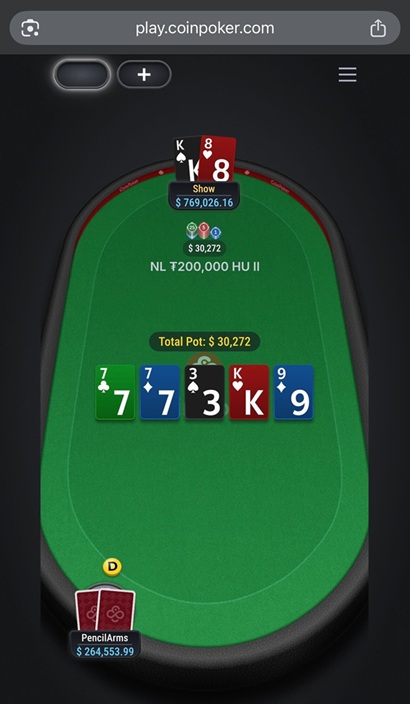
Decentralized crypto casino and poker site CoinPoker has launched a long awaited upgrade to its mobile platform. Previously only available as an Android app, the revamped poker app is now also compatible with iPhone devices in-browser with no download required.

To access the site on iOS, players simply need to visit play.coinpoker.com on any mobile browser such as Chrome or Safari.

Alongside improving the mobile poker app for speed and stability worldwide, CoinPoker has also added a new tournament to its monthly schedule: a $5,000 freeroll tournament.

That giveaway promotion is scheduled for the last Friday of every month at 5pm UTC with no buy-in required. Entry is exclusively available to any new players who sign up and use the code MOBILE during registration.

How to Join the $5,000 Monthly Poker Freeroll

Joining the Mobile Monthly Freeroll is very straightforward. Restrictions are deliberately low so that new CoinPoker players can benefit, with minimum obstacles.

It’s open to all new players sign up and play, like this:

  1. Visit play.coinpoker.com and register using bonus code MOBILE

  2. Play any of the real money poker games – cash games or tournaments, Texas Hold’em or Omaha, the choice is yours

Next, new players automatically receive a seat in the next Mobile Monthly Freeroll that takes place at the end of that month at 5pm UTC.

CoinPoker’s New Real Money Poker App: Fast, Smooth, and Download-Free

The launch of the Mobile Monthly Freeroll pairs perfectly with CoinPoker’s upgraded mobile poker platform. The platform is built to deliver a seamless poker experience directly through mobile browsers.

No App Store download or installation is required – players can get started playing iOS poker from anywhere, through Chrome, Safari, Firefox, or whichever iPhone browser they prefer, and then wait for the freeroll or jump into cash games immediately – stakes run from $0.01/$0.02 all the way up to $1000/$2000.

For beginners and recreational players, the $5,000 freeroll is a safe way to boost their bankrolls and try out the real money poker app for free in one large prizepool tournament.

The Mobile Monthly Freeroll also acts as an open door to explore the platform’s broader offerings, like the upcoming $10M GTD Winter Series, or 24/7 cash games. Now available directly through a mobile browser for smooth iOS poker experience on-the-go.

Latest Updates For Crypto Casino Fans

Checking the verified CoinPoker Twitter or Instagram is the perfect way to stay ahead of the pack, by seeing new promotions, crypto giveaways, upcoming tournament series, and exclusive events like the Android and iPhone poker freeroll before other players.

CoinPoker’s Twitter and Instagram also have never-before-seen footage and interviews with professionals like Owen “PR0DIGY” Messere or Triton ambassador Mario Mosböck, who recently launched a YouTube channel to promote the site.

The site regularly hosts major online poker festivals such as the Coin Series of Poker (CSOP) and the Cash Game World Championship (CGWC) with added value and crypto giveaways for players. The platform continues to push modern poker forward with transparent technology and an innovative design, now supporting iPhone poker play as well as Android poker, alongside its desktop client for Windows and Mac.

Games on the site are played in USDT, equivalent to USD, and the real money poker app also accepts fiat deposits in over 25 countries worldwide, automatically converted before you join the tables. For fans of other games, a full crypto casino and sportsbook are also available within the software. Both poker and casino play comes with a welcome bonus of 150% up to $2,000.

Visit the New Mobile Poker Platform Here

About CoinPoker

CoinPoker is one of the leading crypto casinos focused on fairness, innovation, and accessibility. Powered by a provably fair RNG and supported by some of the game’s most renowned players, such as WSOP Online Main Event champion Benjamin ‘Bencb’ Rolle, Hustler Casino Live regular Nik Airball, and many more.

CoinPoker has been ranked among the best crypto casinos and best poker apps across leading publications such as 99Bitcoins, Card Player Magazine, PokerScout and PokerStrategy.

Website: coinpoker.com

Media contact: media@coinpoker.com