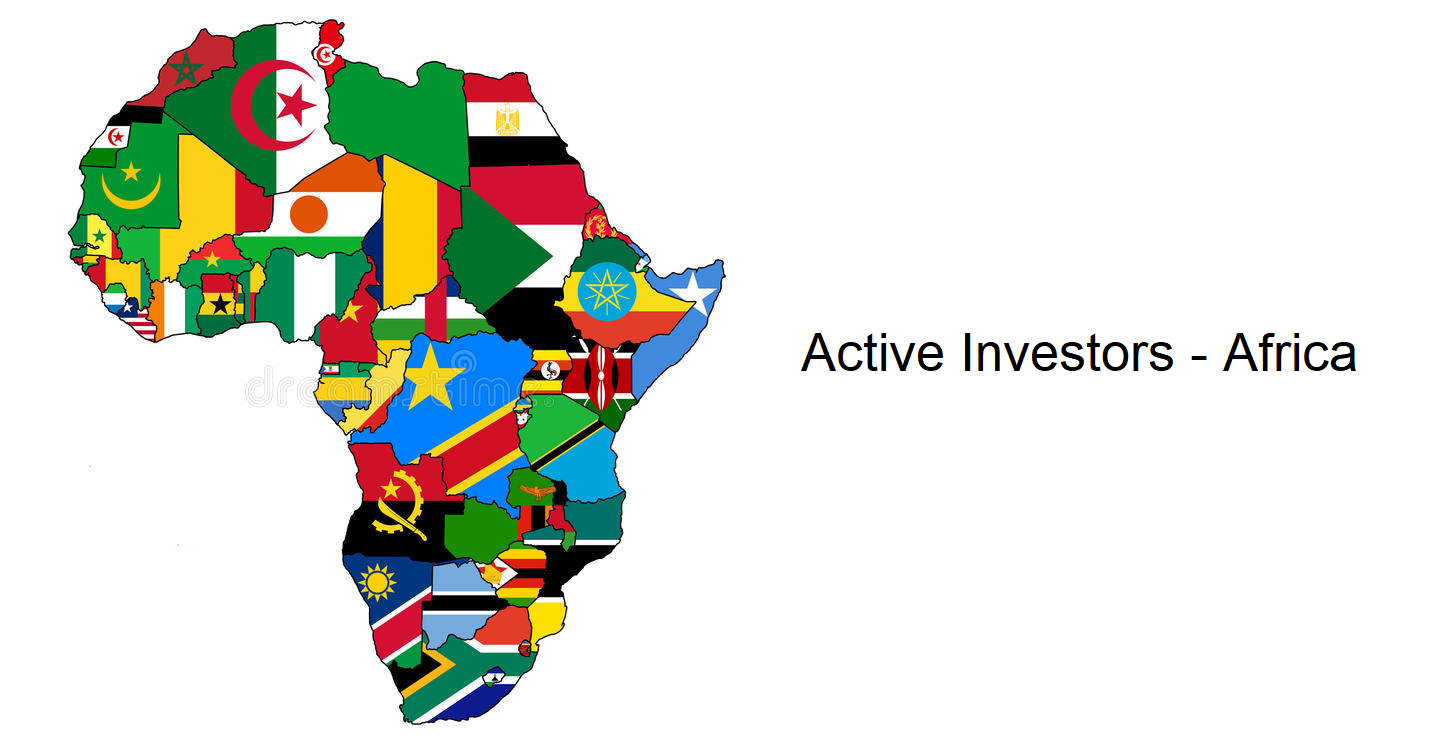
We are launching a new series on Tekedia. It is titled Today’s Active Investor. Daily, we will share profiles of ACTIVE investors who are investing on African entrepreneurs and their startups/businesses. To qualify, the investor must have done a deal within the last 12 months in continental Africa.
All the daily entries will be archived here.
[To make this easier for my team, please share suggestions to tekedia@fasmicro.com. Thanks]
In 2019, I am looking for that President that will “restore the dignity of man” (and woman) [thanks UNN] with the “fierce urgency of now”: Unimpeachable, diligent, pragmatic, intelligent and visionary with traits of decency, honor and service. With him/her, Nigerians will rise to the mountain-top, experiencing the unbounded promise of Oct 1 1960 as the first mounting of the Green White Green even as Union Jack [British flag] was lowered. We yearn: The President for the Knowledge Century.
Our world is changing rapidly. Across the globe, many events, including the unexpected election of Donald Trump as American president, point to a world where nations are looking for fresh ideas to overcome severe economic crises and survive the onslaught of global competition driven by the advent of information and communication technologies. The evolution of knowledge workers (or brain workers) is changing many national policies, as countries device strategies to manage the impacts of globalization by developing infrastructures on education, industry, health and energy. It is a new world where nations that fail to develop or learn, acquire and adapt technologies will remain poor. The emergence of China, and the continuous threats to many established industries by new ones, enabled primarily by brainpower, are showing that this is a ‘knowledge century’.
Knowledge will rule modern man and this knowledge is new, fresh and combative. Since Adam Smith’s ‘Wealth of Nations’, there has never been a more urgent time in the history of man where innovative economic and political leadership is required of leaders. The reason is simple; globalization makes it difficult to control factors like trade and labour, which hitherto, could be easily controlled to the advantages of nations.
Indeed, a world of unbounded and unconstrained markets with internet as the center of new business models, enabling platforms which have become more powerful than some nations. These platforms are restructuring the very elements which have held economies for decades. And they are just starting with new disruptions and dislocations coming.
From American Wall Street to Nigerian Broad Street, leaders have come to realize that new ideas are needed because many old economics are falling. New ideas that accommodate emerging variants that technology has enabled in both the political and economic national models. Models based on the theme that every nation has a limit to national wealth without science and technology. It is an understanding that the era where natural resources dominate international trade is giving way to that of knowledge resources. Natural resources are still important, but unfortunately, the most stable and prosperous nations are those that create ideas with army of knowledge workers.
A vision of new Nigeria is very important for the future of our nation. Our educational system needs immediate improvement. The advancement of any modern superpower has been fuelled by its educational infrastructures. And the collapse of any great nation has always been preceded by the decay in its education. The old Greece was known for its fine philosophers, the Babylon known for its wisdom and the old Egypt, where civilization began was known for its knowledge.
In its age, Egypt was admired for knowledge as the land of pharaoh had some of the best thinkers. Moses of the Bible was highly respected partially because of his Egyptian education, which was better than his Israelite’s comrades. During the British industrial revolution, their education was the best, as no school on earth could be compared to Oxford and Cambridge. Today’s dominance of the United States is attributed to its education, which remains its best industry, at least at the university level. The schools drive the researches that translate to new technologies, which subsequently diffuse into the economy. America has the finest labs in the world and continues to dominate the roll call of Nobel laureates. It is believed that if America loses its educational superiority, it would lose its dominance in the world’s political and economic scenes.
How can Nigeria prepare for this century? We need leadership and fundamental changes in policies to modernize our education and industry. From electricity to road networks, Nigeria has the capacity to provide and sustain them; we are smart, ingenious and optimists. But our problem has been lack of 21st century level leadership.
Nigeria needs a leader with capacity to rally the nation in honesty, hard work and raise our imaginations beyond where we are today, and move us to believe in ourselves, and create the tools to make us build our nation. It must be a leader whose goals will not just be to keep government running, but one who can help the nation dream a bigger, larger and glorious vision that generations of Nigerians will unite for. A leader that besides running the nation will transform it.
A leader that can create a society to engage our brightest minds in government by evolving a new political system designed to seriously solve problems. A person who can engineer Nigeria into rebirth and restoration to offer a prosperous nation that is colorful, fluidic, vibrant and open for change. Yes, a person of immense intelligence, competence, pragmatism, and unimpeachable. A person of integrity, broad knowledge, enormous vision and solid experience; one that can stimulate more vibrancy in the private sector and move the public sector out of its stasis. With that leadership, Nigeria will witness changes in trade, education and commerce as battalion of knowledge workers emerges to give us the needed clout in the global arena.
Finally, Nigeria and indeed the whole world are faced with enormous challenges and opportunities. For Nigeria, the challenge is fundamentally developing the system to enable the emergence of new class of workers, the knowledge workers, and providing the economic environment where they can flourish. The opportunity comes by using the skills of these workers to grow the economy by diversifying the petroleum-based economy and move millions of our citizens out of poverty.
We yearn: The President for the Knowledge Century.
This daily series focuses on business ideas for those looking to launch new ventures in Nigeria (and Africa in general). The short ideas are archived here.
The Problem
The Nigerian insurance sector is on paralysis. Unlike banking, it continues to struggle to permeate into the lives of average Nigerians. Even the people that sell the products do not use them. That tells you the scale of the industry problem [ask any insurance worker if he has home insurance for his village house; the answer is possibly NO]. But there is always someone to blame: the customers do not support insurance as though there is anything like that. No one wakes up in the morning looking for a business to support. Rather, people look for businesses to solve their personal and commercial frictions. Any business that delivers solutions for those frictions would get paid. With low penetration and poor value proposition, the insurance problem is huge.
The Opportunity
Interestingly, because the sector has not been redesigned means that opportunities abound. Though an insurance license is required to actually effect many changes, there are ways tech entrepreneurs can help insurance companies to use technology to improve service and advance the sector. By reducing the claim processing time even when improving the overall experience, insurers can make many people believers. Banks did that and got many people into the sector.
Claim assessment takes more than 12% of the global auto insurance premium, according to Fintech Collective. By using technology in that space, the insurers can easily evaluate the damages and pay timely. This will help its value proposition and possibly make it more appealing to customers. Today, insurance claims in Nigeria take months and customers just give up. Technology can speed up that process and help bring confidence in the industry.
Action Roadmap
Create a product I will call FasLoci to make it easier to explain.
Name of project: FasLoci
Description of technology: FasLoci is a high-end geo-location data collection and management suite which encompasses a mobile application for crowdsourcing geo-location data, remote datacenters for data repository and a web service for content management. It will work in any location and can be configured to support any insurance company.
Application: What FasLoci does is to aggregate photos as they are being taken, tag them with GPS location, and then send them to a repository server where they can be sorted. It offers to clients a technology that will help them associate any photo with its GPS location. The applications are enormous – retailing logistics, insurance claims investigations, trust system in farming, etc.
Take for example an insurance company asking its clients to download the apps and use that to take photos after accidents. They take the photos from their phones which immediately are synchronized to the insurance server. The insurer will look at the photos and compare the report from the Police where available. If they match the location where the Police have described, the insurer will know the photos are legitimate. They do not have to travel from Port Harcourt to Opopo just to gather data. [This is the idea which I explained in details with technical features and structure here].
This daily series focuses on business ideas for those looking to launch new ventures in Nigeria (and Africa in general). The short ideas are archived here.
The Problem
One of the best business ideas to consider is simply DO NOTHING. Yes, you do not have to put that money in any business venture. Yet, you want that money to work for you, possibly beating inflation. There are options: savings, fixed deposit and treasury bills [all are insured or protected by the sovereign power of the Nigerian people, to a limit]. The challenge is selecting one among these three options if you decide to do nothing. In other words, choose a strategy that delivers (meager) returns while protecting the principal. It is key to note that investment is not just starting a company. Indeed, you can invest by putting your cash in treasury, savings or fixed deposit.
The Opportunity
Treasury Bills has many benefits. One of those benefits is tax benefits [you pay lesser on taxes compared with most other income sources offered in the financial sector]. Besides, Treasury Bills has rates that hover above 10%. Savings account investment is typically sub-optimal in Nigeria with low single digit rate. Savings rate will not necessarily beat inflation in Nigeria. Fixed deposit delivers better rates but you need to have more money to unlock the higher rates. Also, it requires warehousing the money for a long term which may not be possible depending on the personal situations.
Action Roadmap
Setup an automatic instruction with your bank to invest a specified amount from your account (savings or current) in Treasury Bills. They will roll it over monthly. You get paid the interests and at the end of the month, the automatic instruction reinvests the money in Treasury Bills. Note that some Nigerian banks do not allow this automatic instruction anymore. They expect you to come in person to re-issue the instructions [they do not want you to move the money out of the bank to the Central Bank. When you move it, they cannot use it to lend to customers]. But if you are diligent, you can do that monthly [over leaving it there for nothing especially if you can spare that cash for 30 days] or use banks that allow automatic rollover. Finally, I have detailed options here to consider including other alternatives besides the three I have briefly discussed here.
The following are the options, based on my synthesis of the scenario. This is happening as I am typing. The thought-process is how long it took me to type this, which is live.
Fixed deposit: You fix the money for three years in a good bank in Nigeria. That will do better than TB
Treasury bills: This can be substituted with the fixed deposit for higher returns
Stock market: You look for some good stocks especially in banking and invest. The risk is there but most are so beaten that they have no room to fall further.
Agribusiness: You explore agro-investing through aggregation with those doing so. Read my works on Aggregation Construct by searching tekedia.com. There are companies doing so. I listed some in my new book
Trade financing: You contribute to finance trade in some Igbo men going to China. But you need to have the right people. They mop money and use that money to bring container. This is a thriving business in Aba and Onitsha as most have shunned banks owing to the fees. And with the good returns, some people are taking risks. They offer good contracts and in some cases provide collateral as they own shops. Make it formal.
Startup/Angel investing: This is off for you as the 3 years will be too short for any meaningful support to the startup. You need to have a window of about 6 years to invest here
You might have read that O.A. has chosen me as the President of our LinkedIn nation [lol]. I am honored for the confidence from our citizens. I grew up in a village and was brought up with the African values of decency, honor and service. Since I left that village for my university education in Owerri, our nation has provided immense opportunities to me. I remain grateful to our nation. But my story is not typical.
As your President, I will institutionalize great moments across homes and communities, uniting all of us to a shared vision of a great nation that is open, dynamic, prosperous and hopeful. From the lagoons of Lagos to the mangrove of Calabar, from the savanna of Yola through the plateau of Jos, to the beautiful forests of Abakaliki, men and women, boys and girls and indeed all citizens will experience an unbounded optimistic future because we will serve.
I will usher a new dawn on nationalism to enable us achieve great success through societal energy. It will be based on substance, and fueled by visible economic roadmaps for all. The nationalism will bring our diasporas to return with money, investment ideas, global standards, networks and passion to build our nation. They will help develop a national pride and confidence, with skill and effectiveness, to harness our national power for national purpose, by using our cottage of intellectuals, artisans, professionals and patriots.
We have a history and we are living through one. The economic, political and institutional evolutions in our nation since oil became the mainstay of our economy remain largely non-core-market parasitic gains fueled by high oil prices. Our nation has not decoupled her fate from oil as oil still dominates our foreign earnings. The progress we have made in agriculture before the dawn of petroleum is equivalent to the progress made in our traditional African medicine which remains largely lost and undocumented.
So while we have knowledge, we have destroyed the process of our learning and experience. Years of poor policies have produced series of catastrophic convulsions that damaged our economic, agricultural, trade and intellectual capital and turned once a vibrant virtuous cycle into a vicious one. They changed a bright modernizing economy with ruthless pragmatic agricultural program into one that cannot feed her citizens. Under my watch as your president, I will work to make our nation one that can feed not just itself but its neighbors.
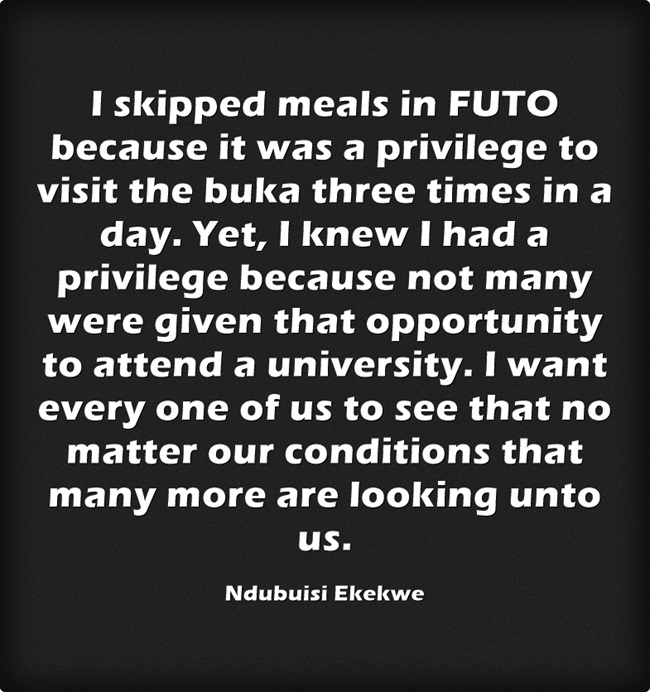
I skipped meals in FUTO because it was a privilege to visit the buka three times in a day. Yet, I knew I had a privilege because not many were given that opportunity to attend a university. I want every one of us to see that no matter our conditions that many more are looking unto us. And as you do that, our government will look unto every one of us. We are one nation, bounded by the sheer power that we have the finest entrepreneurial minds in Africa. I want to tap into the skills of our fellow citizens, making sure that we can all build that nation we all deserve.
Our economy must be diversified towards evolution of potential synchronous regional growth sources across all states of our nation. This will drive an efficient, business-friendly regional system that will support the present effervescence in our economy. A system that will move us from potentially episodic and ephemeral achievements of the present capital markets to a diffused learning that will transform artisans, traders, sculptors and farmers and move them up to learn and apply at higher levels. We will support small and medium enterprises (SME) across our nation. I will engineer a vibrant economy.
To build a nation, I present these pillars. I invite you to come and join this government. We will make our nation the finest where all men and women will come to cherish.
Pillar 1 – Anti-Corruption & Business Reform: We will build a corruption-free nation where it would be extremely impossible to perpetuate corruption because technology will make things obviously transparent. All government systems must be structured to be corruption-resilient so that people that want to perpetuate corruption will fail. We will publish any government expense that is more than N10 million in a web diary which all citizens will have access to. This applies to all levels in the federal government, from ministries to agencies. For national security reasons, a segment will be available to the civil society and accredited press team. Our government will improve business systems and make doing business in our nation easier.
Pillar 2 – SME Funding & Food Security: This government will fight the evils of our society which is poverty by creating jobs. I have confidence in the ingenuity of our fellow citizens and entrepreneurs to build a new nation for us. I will inject $5 billion into SMEs and agro-funding by helping them fund growths and build the future for our nation. All loans will be tied to BVN and re-payable. Any entrepreneur or company that takes the loan and refuses to pay back will be forever banned from our financial system until the person re-pays. The loan will be low interest of 3% re-payable over five years. The recouped money will be invested in new firms. The administration of this fund will go through our banking system with clear mandates on the structure and operation. This government will create two million jobs per year over the next four years. To fund this, I will tap the external reserves. For agriculture, specifically, we will transform the sector into an enterprising sector with injection of capital for research, production, and improvement of inputs looking at capacity for 10x improvement on yields within a decade.
Pillar 3 – Power & Energy: Today, I am instituting a total deregulation in the electricity sector, making it possible for entrepreneurs to have access to metering systems. Our government will fund the meters for households. Any energy producer with a minimum capacity of 10MW will have access to that metering system. We will make it possible for competitions to exist so that customers can receive quality service. We will have energy aggregation station and any energy entrepreneur that produces energy will be paid. We want villagers, communities and cities to have access to power.
Pillar 4- Education: Our government will have benchmarks to improve our educational system. Our people-centric policy will use education to deepen and improve our nation’s innovation. We will improve the compensation of teachers at primary and secondary school levels and demand measurable outcomes. At the post-secondary education level, we will inject $10 billion to help us attract, retain and develop innovations that will transform our nation. Under my leadership, every kobo of this $10 billion will be accounted for. All expenses with a minimum of N10 million will be publicly accessible online in each of the schools. My government has also chosen 6 universities which we will put extra resources to ensure that we can produce one of the top five African universities on research and innovation. I want you to judge me on this promise. Part of the funding will be a total change in our tax code which will open our public schools to private sector support.
Pillar 5 – Health: We all fall sick. Our nation historically has not served our citizens well in this area. My government will expand the use of the BVN/NIMC identification system to unleash a health insurance system in the nation. Every health system in our nation will be redesigned. Corruption perpetuated in the healthcare sector will attract a minimum of 15 years imprisonment which will be prosecuted and completed within 3 months. This administration will require registration of all products and services sold by health institutions from pharmacists, chemists to clinics to ensure they meet a minimum level of care. Governments working through health insurance scheme will support private sector initiatives in each ward to provide top-grade health services. For our fellow citizens that cannot pay, we will do all necessary to provide support systems to ensure that no citizen of this nation will suffer undue hardship because of financial capabilities.
Pillar 6 – Security: We will not fight security of our nation with just guns and bullets. We will use opportunities, food, schools, good health centers, and more to fight them. We will address the root causes that make young people to lose hope and join gangs and terrorism. We will not increase internal security expenditure. Rather, we will make the spending more efficient requiring the ability of EFCC, ICPC, selected Press and civil society to see any spending that is more than N10 million. We will do this while protecting national security. I have instructed the head of our defense that 10% of all security systems and solutions must be sourced locally. We are confident resources will be made available to build indigenous capabilities in this sector. In the time of war, some industries arise. We will use our manpower and companies to support our defense and security nexus. I want the equipment made in our nation: from 10% of all defense budget, we will move to 25%.
You might have noticed that some sectors like Transport and Land Reforms were not included. We are not ignoring them. We will tenaciously address the challenges therein but we want to start with these Six Pillars which are going to be catalytic to other areas.
Let us assume that you inherited 1,000 hectares of farmland in remote Abia state. Today, Nigeria will consider you a poor person because the asset is “dead” (un-transferable and no value). Under my proposal, I will get startups to map that farmland and record it in your name. Then, they will register it in the local government/ministry of lands. They would also put the assets in a portal which can enable you to sell say 100 hectares to someone in Lagos, and the part-title moves immediately to the buyer with all powers of the state protecting that buyer. What is happening here is divisibility due to digitization of assets.
Also, you can put another 100 hectares as a collateral to a bank to get money to pay school fees for your kids and also attend to their healthcare needs. The balance of 800 hectares is documented in the ministry as assets in your name which adds to your net worth as a person.
My thesis is that by doing this, mapping and digitizing and linking that asset to you, your net worth could move from $0 (dead assets) to say $100,000 on that land. Simply, you are now worth $100,000!
By having the ability to “operate” on the $100,000 value, you have built liquidity as a person and have more capacity to borrow and spend, which boosts and drives economic growth. Banks, lenders etc will lend because they know your value is now $100,000, no more the old $0.
Understand that I have not focused on pure selling of any land to anyone. You do not even need to sell the land. You have simply unlocked the assets into your net worth. Also, you may not have planted any crops – this is not farming where we are talking of farm yields. This is purely making a class of asset which is “immobile” with no velocity to become transferable so that values can accrue to the owners.
Over the next few days, we would be publishing more detailed Action Plans & Roadmaps [see the Comment section for skeletal view]. I invite you to read them and connect as we build our nation. Believe in our nation!