

In this section, let us examine some of the methods which are used in malware analysis. Detecting Packed/Obfuscated: Packed or unpacked malware is malware that has been altered during a runtime compression, so that the malware will become tougher to be acknowledged by antivirus, making it tougher for malware researchers to carry out malware analysis. […]
9.1 – Malware Analysis – Goals and Types
Malware analysis is vital to understand malware actions. It helps firms understand existing exposure to malware by providing crime-ware analysis especially after incidence. There are too many alternatives on how attackers operate, using too many actions to hide their nefarious goals. McAfee estimates more than 8 million new alternatives. In analysis, the instant goal is to enclose […]
9.0 – Malware – Variants, Infections and Effects

The following are some of the major variants of malware: Virus: A virus is a program that reproduces its own code by attaching itself to other executable files in such a way that the virus code is executed automatically when an infected executable file is executed. A virus reproduces usually without your permission or knowledge. […]
Huge Lessons as Amazon Becomes a Healthcare Player

I believe one key thing in free markets: a stagnation of incumbents creates opportunities for new entrants. That is happening in the U.S. where Amazon, JPMorgan, and Berkshire Hathaway are working together to establish a new independent company that would redesign how healthcare works for their employees, and possibly the broad U.S. population. They cited rising costs, poor service and other factors as motivations. In the OECD, a league of rich nations, U.S. spends more per person on healthcare, and still comes near-last on derivable value. Yet, for years, the healthcare industry has not bothered to fix that paralysis.
Amazon is diving into health care, teaming up with Warren Buffett’s Berkshire Hathaway and the New York bank JPMorgan Chase, to create a company that helps their U.S. employees find quality care “at a reasonable cost.”
[…]
“The ballooning costs of (health care) act as a hungry tapeworm on the American economy,” Buffett said in a prepared statement. “Our group does not come to this problem with answers. But we also do not accept it as inevitable.
The new company will be independent and “free from profit-making incentives and constraints.” The businesses said the new venture’s initial focus would be on technology that provides “simplified, high-quality and transparent” care.
I tell you that this is a huge deal. There is nothing that stops Bank of America, Google, Apple and others from joining this healthcare company if they see it working. Just like that, the traditional players would be out of business. This is potentially disruptive because it would set a new basis of competition in the broad healthcare sector.
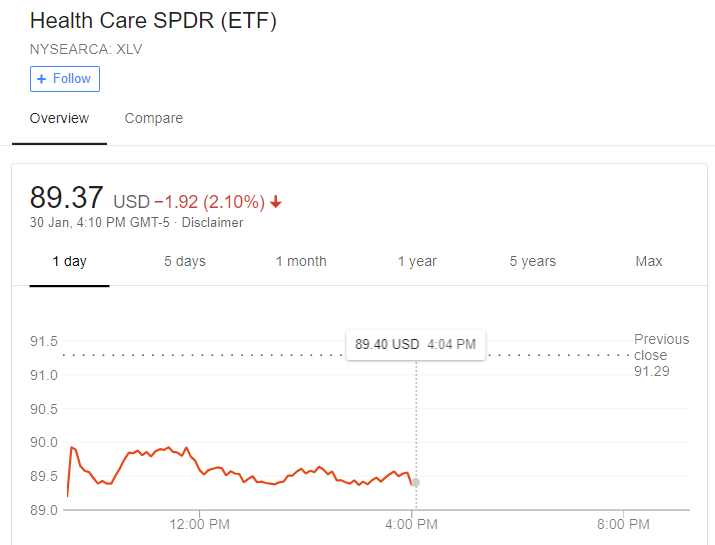
The warning shot has been fired, and many healthcare companies are on panic situations. Most saw erosion of values in the stock market today.
The news sent the S&P 500 healthcare sector .SPXHC down 2 percent in Tuesday afternoon trading, putting the group on pace for its biggest single-day decline since October 2016 and blunting the sector’s strong momentum to start the year.
Through Monday, healthcare had risen 10.5 percent already in 2018, the best performance among all major sectors and well ahead of the 6.7 percent rise for the overall S&P 500 .SPX.
Lessons for Nigerian Banks
As Nigerian banks continue to escalate transaction fees, they are simply pushing the customers to explore new channels. The rise of fintech would be correlated to the level of dissatisfaction with the banking sector by customers.
The new generation banks in Nigeria must understand how they grew: they innovated and provided a new basis of competition. Nigerians responded and embraced them. What they did to old generation banks could happen to them if the fees continue unabated. I have been looking at the annual reports of our banks and the trajectory is not good: the transaction-fees are now increasing faster than interest-fees. Simply, it is a more lucrative business to extract fees from customers than to lend them money to do business. That is not how to grow income, and if they stifle the companies, banks would have none, in future, to make their banking missions worthwhile. The Bankers Committee must lead and find a way to tell its members to apply the brakes on fees.
All Together
Just as the attitude of the healthcare sector moved Amazon (and patners) to plot a roadmap to provide better healthcare service to their internal customers, if our banks do not listen, they could open themselves to something regrettable. This is 21st century, customers do have options and most times they exercise them in ways you never expected. Perhaps, the healthcare industry leaders would have expected Amazon, JP Morgan and and Berkshire Hathaway to come begging for better rates. Today, they are reading that Amazon and friends are coming after their very businesses.
The Problem with Apple Siri’s Accented Language

I have written extensively that the strategy which Apple pursues through differentiated hardware and exclusive software would not work in any other market but smartphone. As I wrote in the Harvard Business Review, iPhone was a perception product which exceeded not just the needs and expectations of the customers, but met them at the level of perception. Replicating the business model of iPhone is any other product would be extremely challenging.
It is really important that the focus moves from the excitement on the technology to the value created in markets. We have to work on building products that bring perception demand. But just having the products is not enough. We need to find ways to also stimulate demand for them. By moving into perception demand, you have changed the basis of competition, a new curve, and if you do not clearly communicate, you could be alone. I never see Apple as a technically great company (yes, those fashion patents!). It does not need to be to have success. The company is peerless in innovation from the lens of customers and that is what matters.
Yes, that you got users at perception demand, for smart iPhone, does not mean that you will get them in smart speakers. So, that Apple exclusivity business model would become a limitation over time especially in these products where the more the users, the better. And that is what usually happens in platforms: you want to deepen your inversibility construct by making the user experience better. And that capability provides a positive continuum which works like this: a great product would attract more users, and the more the users, the better would be the product. It is about data which when it is used to improve the product further, makes it better.
Expect the same struggle as Apple moves into automobile infotainment. I am not really sure if many car companies would adopt the iOS platform (over the open Android) with its closed ecosystem of take whatever you are given, and nothing more. Car makers would like to have the capacity to improve and customize the operating system. Apple does not make that a possibility. That would hurt Apple. Contrast that with Android which you can largely do whatever you want.
Apple is losing in the voice assistant business. It does not have a radically great disruptive product which can technically change the basis of competition. Unlike iPhone, it is one of the players, and not ahead by any measure. So, the exclusive business model depresses its ability to attract more users in the ecosystems. Why work with exclusive Apple when Google and Amazon are open ecosystems. Android is a product that you can use to build a phone business; Apple’s iOS is exclusive to Apple.
Among Apple Siri, Amazon Alexa, Cortana (Microsoft) and Google Assistant, Siri is not the category-king even though it was among the pioneer. At the moment, Apple is yet to build a smart speaker business. It started the voice AI with Siri but it has massively lagged Amazon’s Alexa because even the people using Siri are the richer people who can afford Apple’s largely more expensive products. So, technically, Siri may not excellently understand poor people’s voices because not many of them are using it. That is a limitation to scale.
As Google and Amazon expand the nexus of their voice AI products, they would reach more users. The smart speaker business would give them more opportunities to add more voices and insights over Siri.

Who is winning the market for smart speakers with digital assistants? It’s not Apple yet, obviously. Amazon Alexa has a 69% share with an estimated 31 million units sold, trailed by Google Home with a 31% and 14 million units sold, according to surveys by Consumer Intelligence Research Partners.
We would be waiting for what changes when Apple launches a smart speaker to see if that would improve Siri’s numbers. I do not think so because Apple is sticking with its pricey exclusive strategy: “Apple’s smart speaker HomePod is scheduled for release on February 9. It will have an uphill climb given its higher price ($349) and late entry.”
Apple Siri has an accent problem: it can only understand rich people because it was born for the rich who have been communicating with it. In a world of economic diversity, Siri would be a minority. The other friends, Alexa and Assistant, born into human economic diversity, would have better careers in volumes and growths.