DD
MM
YYYY

PAGES

DD
MM
YYYY

spot_img

PAGES

Home Blog Page 7309

Google Android Pivots with HTC, Implications for African Startups

2

Google is paying $1.1 billion for the unit of HTC, a struggling smartphone maker that makes for Google the high-end Pixel smartphone. HTC, once an industry leader, has been struggling in the age of Apple and Samsung.

Alphabet Inc’s (GOOGL.O) Google said it would pay $1.1 billion for the division at Taiwan’s HTC Corp (2498.TW) that develops the U.S. firm’s Pixel smartphones – its second major foray into phone hardware after an earlier costly failure.

The all-cash deal will see Google gain 2,000 HTC employees, roughly equivalent to one fifth of the Taiwanese firm’s total workforce. It will also acquire a non-exclusive license for HTC’s intellectual property and the two firms agreed to look at other areas of collaboration in the future.

This deal has many implications. What is happening is that Google wants to move into a business model where it can effectively control both the hardware and software. Today, that is not possible as Android runs in many phones of different specifications and standards, making it impossible for Google Android to deliver top-grade experiences to its users. Unlike Apple, which controls all elements of its phone business, Google has relied on others for the hardware. The result has been mixed: user experience has been non optimal and Google wants to change that.

Yesterday, within just a few hours, most of Apple’s millions upon millions of users were using the latest mobile operating system, having tapped on the prompt to download iOS 11.

Contrast that experience on Android, where the company’s impressive and innovative updates are greatly hampered as it can take months, sometimes years, for those features to filter to users.

Google knows this disconnect between its software and hardware is a massive problem. And so this curious deal with HTC, which falls short of the rumoured buyout, is about solving that problem. If it can have close control over key premium devices, it can be more ambitious with its software.

In some respects, this $1.1bn deal is like a good friend lending their pal a few quid to tide them over for a while. HTC needs Google’s money to keep going. And Google needs HTC’s expertise and manufacturing capability to remain competitive with its mobile devices.

The Genius of Apple

Apple makes proprietary hardware and using that differentiation creates software and services which are highly exclusive. The ability to control all aspects of its design process makes it easy for it to make the best possible product. That helps it to achieve high margins even when serving a smaller number of people. It is a closed business model. But for Google, you have a company that cannot control its product: Android runs on different hardware which Google does not influence. The key way it can make money is to have as many people as possible, without necessarily delivering the best experience, using Android. While that makes Android look good on the number of users served, it has not worked for the profit margins desired. Google knows that and wants to own the hardware design experience so that it can more effectively control the user experience, mimicking the Apple business model.

Through this deal, Google will get closer to that. It will have an opportunity to control all aspects of Pixel and then give customers a real user experience that can be closer to what iPhone delivers in the market. It needs to do that to have any chance of competing in the smartphone market. This deal is to save Android and secure the future of Google mobile business.

Implications for African Startups

Everything you know about Google is going to change. In the next five years, try to see Google mobile device business from the same lens as you see Apple today. Google, while not going to run a completely closed business model, as Apple does with its hardware and software, will increasingly become a big player on the physical element of the mobile business. People will still buy the cheap Android but Google will set its eyes to recreate the experience of Apple. It wants the margin and it wants to pursue the most profitable customers. That means we could have “two versions” of Android possibly making it harder for some low-end phones we sell in Africa to run some of the latest Android updates. Google may not really care provided Pixel is engineered to compete against iPhone.

Simply, if Google tests a version of Android on Pixel and it looks great, it can launch it to the world. It is now left for the partners to deal with issues that arise. Yet, even if they work harder, it is not likely that those partners can get to the same level of integration Pixel will have with Android. The present model where Google thinks from outside to inside will be changed from thinking from Pixel world to the outside one. It wants to own its ecosystem and take this challenge to Apple by itself.

My suggestion is to see your mobile business with new perspectives on what the relationship with Google Android will become. It is changing and that will affect what happens to its partners in the future. By moving from a horizontally integrated model to a vertical one, Google has a new focus. Do not expect it to do well on both at the same time. It has made its decision with this HTC deal: Google wants to go vertical and offer choices beyond Samsung Android phones to iPhone.
 

Africa’s Key Innovation Pillar

1

Africans delight on their oral tradition of folklore. In many African villages, boys and girls gather around their elders to listen to stories of hope, imagination, bravery and justice.

These students of culture are expected to pass that tradition to newer generations. For many centuries, Africans have lived that life – a life of ‘more talking, less writing’.

It helped shape family values and embedded the spirit of service and honor. For generations, except Ethiopians, no African culture was able to develop a top-grade  indigenous way of writing.

Contracts were executed with words, marriages were concluded with words, lands were sold with words, and indeed all was about the memory of the human species. When neighbors disagree over land, an arbiter would come in to settle the disputes by telling stories his own parents or elders had passed to him.

Typically, Africans like to talk. That was the tradition. It has remained like that and will be the same for many generations to come. While the western world works to document on black and white or in modern times on bytes and bits, we are just making progress in our rural communities.

Many African universities have no organized way of processing massive data or ideas that emanate from their students theses, projects or dissertations. At the end of every academic year, student dissertations are burnt, to make temporary room for new ones.

It is the culture and no one has found a solution for that. Only few of those works made it to the university library. Years after years, we are burning ideas that can unlock the future of better harvest, and curing diseases that corporations think make no economic sense to invest resources.

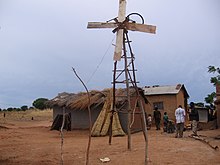
William Kamkwamba built a windmill for his family electricity needs (source: wikimedia)

Notwithstanding, many of the works are still done outside Africa and in most cases their contributions are overlooked. And Africans do not make things easier by not having histories since they rarely keep records. So, how do you assess their capabilities? Very tough and the vicious circle continues unabated.

Strange as it may seem, but that is the reality of many African schools where we run round in cycles wasting time without making progress. When you destroy your progress, you have to repeat it.

Instead of preserving legacies which can be built upon, we have students solving a problem someone that graduated a year before had solved. With no means of sharing data or documenting these works, innovation suffers.

Besides, it hurts the students because they spend money to recreate processes which had been validated a few years ago. It brings a tradition of constantly managing crises without a process to envision bold world changing ideas. They deprive the schools opportunities to attract funding because no one knows what they do. They are rarely published because local conferences are not common.

What Do We Do?

I think that a continental level effort must be put in place by African Union to ensure that all projects, theses or dissertations from any African institution are preserved and accessible on the internet. The NEPAD mission cannot stop in infrastructure and industries, they need to also examine the production and preservation of African works. This is very important as it will make our schools effective and more focused.

This does not have to be expensive. Schools will be encouraged to have websites or portals for this need. The website must be designed in a way that students upon approvals from their schools can post the works themselves. It promises to become a way to help the world know our contributions to knowledge. It can also help the world get refreshed with new ideas and perspectives.

What we are doing today has to change for us to make progress in technology and innovation. We need to document at scale. That is the pillar that will drive our efforts to become a region that can generate new ideas and also commercialize them. If we cannot document the little progress we have made, it will be hard for us to have the capabilities to advance towards the upper level of the technology pyramid.


Three Classes of Tech Companies, Their Growth and Profit Models

0

Bottomline: In this piece, I identify three classes of technology-enabled companies and startups. I begin from hardware to services, through firmware, operating system and application software to build the components on how these companies can be classified. By understanding this classification, technology companies can develop the possible growth and profitability models. The fact is this: […]

This post is only available to members.

The World of AgTech And Opportunities for African Entrepreneurs

1

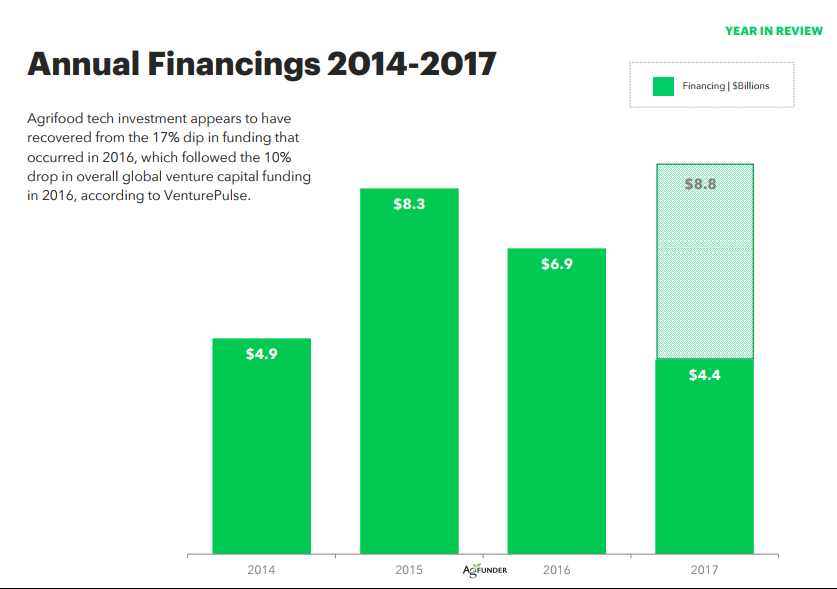
AgFunder has released its annual AgFunder AgriFood Tech Investing Report – MidYear 2017 which expands the scope of their previous AgTech Investing Reports to include startups across the whole value chain, from farm-to-fork.  According to the report, in the first half of 2017, the firm recorded $4.4 billion of early stage investment in agrifood (yes, agriculture or ag) technology startups across 369 deals globally. The key highlight:

  • Investment dollars increased 6% year-over-year indicating some recovery from 2016 lows. But there was a 27% decline in deal activity that was particularly acute at seed stage; this was in line with the global venture capital markets where deal activity reached a nine-year low in Q2. 
Source: AgFunder

From the report, Tekedia will like to educate on the emerging categories of agriculture technology.

What is AgriFood Tech or Simply AgTech?

Agrifood tech is the small but growing segment of the startup and venture capital universe that’s aiming to improve or disrupt the global food and agriculture industry. As with all industries, technology plays a key role in the operation of the agrifood sector, a $7.8 trillion industry, responsible for feeding the planet and employing well over 40% of the global population. The pace of innovation has not kept up with other industries and today agriculture finds itself as the least digitized of all major industries, according to McKinsey.

The industrial agrifood sector of today is also largely inefficient compared to other industries, with an increasing number of demands and constraints being placed on it. These pressures include a growing global population set to reach 9 billion in 2050; climate change and global warming; environmental degradation; changing consumer demands; limited natural resources; food waste; consumer health issues and chronic disease.

The need for agrifood tech and innovation is greater than ever. This creates many opportunities for entrepreneurs and technologists to disrupt the industry and create new efficiencies at various points in the value chain. Agrifood tech startups are primarily aiming to solve the following challenges: food waste, Co2 emissions, chemical residues and run-off, drought, labor shortages, health and sugar consumption, opaque supply chains and distribution inefficiencies, food safety and traceability, farmer welfare, and unsustainable meat production.

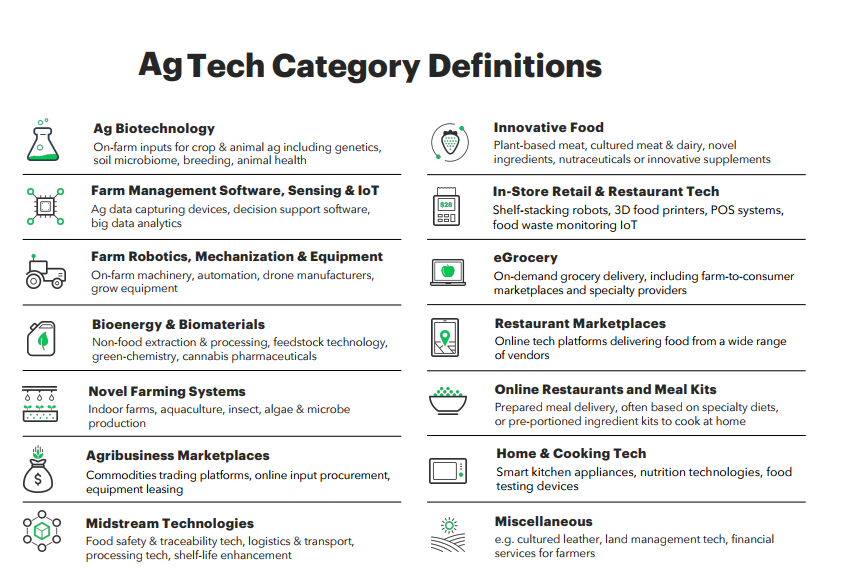
There are many ways to categorize agrifood tech startups highlighting the complexity of the industry, as noted below. These categories are areas of opportunities for entrepreneurs.

  • Ag Biotechnology: On-farm inputs for crop & animal ag including genetics, soil microbiome, breeding, animal health
  • Farm Management Software, Sensing & IoT: Ag data capturing devices, decision support software, big data analytics
  • Farm Robotics, Mechanization & EquipmentOn-farm machinery, automation, drone  manufacturers, grow equipment
  • Bioenergy & Biomaterials: Non-food extraction & processing, feedstock technology, green-chemistry, cannabis pharmaceuticals
  • Novel Farming Systems: Indoor farms, aquaculture, insect, algae & microbe production
  • Agribusiness Marketplaces: Commodities trading platforms, online input procurement, equipment leasing
  • Midstream Technologies: Food safety & traceability tech, logistics & transport, processing tech, shelf-life enhancement
  • Innovative Food: Plant-based meat, cultured meat & dairy, novel ingredients, nutraceuticals or innovative supplements
  • In-Store Retail & Restaurant Tech: Shelf-stacking robots, 3D food printers, POS systems, food waste monitoring IoT
  • eGrocery: On-demand grocery delivery, including farm-to-consumer marketplaces and specialty providers
  • Restaurant Marketplaces: Online tech platforms delivering food from a wide range of vendors
  • Online Restaurants and Meal Kits: Prepared meal delivery, often based on specialty diets, or pre-portioned ingredient kits to cook at home
  • Home & Cooking Tech: Smart kitchen appliances, nutrition technologies, food testing devices
  • Miscellaneous: e.g. cultured leather, land management tech, financial services for farmers
Source: AgFunder


Africa’s Path to “Zero-Click Ordering”

2

Something interesting is happening. A new age of electronic commerce is evolving, and it is going to be exciting for African entrepreneurs. It is very possible that we can grow digital sales despite digital illiteracy in the continent. In other words, we do not need the correlation of improved digital literary rates for digital commerce to happen across rural villages.  Today, digital entrepreneurs are losing sales because most of our people are not necessarily good in online purchase.

I have a case study: buying my new book takes a very simple process, we thought. But it seems we are wrong. For some people, it is not that easy to read through a book content, click a button to add to a cart, verify the cart content, and make a payment. It was laborious!

But the process we have mirrors what Konga, Jumia and other digital companies follow. While Amazon has a one-click ordering process, the customer must have setup payment and logged in before beginning that process. So, if you do not discount those early preparations, one-click ordering by Amazon is not really one step. No one needs to be logged in to read a free blog, so the first time to pay for the book is the very first moment the person needs to create an account in this blog.

Most of our readers are techies and geeks. But there is no doubt that Woo Commerce which we use in Tekedia to collect payment is non-optimal. Some customers prefer to handle the registration and payment manually. That is a big concern to me because if our readers – very brilliant people – are experiencing this level of friction with Woo Commerce, then there is a problem.

Interestingly, going deeper to the root cause of this issue, you will notice a factor. What happens is that naturally people do not have time to read everything on their screens. We prefer to talk. For most digital orders, following the steps will remove any problem, but you are assuming that customers will read through. Personally, I do not read all; I just click through, sometimes. So, solutions have to be built with those assumptions.

For me, the very fact that potential clients are having frictions means the system is non-optimal. It has nothing to do with the customer. The system must evolve to eliminate the friction.

I need a way that will simplify my customer’s experience. I think we need “zero-click ordering” so that anyone that wants to order will not have any single reason to wait. I see that coming from voice control or voice ordering.  Alexa has it already but that is for Amazon.

Voice ordering is getting very popular in America. Amazon is leading in that space. This is designed to help Walmart catch-up with Amazon. It will also help Google build new services in this area. Finding that leg into the e-commerce and grocery will be very strategic in its capacity to compete against Amazon in the broad technology arena. Above all, many will buy Google  Home, partly because of this deal, and that is good for Google.

For the whole world and especially the developing regions like Africa, Google has a template through Google Tez. It is the path to the next billion customers. This is a huge product that will change many things.

According to TechCrunch, Google has a product named Tez that can allow customers to make payments via audio. Period, you talk and the transaction goes through. Where are they testing it? India. It has the same demographics in terms of literacy rate as most parts of Africa. […]

I expect African developers and entrepreneurs to position themselves for this emerging opportunity. They have to find ways to build on top of Tez which will be easier since Google has provided the core elements. Yet, we also have to find ways to manage the accents and our spoken English flavor. There are many opportunities in this area and people have to get excited and begin to explore. I expect banks to begin to explore solutions in this space. Agency banking in Africa and indeed Nigeria will be anchored by voice computing. Google Tez can make that moment happen

What I Need

If you have not gotten the idea, Africa will need a solution that will enable people to make orders with minimal friction, possibly through voice (yes zero-click ordering), online. That will fix many challenges. You will make more sales when people talk than click. Because we like to talk, ordering has to move to the audio universe.

Some pizza companies have zero-click ordering via smile-to-pay where just smiling executes payment and orders a pizza via mobile devices. For others, it is just as easy as launching an app.

Zero-click ordering is as easy as it sounds. Download the app and link it to a Domino’s Pizza Profile. When the new app is opened, the saved Easy Order is automatically re-ordered without a single tap, swipe or click. Customers will see a 10-second countdown timer before the order is placed (giving consumers a chance to stop their order) and voila!

Note: Nigeria’s former minister of agriculture and now the President of the African Development Bank, Dr Akinwumi Adesina, received the World Food Prize for mobilizing agriculture in Nigeria through innovation anchored on mobile technology. He redesigned Nigeria’s agriculture with mobile wallet and other elements. Yet, he executed this turnaround through text-based technologies.

Now, imagine what will happen if “voice agriculture” can be linked to some of the systems in Nigerian agriculture which Dr Adesina and his team pioneered. With voice, farmers can execute contracts through their mobiles devices and records archived in the cloud. They do this with no interference to their farming processes.

All Together

As the voice operating world evolves, voice ordering will emerge and that is going to benefit places like Africa. The one-click ordering will help many businesses improve sales because what we have today can be extremely time-wasting in the age where young people do not have time. I am asking our entrepreneurs who have experiences in voice technology to key into this area because they will have natural advantages over companies like Google through localization and differentiation by mitigating algorithmic bias arising from accent and English flavors. By thinking of commerce, over just dissemination of information, we can solve a market problem that will end up improving the wellbeing of our people.