To be an entrepreneur, under most circumstances in Nigeria, is to declare to be visible. To be successful, you cannot hide. If you are an entrepreneur in Lagos, you must hustle. It is not a career that begins at 8am and ends at 4pm. Simply, when you sign-up, it is a 24/7 operation.
One thing that is very important is finding a way to find voice in the crowded space of the business world. You want people you want to hear about you, to hear what you are doing. The communication must be organic, authentic and from the top. It goes beyond press release released by the communication team. The world wants the Founder to speak and be visible.
Why is that necessary? Because tomorrow can bring different moves. As a startup, that is risk. You must navigate that process of moving from one phase to the other. This is not about being gentle. In short, if you think you are special, it is not likely you will be a good entrepreneur in Africa. To do well in this career, you simply have to assume you are nobody. That gives you the humility to wait for a CEO for 7 hours in the waiting room and when he appears, you thank him for the opportunity to be waiting. Yes, you are even lucky to be allowed inside the building. Your degrees, your products or whatever you think you have accomplished should not matter. The challenge before you is this: close the deal and have the papers signed.
Note one more thing: you are respecting that Office and not necessarily the individual. So, it is very important you have that mindset. If you cannot hustle as an entrepreneur in Lagos, forget it. And besides hustling, you must find a space to command. It requires total commitment and dedication for you to succeed..
Now, if you are among the lucky group that has raised capital, that means you even need to do more. One of the challenges in Lagos and indeed Africa is what I call the Sandwich Problem. You have raised money and been doing well, and need more capital, but no one wants to give you money. You are running low on funds and you cannot find new capital. The old investor cannot invest and new ones are not interested. You are sandwiched and that is a very dangerous state. (I have been inspired by the sandwich generation in coining the Sandwich Problem)
a generation of people, typically in their thirties or forties, responsible for bringing up their own children and for the care of their aging parents.
Most times, the reason why that happens, especially in Africa, is that no one knows you are even doing well. And suddenly you need to tell the story but the time is too short before you run out of money. But if you check promising startups like Paystacks, Flutterwave and Jobberman, they do all they can to tell the world how they are doing. That helps them connect with investors passively and when they need help, those people can become believers.
Jobberman was good. They received a huge in-bound investment in the past. They never asked for it, the company wrote them that they wanted to invest. The same thing happened with iROKOtv and many others. But entrepreneurs, who are doing well, but yet invisible, hoping that raising money is a calendar event, are always surprised when nothing happens within the window they have mapped out for fundraising.
You cannot be a sandwich startup. You must find a voice and be bold to tell your story. The world is listening. That can bring in-bound investments and also get investors ready when you need to hit the market. Being an entrepreneur is not a competition for who is the most invisible person. You must have presence to do well. Otherwise, go and get a job, where you can afford not to have a presence. You can be a gentleman or a lady of class. But to run a business, you must overcome all those classy attributes and swim and make noise. Otherwise, no one will know you are in the water. That you hate to speak in the public is a no-no, because being an entrepreneur is like a play except that it involves risking money. Lagos is a tough place to do business and to succeed, you must find a way to hustle.
The usual example is from agriculture where the addition of more fertilizers in a fixed land, will over time, not have material improvement in crop yield. I take that to explain the Freemium internet business and its monetization. You can add more users to downloading that software, but most times, the value obtainable from display ads does not improve the bottom-line significantly. You could have been better if you never have to make it free, focusing on subscription instead. This is the core of the Construct of Diminishing Freemium Monetization.
Yes, the more users have not translated to more revenue. Most blogs and digital systems follow this pattern, limiting the values they can create, as they never cross what I call the Freemium Break-even point, when huge value will be unlocked on Freemium business. That is the point, similar to the Break-even point in business, after which a business can succeed under Freemium model. That means, the business has enough user to do that. Facebook and Google are examples of companies that have significantly exceeded the Freemium Break-even point.
NB: In the videos and images, replace the Freemium with Free, to avoid confusion with the typical use of the word, freemium in tech.
Most entrepreneurs pursue Internet business with the mindset of a Free pricing strategy: offer services for free and earn revenue through advertising. With Google AdSense readily available, you see many websites operating on that business model. It is not just websites – most apps, games and web apps are based on the Free model, with the advertisement support. This differs from Freemium
Freemium is a pricing strategy by which a product or service (typically a digital offering or application such as software, media, games or web services) is provided free of charge, but money (premium) is charged for proprietary features, functionality, or virtual goods.
The Free business model is challenging in the age of ICT juggernauts like Facebook and Google which dominate the web sector. It has one major flaw: the concept that scale will bring more value, monetarily. Pre-internet, a small newspaper could have small number of paying subscribers, and with luck, that would be enough for them to take care of their bills. But today, that small newspaper is a global firm with users that could come from any part of the world. So instead of dealing with say 1,000 print paid customers, it may have more than 100,000 digital customers through its websites. But those digital customers are coming because the content is free on the web.
There is a problem there: the newspaper has grown by 100x but its revenue might have actually dropped. Why? It might have lost the paying 1,000 print customers, who now may be going for the free internet content also. Over time, the newspaper goes all-internet because no one is buying the printed products. Think of U.S. News which I used to subscribe, until the day they told us that they would cease printing the paper. They moved all to web, and in the process cut their workforce.
It is not just newspapers; we do that when we launch products (games, apps) on the web. You are giving out free software which people come to download. The idea is that by bringing the people, you can earn money through advertisement. The goal is to increase customer growth. However, the growth, most times, does not add much value to your bottom line as advertisement, the way it is done on the web, powered mainly by Google does not deliver good returns.
Sure, I understand that most online creators also get advertisements outside Google AdSence. However, only few creators actually enjoy this privilege. Majority of creators just depend on AdSence.
The law of diminishing returns states that in all productive processes, adding more of one factor of production, while holding all others constant, will at some point yield lower incremental per-unit returns.
The usual example is from agriculture where the addition of more fertilizers in a fixed land, will over time, not have material improvement in crop yield. I take that to explain the Free internet business and its monetization. You can add more users to downloading that software, but most times, the value obtainable from display ads does not improve the bottom-line significantly. You could have been better if you never have to make it free, focusing on subscription instead. This is the core of the Construct of Diminishing Free Monetization.
Yes, the more users have not translated to more revenue. Most blogs and digital systems follow this pattern, limiting the values they can create, as they never cross what I call the Free Break-even point, when huge value will be unlocked on Free business. That is the point, similar to the Break-even point in business, after which a business can succeed under Free model. That means, the business has enough user to do that. Facebook and Google are examples of companies that have significantly exceeded the Free Break-even point.
I do understand that not going Free is hard. When the quality of the product is not top-grade, it is very easy to give it away fast and wait for clicks. That is why the quality of products on the web may not be optimal compared to the printed ones where the estate is more at premium. You can have a crappy app which is free. But to ask people to pay, you have to make a great app. So, in a way, people that pursue the Free may be doing it based on their capacities to compete at the phase where payment will not be needed.
Case Study: Netflix and YouTube
Netflix operates on paid subscription while YouTube does not (sure, there is a small part of Youtube that requires subscription). YouTube has more users while Netflix does not. But under direct comparison, Netflix has created more value than YouTube. If Netflix is free, it surely would have had more users but the revenue it is generating today will be significantly lower. Its market cap is around $70 billion. Without Google, a standalone YouTube would not be up to that amount. YouTube competitors like Vimeo are not close to that level. Vimeo’s parent company, IAC/InterActiveCorp, hovers at $8.3 billion. My point is that Netflix has created more value than Vimeo and even YouTube through its closed system despite not having many customers which it could have commanded had it been free.
Free Break-even Coefficient
From the pros, “in accounting, the break-even point refers to the revenues needed to cover a company’s total amount of fixed and variable expenses during a specified period of time. The revenues could be stated in dollars (or other currencies), in units, hours of services provided, etc.” For internet Free business, the “revenue” here should be a factor of visitor traffic, i.e., the more the visitors, the more the advertising revenue.
Because you have no product you are technically “selling”, the usual calculation of break-even point will not apply here.
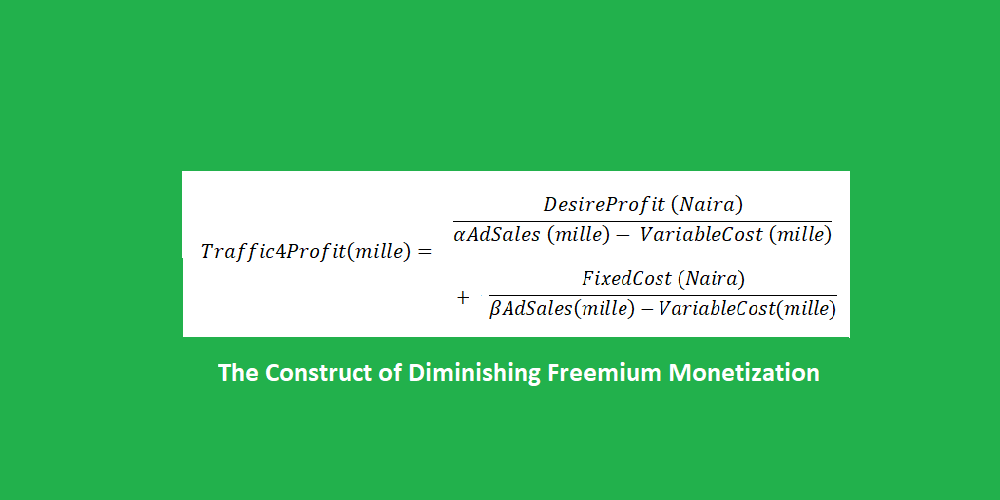
The biggest problem in Free model is that you do not even have control on anything. You do not know how Google prices the traffic and clicks. The king of search is not really transparent as it weighs cost of traffic depending on the location of the IP address. So figuring out the most likely break-even point (in volume of traffic) is hard. More so, traffic does not just mean monetization because many people visiting from Nigeria use Opera which blocks ads. So you can have improved traffic without more revenue. You need a coefficient, the Free break-even coefficient, to capture all the possibilities, if you plan to make the Free a business. That will help you determine what traffic level you need for a break-even in your Free business before you run out of cash. We have the equation thus.
The alpha and beta, the Free Coefficients, depend on many variables: the former has five while the latter has seven. I will leave them here to avoid complicating this piece. The left hand side is the total traffic (in mille, i.e. thousands) required to produce the desire profit. The Coefficients are calibrated for each sector, signifying how much you need to improve.
Free That Works
Free model works when a company has improved its Free coefficients. That means the money it makes through advertisement can cover expenses and then generates profit. The ICT Utilities like Google, Facebook etc have indeed exceeded theirs and that is why they are profitable. But that they have done it does not mean it is easy, for the following reasons:
You need so much scale to have the capacity to command huge revenue. Internet commoditizes value making it harder to easily differentiate. But that is possible, if you find your space. That you have a blog that looks like ThisDay and Punch will not do you so much good.
Your marginal cost must tend to zero since technically in a perfect internet, the marginal cost tends to zero. If that happens, it means that you can easily make profit. Your marginal price is already zero since you are on Free. But if the marginal cost is tending to zero, the small ads can give you profit
ICT utilities like Google and Facebook further puts more pressure in the system through aggregation. You will need a lot of work to differentiate to have a chance to make money.
All Together
I do think that differentiation on the web is important. That helps the ICT Utilities like Google to value your content in their models. But the greatest value is to be so good that you can enjoy subscription. The pursuit of digital growth, most times, does not hold much value because advertising cannot cover most costs unless you have a huge traffic breakout (meaning you have exceeded the Free coefficient). That is the big challenge for those that hope to make careers on the web, as creators. That focus of pursuing subscription from day one with high quality product should be in the central strategy. Becoming a category-king is very important to get people to pay.
According to TechCrunch, Apple plans to unveil an iPhone that will cost $999 or more.
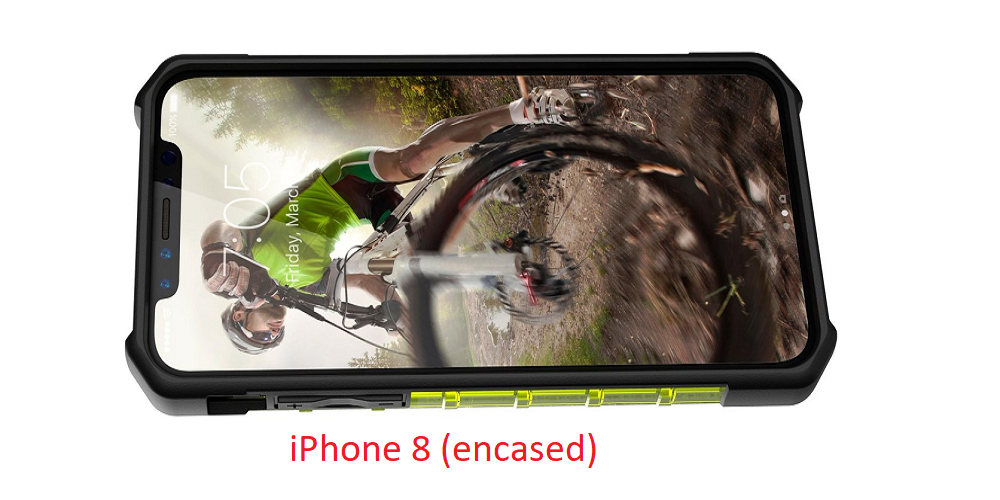
Are smartphones inevitably going to catch up with notebook computers in terms of pricing? It seems that way, as Samsung revealed its Note 8 priced at just under $1K, and rumors are that the forthcoming iPhone 8 (X or whatever it’s called) will also come in at $999.
That’s a lot of money to spend on a device, but smartphones ARE the only computer most people want or need anymore, outside of work. That’s helping justify an increase in the premium market. Also, it kind of fulfills the long-held view that Apple would move into the mid-market – except it did so by adding a new tier above the old definition of “premium.”
The reality is this: no matter how you see it, Apple is making the right move. Apple plans to raise the price of its current iPhone brand and make it super-premium. Yes, only few in this world can afford to spend $1,000 on a phone, which is not a laptop.
This strategy will become very clear in coming quarters. I have noted that Apple must have a phone with price range in the neighborhood of $300-$450. (Note as I explained in LinkedIn, this goes beyond hardware pricing)
A Comment: There’s the more affordable iPhone SE that still goes for $400 though.
My response: Yes, it goes beyond the hardware. I am looking at something in sync with the iOS. Android iOS evolves with all phone pricing level. Apple takes ages to get even the iPhone to the cheaper ones. I do think not allowing its iOS in the hands of many will hurt it. This goes beyond the hardware. It can introduce a phone at $1000, wait for it to sell on a new iOS. Then after 9 months, it launches a cheap $400 version. That means the iOS is coming late to cheap ones. That is bad and that is my point/
The following are the key reasons why Apple Corp must have these two categories:
Data is Critical. Right now, Apple is not collecting any data from the “poor world” for iOS, its operating system. The rich people will not be enough for the AI-first world. It needs all the data to help it make better products. A cheaper phone will help Appple
Car infotainment: In the next few years, many car companies will begin the adoption of mobile OS like Android and iOS at scale, as they bridge the gap between mobile and car. Since cars are sold in the emerging world, familiarity with OS will be a huge factor in adoption. Apple needs to ensure it has a cheap phone that will help introduce these citizens to the iOS
Emerging World is huge: Apple does not have any major strategy to win places like Africa. That is a big mistake because these areas will grow over time. Apple cannot just forget them. It needs a strategy to have them in its ecosystem.
Other Products/OS: Alexa can possibly become the voice operating system. You will like it to be in your ecosystem. The more the users, the better. If Apple remains the phone of the rich, companies like Amazon and others may not just take it the way they will take Android which remains available for both the rich and poor with its wide range of devices, at different pricing points. So, it makes sense for Apple to expand the customer base.
Yet, Apple has to be very strategic in its pricing. My suggestion is this: increase the price of the highest version of iPhone to $1,200 and make it more premium. And then introduce a phone brand called Apple and make the price $350. Make the design of Apple (the phone brand) to be radically different so that you do not cannibalize the premium iPhone. By having these two brands, Apple can compete in both the upper and lower segments of the markets. We will have Apples in Nigeria while they will sell their iPhones in New York. This is similar to Toyota selling Lexus and Honda selling Acura.
Feedback from LinkedIn Readers
These are selected comments from LinkedIn users when this piece was posted in my feed
The issue with Apple has many complexities. Its mindset is largely for the elites or high networth markets. It owns both the device and the OS (unlike Samsung that only owns the device). Samsung phones aren’t cheap either, the difference is that you still see cheap phones with Android OS. Apple wants everyone to ‘step-up’ to use its products, rather than Apple ‘stepping lower’, so that many more markets can afford its products. But when you throw in data collection into the mix, the dynamics changes, which calls for rethinking of its strategy. Maybe Apple is ‘afraid’ that having its products in the hands of ‘poor’ people could undermine its elitist root and feelings it conveys. A huge market is still out of Apple’s reach at the moment, if they want everyone on board, they know what to do!
Interesting abstract... I think the strategy, if adopted by Apple will result in an expanded premium market in Nigeria. We are peculiar and want to be better than our neighbor whose phone is missing the imperial ‘i’ . Anyways, I think the Apple brand (cheaper version of iPhone) is already in some markets, I stand to be corrected though.
The day Apple bow to the pressure of serving the mass market through low pricing, or segmented pricing, that is when it begins to lose its brand essence. Apple is an aspirational brand. Even for those who can’t afford the phone, some look forward to the day they can hold their iPhone. Apple create a perception of a VIP for its consumers. It has maintain this position for a long time. Now I also understand how difficult it is to maintain this strategy, but Apple has no choice but to maintain their brand essence. It is this same reason that makes Apple unique. The pressure to go for market share is unnecessary. I completely agree with Apple’s latest move. its risky but worth it.
Why Apple appears not have a strategy to address the mobile phone users in emerging /developing economies still baffles me. Going by their 2016 Form 10-K filing to SEC, the company remains a predominantly mono-product comapny with the iPhones accounting for ~63% of net sales.
Their sales by geography also shed some light on markets driving their growth. The Americas (North and South) accounted for ~40% of sales value while Europe (which according to their filing comprises European countries, India, Middle East and Africa) accounted for ~23% of sales while Greater China accounting for ~22% of sales value despite the large size of the middles class in China (which is larger than the entire American population).
For all of Apple’s success, I still believe their achilles heel will be their “over reliance” on the iPhone to drive YoY growth. Quoting a esection of the Form 10-K “The Company’s competitors that sell mobile devices and personal computers based on other operating systems have aggressively cut prices and lowered their product margins to gain or maintain market share. The Company’s financial condition and operating results can be adversely affected by these and other industry-wide downward pressures on gross margins”.
I do think the company needs to drive revenue growth from other income lines especially that of “Services” and “other products” which are not entirely hardware based. How and when this will happen remains to be seen. Till then we can only trust that the strategy currently being executed has taken into context some of these concerns.
We live in an era of unusual disruption of cultures, lives and businesses by technologies. As a little boy, I listened to folklore under the moonlight in my south eastern Nigerian village. The elders told the stories of justice, bravery, honor and humanity. There was no cellphone and there was no distraction. Life was under a predictable pattern, especially in the evenings when boys and girls would wait in turns to play under the moonlight, and receive moral education carefully orchestrated in the stories told by the elders. Every child belongs to the village and parents are nothing but stewards.
As we trekked miles to fetch water and firewood for the family cooking, we enjoyed the songs of the happy birds. We treasured the flowers and the gentle winds out of the thick rain forest near our stream. It was a life of great tranquility and we never had a suicide in the village. By norms and traditions, the fishes in our stream must not be fished. They were preserved and in most cases we played with them.
When it was time for school, we continued on that village tradition of brotherhood. The elders have mapped out lands in the village where people could go and plant fruit trees so that any villager, when hungry, could go there and eat. It was forbidden to sell anything from that land because it was designed to be a ‘strategic food reserve’. It worked; I planted an orange tree and my best friend gave the village a coconut tree.
But that was then. Many things have since changed, not just in my village, but around the world. Technology is disrupting all aspects of human existence and our lifestyles have changed. Industries are being demised and new ones are coming up with our lexicons constantly evolving to accommodate new tech-evolutions.
Lives Changed
Food preparation has been professionalized and families do not need to know how to cook. Technology and globalization have already changed family traditions.
As a boy, I heard of professional typists. These were specially trained pros who could churn out characters on typewriters at amazing speed. There are few of them today. There were shorthand experts; people that could write on special characters in order to capture statements as fast as they are spoken by their employers.
Many of these professions have since gone or are going. Technology is displacing their services. Computers make mastering of typing not a big deal since it does not cost anything to edit and delete when using word processing software. Compare that with erasing and changing stencils in a typewriter, you will appreciate the level of innovation that has taken place. A single mistake in a page could render the whole document useless; the typist has to start over, especially in quality documents, where erasure is not permitted. So the trade was to get people that could type with zero error, and at fast speed.
For those that are shorthand experts, video recorders with translation capability make it unnecessary to be writing when a politician or anyone is talking. Just record and soon print out the transcripts. Those experts are also fading. It is rare to see a journalist job that requires mastering of shorthand as Isaac Pitman invented it.
Have you noticed that the city of London could police the whole city through video cameras when in the old dull days, policemen might have been used? Those traffic policemen we used to see across many African cities are disappearing as most of the cities install traffic light systems. Those jobs or careers are being displayed by technology.
What of language interpreters? I recall a meeting in Kenya where someone was giving a speech in French and the interpreters were interpreting in English, Arabic and Portuguese. It worked out so well. But that career will soon die. If Apple or any of the Smartphone makers develop a good language translator in their gizmos, we may not need the interpreters, at least, in some gatherings.
Planning Careers of the Future
So, we have got a lot of challenges in career planning these days. Does it make sense to pursue this career considering how technology could change it in the future? How many ticket masters were displaced when airplane ticketing moved online? How will software affect journalism in the future? How is technology affecting parenting since technology is increasingly displacing our attention to our families? Those late night emails and constant trips to the phones at 10pm are all disruptions.
Planning for careers is not just focusing on what happens today or maybe in two years time. You must have a feel of where technology is going and then anticipate and stay ahead in your career. A business model to open physical bookshops may not be a good idea since most people rarely care to know the bookshop around their neighborhood these days. The first point is to order from eBay, Amazon or BN, if you are living in U.S. The local bookstore is model already endangered. The same goes with building cinema halls. Netflix, iROKOtv and others are our virtual cinema halls. They do not need physical locations; only that you must join via an IP address.
The interesting thing about this technology disruption on careers is that it does not matter what your level of education is. It could be that your industry is booming but has moved out of your locality. That brings the degree to which your field is outsourced. The easier your job can be automated by technology, the higher is the risk of technology displacement.
So when people discuss career planning, it is very imperative that you understand how technology and not just wages could play out in the future. If you specialize in a special type of engine design and from all trends, it is evident that that engine is going to be obsolete and you refuse to adapt and be retrained, you could be in trouble. Ask the expert photographers that made fortune washing and developing films in dark rooms. Those that failed to move to digital photography are only in history books.
All Together
Our world has been made better by technology because it improves our productivity and standard of living. However, it also carries a major challenge: disrupting careers and moving many jobs to museums. It is very important you stay ahead and see how new technologies could disrupt and displace your job. Never wait, plan ahead, and stay above technological innovation with new skills. In this age, as netizens, we must be learning constantly so that we can be ready for whatever comes. We already live in the web, so becoming Homo Netizens as Homo Sapiens may be one aspect of our adaptation. There is nothing you cannot learn from the web these days. That career resilience, disrupted by technology, can also be cushioned by technology. The web is an ocean with unbounded and unconstrained knowledge. You just have to make sure that you are swimming in the right direction with the waves.