DD
MM
YYYY

PAGES

DD
MM
YYYY

spot_img

PAGES

Home Blog Page 7318

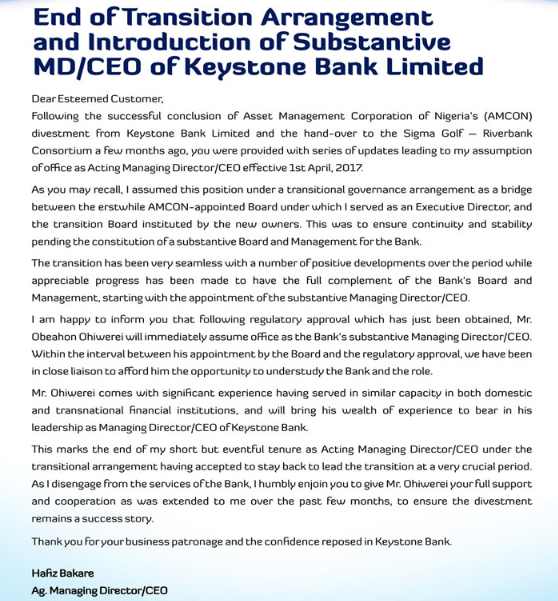
Obeahon Ohiwerei is the new MD/CEO of Keystone Bank Nigeria (profile)

1

Obeahon Ohiwerei is the new MD/CEO of Keystone Bank Ltd, Nigeria. He takes over from the acting MD/CEO Hafiz Bakare. This is his profile

Mr Obeahon Ohiwerei holds a first degree in Mathematics and a Masters Degree in Business Administration. He began his professional banking career with Guaranty Trust Bank Plc in 1991, and his exceptional performance saw him rise to the position of Manager within six years. After a successful career with GTBank, he worked with Standard Trust Bank (now UBA Plc) where he was appointed the Pioneer Group Head, Consumer Banking in 1998.

He resigned in 2002 as General Manager in charge of Lagos and West to join Pacific Bank Limited (then on Central Bank of Nigeria’s holding action) as Managing Director. He repositioned the bank with his new team within 15 months and moved on to take up a new appointment as the pioneer Managing Director of Standard Trust Bank Ghana (now UBA Ghana).

He was a Group Executive Director with Access Bank Plc for 7 years, and a Director in 3 of Access Bank’s offshore subsidiaries as well as FITC, Lagos.

Internet Will Destroy Fintech

0

This is a Short Note.

Yesterday, I wrote that ICT anchored the competitive evolution of Nigeria’s new generation banks, by unleashing productivity in the sector. I made a case that Internet, through its unbounded distribution, will destroy some of the banks, if they fail to adapt.

While ICT provided unprecedented productivity in the Nigerian banking sector, Internet is seriously “destroying” value. This is a “problem”. ICT made them, Internet could destroy some of them. Internet is bringing the construct of creative destruction in the Nigerian banking sector where values are destroyed and new opportunities unlocked. But those new opportunities are not going to be, exclusively, within the controls of the banks.

What Internet is doing today is expanding distribution of banking services thereby putting pressure on banks to control pricing on their own terms. Before Internet, they could charge huge fees to transfer money for clients to foreign accounts via their treasury departments, but today, with internet, there are options. The customers could simply use their debit and credit cards to settle the bills without first spending money on bank fees.

What Internet is doing to banking, it is doing in other sectors. I noted the redesign in the airline, entertainment and other industrial sectors. Internet is commoditizing many elements of commerce.

Now, I make a case that for some financial services, we may not even have a need to have firms. In other words, if Internet can link supply and demand efficiently, the core essence of firms will collapse. Companies exist to handle the friction which exists between supply and demand, as noted in the refereed piece above.

The essence of firms is to make sure that demand and supply have lesser friction. If you can use internet to remove that friction between demand and supply ( i.e. they can come together, with ease), you do not need firms. For example, if a saver can efficiently find a borrower, there is no need, partly, to go to a bank to put money to earn interest. If Internet attacks that, the heartbeat of most business sectors will be damaged.

Why Internet Will Destroy Fintech

At maturity level, Internet could enable seamless linkages between sellers and buyers in many industries: the implication is that many companies will disappear. Who needs an accountant when all transactions are powered by blockchain? Many areas we see in fintech (financial technology firms) will disappear; some include:

  • Remittance: As internet matures and the core elements developed, the world will have one “currency” and the elements of remittance will not be needed. Besides, the transfer of funds, if necessary, can be done without fintech in the midst. We already have companies doing remittance for free between U.S. and Europe. In future, that will not be a service because technology will make Internet to get all nations and their currencies to converge.
  • Payment: In a blockchain, no one  will need a bank or fintech to facilitate payment. The buyer and seller can exchange blockchain transactions to effect deals. It is going to be an advanced mPesa where buyer pays seller through the mobile number, except that mPesa is not owned by any corporate entity
  • Lending: With most frictions gone, lenders will lend to borrowers and all contracts sealed in the open general ledger of blockchain. The need for fintechs and banks will be limited.

As I noted in the piece, anyone that thinks that because it is a fintech, that the wave will flow in its direction could be wrong. Internet will redesign and even destroy the companies it had made possible. Internet is making today’s fintech possible and it may not spare them.  When consumers have unbounded access through unlimited distribution channels to immense product supplies, made possible by Internet, business will be totally different from the way we see it today.

As the distribution happens, IT utilities like Google, Amazon, and Facebook will be the clear winners. They will continue to tax advertisers or partners for access to web users who will see the world through their lenses. And with limited efforts they will make that linkage between buyer and seller easier displacing other entities. If you live in the Amazon universe and your neighbor does, you can shop for more than 80% of your life needs. Who needs a currency, when Amazon currency will suffice? Extend that to the top 10 digital firms, you will have a different world. They can lock the ecosystems making it extremely hard for any other firm to participate. They can take us to that friction-less commerce, except now the digital universe is within their domains.

All together, prepare for an unconstrained future. Fintech cannot be talking of disruption because they are also vulnerable, if the very pillars of Internet remains: unbounded distribution and commodification of value. The services would be endangered if blockchain becomes the pillars of modern digital economy.

Jumia Parent Company Is Buying a Rocket

0

Jumia parent company, Rocket Internet, is buying back its shares. This is certainly surprising for a company that is known to be raising new funds to start new digital companies or pump into current ones. Buying back its shares means that it is turning everything on its head. It wants to return money to investors? Not really, I do think it wants to boost its share price, which is not a bad thing.

The Management Board of Rocket Internet SE (“Rocket Internet”), with consent of the Supervisory Board, has resolved to carry out a share buy-back program with a total maximum consideration (excluding ancillary costs) of up to 100 million Euro and a maximum volume of up to 5,000,000 shares, representing a maximum of up to 3.03% of the outstanding share capital of Rocket Internet (the “Share Buy-Back Program”). The buy-back will be executed via Xetra trading on the Frankfurt Stock Exchange and will begin on August 14, 2017 and end on April 30, 2018. The repurchased shares are intended to be redeemed, and Rocket Internet’s share capital is intended to be reduced accordingly.

First, share buy-back “occurs when the issuing company pays shareholders the market value per share and re-absorbs that portion of its ownership that was previously distributed among public and private investors”. For Rocket Internet, there are three main reasons why this company will do this:

  • Rocket Internet shares are very cheap, so it wants to get many out there in-house. You buy back when you believe that your stock value is undervalued by the market
  • Vision is stunted, so buy-back can generate short-term share appreciation. You have no practical means (minus the share buy-back) to generate value which will move the shares.This comes after many frustrations that nothing has worked, over months and years, to get the stock going north.
  • Balance sheet is dislocated and some funds can be expended to pump up the shares. You have very terrible ratios and by reducing the number of shares available, you will magically improve many indicators like earning per share. Just like that, you will join some clubs, because the ratios will look good.

Many short-term investors will rush to the stocks to take advantage of this announced buy-back. As interests build, the stock will appreciate in value over the next few days, weeks or months since it expects to end it around April 2018. So you will see a decent price per earnings over the next few months.

Rocket Internet is doing well and it deserves a lot of commendation for even having this type of money to spend on buy-back. It does means it is generating cash. Over the last few months, they have listed a company (food logistics company Delivery Hero), sold companies (its Lazada stake to Alibaba), raised new capital, went to bond market and did all they needed to do to survive. The brilliance of the Management has seen the company holding excess of 1.7 billion euros in cash reserves. That is not a small feat.

As expected, the stock appreciated more than 6% in the German bourse where it is traded. The short-term investors are excited for quick gains. Yet, this stock position is still about half of its IPO value when it went public in October of 2014.

Rocket Internet has one big issue: HelloFresh, its meat-kit company, is undermined by the unfortunate performance of Blue Apron which went public and is turning out to be a disappointment. Amazon is rumored to be interested in this sector with the acquisition of Whole Foods. So, investors are careful in putting money in a company which may be unable to compete with Amazon, if it decides to enter the sector. With the performance of Blue Apron, there is no clear path to take HelloFresh public. This is partly one of the reasons why the stock is languishing. This share buy-back could help, albeit temporarily. They will get the rocket, in Rocket Internet, in-house, of course, nevertheless.

Nigeria Needs N180 Billion (Short Term Only) To Execute National Science, Tech and Innovation Roadmap (2017-2030)

0

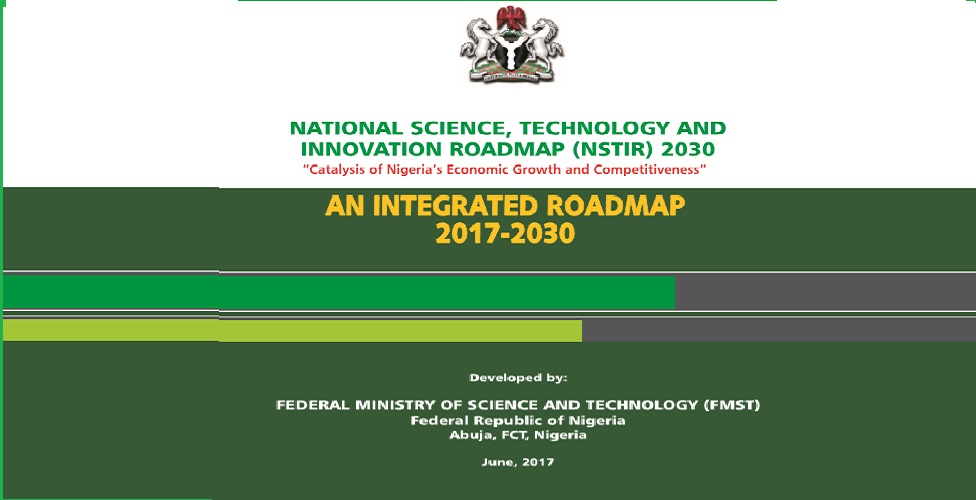
We have received a copy of the National Science, Technology and Innovation Roadmap (2017-2030). We are studying and will discuss contents later. Meanwhile, here is the Executive Summary, from the 197-page tome.

National Science, Technology and Innovation Roadmap (2017-2030) – Executive Summary

Nigeria is a country that is rife with talent and abundance of natural resources but is yet to achieve its potential in the development and application of science, technology and innovation (STI) effectively in national sustainable development initiatives. The deepest constraint has been non-implementation of effective schemes for propagation of talent and harvesting of the immense intellectual capital of Nigerians which if applied to Nigeria’s economic development challenges, would yield innovative systems and products for sustainable economic growth and competitive advantage over other countries. Oil dominates Nigeria’s trade, contributing about 90% of total export earnings as crude oil, an unprocessed material that does not contribute significantly to other industrial activities. The Nigerian industrial sector contributes only about 3% of Nigeria’s export revenue but gulps overs 50% of Nigeria’s imports, thereby ravaging the country’s balance of payments. It is well-recognized that there are some constraints to the attainment of Nigeria’s comprehensive development plans as well as sector plans, among which are inadequate power supply, limited financing, skilled mismatches and historical social system instabilities

Nigeria needs to diversify its economy by capitalizing on its huge talent bank and abundance of natural resources. This implies stimulation of productive activities and adoption of export mentality in other economic sectors such as agriculture, low-medium technology manufactured products, pharmaceutics based on local biological resources, processed minerals, and ICT services. Focusing on Nigeria’s 2014 Industrial Revolution Plan and many multi-year integrated and sectoral development plans, that targeted intensification of local manufacturing, the primary constraints have been inadequate infrastructure; shortage of skilled manpower; poor linkage to industrial subsectors; over dependence on export of raw materials; the subsistence nature of manufacturing activities without attainment of economy of scale. Inadequate investment in STI to generate new ideas, processes, systems and products that can compete favourably both domestically and in the global market has been a challenge that cuts across all the constraints stated above.

This National Science, Technology and Innovation Roadmap (NSTIR 2030) has been developed after detailed review of Nigeria’s challenges and opportunities since independence in 1960 and with fair assessment of future scenarios, to serve as Nigeria’s strategic plan for creation and deployment of STI utilities to national development initiatives, programmes and projects. The overall aim is to use STI as the catalyst for Nigeria’s long term sustainable development in consistence with the National Policy on Science, Technology and Innovation that was developed in 2011. The primary objectives of NSTIR 2030 are: to provide a long-term science and technology framework and support mechanisms for industrial revolution in Nigeria; to facilitate the creation and acquisition of knowledge for production, adaptation, replication, and utilization of technologies to support Nigeria’s technological and sustainable development aspirations; to support the establishment and strengthening of organizations, institutions, structures and processes for rationalization of decisionmaking; coordination and management of STI activities within an institutionalized national innovation system; and to encourage and promote the creation of innovative enterprises that can beneficially utilize Nigeria’s indigenous knowledge and technologies to produce marketable goods and services that compete with others in the global market. Additional objectives of NSTIR 2030 are to coordinate and support the development of science and technology infrastructure to enable significant research for production of methodologies, models and data to support Nigeria’s socio-economic development plans; to devise and implement systems for identification and pruning of STI talent at all ages and educational levels in Nigeria through support and incentives to build a strong long-term workforce; to coordinate the planning and catalyze the implementation of strategic projects such as those of space exploration, advanced computing, telemedicine, robotics advanced navigation systems and, nanomaterials that can accelerate the emergence of Nigeria as a technologically developed country. NSTIR 2030 congeals the STI elements of past and current national and sectoral roadmaps and plans. Among them are those of Vision 20:2020, the National Economic Empowerment and Development Strategy (NEEDS 2004-2007); 2017 National Economic Recovery and Growth Plan (NERGP); Roadmap for Growth and Development of the Nigerian Mining Industry (2016); the Nigerian Industrial Revolution Plan (2014); the Agriculture Promotion Policy (2016-2020); the National Renewable Energy and Energy Efficiency Policy (NREEP, 2015); the National Health Policy (2016); the National Communication Technology Policy (2012); the Draft National Transport Policy (2010); the Nigerian Water Sector Roadmap (2011); and the Roadmap for the Nigerian Education Sector (2009).

Although NSTIR 2030 is a long-term plan, short-medium term events can generate necessary adjustments in the overall plan while the major targets remain relatively stable. Essentially, shortmedium term opportunities to congeal systems toward attainment of NSTIR 2030 will not be ignored. On the other hand, the strategic nature of NSTIR 2030 will aid and factor into the configuration of tactical systems to address short-medium term needs. One of such short-term plans is the National Economic Recovery and Growth Plan (NERGP, 2017-2020) that focuses on the following objectives: macroeconomic policy improvement, economic diversification, competitiveness improvement, social inclusion, and Jobs creation. STI is an enabler of the planning and implementation of the NERGP 20172020. Apart from the analytical components such as models, simulations, designs and monitoring systems that can support the first three objectives, science and tech-supported entrepreneurship can generate ventures which when given the right policy framework and financing, can create jobs and promote inclusion. The year 2015 was the sunset of the UN’s Millennium Development Goals (MDGs) programme. Nigeria was active in the programme and used it to frame some of its socio-economic development programmes and projects as described in the 2005 report. Its successor programme-the Sustainable Development Goals was initiated in 2015 to cover the period up to 2030 which is incidentally the timeframe for NSTIR 2030 as well. There is then the opportunity for SDG 2030 programmes to overlap beneficially with this plan.

With respect to implementation, NSTIR 2030 is divided into 7 categories of objectives, each of which comprises several initiatives and projects. The 7 categories which align with the Roadmap’s objectives are Science Policy Support Programmes and Activities; Science and Technology Improvement; Research and Development Intensification; Training and Talent Deployment; Technology Deployment and Commercialization; and Science Literacy Improvement and Public /Stakeholders Engagement. NSTIR 2030 will be implemented in three time segments, namely: Short Term (2017-2020); Medium Term (2021-2025), and Long Term (2026-2030). NSTIR 2030 covers many high-utility projects that will be implemented by the various institutes/centers of FMST in collaboration with industrial partners, universities, other government entities and NGOs. Examples are commercialization of locally invented equipment and products, establishment of the National Science and Technology Agency/Fund, implementation of artisan training programmes, manufacturing of another set of satellites with expanded involvement of Nigerian scientists and engineers, establishment of advanced analytical laboratories and fabrication of several equipment and their components. Research and development support will be given by FMST units to steel development, automobile production, implementation of renewable energy technologies, telemedicine, local drug manufacture, processing of agricultural products, development and application of new materials in infrastructure and individuals processes, and development and economy-wide applications of ICT techniques, as well as several other STI advancements.

As described in Nigeria’s Industrial Revolution Plan published in January, 2014, systems are planned to make industry the dominant job creator and income generator up to 2020. The specific targets are to make Nigeria the preferred manufacturing hub in West Africa; and become the supply source of low-medium-technology consumer and industrial goods domestically, and regionally. The plan which is outlined, covers the creation of 8 general-purpose specialized industrial cities in strategic locations along transport corridors, creation of 6 Technology Innovation Clusters and improvement of services at Nigeria’s 27 Free Trade Zones. These facilities will present more opportunities for scienceand technology-catalyzed industrialization and create jobs for Nigerians with improvement of the socioeconomic services to Nigeria’s growing population which is expected to reach about 289 million by 2030. NSTIR 2030 which has many entrepreneurship elements, will catalyze the production of goods that meet standards specified by international markets in trade agreements.

Budget estimates for the short term programme total N180 billion over the three budget years (4-year duration) with the distribution of Programme Configuration and Planning (1.5%), Stakeholder Engagement Processes (2.7%), Management and Personnel Support (11.6%), Facilities and Equipment (25.6%), Deployment and Diffusion of Deliverables (3.4%) and Project Operations (55.2%). NSTIR 2030 will be implemented in collaboration with a wide variety of stakeholders, including academic institutions, public and private research and development centers, the private sector, State and local government agencies, non-profit and community groups, development partners and professional associations using revised and more efficient structures and governance systems that have been ratified by the Federal Government of Nigeria through the Federal Ministry of Science and Technology.

My Book Makes It into Clarivate Analytics’ Book Citation Index

0
The book award

One of my books, Nanotechnology and Microelectronicsmade it into Clarivate Analytics’ Book Citation Index. This is part of an email from IGI Global, the publisher, informing me of the addition.

Greetings! I hope this email finds you well. I would like to inform you that your publication Nanotechnology and Microelectronics (https://www.igi-global.com/book/book/40290) was recently indexed by Clarivate Analytics’ Book Citation Index, a part of the Web of Science Core Collection. Please take a moment to view the IGI Global Newsroom post, “Web of Science Indexes 46 IGI Global Titles” at this link: https://www.igi-global.com/newsroom/archive/web-science-indexes-igi-global/3323/.  We take great pride in receiving commendable endorsements and indexing and we appreciate your hard work and dedication!

….

Part of the Web of Science Core Collection, the Book Citation Index is one of the largest citation databases covering books in the sciences, social sciences, and arts and humanities. The index ensures that each reference is meticulously indexed and that only the most elite research is included. Inclusion in Web of Science, Book Citation Index provides greater discoverability, which leads to measurable citations and more transparency in the selection process. The new IGI Global publications selected for indexing include: