Africa’s CEOs are confident that the outlook for business on the continent remains positive notwithstanding the unpredictable economic and socio-political climate. PwC’s Africa Business Agenda report shows that 85% of African CEOs (Global: 85%) are confident in their own company’s prospects for revenue growth over the next 12 months. Despite the fact that only 30% of CEOs in Africa (Global: 29%) believe the global economy will improve in the next year, no less than 97% (Global: 91%) are confident about the prospects for their own company’s growth in the medium term.
Hein Boegman, CEO for PwC Africa, says: “This level of optimism is the highest recorded since we started our research on Africa CEOs in 2012. However, in the past year we have seen a change in the outlook for some countries as external developments impact many of the drivers of Africa’s growth.
“As countries around the globe try to make sense of the increased levels of risk and uncertainty that have gripped the world, Africa needs to continue rising by capitalising on all the opportunities that lie ahead.”
The report suggests that one of the reasons for such optimism on the Africa continent is that CEOs have learned to look for the upside and seize on opportunities that may arise in the face of uncertainty. In the wake of climate of muted growth, CEOs have also acknowledged that while they focus on organic growth and cost reductions, they also need to prioritise investment in new strategic alliances and joint ventures to expand their markets and grow their customer bases. According to the survey, organic growth (Africa: 80%; Global: 79%) and new alliances (Africa: 69%; Global: 48%) are the top activities CEOs are planning in order to drive corporate growth or profitability.
The Agenda compiles results from 80 interviews with CEOs across 11 countries in Africa and includes insights from business. The results are benchmarked against the findings of PwC’s 20th Annual Global CEO survey of 1 379 CEOs in 79 countries conducted during the 4th quarter of 2016. The Agenda provides an in-depth analysis and insights into how businesses are adopting to meet the challenges of operating in Africa.
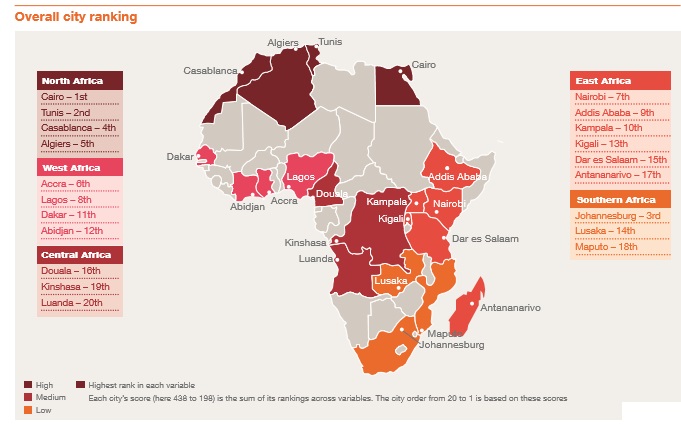
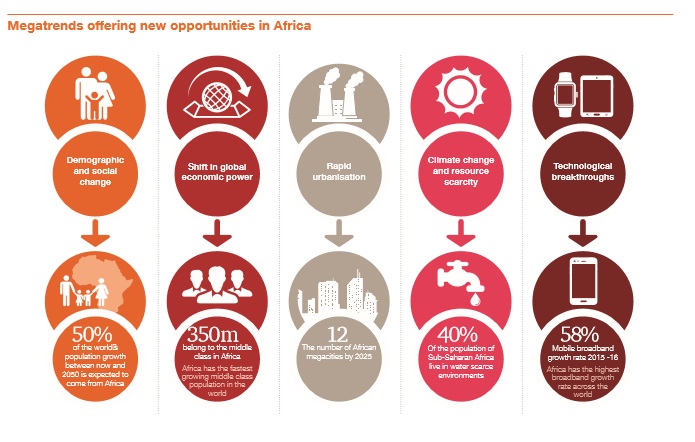
Notwithstanding the current climate and challenges, it is notable that there remains a significant amount of potential to unlock more growth on the continent. African CEOs are looking to international markets for opportunities, with the US (31%), China (28%) and the UK (24%) considered the top three countries for growth. Johannesburg (36%), Lagos (16%) and Cape Town (14%) are considered the top three African cities for growth opportunities.
Main risks to doing business in Africa
Although the returns for doing business on the continent can be high, so too can the risks. Africa’s CEOs are working in difficult times – finding the right talent for their business, dealing with hurdles that come with working with governments, and managing expansion plans across the continent.
In addition, infrastructure remains a challenge as it lags well behind that of the rest of the world. More than two-thirds of African CEOs (69%) are concerned about inadequate basic infrastructure (Global: 54%) and a stronger focus on expanding power supply is required to solve one of the biggest challenges in the business environment.
Other clouds on the business horizon include exchange rate volatility (Africa: 90%; Global: 70%); social instability (Africa: 85%; Global: 68%); geopolitical instability (Africa: 79%; Global: 74%); unemployment (Africa: 79%; Global: 45%); and climate change and environmental damage (Africa: 64%; Global: 50%). For most of these factors, the level of concern among African CEOs is higher than the global average. In addition, over-regulation features on the list of concerns this year, with almost half (46%) (Global: 42%) of African CEOs saying they are “extremely concerned”.
CEOs also believe social instability resulting from inequality, an increasing tax burden, a lack of economic diversity with an overdependence on natural resources, and corruption remain problems in many countries.
Globalisation
Overall, globalisation has benefitted connectivity, trade and mobility. However, just over half of African business leaders say globalisation has done nothing to promote equality, in particular in closing the gap between rich and poor – in fact, this gap may well be widening.
A number of CEOs think it is vital to address social challenges. CEOs believe the corporate community can assist in spreading the benefits of globalisation more widely. The majority say the best way is to collaborate, particularly with government. “While Africa’s potential is undoubted, its achievement remains in question. Business, government and civil society will need to work harder to turn potential into tangible gains against the backdrop of a rapidly changing world,” Dion Shango, CEO of PwC Southern Africa adds.
Talent and technology
The forces of globalisation and technology are increasingly transforming the workplace. Over half of African CEOs (53%) are exploring the benefits of humans and machines working together in the workplace. Over a third of African CEOs (36%) are considering the impact of artificial intelligence on future skills needs.
In some sectors, automation has already replaced some jobs entirely. “As automation takes deeper root in the workplace, companies in Africa will have to increasingly focus on achieving the right cognitive re-apportionment between man and machine,” Shango adds.
However, as CEOs develop their services, they are finding that human interaction in the workplace is still important and place the investment in talent as a top business priority. Just over half of African CEOs (51%) plan to increase their headcount in the next 12 months. Conversely, 23% plan to cut their company’s headcount over the coming year, with more than two-thirds of expected reductions being attributed to automation and other technologies.
According to the survey results, no less than 80% of African CEOs (Global: 77%) see the availability of key skills as the biggest threat to growth (ahead of volatile energy costs and cyber threats). They are finding it particularly difficult to source soft skills – adaptability, problem solving, creativity and leadership.
Technology & trust
Technology has brought about a number of advancements in efficiency and the ease of doing business in Africa. No less than 91% of African respondents (Global: 90%) believe technology has changed competition in their industry in the past five years.
While the digital era offers a host of opportunities, it also creates significant challenges and constraints in the arena of privacy and security. Organisations are holding increasingly large volumes of personal data about their customers, suppliers and employees. According to the survey results, 71% of African CEOs (Global: 61%) say they are concerned about cyber threats. Furthermore, the vast majority of African CEOs (93%) (Global: 91%) believe that cybersecurity breaches affecting personal information or critical systems will negatively impact stakeholder trust levels in their organisations in the next five years. A high 96% of business leaders are also concerned that IT outages and disruptions could impair trust in their respective industries over the next five years.
As disruptions gain more speed, the ability to ensure trust, security and privacy across all interactions will become critical to businesses’ competitiveness. But almost two-thirds of African CEOs (61%) (Global: 59%) are concerned that they are not prepared to respond to a crisis in their business, should one arise.
“In the face of economic and socio-political uncertainty, we remain confident that the outlook for business in Africa remains positive. But to succeed, businesses need to adapt swiftly to change,” Shango concludes.
Download the PWC report here.
Like this:
Like Loading...