DD
MM
YYYY

PAGES

DD
MM
YYYY

spot_img

PAGES

Home Blog Page 7423

The concept of core competency or specialization is dead with the evolution of frenemies in tech companies

0

They taught us in economics that companies have to specialize and build core competencies.  They need to do things really well and be the best possible in the domains. But today, we think that does not make a lot of sense. For technology companies, everyone is doing everything, even at top-level. Alphabet, Google parent company, is a car company, a search company, a medical company, an advertising juggernaut, etc. Amazon.com is an e-commerce firm, a publisher, a movie producer, a drone maker, and soon a car maker.

Today, what do you think IBM does? Practically everything when you know that Watson has more than 100 flavors focusing on health, finance, real estate, etc. So as frenemies hit up, the entrenched mantra of core competency is falling apart. Read this piece from Fortune newsletter to get the idea.

Raise your hand if your company isn’t somehow involved with developing technology for autonomous vehicles. Okay, if your hand is up, quick question: What’s wrong with you?! Don’t you know you’re nothing right now if you’re not working on a self-driving car?

(You can put your hand down now. I’m kidding.)

To review, robotic vehicles not so long ago were the preserve of the Jetsons, locomotives and some other mass-transit trains, and various competitions funded by DARPA, the federal agency whose predecessor, ARPA, developed the Internet.

Then Google, seemingly inexplicably, started fooling around with cars without steering wheels, a “moonshot” unit now known as Waymo. Into the fray jumped Tesla and its Autopilot technology; General Motors, which bought 15-minute-old Cruise Automation and partnered with Lyft; Uber, which raided Carnegie Mellon’s roboticists, bought an autonomous trucking company called Otto, and got sued by the aforementioned Waymo; and Apple, which has said nary a peep about its self-driving aspirations, though it obviously has them.

This is merely the tip of the iceberg. The Wall Street Journal has a fascinating report that now Amazon is investigating autonomous technology too with a top-secret team devoted to the topic. The Journal said “the team serves as an in-house think tank to figure out how to leverage autonomous vehicles,” presumably for the purpose of delivery of packages. The account also said Amazon recently hosted a “radical transportation salon” on the future of transportation.

At the dawn of the Industrial Revolution companies specialized. They focused on electricity generation or steel manufacturing and the like. Today, the “frenemies” of the digital age must be end to end, or intelligent conglomerates. It isn’t sufficient to make software or Web-enabled platforms, for example. The megacaps of tech build their own data centers. Uber, a ride-hailing app, feels compelled to develop its own robotic-car technology. Amazon, already a massive UPS and United States Postal Service customer, is snapping up its own planes.

It probably won’t want people to fly them either.

In case you didn’t notice, Google is now worth more than $600 billion. What’s even more mind-boggling is that the next three largest public companies (Microsoft, Amazon, and Facebook) and the one that’s bigger (Apple) are all in tech. Little ‘ole Berkshire Hathaway, at $409 billion, is the biggest non-tech player.
Business Plans/ Pitch Decks of Airbnb, Square, LinkedIn, Youtube, Mint and 15 other Startups

1

Closing a funding round is not just about what is written on a piece of paper as a business plan or pitch deck. Most times, investors do not really care. Nevertheless, not having a business plan or pitch deck could portray you as someone who does not plan or take things seriously. That may be the problem and not necessarily the lack of the documents.

Here are business plans/pitch decks used by some of the world’s game changing companies. You can borrow ideas from them as you plan to craft yours.


1. Airbnb

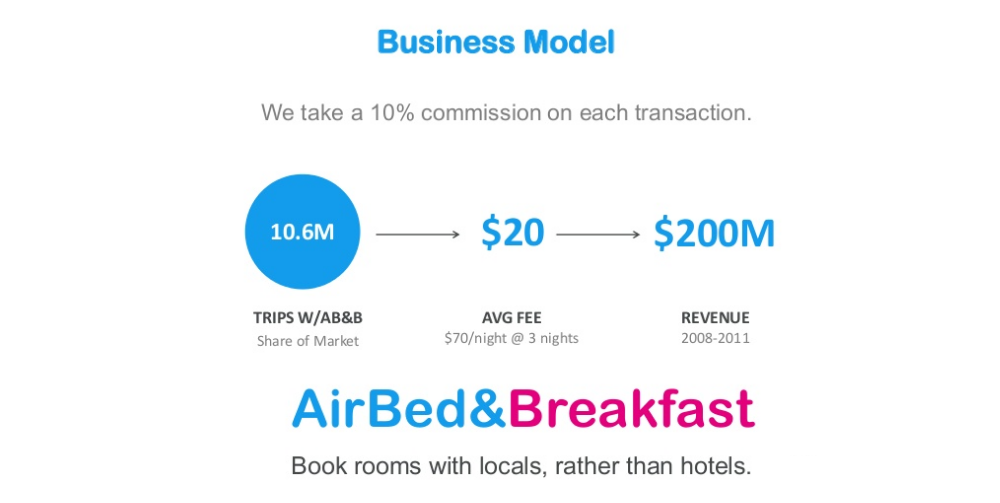
Airbnb is an online marketplace which lets people rent out their properties or spare rooms to guests. What started out as an obscure idea has turned into one of the greatest startup success stories of our time. And Airbnb’s pitch deck has become a sort of reference point for entrepreneurs around the world. AirBnB Pitch Deck

2. Buffer

Buffer is a social media scheduling platform that helps you schedule content to Facebook, Twitter, Linkedin and Pinterest. This is the pitch deck that Buffer used to raise half a million dollars. What’s more crazy is the founders don’t even think this is a big deal. This is a great pitch deck because it tells a story, building up to the apex which was the Traction slide. Buffer’s $500,000 pitch deck

3. Square

Square is a company that allows merchants to accept mobile credit card payments via a dongle. I think the major selling point on this pitch deck was the management team. Notice how it was among the first three slides they showed? Seriously, who wouldn’t bet on a company with the big boys from Twitter, Google, Linkedin, Paypal, and more? Square’s detailed pitch deck outlines their business model and a simple financial model that portrays annual revenue and five-year growth rate. Square’s pitch deck

4. LinkedIn

Founded in 2002, LinkedIn is the top business-oriented social networking platform. The company’s Series B pitch deck talks a great deal about how it’s different from other social networks and the value the network brings. It also uses a great analogy to explain it’s value i.e. it talks about “Web 1.0” vs. “Web 2.0”: According to the deck, Alta Vista was “Search 1.0”, and Google was “Search 2.0”; LinkedIn is “Networking for Businesses 2.0”. LinkedIn’s Pitch Deck

5. Buzzfeed

Buzzfeed is arguably the world’s highly clickable site. It provides shareable breaking news, original reporting, entertainment, and videos across the social web. As of today, BuzzFeed has managed to raise over $446.3 million. As you’ll notice in their pitch deck, it doesn’t hurt to start your deck with your most impressive figures. The millions of users visiting the website on a monthly basis and quotations from large organizations such as CNN, I’m sure would convince any investor to bring our their checks. Buzzfeed’s First Pitch Deck

6. Youtube

Youtube was acquired by Google in 2006 for $1.6 billion. Like Facebook, this company doesn’t require any introduction. Unfortunately, this is not the original deck. This is Youtube’s pitch deck to Sequoia Capital (one of the most established VC investors who’s often regarded as one of the industry’s best), which was released through a legal proceeding. Youtube’s Pitch Deck

7. Foursquare

Foursquare is a mobile platform that helps you find the best places to go in your area. Their pitch deck does a great job of using screenshots of social proof. Like all good storytellers know, showing is better than telling. Foursqaure’s First Pitch Deck

8. Mint

Mint is a personal financial services tool that helps people track their spending and find ways to save money. This deck was used in a competition and was never used for raising money, but it’s still a powerful deck that startups can learn from. Mint’s Prelaunch Deck

9. Moz

Moz started out as an SEO company but has pivoted to support marketers across all inbound marketing strategies. This is the series-B deck for Moz which they used to raise over $18 million. Because the company had already been in operation for five years, they were able to present an accurate estimated revenue, revenue run rate, average customer lifetime value, cost of paid acquisition, etc. Moz’s Pitch Deck

10. Tinder

To put it simply, Tinder is a dating app. Tinder’s Pitch Deck

11. Contently

Contently helps brands do great content marketing at scale—with smart technology, content strategy expertise, and a network of 100000 freelance creatives. Contently Pitch Deck

12. WeWork

WeWork is a multibillion dollar office space rental startup in New York City. WeWork’s Pitch Deck

13. Intercom.io

Intercom shows you who is using your product or website and makes it easy to personally communicate with them through targeted content, behavior-driven email, in-app, and web messages Intercom’s Pitch Deck

Related:  The one tip you need to turbocharge your customer service

14. Manpacks

Manpacks is a platform that delivers men’s essentials such as underwear, razors, grooming and other products.Manpacks’ Pitch Deck

15. Dwolla

Dwolla is a payment solution that allows users to send, receive, and request funds from other users. This 18-slide pitch deck landed the company $16.5 million. Dwolla’s Pitch Deck

16. Gusto

Gusto (previously ZenPayroll) is a cloud-based solution tool for small businesses to pay employees. The company raised $6 million with this deck. Gusto’s (when it was still ZenPayroll) Pitch Deck

17. Wealthsimple

Wealthsimple is Canada’s first online investment manager. They raised more than $2 million in seed funding.Wealthsimple’s Pitch Deck

18. AppVirality

AppVirality allows app developers to grow their platform using growth method techniques proven by other startups. This deck was used to raise $270k AppVirality’s Pitch Deck

19. Castle

Castle is a startup that lets rental owners put their properties on autopilot. This was the deck Castle used to raise $270,000 for their startup. Castle’s Pitch Deck

20. Swipes

Swipes is a task manager app to help its users increase their productivity. Swipes’ Pitch Deck


adapted from here.

Go Ignite is calling African Startups on AI, Connected Homes, IoT Security

0

Following the success of its inaugural global call for start-ups last year, Go Ignite, an alliance of four leading telcos, has launched its second global call at the Four Years From Now (4YFN) technology and start-up event at the Mobile World Congress 2017 in Barcelona. Go Ignite comprises hub:raum, Orange Fab, Singtel Innov8 and Telefonica Open Future_, the open innovation arms of Deutsche Telekom, Orange, Singtel, and Telefonica.

The Go Ignite Second Global Call is seeking growth stage start-ups that have market-ready solutions in Consumer Experience Artificial Intelligence (AI), Connected Homes, or Internet-of-Things (IoT) Security. Consumer Experience AI refers to the use of new technology to provide personalised customer support or new forms of customer interaction. Connected Homes are solutions that use software or hardware to enhance smart living or connectivity, while IoT Security leverages new technologies to keep vehicles, industries, smart homes and smart cities safe

The application window is open from 1 March 2017 to 30 April 2017 for up to five winners to be selected. The alliance members will provide the winners with mentoring expertise, contacts, office space, event support and access to a combined market of more than 1.2 billion customers across Africa, Europe, Latin America, the Middle East, South East Asia and Australia. The alliance members will provide them with a two-day training session with experts in telco innovation, technologies and investments practices, to help them refine their solutions and sharpen their strategies.

Through exclusive meetings, the winners will be given the opportunity to form business partnerships with the four telcos. They will also be introduced to the telcos’ key decision makers and’ venture capital teams where successful start-ups will receive funding to grow their business.

To apply, click here.

Jumia 2016 Financials – adjusted EBITDA loss €91.9 million, revenue decreased by 42%, both total transactions and active users down

0

Rocket Internet SE has published today FY 2016 Results for Rocket Internet SE and selected companies.

Rocket Internet SE’s selected companies have shown continued revenue growth and progress on their way towards profitability in 2016. Aggregate revenue across the focus sectors Food & Groceries, Fashion, General Merchandise and Home & Living grew by 29% from EUR 1.7 billion in 2015 to EUR 2.2 billion in 2016. The aggregate adjusted EBITDA margin improved by 16.4 percentage points from -31.3% in 2015 to -14.9% in 2016, which equates to an absolute EBITDA loss reduction of EUR 234 million.

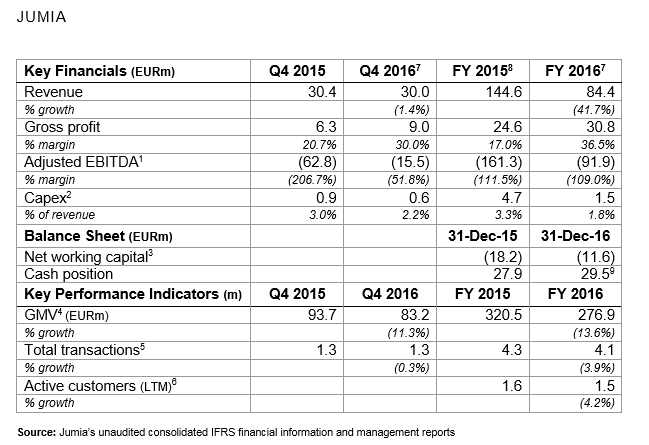
But the African business, Jumia, recorded an adjusted EBITDA loss of €91.9 million from €161.3 million in 2015.

African online platform Jumia, formerly known as Africa Internet Group, has successfully completed the rebranding of all services under the Jumia brand in 2016 with a positive impact on traffic and brand awareness. Jumia reduced its adjusted EBITDA losses from EUR -161.3 million in 2015 to EUR -91.9 million in 2016.


Notes: On August 30, 2016 Africa eCommerce Holding GmbH, the holding company of Jumia, was merged into Africa Internet Holding GmbH (formerly trading under Africa Internet Group). In June 2016, all business models of Africa Internet Group were renamed around the Jumia brand. The figures shown for all periods refer to Africa Internet Holding GmbH.

Jumia is really doing well as it has recorded gross profitability made possible by the consolidation of its operations in Africa.

The Buhari Plan of 3 million jobs is the Smart Nigeria Digital Economy Project

0

It has emerged that financial services within Nigeria’s digital economy could add US$88 billion and create over 3 million new jobs over the next 10 years. This comes as Ministers from developing countries namely Nigeria, Mexico, Kenya, Argentina, Colombia, Sri Lanka, Uruguay, Chile, Costa Rica and Pakistan under the auspices of Friends of E-Commerce for Development (FED) resolved to put forward a policy agenda to bridge the digital divide as well as provide development solutions in the long term, during their meeting in Geneva, Switzerland today.

The job figures are in line with estimates of a study carried out by McKinsey Global Institute (MGI). Further studies indicate that potential gains of the digital economy will be manifest in digital accounts, payments, mobile money, health and educational services and other sectors of the economy. Minister of Industry, Trade and Investment  Dr. Okechukwu Enelamah who led the Nigerian delegation to Geneva, explained that the Ministry is already developing the “Smart Nigeria Digital Economy Project” and that the objective is to solve efficiency problems and create leap-frog opportunities in the economy, improve competitiveness and foster technology development and innovation more generally.

“The Smart Nigeria Digital Economy Project is Nigeria’s response to an area of intense economic and technological activity by Nigerian youths, where there is a growing pool of talent”, he stated. “It is a sector of the economy where the private sector already has ownership. The role of government would therefore be to ensure a sound pro-competitive regulatory environment and hardware infrastructure to foster rapid growth of this area,” Enelamah added.

The Minister also shared the fact that there are currently 150 million active mobile users in a country of 170m, of which over 60% are connected to the internet. There are some 17m Facebook users and new technology start ups and young people writing apps that solve problems and spur growth.

Lagos, the largest commercial city in Africa accommodates some of Africa’s well-known consumer tech businesses such as iRokotv, Hotels[dot]ng, Jobberman, Andela, Balogunmarket, and Truppr[dot]com.

Meanwhile, FED gathered for its first Ministerial Meeting in Geneva on the sidelines of the United Nations Conference for Trade and Development (UNCTAD) E-Commerce week. In a communiqué at the end of their meeting, the group said that the road map put together by member countries would form the foundation for sustainable economic development as well as pave the way for conversations at UNCTAD and the World Trade Organisation (WTO) in advance of the Ministerial Meeting of the WTO in Argentina later this year.

The communiqué noted that the “FEDs came together to build an inclusive and open space for discussion of e-commerce viewed from the development perspective. FEDs view e-commerce as an instrument that brings the digital, development and trade agenda together and as a tool for inclusive and sustainable economic growth.” The FED is a diverse, non-negotiating, group of WTO Members and UN Member States at different levels of development, with an understanding of the impact of E-Commerce and its ability to create sustainable economic opportunities for all.

In light of Nigeria’s strong engagement in the fast developing area of digital economy of which e-commerce is a part, on 24th April, Nigeria’s Chief Negotiator Ambassador Chiedu Osakwe was invited by the office of the UNCTAD Secretary-General to deliver the Keynote Address at the UNCTAD E-Commerce week session on E-commerce in Africa. In his address titled: “Trumping Timidity: The Importance of Audacity in the Digital Economy”, Ambassador Osakwe urged African countries to integrate digital economy strategies and action plans into domestic structural reforms for diversification, modernization and growth. “Africa needed to be offensive in this area, acting innovatively, purposefully and expeditiously” because the gains and development yields were considerable as evidenced