DD
MM
YYYY

PAGES

DD
MM
YYYY

spot_img

PAGES

Home Blog Page 7475

Paris-based Bonjour Idee unveils 20 finalists for “African Startup of the Year 2017”

0

Bonjour Idee, the custodian of Startup.info, has unveiled 20 finalists for “African Startup of the Year 2017”.

Five of these 20 startups will be invited to present their innovation during the Awards Ceremony in Casablanca (Morocco) on January 26, 2017 in front of the jury composed of experts, heads of international groups and successful startuppers.

Please find the 20 candidates for the Jury Awards in alphabetical order :

AFRICAN GLOBAL MARKETING SERVICES AGMS : a startup based on commercial development and digital innovation [FR] https://startup.info/fr/agms/

Association for Research-Action Development and Environment in the Sahel (ARADES) 7623 ARADES: Social Marketing of Thermal baskets in Senegal https://startup.info/arades/

Authentic African E-bikes Chilled Squirrel proposes Authentic African E-bikes https://startup.info/chilledsquirrel/

Bassita, le clickfunding With clickfunding, finance the issues that matter to you in one click [FR] https://startup.info/fr/bassita/

Cameroon Safety Services (CSS) CSS: Making the World Healthy, Safe and Green Again https://startup.info/css/

Craft Planet Craft Planet: improving lives through forest conservation and waste management https://startup.info/craftplanet/

EcoAct Tanzania EcoAct Tanzania is Transforming Waste into Building Materials https://startup.info/transforming-waste-building-materials/

EcoFuture EcoFuture: a waste recovery company that uses IOTs to solve Nigeria urban waste crisis. https://startup.info/ecofuture/

FAPEL GUINEE FAPEL GUINEE : local pump production [FR] https://startup.info/fr/fapelguinee/

Firefly Firefly, a network of connected advertisement screens [FR] https://startup.info/fr/firefly/

iroko project iroko project, a crowdlending platform in West Africa [FR] https://startup.info/fr/iroko-project-la-plateforme-de-crowdlending-en-afrique-de-louest/

Just Land Just Land: affordable & efficient services to register and acquire legal land documents https://startup.info/justland/

Mahazava With Mahazava, solar energy becomes accessible to everyone [FR] https://startup.info/fr/mahazava/

MOÛ-KÔH(résidus agricoles) ECOPAVE : fabrication of pavement out of plastic waste [FR] https://startup.info/fr/ecopave/

Nextapp Discovercity : mobile platform of urban information [FR] https://startup.info/fr/discovercity/

SpellAfrica Spellafrica , a mobile learning tool to improve education in Africa https://startup.info/spellafrica-mobile-learning-tool-improve-education-africa/

ThinVoid ThinVoid Tambula: promote financial inclusion among the unbanked in the informal transportation and farming sectors. https://startup.info/thinvoidtambula/

VOB Research TEACHMEPAD, a materially and energetically hybrid african educational tablet [FR] https://startup.info/fr/teachmepad/

Wizall Wizall, money transfer services and purchase vouchers between Europe and Senegal [FR] https://startup.info/fr/wizall/

Yeli Paper Bags Limited YELI proposes eco friendly paper bags from recycled paper https://startup.info/yeli/

Zenvus leadership travels to Morocco, to visit Africa’s largest fertilizer producer

0

Leaders of Africa’s pioneering agtech startup, Zenvus, will be in Morocco this week and will visit Africa’s largest fertilizer maker, the OCP Group.

OCP Group extracts, processes, markets, and sells phosphate and its derivatives, phosphoric acid, and fertilizers worldwide. The company offers phosphate rock, which is primarily used in soil fertilization, as well as is used as raw material for animal feed supplements and industrial applications. It also provides merchant phosphoric acid that is used in fertilizer production and fertigation; purified phosphoric acid, which is used in oil, beverages, cheese, canned food, yeast, sugar, and water, as well as in pharmacy, detergents, animal feed, metal treatment, textile, and pigments industries; and phosphate fertilizers, such as di-ammonium phosphate, mono-ammonium phosphate, and triple super .

Zenvus plans to become the new architecture to drive precision agriculture across Africa. We will explore how our technology will find relevance in OCP Group’s redesigned efforts to improve farm productivity through technology-driven innovation.

In Africa, no company has worked harder than OCP Group is making sure that the continent has assured food security. OCP Group is one of the most innovative firms in the world with history that spans more than nine decades. It has pioneered phosphate production and continues to invest massively to drive improvement in farm yields through higher efficiency in fertilizer usage.

Zenvus leadership will also use the opportunity to participate in some industry programs sponsored by OCP Group for global agtech innovators.

Zenvus is an intelligent solution for farms that uses proprietary electronic sensors to collect soil data like moisture, nutrients, temperature, pH etc. It subsequently sends the data to a cloud server via GSM, satellite or Wifi. Algorithms in the server analyze the data and advise farmers on what, how and when to farm. As the crops grow, the system deploys hyper- spectral cameras to build crop normalized difference vegetative index which is helpful in detecting drought stress, pests and diseases on crops. The data generated is aggregated, anonymized and made available via subscription for agro-lending, agro-insurance, commodity trading to banks, insurers and investors. Zenvus also has a mapping feature which can help a farmer map the farm boundary with ease.

Why Tech Startups Can Gain Competitive Advantage from Operations

0

Hunter Walk’s blog post serves as the inspiration for this one. He points out that operations is key for startups operating in the on-demand economy. I want to pick up where he left off, and attempt to connect the dots. This post will answer the question “Why is operations important for tech startups?”

All else equal, and I know that is rarely true, operations marks the difference between an unsustainable competitive advantage and a sustainable competitive advantage.1 In order to understand the role of operations in determining the success or failure of a startup we must start with some definitions.

Definition #1: What is a startup? When I think of a startup I prefer to paraphrase the definition provided by Steve Blank and Bob Dorf in their book The Startup Owner’s Manual; A startup is a temporary organization built to search for the solution to a problem, and in the process to find a repeatable, scalable and profitable business model. The defining characteristic of a startup is that of experimentation – to have a chance at survival every startup has to be good at performing the experiments that are necessary for the discovery of a successful business model.

Definition #2: What is a company? A company is what a startup becomes once its search for a repeatable, scalable and profitable business model is complete. The inflection point between startup and company is characterized by the creation of the kind of infrastructure that we typically associate with large companies. For example, it becomes essential to have an HR organization where one was previously unnecessary. It become necessary to have a marketing and sales organization where that would have been hard to justify during the startup phase. Finally, it might also become necessary to build a sophisticated finance and accounting organization where previously there was not much to monitor or report, and someone with an unsophisticated understanding of accounting was adequate for the startup’s requirements, or the role might have been filled by someone working on a part-time basis. Basically, a startup becomes a company when its continued existence depends nearly equally on having the right organizational structures in place to ensure that the business is well managed as it does on having the right product or service to sell.

Definition #3: What is strategy? According to Fred Nickols, strategy is the accumulation of perspectives, positions, plans, patterns, tactics, choices, policies, concrete actions, decisions, thoughts, ideas, insights, experiences, goals, memories, perceptions and expectations that enable a company bridge the gap between the factors of production that the company controls and the output that it wishes to create and deliver to its customers.2 More succinctly, strategy is the qualitative essence of how a company does what it says it will do for its current and prospective customers. At a high level, strategy gives broad, abstract and general answers to the question; In what direction should we travel?

Definition#4: What is marketing? Marketing is the process by which the producer of a product or service creates demand for its output. It involves various modes of communication aimed at helping consumers interpret the value that the producer hopes to deliver to each consumer that buys the product or service. Marketing includes sales, advertising, public relations, and any other practice or activity whose ultimate goal is to build awareness in order to directly or indirectly facilitate sales. Marketing is what makes operations necessary. Without marketing, there would be no demand to satisfy.

Definition #5: What is operations? Operations is the set of activities in a startup or a company that takes inputs and turns them into the final product or service through which the value proposition is delivered to the market. Operations is focused on the process of transformation – transforming tangible and intangible inputs into something that the market is willing to pay for, at a cost level that enables the producer to earn a profit consistent with the accompanying strategy. Operations seeks to answer the question; How do we implement strategy?

In a fine dining restaurant operations is the process of transforming the knowledge and experience of every member of the restaurant’s staff into a consistently enjoyable and memorable dining experience. This process has to deliver results in tangible and intangible ways. Dishes have to be executed to a high degree of excellence, and the atmosphere, decor and service have to evoke emotions of pleasure, satisfaction and joy that meet or exceed diners’ expectations and cause them to dine at the restaurant as frequently as the restaurant’s operators wish. Each time a diner has a meal at the restaurant it must be memorable, in a good way.

In a general aviation company operations is the process that begins with finding out the traveler’s needs, matching those needs with a specific aircraft, and then safely transporting the traveler from the point of departure to the desired destination within a period of time acceptable to the traveler. Each time a traveler is transported from one place to another, that passenger must arrive safely. Also, the passenger should have enjoyed the trip enough to choose that charter company as frequently as its operators wish.

In a software startup operations is the process that begins with designing and creating the software, delivering it to users, and then ensuring that it is available whenever users or customers wish to use it. The experience of using the software has to be such that it is the first choice that users think of when they consider using software to facilitate that specific set of activities.

Once a strategic choice has been made, the process of transforming inputs into outputs is accomplished through capabilities within the organization. The diagram below shows the connection.

What is the connection between strategy, capabilities, and operations?

What is the connection between strategy, capabilities, and operations?

Strategy is concerned with answering the question; Where should we go? Operations is concerned with answering the question; How will we get there? The question around capabilities is; What do we have to be good at to get there? While all this is happening, processes that determine how a startup does its work are being developed. Processes matter because eventually a set of processes will lead to the development of a certain set of capabilities. As a result, it is essential to think about which capabilities are most critical to the startup’s survival before adopting one process over another. Eventually, as the startup matures it builds up a legacy of past choices that may limit or enhance the strategic options it can pursue in the future. Faced with a period of dramatic change in consumer or customer preferences, market structure, technological innovation, or regulations, flexibility is what separates winners from losers. The key attributes of a successful operations organization are:

    1. It must work hand in hand with strategy, marketing, finance, human resources, and every other area within the company.
    2. It must implement procedures and processes that lead to the right blend of capabilities within the company – for exploiting current opportunities, or resolving future threats.
    3. It must make infrastructure choices that protect the startup’s strategic flexibility to deal with current and unforeseen developments in the market.

Here are a few examples of how strategic and operational flexibility made the difference between startups that otherwise were neck-and-neck at some point in time – Friendster, Myspace, and Facebook.

What do you do when your users adopt your product for uses you did not intend or foresee? Facebook and Friendster were founded roughly around the same time. Friendster was founded in 2002, Facebook in 2004. Friendster reportedly grew to 3 million users within 3 months after it became generally available to the public in the United States. It soon became obvious that users were using Friendster for purposes its creators did not intend. For example they started creating various types of profile pages that were not tied to a real person – these became known as Fakesters. Friendster’s founders decided to prevent users from creating such profiles. Facebook experienced a similar behavior from its users. However, it took a different approach. It observed such behavior, learned from it and eventually enabled the behavior it observed. For example, users’ habit of creating profile pages for parties on college campuses eventually led to the development of the events feature on Facebook. In effect;

Facebook continuously watched how users used, and of course misused, their products by gathering usage data. These data guided their product development roadmap and helped ensure they were building features or making changes to their services that would encourage users to recommend the service to others (fan-out) and continue using it themselves (retention).3

While we can not say precisely what motivations drove the opposite reactions Friendster and Facebook had to observed user behavior, we can guess that a need for operational simplicity motivated Friendster’s response. Locking down and restricting the number of ways in which its users could engage with its product made operations easier to manage. On the other hand, Facebook’s approach seems to reflect a philosophy that is more outward looking and user-centric. In other words, operations would adapt to ensure that Facebook’s product evolved to reflect the desires and wants expressed by its users in their day to day interaction with the product. In the process, Facebook developed capabilities that strengthened its strategy and so on and so forth.4

What do you do when your technology infrastructure appears to be unable to keep up with growth, and the accompanying demands? 1 Sometimes things change in a really big way as a startup makes the transition from searching for a business model to scaling. Maybe its marketing and its product are so successful that existing infrastructure proves to be inadequate to meet the demands that the startup’s customers and users place on it. The startups that thrive and go on to become transformative companies adapt operations to deal with this reality. To do so they call on new capabilities that they have developed over the course of time. Google5 and Facebook6 provide examples. They both realized that the off-the-shelf server hardware that they were relying on to run their operations were not necessarily designed to handle the massive amounts of data that their unique business models require them to each deliver to their users and customers daily. As a result they have modified their operations so that they now develop, design and build their own server infrastructure.7 There are many benefits to be derived from this. For example; First, this practice saves them money by optimizing energy usage. Second, it ensures that their business runs smoothly and efficiently so that users and customers have an experience that is commensurate with the value propositions that Facebook and Google have made and the experience users and customers have come to expect. Third, this makes it more difficult for new competitors to compete directly with Facebook or Google in the core areas of their business. As a testament to the soundness of this approach, many other companies that rely on technology as a cornerstone of their business operations are moving towards the practice of building their own custom server and networking hardware and software.8

Contrast the fate of Facebook with that of Myspace and Friendster. Remember that Friendster, Myspace and Facebook were founded in 2002, 2003, and 2004 respectively. At one point Myspace was the most visited social networking site in the world. It briefly overtook Google as the most visited website in the world. So What happened to Friendster and Myspace? I am certain there is more than one reason for their failure. However, reports in the press suggest that their inability to adapt the technology that was core to running their business played an important role in their loss of market leadership to Facebook, and their subsequent failure – they continued to rely on server hardware and software from original equipment manufacturers who build off-the shelf servers. Friendster reportedly slowed down as traffic to its website grew.9 Similar observations are made about Myspace.10 While we do not know the full details, we can deduce that operations at Friendster and Myspace did not mature to the the same extent that operations at Facebook had matured.

As these examples suggest, operations is critical to the survival of any entity that intends to grow to any substantial size by satisfying demand from a large number of customers or users. To succeed technology startups cannot make the mistake of treating operations like an unwanted orphan stepchild. Rather, operations must have a seat at the table, and it must participate in a healthy exchange of ideas, information and opinions with strategy, marketing, finance and accounting, and HR about how each of those functions can work, individually and in concert, to accomplish the goal that the startup wishes to set for itself. Tech startups can ill afford to have operations start from the bottom.


  1. Any errors in appropriately citing my sources is entirely mine. Let me know what you object to, and how I might fix the problem. Any data in this post is only as reliable as the sources from which I obtained them. ?
  2. Fred Nickols, Strategy: Definitions & Meanings, 5/24/2012. Accessed online on Aug. 10th, 2014
  3. Fisher, Michael; Abbott, Martin; Lyytinen, Kalle (2013-11-01). The Power of Customer Misbehavior: Drive Growth and Innovation by Learning from Your Customers (p. 103). Palgrave Macmillan. Kindle Edition. ?
  4. Twitter and Zynga are two more examples of cases in which product features, and operations have been adapted and modified on the basis of observed user behavior. Pinterest just updated its web and mobile apps with a messaging feature. From the outside it appears this update is a response to the observed behavior of its users.
  5. Jeff Dean(2008 Google I/O Session Videos and Slides); Underneath The Covers at Google: Current Systems and Future Directions. Accessed online, Aug. 15th 2014.
  6. Jonathan Helliger; Building Efficient Data Centers with The Open Compute Project, Apr. 7th, 2011. Accessed online, Aug. 15th, 2014.
  7. Jon Brodkin; Who Needs HP and Dell. Facebook Now Designs All Its Own Servers, Feb. 14, 2013. Accessed online, Aug. 16, 2014.
  8. Netflix, Amazon and RackSpace are each reported to have adapted their operations to rely on custom designed server hardware. I assume there are others we do not yet know about. At one point SingTel, the huge Asian telecommunications company was thinking of building its own CDN instead of relying on providers like Akamai.
  9. Gary Rivlin; Wallflower at The Web Party, Oct. 15th, 2006. Accessed online, Aug. 16th, 2014.
  10. Abel Avram; Debate: What’s The Reason for MySpace’s Decline?, Mar. 30, 2011. Accessed online, Aug. 16th, 2014.

A Note On Viral Marketing – Part IV: Examining The Widely Used Skok-Reiss Virality Model

0


Viral growth in users, over time. The virality formula is attributed to Stan Reiss by David Skok.

Viral growth in users, over time. The virality formula is attributed to Stan Reiss by David Skok.

This post is the fourth in a series I am devoting to the examination of viral marketing.1 I tried to define the term in Part I, and examined how Hotmail and Dropbox each grew, in Part II and Part III respectively.

The formula in the image above is widely used to model the growth of users of a website or an app. It has been popularised through a series of posts by David Skok.2 Kevin Lawler explained how the formula is derived.3 Furthermore, Andrew Chen and others, investors and entrepreneurs alike, have written several blog posts about virality and viral marketing that build on this formula.

In this post I will state the problem that one is trying to solve when one sets out to model viral growth. Then I will examine this formula within that context. Valerie Coffman has already done a great job of examining the flaws in this formula.4 For the most part I will reiterate points that she has already made in her post.

The modeling problem: The fundamental research questions one wants to answer by modeling the viral growth of an app, website or some other digital product are these:5 If one person in a population of potential users adopts a product, how will the average number of users of that product change over time? How large could that user base ultimately become? What factors influence the growth of the number of users over time?

The model above, which I will call the Skok-Reiss Virality Model, uses the following variables in modeling viral growth; t represents time, the function U(t) represents the number of users at a specific time and U(0) is the number of users at the outset, K represents the viral coefficient, p represents the cycle time, the amount of time it takes a new user to try a product and then send out invitations to other potential new users, represents the number of invitations each new user sends out, and C represents the rate at which people who receive a new invitation convert to become actual new users of the product. The quotient t/p represents the number of invitation cycles that occur within each unit of time.6

A key variable in the Skok-Reiss Virality Model is the viral coefficient, K. The best definition of that variable as it is applied in viral marketing is given by Eric Ries:

Like the other engines of growth, the viral engine is powered by a feedback loop that can be quantified. It is called the viral loop, and its speed is determined by a single mathematical term called the viral coefficient. The higher this coefficient is, the faster the product will spread. The viral coefficient measures how many new customers will use a product as a consequence of each new customer who signs up. Put another way, how many friends will each customer bring with him or her? Since each friend is also a new customer, he or she has an opportunity to recruit yet more friends.7

The Skok-Reiss Virality Model has a number of limitations.

First, the model does not specify the size of the market. Phrased another way, in the long run how many people are favorably predisposed to adopting this product once they have been exposed to it by someone they know? As Valerie Coffman points out this is not an inconsequential question because viral growth quickly leads to market saturation. Market saturation in turn reduces the viral coefficient. In more concrete terms, the more time elapses and the larger the proportion of people who have already heard about a product but have not yet become users of that product, the less likely it is that such people will remain as susceptible to becoming new users of the product as they were at the outset of the process. In a sense, exposure without adoption leads to immunity to future adoption. Intuitively, we would expect that market saturation imposes a limit on how large U(t) can become as t becomes infinitely large. However, as it has been formulated, the Skok-Reiss Virality Model suggests that U(t) becomes infinitely large as t approaches infinity.8

Second, the model assumes that the market is one in which people adopt a product and then use that product for ever. In Valerie Coffman’s words the Skok-Reiss Virality Model assumes that “there’s no churn in the customer base – once a customer, always a customer.” In reality the market is more likely to be one in which certain people might initially become users of the product, but then abandon it at some point in the future.9

To understand why the Skok-Reiss formulation is problematic in this sense one needs to understand and be able to describe three types of populations. A hypothetical population is one that is completely made up for the purpose of studying a specific research question. A hypothetical population typically does not reflect reality. A closed population is one in which there is no entry or exit. In certain instances a closed population is defined such that changes to the size of the closed population occur only through birth or death. In other instances a closed population is defined such that birth and death do not occur. An open population is one in which population growth is affected by birth, death, immigration and emigration. The concept of churn is important because it makes it possible for a model of viral growth to more closely resemble reality by making assumptions about; birth – an existing user brings in more users, death – existing users who adopted the product through an invitation abandon the product, immigration – new users stumble upon the product and adopt it without an invitation from an existing user, and emigration – existing users who adopted the product without an invitation abandon the product.

These two problems with the Skok-Reiss Virality Model make it unlikely that the model produces sufficiently reliable answers to the first two research questions that people modeling viral growth seek to answer.

Third, the model assumes that each user sends out a single batch of invitations after a period of time p. The assumption that each user sends out a single batch of invitations is suspect. Rather, when a user first encounters the product and enjoys the initial first few interactions with the product that user will probably send the first batch of invitations to only a few close friends and  relatives. As time progresses and the user becomes more trusting of the product’s developer the user might then send a subsequent batch of invitations to a wider circle of friends and social acquaintances. Eventually the circle of people that the user sends invitations to might grow to include professional and business associates. Finally, it will get to the point where that specific product or others like it are so widely known that the average user does not send out invitations. This is the point of market saturation, at which the researcher would expect to start seeing a decline in the viral coefficient. It is not also clear that the first invitation as well as subsequent invitations, if the model accounted for them, happen at the same frequency.10

Last, the Skok-Reiss model makes the error of assuming that two very different processes that form the basis for viral growth happen on a similar timescale. To use Valerie Coffman’s words, the model assumes synchronicity when it should not. The first process is that by which individual users of the product attract new users by word of mouth and through in-product invitation mechanics. The variable in the Skok-Reiss model that reflects this phenomenon is the cycle time. Though as we have pointed out, the way it is formulated falls short of adequately reflecting what one might intuitively expect to observe in reality. The second process is that by which the product’s total user base experiences significant jumps in size. Over time the nature of the growth that this process leads to is seen to resemble exponential  or compound growth. This process is driven by actions of the product developer that differ from, but complement, the actions of individual users in the first process.11 The Skok-Reiss model does not adequately differentiate between these two different but complementary processes.

As a result discussions about tactics for achieving viral growth might be flawed, and could lead to disappointing results if they are based on a naive understanding of the Skok-Reiss Virality Model. Indeed, it is often suggested that cycle time is the most important lever that one should focus on in order to achieve viral growth. In David Skok’s words;

Shortening the cycle time has a far bigger effect than increasing the viral coefficient!

Let’s examine that statement with some algebra.

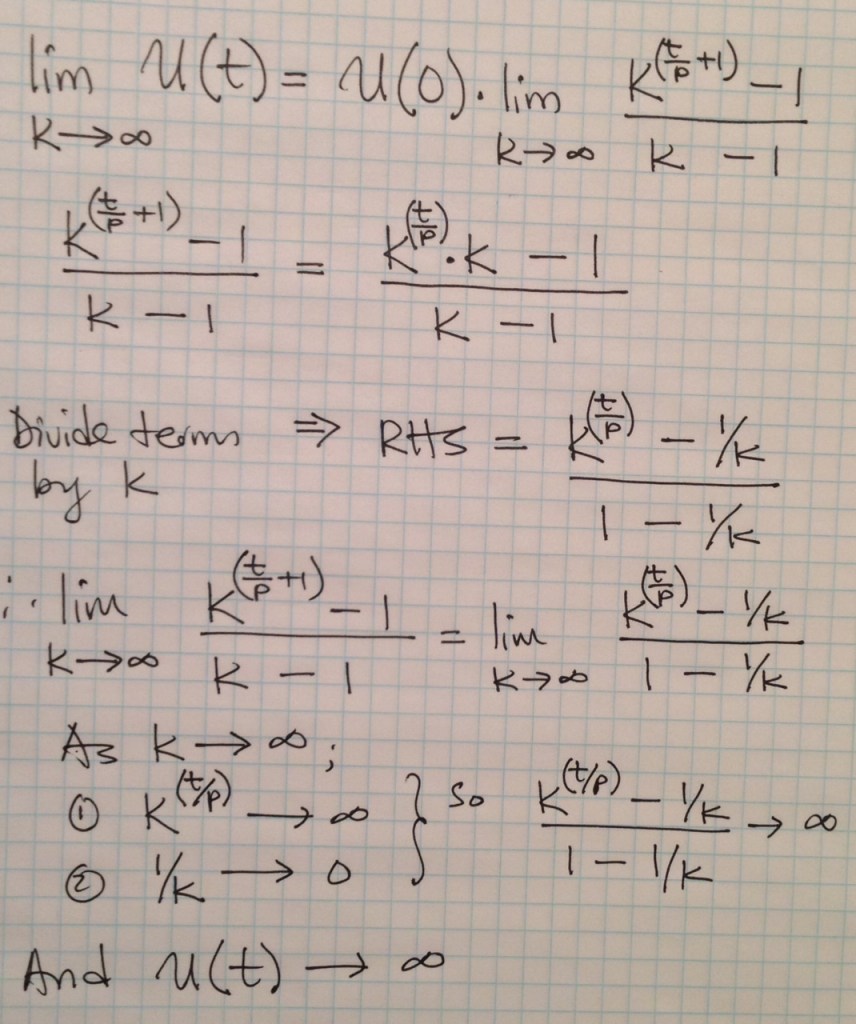
First, what would we expect to happen to U(t) if we let p become infinitesimally small and hold everything else constant? As the back of the envelope analysis below suggests we expect the number of users at any given time to become infinitely large as we make the cycle time infinitesimally small. So far so good.

What happens if we make cycle time infinitessimally small?

What happens if we make cycle time infinitessimally small?

Second, what would we expect to happen to U(t) if we let K become infinitely large and hold everything else constant? As the back of the envelope analysis below suggest we expect the number of users at any given time to become infinitely large as we make the viral coefficient infinitely large.

What happens if we make the viral coefficient infinitely large?

What happens if we make the viral coefficient infinitely large?

This bears repeating. There are at least two ways to make the number of users at any given point in time infinitely large. One approach focuses on cycle time and tries to make that as small as possible. The other approach focuses on the viral coefficient and tries to make that as large as possible. Which one should the product developer focus on? That depends. Certain products lend themselves to the approach that focuses on cycle time as the lever. Youtube is a great example, one that David Skok himself uses to make his argument for focusing on cycle time as the driver of viral growth.12 Other products lend themselves more to the approach that focuses on the viral coefficient. Dropbox comes to mind as a product for which it would make much more sense to focus on the viral coefficient as the lever that drives user growth.13

A third driver of viral growth exists, and it is not given enough emphasis in the Skok-Reiss framework. Churn. There are two types of churn. The first type is the instance of the user who signs up for the product, but uses it so infrequently that ultimately that user’s contribution to the growth in total users is negligible. Tactics should be devised to increase that user’s engagement with the product. The second type is the instance of the user who abandons the product altogether soon after adopting it. Efforts should be made to minimize this occurrence. Managing churn is critical because it gives the team of people working on tactics to minimize cycle time or maximize viral coefficient room to run experiments and determine which tactics will work best in accelerating growth in the user base, ultimately compensating for a product’s initially unfavorable cycle time and viral coefficient if that is the situation in which a product finds itself after it has been been launched. Pinterest is often cited as a product that started out with a small viral coefficient and a small user base.14

The Skok-Reiss Virality Model is most frequently discussed amongst investors and startups interested in the topic of viral marketing and viral growth, but it is by no means the only one.  In my next blog post on this topic I will examine an approach discussed by Rahul Vohra in a series of posts on LinkedIn, and I will compare his approach to the Skok-Reiss model. After that I will delve into the Bass Model of Technology Diffusion. I’ll wrap up this series on viral marketing by following Valerie Coffman’s footsteps once more by looking to infectious disease modeling for some pointers regarding how one might fix the flaws in the Skok-Reiss model.

Model’s are useful as a guide to the researcher’s thought process, but it is the researcher’s responsibility to examine each model for flaws and weaknesses and then to devise ways to compensate for them in order to reduce the possibility of forecasts that contain large errors.


  1. Any errors in appropriately citing my sources is entirely mine. Let me know what you object to, and how I might fix the problem. Any data in this post is only as reliable as the sources from which I obtained them. ?
  2. For example: The Science Behind Viral Marketing, Sep. 15th, 2011 and Lessons Learned – Viral Marketing, Dec. 6th, 2009. Accessed online on Jul. 23rd, 2014.  ?
  3. A Virality Formula, Dec. 29th, 2011. Accessed online on Jul. 23rd, 2014. ?
  4. 4 Major Mistakes in The Current Understanding of Viral Marketing, Jan. 17th, 2013. Accessed online on Jul. 24th, 2014 ?
  5. Adapted from Vynnycky, Emilia; White, Richard (2010-05-13). An Introduction to Infectious Disease Modelling (Kindle Locations 930-931). Oxford University Press, USA. Kindle Edition. ?
  6. For example a monthly unit of time represents 4 cycles if the cycle time is one week. ?
  7. Ries, Eric (2011-09-13). The Lean Startup: How Today’s Entrepreneurs Use Continuous Innovation to Create Radically Successful Businesses (Kindle Locations 3008-3012). Random House, Inc.. Kindle Edition.  ?
  8. To see this; Assume K > 0, p > 0, and U(0) > 0. Then substitute increasing values of  t into the formula. ?
  9. Also, certain people might stumble upon the product without an invitation. ?
  10. Some models of how infectious diseases spread within a population often account for an incubation period, an infectious period, and a pre-infectious or latent period. ?
  11. For example; marketing, PR, press related to product updates, content marketing with calls to action directed at potential new users who might want to sign up for the product without the benefit of an invitation from an existing user, presentations at conferences etc. ?
  12. Messaging apps as a family might fall within this camp as well. Examples; WhatsApp, Viber, Kik, KaKaoTalk, Line, WeChat, Momo etc. ?
  13. It is important to reiterate that neither cycle time nor viral coefficient need to remain constant over a product’s lifetime. In fact, one would argue that there ought to be a team of people whose sole focus is designing ways to reduce the cycle time and increase the viral coefficient. ?
  14. I have actually heard the argument “Our viral coefficient is higher than Pinterest’s at this stage in their development.” in two or three pitches. An example of discussions about Pinterest are; Steve Cheney, How To Make Your Startup Go Viral The Pinterest Way. Accessed at Techcrunch on Jul. 27th, 2014. You can examine the raw data here. There’s also this discussion on Quora: Why Did It Take Pinterest Such A Long Time To Go Viral? Accessed Jul. 27th, 2014. ?

How 5G networks will transform African commerce

0

5G network will be very huge and African commerce will likely benefit in an unprecedented way.

Imagine a world where your car detects you have left a meeting, anticipates the optimal route, and pulls up to the curb on your behalf. Or a sensor deep in the forest that notifies authorities of a wildfire before it happens.

5G may help to massively expand IoT by enabling connected devices and sensors to gather data continuously, proactively, and (eventually) to allow our devices to act on our behalves. Qualcomm Sr. VP Raj Talluri envisions a world where sensors communicate hazards to the appropriate people before they ever materialize.

We’ll be aware of and able to interact with our surroundings to new levels — even with “things” thousands of miles away — through very intelligent connected devices and sensors. These sensors will allow us to gather data continuously, to be proactive and, eventually, even allow our devices to act on our behalves. For example, smart home cameras will alert people when a package has been delivered to the front door, or when a stranger standing at the door. Or a baby camera will allow parents to see how well their baby is sleeping, or inform them about the baby’s sleep trends and monitor breathing and other vital signs for peace of mind during the night.

From autonomous cars to smart cities, the potential for the “internet of things” (IoT) is extraordinary. Despite this promise, today’s sensors are relatively disconnected – making many of the envisioned IoT applications impractical for the moment.

Industry leaders are hammering out standards for 5G networks which are projected to switch on around 2020. 5G may empower an internet of things revolution, as even the smallest connected devices could become able to do heavy computational tasks via connections with other devices, notes Intel’s Asha Keddy.

These 5G networks will be faster but also a lot smarter. Devices will need to become smarter, too, as they will act as networking nodes rather than just terminals. Keddy said that’s why Intel is working on technologies for the core, edge, and access points of these networks as well as what’s required for devices to take full advantage of 5G networks.

With 5G, computing power and information will feel like they’re following you around. Wearables, smartphones, tablets, and other devices with sensors that are location and context aware will work together with apps and services you use. Keddy said that with all of these things working together, they might bring augmented experiences to real life.

However, 5G mobile which is projected to be commercially available in 2020, may power a Massive IoT revolution (MIoT). IHS Markit expects 5G to create 22m jobs and produce up to $12.3tn of goods and services by 2035. Yes, 5G is expected to create 22 million jobs, produce up to $12.3 trillion of goods and services by 2035 and catapult mobile into the exclusive realm of General Purpose Technologies, like electricity and the automobile.

According to the study, in 2035, when 5G’s full economic benefit should be realized across the globe, a broad range of industries – from retail to education, transportation to entertainment, and everything in between – could produce up to $12.3 trillion worth of goods and services enabled by 5G.

The 5G value chain itself is seen as generating up to $3.5 trillion in revenue in 2035, supporting as many as 22 million jobs. Over time, 5G will boost real global GDP growth by $3 trillion dollars cumulatively from 2020 to 2035, roughly the equivalent of adding an economy the size of India to the world in today’s dollars.

The network may achieve 1000x the data capacity of 4G, while the smallest connected devices will gain the ability to execute complex tasks. As large datasets are rapidly interpreted and our physical world gains intelligence, risk models will need to adapt. The implications for insurance are noteworthy, and startups who incorporate the flood of data into their businesses may find an edge.

The promise of 5G is huge – Africa needs to prepare for this technology at the creative side.