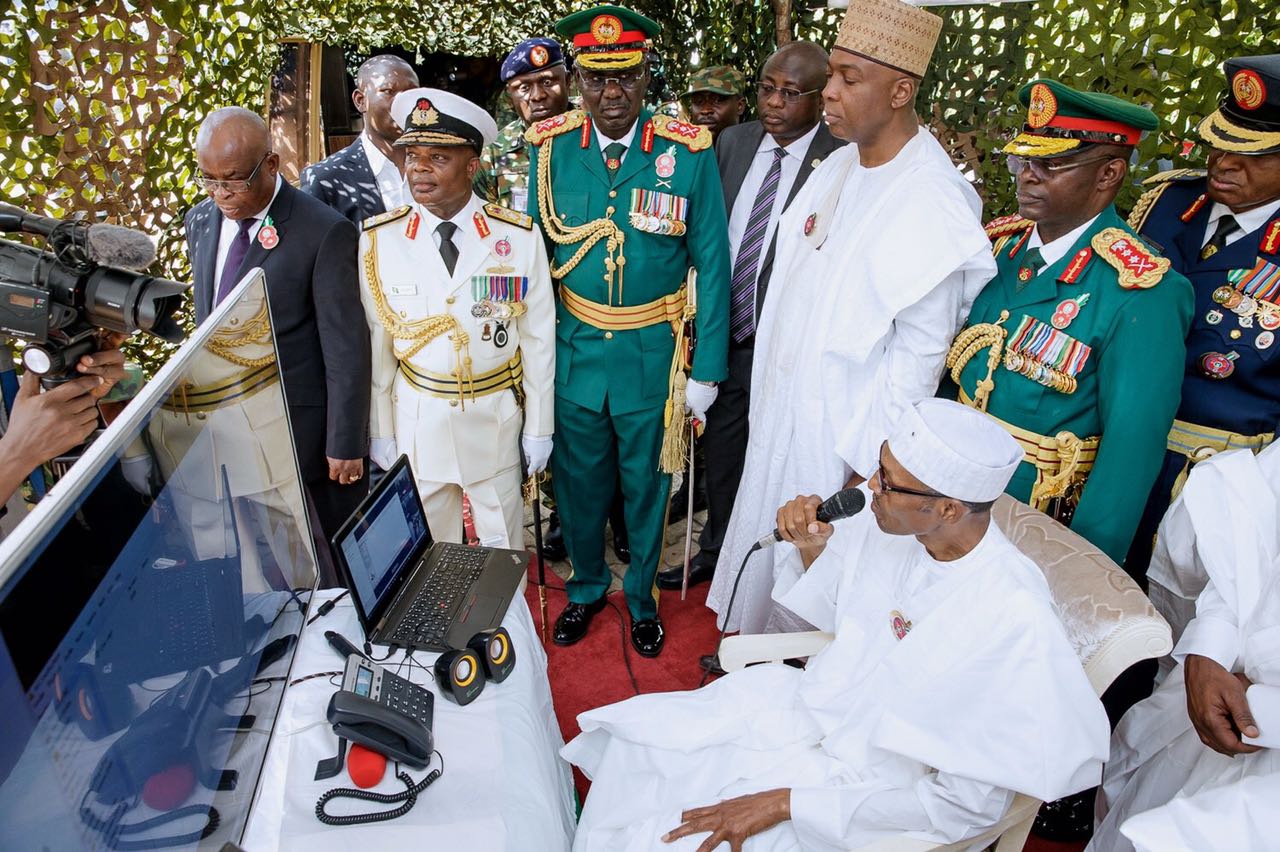
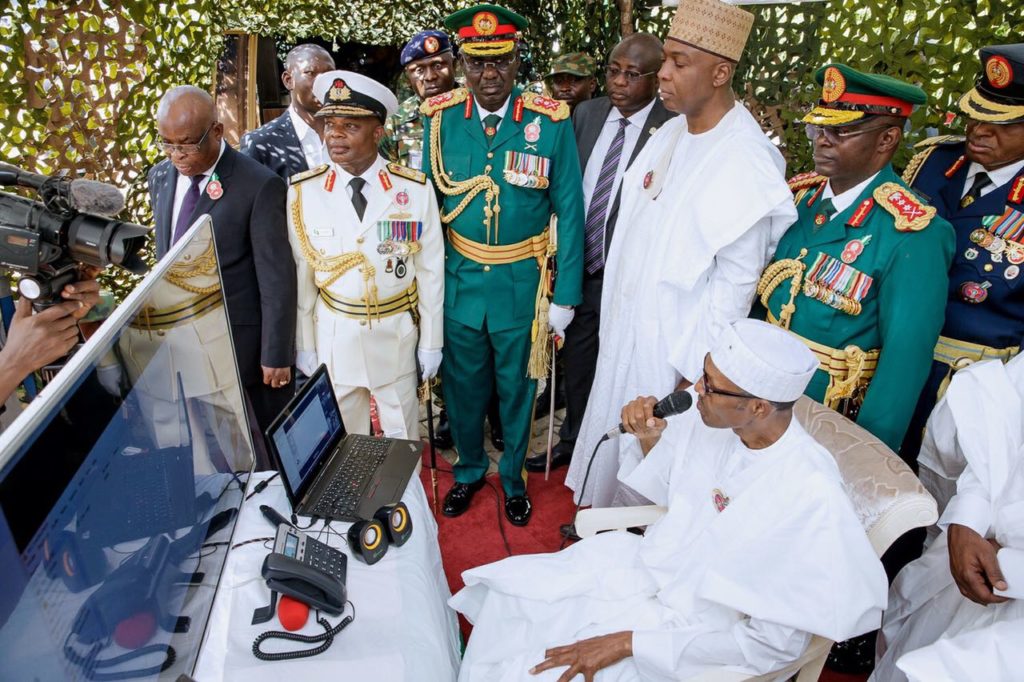
President Muhammadu Buhari GCFR spoke with the Nigerian troops in Sambisa as well as the UN special mission in Liberia via multimedia network powered by NigComSat-1R satellite during the 2017 Armed Forces Remembrance day event at the Eagle Square in Abuja recently.
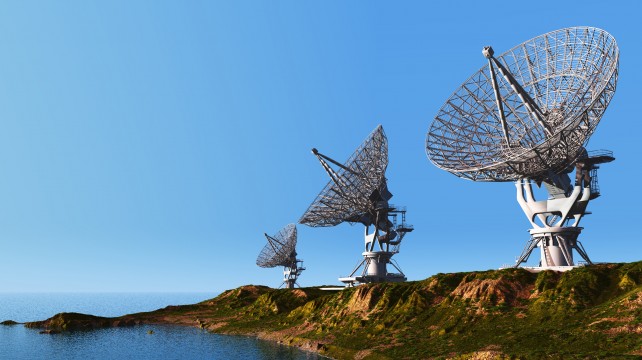
The satellite which was launched in 2011, is a strategic communication infrastructure to improve local content development in both upstream and downstream sectors of ICT. NigComSat-1R is poised to provide excellent and secure connectivity solutions to remote and underserved areas of the country and beyond through its strong regional beams over the African continent.
NigComSat, please make this available for all Nigerians. If you do, data plans will crash and we will see a digital economy ushered.
Africa is connecting but we still have a long way to go.
In 2014 the inventory of terrestrial fibre transmission networks in Africa totaled 958,901 km (Hamilton Research) and yet in the same 2014, 56% of the population of Africa still live more than 25 miles beyond the nearest fibre node (FTTH Council Africa)
Satellite communications still provides the the most viable connectivity solution for much of Africa. There are many reasons for that:
Sparsely populated rural communities will never be economically viable to connect to broadband via fibre
Unlike other connectivity solutions, satellite offers the same broadband speeds regardless of distance from urban infrastructure •
Fibre can offer 100% national coverage and can be rapidly deployed with full mobility to support Healthcare, Tourism, Military, Education, Aviation, Maritime and Large Enterprise •
Satellite connectivity integrates seamlessly and supports other technologies to improve mobility, affordability, reliability and national broadband coverage.
Countries across Africa have ambitious connectivity agendas to support their socio-economic growth, meet Millennium Development Goals, attract inward investment and create knowledge based economies. Governments and Regulatory Authorities are searching for the elusive solution to the challenge of connecting people in remote, under-served regions. And NGO’s and UN Agencies need reliable communications to be available anywhere and at any time. Also large enterprises with dispersed and travelling workforces need ubiquitous mobile connectivity.
Satellite connectivity could become that vehicle to help execute these plans especially in Nigeria with a relatively large land mass with non-homogeneity in development.
The above makes it clear why Nigeria needs to get its satellite communication strategy right by doing all necessary to get NigComSat and NARSDA up and running.
It is a well-known fact that road accidents kill a lot of Cameroonians. Statistics from a World Bank report published in 2014 shows that road accidents were among the leading cause of death in Cameroon.. The sickening issue here isn’t that road accidents are disproportionately high in Cameroon and Africa in general, but that when these accidents occur, emergency services either arrive late at the scene of the accident, or don’t go at all. This leaves victims in the hands of people who know little or nothing about first aid. Most of these victims die on their way to the hospital.
Achiri Arnold Nji,a 27 year old Cameroonian, wants to do something about this problem. According to him, he was inspired by the humanitarian works of Peter Drucker and he strongly believes that with a robust system in transport and information in Africa, road accidents and emergency response can be ameliorated.
He created an app called Traveler to fix the problem.
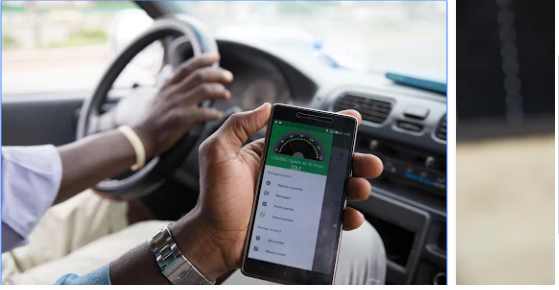
Traveler is a mobile phone app which monitors the speed, location and number of passengers on a bus, and with the help of big data and machine intelligence alerts drivers and authorities to potential dangers. The system automatically sends high speed alerts each time a given bus runs above regulatory speed limits. This helps reduce over speeding which is responsible for over 70 percent of highway accidents in Cameroon. In the unfortunate case of an accident, the app notifies emergency services and families of victims. The app also empowers people with no prior knowledge of first aid at the scene of an accident to give lifesaving assistance to victims in the absence of trained emergency personnel.
The app is free to the ordinary Cameroonian who travels every day, and it can only notify families of people who register their journeys.
Traveler is a road safety app that uses big data to track user’s journeys and contact emergency teams when an accident occurs. We also automatically notify friends and relatives of victims.
Traveler wants to be a passenger monitoring tool in their travels; allowing them to report susceptibles problems which may arise: Speeding, wrong overtaking, wrong parking, accident, …; information that will be redirected to the authorities and competent people (relatives of the victims, agencies, law enforcement, emergency medical centers, …); this with the goal of making our roads safer and healthier.
Traveler is made up of two apps that can do the same thing – one for transport companies and the other for passengers. The passenger app’s role is to permit passengers register their journeys for free so that during an emergency, friends and family are contacted automatically (for free).
Traveler also has a monitor that tracks the speed, position and performance of all buses registered in the system and automatically rates all drivers of public transport buses.
Traveler is not the only app in this space. But according to the creator, the app is unique when compared to competitors on these two specific areas.
We track interurban public transport buses and connect passengers to families, and hospitals automatically. We automatically record the location, speed, bus number and number of passengers in a bus and forward this information to road safety teams, each time a driver of a bus drives above recommended speed limits. We have made it possible to use ‘big data analytics’ to monitor the performance of drivers on the highway and give them advice concerning events susceptible to cause an accident. We literarily can predict an accident based on a driver’s speed/location coefficient (big data).
Our app provides a guide on how survivors of road accidents can take care of themselves while waiting for emergency teams. our app also provides a guide through which people with no knowledge in first aid can assist and transport victims of road accidents to nearby hospitals in the absence of emergency teams, without worsening the medical situation of the said victims. Where on earth has a phone app been developed to tackle effectively road accidents and the problems associated with them? Road accidents are the leading cause of death in the world, and a bulk (90%) of all victims (51.3 million per year) occurs in developing countries!
If you are in Cameroon, you can download the app here.
The Central Bank of Nigeria, CBN has banned banks from any transactions in virtual currencies. Director, Financial Policy and Regulation department, CBN, Mr. Kelvin Amugo, who announced the ban said it was necessitated by money laundering and terrorism financing risks inherent in operations of virtual currencies
In a circular to banks and other financial institutions on virtual currency operations in Nigeria, Amogu stated:
“The emergence of Virtual Currencies (VCs) has attracted investments in payments infrastructure that provides new methods of transmitting value over the internet.
“Transactions in VCs are largely untraceable and anonymous making them susceptible to abuse by criminals, especially in money laundering and financing of terrorism.
“VCs are traded in exchange platforms that are unregulated, all over the world. Consumers may, therefore, lose their money without any legal redress in the event these exchanges collapse or close business.
“The development of VCs Payment Products and Services (VCPPS) and their interactions with other New Payment Products and Services (NPPS), give rise to the need for guidance to protect the integrity of
the Nigerian financial system. There is, therefore, the need to address the Money Laundering/Terrorism Financing risks associated with VC exchanges and any other type of institutions that act as nodes,
where convertible VC activities intersect with the regulated fiat currency financial system.
“The attention of banks and other reporting financial institutions is hereby drawn to the above risks and you are required to take the following actions pending substantive regulation or decision by the CBN.”
The Central Bank therefore advised banks to ensure that they do not use, hold, and transact in virtual currencies. The apex bank also warned the banks to ensure that existing customers that are virtual currency exchangers have effective AML/CFT controls that enable them to comply with customer identification, verification and transaction monitoring requirements.
“Where banks or other financial institutions are not satisfied with the controls put in place by the virtual currency exchangers/customers, the relationship should be discontinued immediately; and any suspicious transactions by these customers should immediately be reported to the Nigerian Financial Intelligence Unit (NFIU),” the CBN said.
?
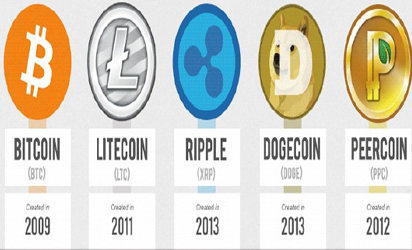
The CBN stressed that virtual currencies such as Bitcoin, Ripples, Monero, Litecoin, Dogecion, Onecoin and similar products are not legal tenders in Nigeria, thus any bank or institution that transacts in such business does so at its own risk.
The full CBN Statement is available here – AML January 2017 Circular to FIs on Virtual Currency.
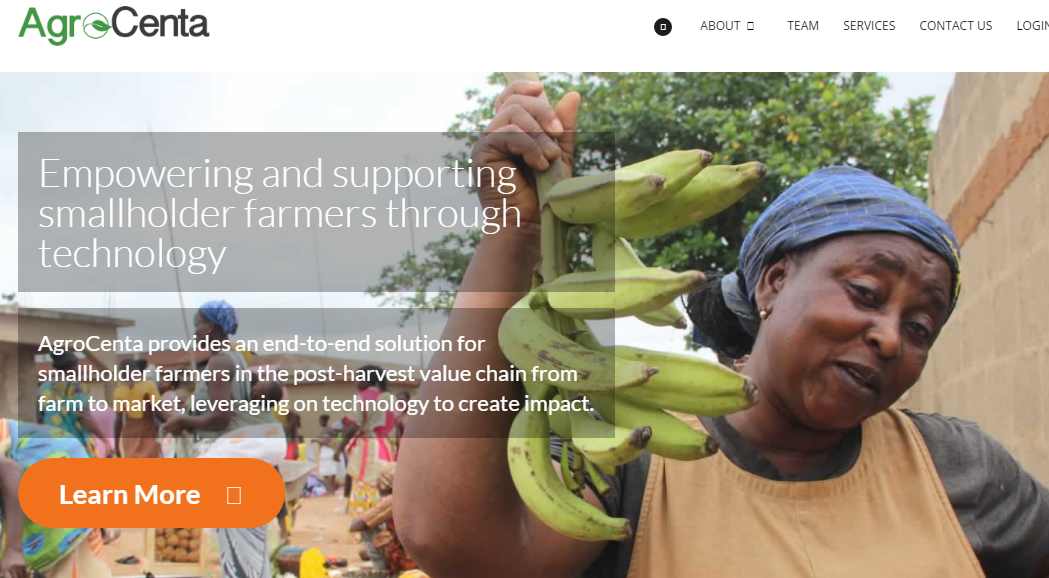
AgroCenta is an AgTech company that provides the “last mile” approach for the smallholder farmers, going a step further to help farmers sell competitively after they get market information from existing e-agriculture products on the market.
AgroCenta was founded by two ex-esoko employees, Francis Obirikorang and Michael Ocansey in 2015 to improve the agricultural value chain in Ghana. Two critical problems within the value chain, which are the lack of an access to market for smallholder farmers in the rural areas, which subjected them to activities of exploitative, buying from middlemen and the lack of a coordinated truck delivery system to cart their commodities from farms to markets to sell.
The idea is to solve these age-old problems by introducing an online sales platform that connected smallholder farmers directly to an online market, which has wider geographic size, to sell their commodities. The end result? Exploitative buying was reduced to the barest minimum since farmers were in control of selling their commodities at prices that were favorable to them.
Once a farmer gets offers from interested buyers, the problem of logistics and transportation were sorted using AgroCenta’s TrucKR solution that allowed the smallholder farmer in any remote village in Ghana access trucks at the click of a button. You can call it the Uber for trucks for local farers. AgroCenta is changing the very lives of smallholder farmers by using technology to solve problems they encounter in agriculture.
AgroCenta’s core services are
AgroTrade : Which is a sales platform that connects smallholder farmer directly to a larger market to trade fairly. AgroTrade matches smallholder farmers in rural areas to small, medium and large buyers in the urban areas.
TrucKR : TruckR is the on-demand trucks and logistics aspect of AgroCenta where farmers can book for truck delivery services to cart their commodities from farms to markets just at a click of a button
AgroInfo : Real time weather, market prices and extension advisory services are delivered via SMS and voice solutions to smallholder farmers using mobile technologies
AgroPay : AgroPay is the financial inclusion platform for smallholder farmers where farmers in rural areas, without bank accounts, receive payments for goods and services via mobile money technologies.
AgroCenta’s success factor stems from the elimination of the exploitative buying approach from the post harvest value chain, and putting the smallholder farmer at a pivotal position where they are able to sell their commodities to interested buyers fairly, generate enough income and become financially independent.
AgroCenta is not alone in this space as the field of AgTech has seen many competitors.
AgroCenta’s main competitors are Esoko, FarmerLine and Farm Radio. These 3 competitors are “information-based” only, delivering market prices, weather information and extension advisory services via SMS to farmers. AgroCenta offers more by actually facilitating the movement of produce with their trucks.