DD
MM
YYYY

PAGES

DD
MM
YYYY

spot_img

PAGES

Home Blog Page 7480

What is a “hyperconverged” hardware?

0

A  “hyperconverged” hardware is a type of data center hardware that combines a computer server and storage with networking.  The hardware can be managed and reprogrammed, meaning customers don’t have to write a check for new hardware every time their needs change.

Companies playing in this domain includes Simplivity which HPE plans to acquire.for $650 million in cash, and Nutanix,

This type of hardware is good for “hybrid IT” . Hybrid IT is tech talk for the ability to run some computing jobs and retain some data storage in-house, and delegate other jobs and data to outside public cloud infrastructure like Amazon Web Services or Microsoft Azure.

Africa Startup of the Year Contest Holding Next Week in Casablanca, Morrocco

0

Africa Startup of the year award is a contest organized by Bonjour Idée with the support of 50+ partners (international corporations, incubators, chambers of commerce, media, competitive centers, influential blogs). While shedding light on disruptive startups, this contest is meant to add value to the partners’ actions at the heart of the entrepreneurial ecosystem of innovation and startups, and put them in contact with innovative startups.

The company just concluded its selection process based on the following metrics:

  • Company must be registered
  • Based in Africa to be named « african startup of year » or « OCP Africa Agritech of the year »
  • No geographical restriction for other awards
  • Company created after jan 1st 2010
  • Your activity’s environemental impact will be taken into account by the jury
  • Your product or service must be innovative
  • You should have a running MVP or prototype


The contest will hold in Casablanca as follows for the finalists:

25 January 2017 (Casablanca): Finalists pitches
26 January 2017 (Casablanca): Awards Ceremony


MAIN PRIZE: AFRICAN STARTUP OF THE YEAR

Named by Jury after Casablanca Pitches (see calendar)

  • 10000€ in Cash
  • 10000€ Visibility Pack (Bonjour idée website background with 100000+ views, mention in press campain, banner in emailing)
  • Integration into our partners’ business network


OCP AGRITECH STARTUP OF THE YEAR

Rewards an Africa based startup bringing innovation to farms and farmers

  • 5000€ in cash offered by OCP Group
  • 10000€ Visibility Pack offered by Bonjour idée
  • Integration in OCP Group Business Network

Farmers digital marketplace 2KUZE launches in East Africa to connect farmers, agents and buyers

2

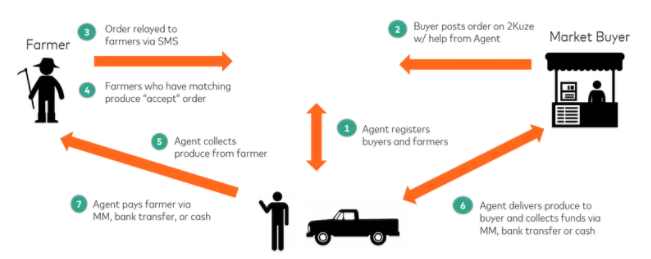
2KUZE, a digital platform that connects smallholder farmers, agents, buyers and banks in East Africa. 2KUZE, which in Swahili means “Let’s grow together,” enables farmers to buy, sell and receive payments for agricultural goods via their feature phones have been launched. The platform brings the benefits and security of mobile commerce and payments to farmers in Kenya, Uganda and Tanzania.

2KUZE was developed at the Mastercard Lab for Financial Inclusion in Nairobi, which was set up in 2015 to develop practical and cost-effective financial tools that expand access and help build stable futures for more than 100 million people globally. Through an $11 million grant from the Bill & Melinda Gates Foundation, the Lab is working with East African entrepreneurs, governments and other stakeholders to develop local products rooted in the company’s global knowhow.

In the initial pilot, 2KUZE is being launched in partnership with Cafédirect Producers
Foundation, a non-profit organization working with 300,000 smallholder farmers globally. Currently, 2,000 small-scale farmers in Nandi Hills, Kenya are currently using the solution to sell their produce and working with farmer-friendly agents to ensure they reach the right buyers for the best price.

According to Mastercard, 2KUZE makes transacting much safer and simpler for all stakeholders in the agricultural supply chain – the farmer, the buyer and the agent. Farmers using 2KUZE can conduct the entire transaction of selling produce and receiving payments via their feature phones, without having to walk for hours to the markets. This enables farmers to capture a greater percentage of the wholesale value of their goods by providing price transparency, more direct access to buyers and empowerment of farmer-friendly agents.

This solution in particular supports women farmers, who often have household duties that prevent them from leaving the farm gate and are more often subject to having to take whatever deal is given to them on the day. Digitizing these transactions in a trusted, auditable environment provides a legitimate financial footprint, opening up access to loans and other financial services, and also introducing a more efficient process that benefits the entire value chain, as well as the overall economy.
Mastercard Lab is exploring the potential for 2KUZE to help farming communities receive the right level of investment and to encourage more efficient ways of doing business with smallholder farmers.

2KUZE is one of several broad-based collaborations on which the Mastercard Lab for Financial Inclusion is working. The Lab was established in Africa to contribute to the company’s global commitment to connect 500 million people to formal financial services through the use of public-private partnerships with governments, the private sector and non-governmental organizations.

How an Investor’s Behavioral Traits Might Completely Derail Your Pitch – Part III

0

This post continues the discussion about how behavioral psychology might affect the outcome of a meeting at which a startup team is pitching to a potential investor. You can get caught up by reading part I and part II. My goal is to offer some advice on how entrepreneurs pitching to early stage investors might prepare to mitigate the problems that I have seen arise during some pitches because of the behavioral traits of investors.

Each investor has a unique psychological disposition that will affect how that individual will interpret the information that is presented during a pitch. In this post we’ll focus on emotional biases.1 The cognitive errors I discussed in the first two posts in this series arise from constraints investors face as they process information that is unfamiliar. Generally, an entrepreneur pitching to investors should be able to develop a strategy to mitigate the potentially negative impact of cognitive errors on the outcome of a conversation with investors by making new and unfamiliar information easier to process, understand and interpret by the investor.

Emotional biases do not arise from our limitations in reasoning about unfamiliar information, instead they arise from our basic need to feel good about ourselves and to avoid things that cause us fear and discomfort. An investor’s cognitive processes may be over-ridden by that individual’s emotional biases depending on how the information presented during the pitch is framed, though there is evidence to suggest that some investors may be capable of modulating their emotional responses to informational stimuli in order to minimize the frequency with which they make sub-optimal decisions.2 It is difficult to mitigate the potential negative impact of emotional biases, cognitive errors are easier to work-around by comparison.

Emotional Biases

  1. Regret Aversion: Regret Theory says the choices that investors make are affected by their anticipation of how much they will regret making those choices in the future. Fear of regret can cause an investor to behave unpredictably. Regret aversion is closely linked to loss aversion bias – in both instances the investor frames an investment in terms of gains and losses, and tries to avoid an anticipated future loss (regret) given the same level of current perceived risk. The concept of regret is critical in understanding how people behave in circumstances similar to gambling – high current uncertainty, and lack of insight regarding how to determine the likelihood of future outcomes.3
    • Case 1: Andrew is an early stage investor. His investment process typically relies on relatively extensive background research and analysis before his fund makes an investment. He learns about an investment that is “closing as we speak” with every brand-name investor trying to get in. He is told there are mere hours before the allotment that is still open might be taken by someone else. He makes an investment without going through his fund’s typical process.
    • Case 2: Andrew encounters a startup doing some really interesting work. However, it is not using technology that he is familiar with. Also, the entrepreneur has not yet been able to get an introduction to any other early stage investors that Andrew knows or has heard of. He passes on the investment without studying the problem this startup is solving although it would otherwise fit the other criteria that he typically looks for – it has paying customers, is capital efficient, and has underlying IP. Andrew decides not to make an investment.
    • Analysis: In the first scenario, Andrew likely does not want to regret missing out on an investment which “every brand-name” early stage investor wants. In the second scenario he may not want to regret making an investment when no other early stage investor he knows seems to know about this startup. His fear of future regret is amplified because he is unfamiliar with the technology that the startup is using, and by the lack of social proof.4
  2. Overconfidence Bias or Illusion of Knowledge: Evidence of this bias is demonstrated when the investor behaves in a manner that suggests that he believes he “knows it all” or that he is better at understanding and interpreting unfamiliar information than others, or that he possesses information and insight that no one else does. Illusion of knowledge leads to prediction and certainty overconfidence.
    • Case: Diana is an early stage investor. She is meeting with Alex who wants to tell her about a startup he and his co-founders are building. Alex finds the meeting highly frustrating because Diana does not let him get past the first few sentences describing what they are doing before she incessantly tries to convince him that what he and his co-founders are doing “will never work” because “I have seen it all in that industry and there’s no way that will work.” As a result Alex never gets to tell her about the traction that they are gaining with paying customers, nor could he explain why her assumptions were incorrect because of new discoveries and developments, which in turn make the innovation that Alex and his co-founders possible.
    • Analysis: Diana’s illusion of knowledge bias is preventing her from fully assimilating the information that Alex prepared to discuss. It is also preventing her from questioning the assumptions that she has come to accept about that industry.

There are other emotional biases worth studying. I am focusing on these two only to keep from writing a post that is needlessly long. It is important to note that one emotional bias might give rise to another behavioral trait that works against the interests of the entrepreneur pitching to an investor.

Here is one example. Regret aversion may lead to inadvertent in-group bias amongst early stage investors.5 In-Group bias is the tendency for members of one social group to treat others they perceive as members of the same group preferentially than people they perceive as not belonging to that group. Here is another example. Regret aversion may also cause an early stage investor to inadvertently succumb to the bandwagon effect. The bandwagon effect is the tendency to think, justify or believe something simply because many other people believe and accept that thing.6

In this post I have decided not to suggest mitigation strategies for the cases I have created. Emotional biases are much harder to tackle in that manner, and I do not want to create the illusion that there’s a simple solution that will work every time with an acceptable level of efficacy. Nevertheless, every team that is building a startup and trying to raise funding from early stage investors should spend some time studying how emotional biases might affect the conversations they have with investors, and develop work-arounds that help them get past the communication barriers that could arise as a result.

One key first step would be to study the background of the investor before the meeting. That simple step might help the team anticipate where objections might arise from the investor solely due to cognitive errors, and emotional or social biases.

A process of experimentation is probably the best approach.


  1. I am focusing on those errors described in the CFA Institute’s Level III curriculum. There may be others not discussed here that are nevertheless worth studying and understanding. ?
  2. Frames, Biases, and Rational Decision-Making in the Human Brain, Benedetto De Martino, et al. Science 313, 684 (2006); DOI: 10.1126/Science.1128356. Accessed online on Oct. 26, 2013. ?
  3. Consequences of Regret Aversion in Real Life: The Case of the Dutch Postcode Lottery, Marcel Zeelenberg and Rick Pieters. Organizationa Behavior and Human Decision Processes 93 (2004) 155-168. Accessed here on Oct. 27th, 2013 ?
  4. Social proof or informational social influence happens when people operating under conditions of ambiguity and high uncertainty look for signals from other people about the correct decision. This phenomenon leads to conformity in large groups. There is a Wikipedia entry here?
  5. What You Are is What You Like – Similarity Biases in Venture Capitalists’ Evaluations of Start-up Teams, Franke et al. Accessed online on Oct. 27th, 2013 ?
  6. Here’s a video of Brad Feld from Foundry Group discussing venture bias. ?

Nigerian students and job seekers, prepare for this booming field

0

Prepare or gift a new career in 2017. Cybersecurity and digital forensics are careers in high demand and First Atlantic Cybersecurity Institute, Pittsburgh USA (www.Facyber.com) provides the education needed to enter these fields.

Our online learning programs are flexible and affordable and come with a (first week)100% money back guarantee.

Learn about:
– Cybersecurity Policy
– Cybersecurity Management
– Cybersecurity Technology
– Cybersecurity Intelligence and Digital Forensics

Each program category is phased as Certificate (online 12 weeks), Diploma (online 12 weeks), and Nanodegree (1 week live). Our programs are relevant for engineers, lawyers, policymakers, law enforcement, health professionals, students, investors, bankers,insurers, etc as they cover all areas of cybersecurity – from policy to technology to management.

Start today and you can finish your program in a few months with real world skills you can use on the job. Alternatively, gift it to someone you love (cousins, friends, students, children, etc). He/she can begin a new journey to a new career.

New Year Special!
Enroll or gift a certificate program for only $200! Paypal, debit & credit cards, and bank transfer supported across Africa.

The Program Catalog and detailed Table of Contents.
We’re looking for local partners across Africa to help promote our programs. For more, contact Audrey Kumar via info@facyber.com

This post has been updated