DD
MM
YYYY

PAGES

DD
MM
YYYY

spot_img

PAGES

Home Blog Page 7558

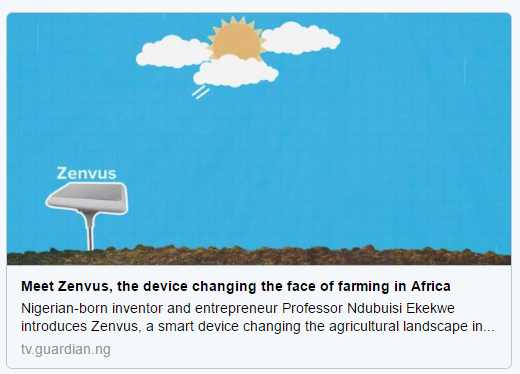
Meet Zenvus, the device changing the face of farming in Africa [GuardianTV Video]

0

Nigerian-born inventor and entrepreneur Professor Ndubuisi Ekekwe introduces Zenvus, a smart device changing the agricultural landscape in sub-Saharan Africa by telling farmers what, how and when to farm.

Watch the video here produced by Guardian TV.

[Guardian TV]


Three Types of Machine Learning and AI companies that exist today

0

According to Auren Hoffman, SafeGraph CEO, on Quora, there are three different types of Machine Learning and Artificial Intelligence companies: The Superrich, the Servicers, and the Innovators.

  1. Superrich: Companies that do machine learning AND have their own data.
  2. Servicers: Companies that do machine learning on other people’s data.
  3. Innovators: Companies that do machine learning and have to get access to data.

All three of these type of companies can be massively successful and each one has a distinct flavor.

The Superrich are companies like Google, Facebook, Baidu, Tencent, Amazon, Microsoft, and others. There are very few of these companies in the world but they have a massive advantage over everyone else in the machine learning space because they have access to vast amounts of clean, structured data. Engineers that do machine learning can do what they do best … predict the future.

The Servicers help other firms make use of large amounts of data. These companies comb through data (sometimes unstructured) and develop insights. These companies are essentially service firms because they work directly with the data of their customers. One of the most successful Servicers is Palantir Technologies which made a name of itself helping government organizations make sense of the data. Salesforce.com also is creating initiatives to do this. Many other companies fit into this mold (for instance, a company that helps airlines optimize its pricing). And any consultancy fits in this category too.

The Innovators — are companies that are working on a specific problem but don’t have access to their own data and are not service-oriented companies that help others. These are companies that want to use data to cure cancer, creating self-driving car technology, and predicting the stock market (like hedge funds). Some of these firms, like Two Sigma Investments and Point72 Asset Management, spend hundreds of millions of dollars on data because unlike the Superrich, they do not generate tons of data themselves. Other good example of Innovators are Cruise Automation (self-driving cars and recently acquired by GM) and Flatiron Health (cancer research). Flatiron Health felt it had to acquire a software services company, Altos Solutions, to get access to raw data. Of course, once these Innovators get the data, they still need to stand it up, clean it, merge it, join it, and do a bunch of ETL.

Summation: As access to data becomes more democratized, we will see more and more Innovators starting and being successful. Today, the Superrich have a big advantage but we should see more Innovators that are focused on a specific solution winning in the future.

[Quora]

Diploma in Cybersecurity Management

0

Diploma Programs require successful completion of equivalent 12-week Certificate Programs. Available in Policy, Technology, Management and Digital Forensics, Learners complete 12-week Capstone (project) under instructor supervisions.

The Diploma in Cybersecurity Management is a practical-oriented program where learners are tasked with developing cybersecurity project management capabilities with the guidance of a mentor. Examples include developing cybersecurity implementation frameworks, cybersecurity Center of Excellence charters, cybersecurity management processes, etc.

Learners are encouraged to take on projects which will have real impacts in their organizations. A project report is required at the end of the program. Has Certificate in Cybersecurity Management as a prerequisite. Click the prerequisite Certificate program detailed Table of Contents

Big coding trends to watch in 2017

0

Online Gaming: Online games will be big in 2017. Sure consoles will still be in existence and hugely popular at that, but so will games played over the internet. The only difference is that the ones on the internet will be so huge that soon consoles will begin to be obsolete.

 Web development: Anyone doing web development will have to learn from CSS 3 upwards and HTML5 as well. Liquid graphics are in. Beach-side hotels want a website with a wave crashing in the background. They want liquefied tabs. They want to smell the humid salty air that hit their face when they visited Diani last holiday season. Make the website an experience that will sell the dream.

Chrome to run on Android devices: Currently, Chrome runs well on Desktop and particularly well at that. It is not a memory hog like some other browsers and is good on functionality such as Bookmark handling and password keeping. Only issue is that you lose some of this on the installation on mobile. Google are making changes on this though. Expect something better on all devices, including non-Android devices like iPads.

Better web navigation on mobile:  If you are not on mobile, then you are not thinking long-term. Or so the saying goes. Every website will be available on Mobile. There will be a growth in mobile themes for practically all content management systems (CMSs) to enable easy navigation, easy use and the clicks will now largely be generated on mobile browsers.