DD
MM
YYYY

PAGES

DD
MM
YYYY

spot_img

PAGES

Home Blog Page 7605

Fasmicro Group Chair Ndubuisi Ekekwe to speak at “Make Innovation Happen” Conference – Lagos, Nov 16 2016

0

The pace at which innovative technology is traveling across Africa is incredible; it is reshaping how Africans consume financial products, consume media content, invest in innovation and build the cities they live in. From Rwanda to Cape Town, Nairobi to Lagos, the continent’s strive for innovation and development in Financial Technology and payment systems is impressive. This has been fostered by the increasing rate of mobile penetration across Africa. Will Africa become the new global hotbed of innovation?

This November, join leaders from across the world in Nigeria for Africa’s flagship conference on innovation with highly thematic conversations and cross-industry thought leadership sessions on Smart Payments, Smart Cities, Smart Agric, Smart Content and Smart Corporations.

To attend, reserve a spot here bit.ly/emergentcontinent

Bogus Audited Statements Are Holding Africa Back – Harvard Business Review – Ndubuisi Ekekwe

0

The Great Recession revealed one of the weakest links in Africa’s quest to build strong capital markets — bogus audited statements. After the fall of Lehman Brothers, the cascading dominoes spread around the world crippling markets and decimating companies. Despite the Wall Street-engineered financial avalanche, investors lost money in African equities largely because some audited statements were revealed to be patently deceptive.

As investigations exposed all the myriad contributions to the market collapse, the asymmetries between the audited statements and what was happening in companies were mind-blowing. Regulators failed markets, as some public companies and auditing firms orchestrated monumental misdeeds, which continue to haunt the region. Yet since those epic letdowns, few bold regulatory reforms have been enacted in most African exchanges.

Continue reading @ the HBR

NASA opens its vaults

0

NASA is opening its vaults. The US space agency is now making its research data available to the public via a web portal. It’s not the prettiest site just yet, but it hosts a wealth of knowledge.

The US space agency has announced that it will be archiving research data at a web portal open to the public. Beginning this year, all NASA-funded authors of peer-reviewed papers will be required to provide copies of their science journal articles and the accompanying data. The research will be made available on the public portal, for free, within a year of publication.

“At NASA, we are celebrating this opportunity to extend access to our extensive portfolio of scientific and technical publications. Through open access and innovation we invite the global community to join us in exploring Earth, air and space,” NASA deputy administrator Dava Newman said in a press release.

That is exciting – see more community developments around this gesture from NASA.

CityAirbus is an Autonomous Flying Taxis

0

Move over Uber. Welcome CityAirbus.

Billing it as a solution to urban congestion, Airbus has announced a new effort to build helicopter-like autonomous flying vehicles to transport both small parcels and, even more radically, passengers. The battery-powered passenger vehicles, currently dubbed CityAirbus, would be summoned by smartphone and travel along aerial urban roadways, constituting a system of robotic flying taxis.

It’s the kind of futuristic proposal we’ve come to expect from ambitious startups. The Chinese-developed Ehang 184 this year became the first quadcopter drone to carry a passenger, and Germany’s e-Volo accomplished a similar feat with its Volocopter soon after.

This is the future of transportation.

Stanford Artificial Intelligence Shows Distribution of Poverty in Nigeria via Satellite Images

1

Getting aid to impoverished Africans is hard enough, what with blockades of bureaucracy and red tape. But in many African countries, bad data, or a lack of it, makes distributing funds even more troublesome.

“Fighting poverty has always been this shining goal of the modern world,” Neal Jean, a doctoral student in computer science at Stanford University’s School of Engineering, noted. “It’s the number one priority for the United Nation’s 2030 Agenda for Sustainable Development, but the major challenge is that there’s not enough reliable data. It’s really hard to help impoverished people when you don’t know where they are.”

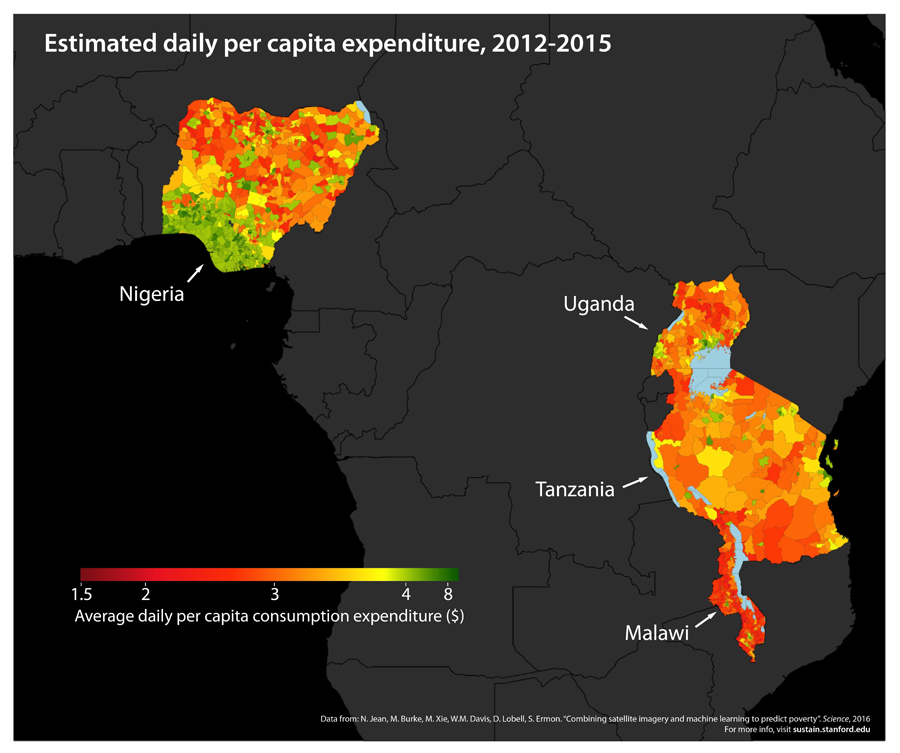
This fundamental problem was what Jean and five computer scientists hoped to solve, using satellite imagery and a machine learning model. Their new study, which was published today in Science, provides a proof-of-concept for an algorithm capable of predicting information about poverty in five African countries: Nigeria, Tanzania, Uganda, Malawi, and Rwanda.

poverty in nigeria

And they seem to be right as the map nearly looks it.

Source: QZ
Besides this news, ros pc download is trending too. Do check this amazing game to get into the battleground action now!