DD
MM
YYYY

PAGES

DD
MM
YYYY

spot_img

PAGES

Home Blog Page 7638

The Most Important And Most Profitable Startup In Nigeria For Investors To Put Money

0

The startup ecosystem in Nigeria is very noisy. Some have become lords purely because of the amount of money they raised.  They have neither built nor exited any company. They just raised capital and they party, publicly. From Forbes to circuits of conferences, we are inundated with stories of raising money from international and local investors in some of these companies. We surely like them and we treasure them, at least they pitched right and some people trusted them to risk their funds on them.

That said, most of these companies making noise are years away from profitability. The ecosystem is not going to support their business models until many years in the future. They may do well provided other entrants with fresh capital and new energy levels do not come and supplant them. But at the moment, we are not seeing that value creation.

Understand that because of the difficulty of raising capital in Africa, when someone does, it becomes a very critical aspect of one’s resume. Few years ago, I watched a video of a South African conference where an entrepreneur was introduced by the amount of money he has raised from investors. Vinny Lingham of Yola and now Gyft is noted as someone who raised more than $30M from investors for Yola. Today, he has since moved from that company for another one.  He is now running Gyft.  It is good to show you can raise capital on your LinkedIn profile!

Founder & CEO of Yola (previously named SynthaSite). Raised multiple rounds of funding from investors, from early stage/seed/angel to Series A & Series B (total of +$30M raised). Overall responsibility for the operations and success of the company and leads the Business Development & Marketing functions of the company.

It is the same phenomenon here in Lagos. The resume of the Yaba entrepreneurs is now transmuting to how much money they have raised from the few angels and VCs and not necessarily how much value they have created. I was in Yaba last night for a demo in a friend’s house who has $10,000 to invest in one startup. The guy began the pitch by reminding everyone how he has raised $7,000 from his uncle! In the bio blurb, he also underlined that. The core value of his business and what he is offering is taking backseat. Do not blame him, celebrity status comes in Africa when you raise capital irrespective of how much value you are creating afterwards.

In Yankee,  the focus is how much valuation does the startup have and most importantly how successful was the exit or IPO. But here, it is the amount the person raised.  You can give away your company and get all the money in this world and technically own nothing. Only stupid investors will continue to buy that proposition.

That brings us to the real deal. Who are those building valuable companies and making money in Nigeria? You do not see them in talk circuits. They have no time for conferences. They do not even own blogs to waste time as I am doing here. They simply focus on building their companies. And they are doing well. They are displacing the Indian companies in Lagos with core innovation in providing technology in our key sectors. They are young and they are dynamic.

So, despite all the noise you may be reading about the local startup environment, the ones making money are very opaque. You need to work hard to see them. When all things are computed, the most important startup in Nigeria is AppZone. The founders may not have the noise-making skills of other entrepreneurs but they have the skills on how to create value.

AppZone is Africa’s leading provider of Integrated Banking and Payment software platforms and incidentally creator of BankOne; the world’s leading cloud infrastructure for Banking and Payment processing targeted at Small and Medium financial Institutions.

AppZone works at an interface in finance where you cannot displace them easily. What they offer is so vital to their bank-clients and the banks’ customers. They are not looking for clients because they already have clients. They are executing massively well with teams of youth. Our recent conversations show they are moving into insurance, oil & gas, power sector to provide a system that connect these firms and their customers for seamless payment experience. They go beyond payment to business process advancement by providing software that make  operations work better. Paypal is not a threat to them. They will exist and can easily scale to become a viable IPO quality company in the local stockmarket. For us,  it is one of the deals for Nigeria’s first listing in NASDAQ. There are a couple of other firms in the nation, we will cover them in coming days.


Their BankOne product supports more than 100 microfinance banks in Nigeria. Many commercial banks are their customers. They have become the operating system that connects the banking sector with their customers, providing technologies that make ATMs work for us across Nigeria. They have three core products, all created by them and none is a reseller for a foreign brand. That is the difference here – they are not working for one foreign company that collects bulk of the money at the end.  They create their technology here in Lagos. Some of their services cover


  • AppZone delivers Africa’s leading core Banking software application as a service and as part of the flagship BankOne suit. The BankOne core Banking platform automates and manages all internal operations of a typical retail Bank. The robustness, feature richness and continuous enhancement of the platform ensure that client financial institutions achieve and sustain world class operations.


  • One hallmark of small and medium financial institutions is limited geographical presence. Key challenges facing these institutions as a result include lack of wide spread physical reach to boost customer patronage and fuel overall business growth. To effectively overcome these hurdles and to allow small/medium Banks remain competitive amidst large commercial Banks, AppZone has created and deployed a shared payment services suit within BankOne.


  • Large Scale Commercial Banks in Nigeria and Africa at large have previously excelled, at providing traditional Banking services to different categories of customers. However, recent developments in consumer enlightenment, telecommunications services and e-payment infrastructure along with a drastically more competitive environment have nudged Banks towards exploring electronic channels for delivering Banking services.


So for all these services where are totally local, we think AppZone is the most important startup in Nigeria. From our analysis, AppZone is very profitable. It has grown organically and continues to sign-up clients at rapid rate. Most of the equities are controlled by the young Nigerian graduates that started the firm. Two brothers and their partner.


OBI EMETAROM (Managing Director/CEO)– An Electrical Engineer, and graduate of the Federal University of Technology Owerri.

EMEKA EMETAROM (Executive Director/COO)- EmekaEmetarom is a Chemical Engineer with a bachelor of engineering degree from the Federal University of Technology, Owerri

WALE ONAWUNMI (Executive Director/CTO)– A graduate of Computer Science with Economics from ObafemiAwolowo University, Ile-Ife where he finished amongst the tops in his class, Wale is known as a Software Prodigy by many as he is versatile in many languages and software application packages.


Across Nigeria, we see some of these types of companies. In the oil & gas, there are indigenous companies building and creating value. But most of the founders do not have time for the press. They simply focus on execution. They do not measure success by how much they have raised but by the value they are creating which is simply how much cash they are bringing in. The best investment comes from the customer and these local firms with AppZone as one of them are showing that innovation lives here.  No wonder South Africa’s Business Connexion will invest $6M  over time in them. They want to go continent-wide.


Obi is currently focusing on AppZone’s imminent expansion into Africa through a just concluded strategic investment deal that has enlisted South-Africa’s leading ITservicesgroup; Business Connexion as a strategic partner and core investor in AppZone with 3 to 4 year plans to invest up to 6 million dollars as well as facilitate roll-out across at least six African countries. .


Guys, good luck.
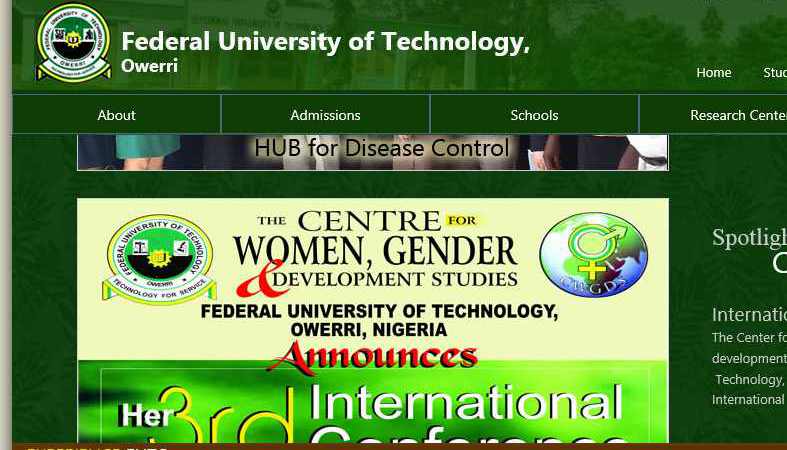
FUTO Is The 2014 Best Federal University of Technology In Nigeria

0

The following are  the top five federal universities of technology in Nigeria according to our methodology. Thank you for reading and sharing with your friends and networks.

Section One

Introduction

When we started this project many months ago, we discussed the possibility of severe criticisms because of our methodology or technique. Yet, we are very optimistic that what we hope to offer has value for students, parents, guardians and indeed the institutions. We do believe that some metrics are global standards and every institution must aspire. Quality of faculty, excellence in academic program, availability of learning infrastructure, value to employers, research output, among others are metrics any school should open to be assessed.

Tekedia Intelligence offers a tool, as a starting point, for stakeholders to use to evaluate the choice of schools. In a non-homogenous society like Nigeria where the Northern students prefer, overwhelmingly the schools in the North and their Southern counterparts those in the South, we are ethnic-blind in the methodology. In other words, a student from Sokoto who prefers Usman Danfodio University despite, perhaps, a better academic program, for a chosen discipline, say, in University of Calabar, will not get any benefit from our work.

We went through stages to develop the model and used extensive data and publications from JAMB, WAEC, schools, NUC, among others. For the classification, we followed exactly how JAMB has categorized school into Private, Federal, State, Federal University of Technology, State University of Technology, and so on. In each category, we considered all the schools and focused on the first ten, where applicable, largely because of resources. One major factor we considered in our ranking is how students enter into degree programs. For schools that encourage preliminary programs that diminish the influence of WAEC and JAMB in admission, they lose marks on the admission process.


Thankfully, the availability of national examination board like JAMB made many things very easy. Though most schools run post-JAMB examinations, we relied on the JAMB cut-off marks to determine the difficulty of getting admission in selected departments.  We then averaged those marks across the board. Except the schools that pursue the preliminary programs, admission process to most disciplines, with some exceptions, is largely uniform, and was easy to access

Just as we developed some quantitative models for our stock market index, we relied on standard metrics. Tekedia Intelligence then decides what it considers to be the key driver for student attainment and success in today’s education.

What We Did

We have 16 indicators that guided our ranking. For each factor, we put a weight which to our ability reflects what we think that school merits or based on data we have obtained or assessments from students, schools or public. Then we rank the schools among themselves based on a weighted composite across the factors. Some of the metrics are

  • JAMB Cutoffs (student selectivity and admission process)
  • Academic reputation by students (the more first choice, the better)
  • WAEC/SSCE Minimum Requirements
  • Admission Through Preliminary Programs
  • Number of Professors and PhD holders in faculty
  • Assessment from Employers
  • Students First Choices in JAMB (an indication of value)
  • Diversity of Programs
  • Academic Environment and Facilities, and National labs on campus
  • Nearby Industrial Ecosystem
  • Recreation  and school location
  • University Management and academic session stability
  • Graduation rate (we took samples of some metrication documents and convocation and compared how many got in and the number that finished)
  • Alumni activity (an indication of satisfaction with their education)
  • Evidence of private-university partnerships (funded labs by companies, etc)
  • International visibility
  • Research and publications

Please note that some metrics have higher weight than others. We developed a survey which we wanted to send to all the schools. Unfortunately, the cost was just much for us to execute. Yet, we think our estimates are rational as we spoke with some of the school officials, students and the public. We hope in the future to ask schools to rank others so that we can get assessment of what the peers think among each other.

How We Arrived At School rank

We assigned the scores to each of the metrics and then calculated the weighted sum of the scores. We then rescaled it so that the school with the highest mark gets 5 (it does not mean they have perfect scores across metrics). That proportion was applied to other schools. We then rounded the numbers to two decimal places and ranked them in descending order.  When schools tie, we list them alphabetical and miss the next rank below. For instance if School A and B are tied at 3.7% and ranked #12. There will not be #13, the next below will be #14.


Section Two


Ranking of Federal Universities of Technology in Nigeria

So based on the data we have and as we explained above, here is the 2014 ranking of the Federal Universities of Technology in Nigeria:

#1 Federal University of Technology, Owerri (score: 5)

#2 Federal University of Technology,Akure (score: 4.95)

#3 Federal University of Technology, Minna (score: 4.82)

#4 Abubakar Tafawa Balewa University, Bauchi (score: 4.48)

#5 Modibbo Adama University of Technology, Yola  (formerly FUT Yola) (score: 4.20)


Flatiron School – Brooklyn, NY – February 18th, 2014

0

This is an outline of a presentation I gave to students at the Flatiron School in Brooklyn on Tuesday, February 18th 2014.

I talked a bit about my background, and about KEC Ventures. I will not outline that in this post. I discussed: How Software is Changing The World, or more generally How Technology is Changing The World. I decided to focus on Africa as a means of broadening our discussion.

  1. Marc Andreessen’s August 2011 article in the WSJ: Why Software is Eating The World
    • There are many more people online
    • Technology is getting really good
      • Hardware costs are declining
      • Hardware is getting really good
      • Software tools are improving
    • Examples of the dramatic impact that software has had on various industries
      • Retail: Borders, Bestbuy – Amazon
      • Movie Rentals: Blockbuster – Netflix
      • Games: EA, Nintendo – Rovio, Supercell, King
      • Transportation: Taxis, Car Rentals – Uber, Relayrides, ZipCar
  2. It is important to remember that technology is more than just software
    • Technology: The combination of tools, skills, methods, and knowledge to solve problems or accomplish an objective. Examples: fire, the wheel, domestication of animals, cultivation of food crops.
    • Software: The stuff that makes a computer work; operating systems, utilities, applications.
    • Think of: Opportunities to marry software engineering and hardware design. Examples: Canary.
  3. How is Technology Changing Life in Africa?
    • Africa is enormous – more than  50 countries, nearly 1 billion people, hundreds of different languages. However, the basic problems are the same across the continent. This map will give you an idea just how big Africa is.
    • I like to tie almost every startup I study back to Maslow’s Hierarchy of Needs. Basically, I want to understand why people will buy a product or use a service. What will be the motivation? In the developing world there is an opportunity to solve problems across the entire height of the pyramid.
    • One more important framework worth keeping in mind is Clayton Christensen’s Job To Be Done framework. I think it is worth studying. You’ll reach great insights about the products and services you develop if you can connect the dots between the Job To Be Done framework and Maslow’s Hierarchy of Needs.
  4. African Startups
    • Discussed
      • Brck – a back up generator for the internet.
      • mPawa – a job portal for blue collar labor.
      • 22Seven – a personal money management tool.
      • Dropifi – a lightweight CRM system for SMBs.
      • Karibu – a modular solar lamp.
      • iCow – a data service for small scale dairy farmers.
      • mFarm – a portal for farmers and produce buyers.
    • Other examples:
      • 7 Innovative Products From Africa You Should Know About
      • 15 African Startups To Watch in 2014
      • There are many more working under the radar.
  5. Building An Innovation Ecosystem
    • It takes a lot of work to build the systems that support innovation, entrepreneurship, startups and venture capital. Some examples of organizations doing interesting work:
      • AfriLabs
      • MEST
      • VC4Africa
  6. Q&A – what I can remember
    • Are there examples of technology from the developing world coming across to the US or other developed markets?
      • Yes – people are testing tablets at $29.99 for possible use in the North American market. Dropifi has customers all over the world. There are other examples.
    • How do we learn about opportunities in other parts of the world?
      • Connect with people online, through social networks – I co-authored a blog post for Tekedia  with Chao Charity Mbogho. She’s a Ph.D candidate in computer science at the University of Cape Town. Our collaboration started with a retweet from someone I follow. I reached out to Chao with a question, and a short while later we had co-authored a blog post. Lots of tools exist to make collaboration with people in other parts of the world easy.
      • Partnering with people on the ground is important – they understand the local problems more completely than you will.
    • What do you look for in the startups in which you invest?
      • I answered that question in this blog post: The Most Important Thing A VC Needs To Know About Your Startup
    • What are some of the challenges African entrepreneurs face? Things can’t be easy for them.
      • Not at all. I hope I did not make it sound as if things are easy. Somehow they find ways around the obstacles they face. Here’s one story about a 17 year old girl from Kenya who taught herself to code and has now started a dev school in Nairobi. Here’s another about how an entrepreneur in Nigeria is solving the problem of not having enough people with coding skills.
    • How easy is it for African women to get involved in the technology startup community? Is there a difference from the state of affairs in the US?
      • I’d be lying if I told you I can answer that question definitively. I know that in general, across the continent there are cultural barriers that still exist related to the education of girls. However I also know of several African women who are prominently leading the charge in the effort to build startups, and create an environment for startups to flourish in different parts of the continent. Some of the startups we discussed are founded by women.

Really High Speed Travel: Elon Musk’s Hyperloop

0

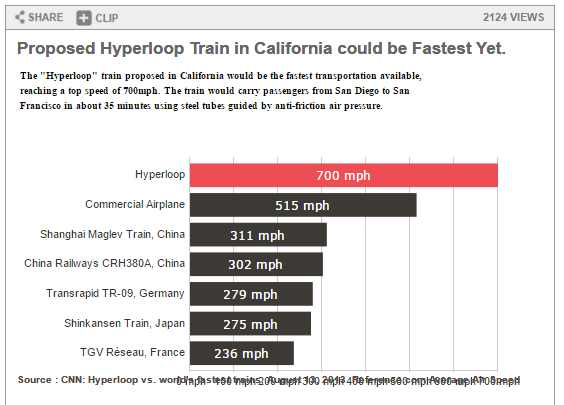
This falls in the category of what some people might term a big, hairy, audacious goal. You can read the initial documentation here: Hyperloop Alpha PDF, and Forbes’ commentary here: Hyperloop Update: Elon Musk Will Start Developing It Himself. You can read about a design that bests the speed records claimed by hyperloop in this article published by Fast Company: How Much Did Hyperloop Lookalike Inspire Elon Musk?

The key insight that Elon Musk gives us in the article by Forbes is: “I’m not trying to make a ton of money on this but I would like to see it come to fruition. I don’t really care much one way or another if I have any economic benefit, but it would be cool to see an alternate form of transport.”

iCharts

Exclusive: Nigerian Prof Amagh Nduka Explains the Asymmetry between Matter and Antimatter

0

This is an exlusive post by Amagh Nduka, a respected professor of theoretical physics and applied mathematics.

Click the post to read in PDF below.

The Asymmetry Between Matter and Antimatter

Amagh Nduka

BS (Berkeley), MS (Stanford), Ph.D. (Chicago)

Professor of theoretical physics and applied mathematics