DD
MM
YYYY

PAGES

DD
MM
YYYY

spot_img

PAGES

Home Blog Page 776

4 Top Crypto Gems to Buy Now for Long-Term Growth: BlockDAG, ETH, SOL, & LINK!

0

Short-term profits tempt many traders, often leading them into projects that fade quickly. While these gains may seem attractive, they rarely last when the hype disappears. True long-term success in crypto depends on choosing coins that combine momentum with real staying power. Projects with solid backing, working features, and strong communities tend to deliver more over time.

This article highlights four top crypto gems to buy now: BlockDAG, Ethereum, Solana, and Chainlink. These coins have shown consistent progress and strong support in a competitive space. Here’s what puts them ahead in 2025’s top-rated cryptos.

1. BlockDAG: Presale Gem Already Pulled in $359M

Among the top crypto gems to buy now, BlockDAG (BDAG) has quickly attracted attention with its advanced architecture and real-world utility. Its DAG-based system allows blazing-fast speeds of up to 15,000 transactions per second, minimal fees, and unmatched scalability. Backed by over 4,500 builders working on 300+ projects in DeFi, AI, and practical apps, its active testnet is already proving functional use.

BlockDAG’s smart contract integration and unique Primordial IDE offer developers the tools to build and grow their dApps easily. The team aims to support 1,000 decentralized applications by 2026. So far, the presale has raised $359 million, with 24.6 billion BDAG coins already sold. Early supporters have already seen their funds grow by 2,660% since batch 1.

Currently, batch 29 is live at $0.0016 per coin, with the price fixed until August 11th. With a confirmed launch listing at $0.05 across 20 platforms, including MEXC, BitMart, LBank, and XT.com, those joining now could benefit from a massive 3,025% ROI. BlockDAG clearly leads the top crypto gems to buy now.

2. Ethereum: Strong Base and Growing Institutional Trust

Ethereum (ETH), hovering near $3,280, continues to show why it’s one of the top crypto gems to buy now. With a market cap exceeding $200 billion, Ethereum is the go-to platform for NFTs, decentralized apps, and DeFi protocols. Layer 2 upgrades like Arbitrum and Optimism improve efficiency by cutting down costs and boosting speeds.

Its supply keeps reducing through a fee-burning mechanism, supporting long-term value growth. One notable achievement is its selection in the U.S. government’s crypto reserve, signaling increasing institutional acceptance. Thanks to its wide utility, regular updates, and user trust, Ethereum remains a key asset in any list of top-rated cryptos in 2025.

3. Solana: Rapid Speeds and Expanding User Base

Solana (SOL), valued at about $178, keeps drawing attention due to its fast-growing ecosystem and efficient network. It currently processes 2,600 transactions per second, outpacing many rivals. Solana has also seen faster user growth than Ethereum in recent periods, showing its rising popularity.

The Firedancer upgrade is expected to push its capabilities further, with estimated speeds reaching up to 1 million TPS. It has also been added to the U.S. government’s strategic crypto holdings, indicating solid confidence from institutions. With its strong expansion, performance improvements, and active usage, Solana earns its place among the top crypto gems to buy now.

4. Chainlink: Essential Infrastructure for Real-World Data

Chainlink (LINK), now priced at around $16.70, plays a vital role in linking blockchains to off-chain data sources. This function is critical for sectors like supply chain tracking, smart contracts, and decentralized finance. As demand for real-time, verified information grows, Chainlink’s oracle system becomes even more valuable.

The network is trusted by top financial names such as Swift, Euroclear, and BNY Mellon, who use it to bridge traditional systems with blockchain tech. With over 2,300 partnerships and $19 trillion in enabled transaction value, Chainlink proves its worth as one of the top crypto gems to buy now. Despite new challengers, its wide integration and clear use case ensure long-term strength.
Which One Leads the Top Crypto Gems to Buy Now?

Ethereum still stands as the most trusted smart contract platform, leading in Web3 development and DeFi activity. Solana is speeding ahead with impressive throughput and a growing user base. Chainlink connects everything with reliable off-chain data, anchoring real-world use cases.

However, BlockDAG currently stands out the most. Its fast DAG-based structure, strong presale growth, and clear focus on developer tools give it a solid edge. With the price frozen at $0.0016 and the confirmed listing rate at $0.05, early adopters can still get in before the GLOBAL LAUNCH window closes on August 11th. BlockDAG isn’t just another project; it’s reshaping how people view blockchain speed, scalability, and real use.

In the current crypto space, where short-term hype often fades, these four top crypto gems to buy now offer lasting strength and serious growth prospects through 2025 and beyond.

Solana (SOL) to Reclaim $294 on ETF Optimism and Institutional Inflows, While Cardano (ADA) and Little Pepe (LILPEPE) Eye $3

0

The crypto market is at a high-stakes juncture with investors closely watching top performers for breakout signals. Solana (SOL) is gaining momentum amid growing ETF optimism and steady institutional inflows, aiming to retest its 2025 high near $294. Meanwhile, Cardano (ADA) shows bullish stability around $0.80 and is positioned to challenge higher price levels as buying volume strengthens.

In parallel, Little Pepe (LILPEPE), a rapidly growing meme coin powered by advanced Ethereum-compatible Layer 2 technology, is heating up through its presale stages—from an initial $0.0010 price to the current $0.0017 in Stage 8. Fueled by a passionate community and strong fundamentals, analysts now predict that LILPEPE could emerge as a major player in the meme coin space, with a potential target of $3 after launch.

LILPEPE Presale Accelerates: Over $13 Million Raised as Stage 8 Nears Completion

LILPEPE presale has turned out to be a huge hype. At Stage 1, pricing started at $0.0010, and this means that the project rewarded the early believers with the minimum entry, raising $500K. Stage 2 was increased from Stage 1 to $0.0011, appealing to meme coin enthusiasts and pioneers of DeFi, raising $1.325 million. Stage 3 followed at $0.0012 and brought in $2.5 million as early momentum picked up pace. At Stage 4 ($0.0013), sellouts began to accelerate due to media attention and rode the wave of virality, helping the project raise $4.475 million. Stage 5 ($0.0014) pushed the total raised to $6.575 million, followed by Stage 6 at $0.0015, which brought in $8.825 million. Stage 7 continued the surge, with $11.225 million raised and 8.25 billion tokens sold overall by that point.

FOMO is at Level 7, and it is at an all-time high. A robust Layer 2 foundation, EVM compatibility, and key features like staking, DAO governance, and sniper bot protection have made LILPEPE one of the hottest presales of 2025.

Currently, LILPEPE is in Stage 8, priced at $0.0017, with over $13.23 million raised and 9.43 billion tokens sold—now 96.76% complete. The next stage 9 will raise the price to $0.0018 and  a complete launch will propel the prices to the $3 scale on time. Adding to its hype, Little Pepe recently launched a $777,000 giveaway campaign, offering $77,000 in tokens to ten lucky winners. The contest is open to all presale participants who contribute at least $100 and complete basic tasks.

Solana and Cardano Flash Bullish Patterns

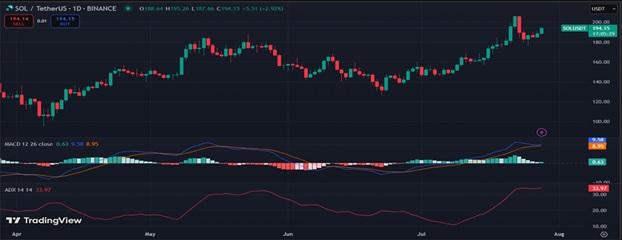
Solana (SOL) is recovering strongly, currently trading near $194.15, and attempting to retest its new 2025 high of $293.31. SOL is consolidating around $193–194, having recently broken through key resistance at $180 and forming an inverse head-and-shoulders pattern targeting $220–223 upon a sustained breakout above $200–205.

SOL 1D-chart showing price action | Source: TradingView

The daily technical rating is Strong Buy, with 13 of 15 moving average indicators and 5 of 10 oscillators signaling bullish momentum. RSI sits at ~61.9 (neutral to mild bullish) and MACD/ADX/ROC also reflect strength. If SOL holds above $180 and breaks above $200, analysts see minimal resistance to a fresh high near $250–293. Institutional inflows remain steady, with SOL benefiting from near?term ETF opportunities and heightened developer interest. Given its high throughput and network maturity, significant capital continues to pour in.

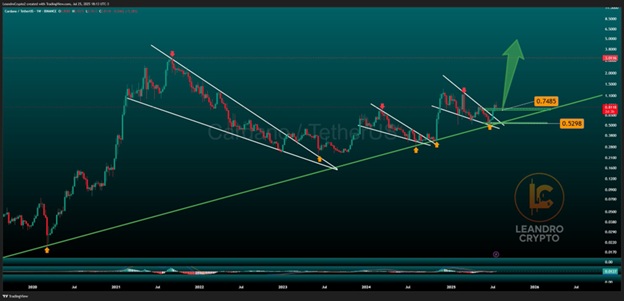
Meanwhile, Cardano (ADA) builds a bullish technical structure, supported at $0.5298 and $0.7485, with its current price hovering around $0.8472.  ADA is trading around $0.846–0.85, breaking into a sustained bullish zone after surpassing resistance near $0.85. Key support established at $0.56–$0.59, and stronger volume-based support around $0.72–$0.74. Trading well above the 20?day (~$0.75), 50?day (~$0.66), and 200?day (~$0.74) EMAs, all signaling buy signals.

ADA 1W-chart showing price action | Source: X

RSI is around 63.2 (neutral), and MACD is mildly bearish (0.06), but the overall technical summary remains bullish. ADX (~42) suggests moderate trend strength, while ROC and Williams %R indicate further upside potential. Immediate hurdle at $0.90–$1.00; longer-term potential includes $1.80 if bullish volume sustains. A failure to hold $0.80–$0.82 could reopen downside risks around $0.68–$0.75. If buying momentum picks up, ADA has the potential to challenge higher levels in the $3 zone.

Little Pepe’s presale is benefiting from a similarly explosive growth cycle—if its massive presale velocity and tech fundamentals hold through post-launch, it could see a comparable breakout in its own market.

Beyond the Meme: Why LILPEPE Is More Than Just Hype

The difference between Little Pepe and the average meme tokens is that the former has incorporated actual purposefulness. The token, based on Layer 2 technology compatible with EVM, will have inexpensive and instant transactions and the prospect to grow a decentralized application in the future. The community-oriented model, the principles of transparent governance, the community-based approach, and scheduled liquidity enablement further add to its credibility. Additional features like zero-tax trading, staking rewards, sniper bot protection, and a dedicated meme launchpad round out the ecosystem with tangible value. Because most meme coins are sustainable only with viral trends, Little Pepe integrates the combination of humor and the presence of real infrastructure. In the same breath as early SHIB or PEPE before their explosive moves, LILPEPE has been spoken about as the next big move once its presale is fully subscribed with a bullish sentiment filling the market.

Conclusion

LILPEPE presale is in its eighth stage, which started at the price of $0.0010 and is currently sold at $0.0017, attracting the attention of crypto investors. Market conditions indicate a forthcoming surge, as Solana is aiming to reach $294, while ADA is showing stability above $0.7485. LILPEPE has a very strong argument to reach the $3 mark based on the combination of meme money culture, Layer 2 utility, and presale heat. These three tokens seem to be at the center of attention, and there’s a reason—the market appears to be gearing up for another round of its bull cycle.


For More Details About Little PEPE, Visit The Below Link:

Website: https://littlepepe.com

XLM’s Price Is At Risk Due to Increasing Outflows and Weakening Technical Indicators

0

Stellar Lumens (XLM) is facing increasing outflows, which could put downward pressure on its price. As of August 1, 2025, XLM is trading at approximately $0.3973 USD, with a 24-hour trading volume of $556,960,128, down 2.1% in the last 24 hours and 10.6% over the past week.

Chaikin Money Flow (CMF): The CMF indicator is declining and currently at a three-week low, signaling rising outflows. While still in positive territory, it’s close to crossing into negative, which would indicate outflows surpassing inflows, potentially pushing XLM’s price lower. A drop below zero could confirm a bearish phase, with support levels at $0.393, $0.41, or even $0.35 if selling pressure persists.

Chaikin Money Flow (CMF) is a technical analysis indicator used to measure the accumulation and distribution of a financial asset, like a cryptocurrency or stock, over a specific period. It helps traders assess whether buying or selling pressure is dominating by combining price and volume data.

Developed by Marc Chaikin, CMF is particularly useful for identifying trends in money flow, which can signal potential price movements.How CMF WorksCMF calculates the strength of money flowing into or out of an asset by analyzing the relationship between the closing price and the high-low range, weighted by trading volume. It’s typically calculated over a 20-day or 21-day period, though other timeframes can be used.

XLM is struggling to break the $0.50 resistance level, with recent consolidation around $0.45 after a 7% drop in 24 hours as of July 20, 2025. The Parabolic SAR above the candlesticks and a bearish MACD crossover suggest growing downward momentum. However, a Golden Cross and RSI above 50 indicate some lingering bullish sentiment, suggesting a potential reversal if inflows recover.

XLM is currently testing support around $0.424. A failure to hold could see it drop to $0.393 or lower to $0.35, representing a potential 40% decline from recent highs of $0.47. After a 97% surge earlier in July 2025, XLM’s gains are at risk of being erased due to these outflows and weakening momentum. The broader crypto market’s performance will significantly influence XLM’s recovery, as it often correlates with market trends.

Despite the bearish pressure, partnerships with major players like Visa, MoneyGram, and Franklin Templeton, along with Stellar’s Soroban smart contract integration, bolster its long-term fundamentals. Analyst Peter Brandt has highlighted a bullish chart pattern, suggesting XLM could reach $7.20 if it breaks key resistance levels like $1.

The increasing outflows and failure to breach $0.50 indicate a risk of further declines. A break below $0.41 could lead to a deeper correction toward $0.35, especially if the CMF turns negative or broader market sentiment worsens. A recovery in inflows or a broader altcoin rally could push XLM back toward $0.50–$0.56. A decisive close above $0.445 would invalidate the bearish thesis in the short term.

Long-term predictions remain optimistic, with some analysts forecasting $1–$1.29 by the end of 2025 and up to $6.19 by 2030, driven by adoption in cross-border payments. XLM’s price is at risk due to increasing outflows and weakening technical indicators, with key support levels at $0.41 and $0.35 under threat. However, Stellar’s strong fundamentals, including partnerships and network growth, suggest potential for recovery if market conditions improve.

Investors should monitor CMF, RSI, and broader market trends closely, as these will dictate XLM’s near-term trajectory. For a cautious approach, consider waiting for a confirmed breakout above $0.50 or accumulation at lower support levels like $0.24–$0.25.

The Implications of Invesco Galaxy Solana ETF Filing With the U.S SEC

0

Invesco and Galaxy Digital have filed for a spot Solana ETF, named the Invesco Galaxy Solana ETF, with the U.S. Securities and Exchange Commission (SEC). The proposed ETF, which would trade on the Cboe BZX Exchange under the ticker “QSOL,” aims to track the spot price of Solana (SOL), the sixth-largest cryptocurrency by market cap.

This marks the ninth Solana ETF filing in the U.S., joining other issuers like VanEck, Bitwise, Grayscale, 21Shares, Canary Capital, Franklin Templeton, and Fidelity. The filing includes provisions for staking SOL to generate additional yield, with Coinbase Custody as the custodian and Invesco Capital Management as the sponsor.

A spot Solana ETF would provide institutional investors with a regulated vehicle to gain exposure to Solana (SOL) without directly holding the cryptocurrency. This could drive significant capital inflows, boosting Solana’s market liquidity and price stability. The filing reflects growing mainstream acceptance of Solana, known for its high-speed, low-cost blockchain, potentially solidifying its position as a competitor to Ethereum.

Approval could catalyze price appreciation for SOL, as seen with Bitcoin and Ethereum ETFs, where inflows led to significant rallies. For context, Bitcoin ETFs saw $50 billion in inflows within months of approval, and Solana’s smaller market cap (~$76 billion as of August 2025) could amplify price sensitivity to new investment. Increased visibility may attract retail investors, further driving demand and potentially reducing volatility over time.

Approval would signal a more crypto-friendly SEC, especially under a potentially pro-crypto administration. It could pave the way for other altcoin ETFs, diversifying crypto investment options. However, rejection or delays (e.g., due to concerns over market manipulation or staking complexities) could dampen market sentiment and slow Solana’s institutional uptake.

The ETF’s staking mechanism could increase Solana’s network security by locking up more SOL tokens, reducing circulating supply and potentially supporting price appreciation. Institutional staking may further decentralize Solana’s validator network, enhancing its credibility and resilience.

Impact of Staking on Costs

Staking SOL typically yields 5-7% annually (based on current Solana network rates). This passive income could offset some of the ETF’s operational costs, such as management fees, custody fees, and administrative expenses. For example, if the ETF stakes 50% of its SOL holdings at a 6% yield, it could generate 3% annual returns on those assets, potentially lowering the net expense ratio for investors.

Staking introduces risks like slashing (penalties for validator downtime) or smart contract vulnerabilities, which could lead to losses. The ETF may need to allocate funds for risk management or insurance, potentially increasing fees. Managing staking (e.g., selecting validators, monitoring performance) requires additional infrastructure and expertise, likely increasing administrative costs passed on to investors.

Staking rewards may be treated as taxable income in the U.S., which could complicate the ETF’s tax structure and increase costs for investors, depending on how Invesco structures distributions. Without specific fee disclosures, it’s unclear whether staking will result in a lower expense ratio compared to non-staking ETFs (e.g., Bitcoin ETFs typically charge 0.2-0.4%). The staking yield could offset fees, but additional costs from staking management might neutralize this benefit.

For comparison, the 21Shares Core Solana ETF (also staking-enabled) has not disclosed fees, but industry speculation suggests Solana ETFs may aim for competitive fees around 0.3-0.5% to attract investors. Staking could make the ETF more attractive by offering higher returns than a non-staking Solana ETF, assuming yields are passed to investors.

The Invesco Galaxy Solana ETF could significantly boost Solana’s adoption and price, especially if approved by October 2025. Staking offers the potential to lower costs through yield generation but introduces complexities that may increase fees or risks. Investors should monitor the ETF’s final expense ratio and staking strategy (e.g., percentage of assets staked, validator selection) once disclosed.

No Delays, No Cards: How Spartans Delivers Fastest Crypto Payouts

0

Winning on a crypto betting site feels great until it’s time to withdraw, and the process slows everything down. Older platforms like Bet365 or BetMGM still require identity checks, long waits, and even declined withdrawals due to banking issues. Spartans skips the extra steps.

Designed entirely for crypto users, Spartans allows for quick, secure, and hassle-free withdrawals. This walkthrough breaks down how to use crypto on betting sites like Spartans for a faster and smoother experience.

Check If Your Balance Is Ready for Withdrawal

Start by making sure your balance isn’t tied up in any active wagers or bonus requirements. Accepted offers like a welcome reward or daily promo might require you to meet a wagering target before cashing out. Some casino bonuses may come with a 30x–35x playthrough rule. With Spartans, a visible bonus tracker helps you stay updated easily.

Once the conditions are satisfied, your actual balance becomes available for withdrawal. That’s one major perk of using crypto on betting sites: cleared funds move out faster.

Connect a Compatible Crypto Wallet

For cashing out, you’ll need a crypto wallet that supports the currency you’re withdrawing. Spartans works with major crypto assets including Bitcoin (BTC), Ethereum (ETH), Tether (USDT), USD Coin (USDC), Avalanche (AVAX), and Cardano (ADA). Popular wallet options include MetaMask, Trust Wallet, and Coinbase Wallet. There’s no need for personal verification, bank authorizations, or sharing private financial details.

Just paste your wallet address in the withdrawal section to begin. This seamless process is part of why many users pick Spartans when learning how to use crypto on betting sites.

Pick a Token and Input the Withdrawal Amount

After linking your wallet, select which crypto asset you want to withdraw. Minimum withdrawal values depend on the token’s transaction fees and platform policy. Bitcoin often has a higher threshold due to on-chain costs, while coins like USDT or AVAX may allow smaller withdrawals. Spartans shows these limits upfront on the withdrawal screen.

Before submitting, confirm the entered amount meets the minimum required. You’ll also be able to see the final payout after fees, offering full visibility before you go ahead.

Send Your Request and Wait for Network Confirmation

Once your details are reviewed, go ahead and send the request. Spartans usually complete transactions right away, though slight delays can happen depending on blockchain activity. There’s no waiting for staff reviews or dealing with traditional banking hours.

After processing, you’ll receive both a confirmation and a blockchain transaction ID. This lets you track your payout instantly. It’s this transparent process that shows why understanding how to use crypto on betting sites like Spartans is so beneficial.

Check for Funds in Your Wallet

Once your request is submitted, keep an eye on your wallet. Arrival times can vary based on the chosen token. BTC and ETH might require more confirmations, while USDT and other stablecoins often settle quickly. If you don’t see your crypto after 30 minutes, Spartans’ customer support is available around the clock.

In most situations, users say they get their payouts faster than they ever did using fiat-based betting platforms. Those moving away from services like Bet365 will likely notice the difference right away when switching to crypto for withdrawals.

Final Words!

Spartans Games keeps the withdrawal process simple and efficient. There’s no paperwork, no bank delays, and no third-party review. Pick your crypto, enter the wallet address, and receive your funds with no fuss. Whether you’re withdrawing a small sum or a larger amount, the process runs smoothly from start to finish.

For anyone tired of the old delays seen on legacy betting sites, learning how to use crypto on betting sites like Spartans offers a real solution. Make your next crypto withdrawal fast, clear, and dependable with Spartans.

Find Out More About Spartans:


Website: https://spartans.com/

Instagram: https://www.instagram.com/spartans/

Twitter/X: https://x.com/SpartansBet

Youtube: https://www.youtube.com/@SpartansBet