DD
MM
YYYY

PAGES

DD
MM
YYYY

spot_img

PAGES

Home Blog Page 785

Premarket Trading Data Indicates That Major U.S. Stock Indices Are Experiencing Declines Exceeding 1%

0

Premarket trading data indicates that major U.S. stock indices are experiencing declines exceeding 1%. Specifically, the S&P 500 is down 1.00%, the Nasdaq 100 is down 1.18%, the Dow Jones Industrial Average is down 0.90%, and the Russell 2000 is down 1.81%.

These declines align with broader market concerns, including uncertainty surrounding U.S. trade policies and tariffs, which have been a significant driver of volatility in 2025. The recent announcement of potential tariff implementations effective August 1, 2025, particularly ranging from 25% to 40% on key trading partners, may be contributing to the bearish sentiment.

Additionally, disappointing guidance from the Federal Reserve regarding interest rate cuts and mixed economic signals, such as sticky U.S. inflation and a contractionary China manufacturing PMI, could be weighing on investor confidence.

However, premarket movements are not always indicative of regular trading session outcomes, as sentiment can shift with new developments or economic data releases, such as the upcoming July jobs report. Investors may be reacting cautiously to these macroeconomic factors, but the situation remains fluid.

The announcement of sweeping tariffs, including a 10% baseline tariff on most trading partners and higher rates (25%-50%) for countries like Canada, Mexico, and China, triggered sharp market sell-offs. For instance, the S&P 500 dropped 4.88% and the Nasdaq Composite fell 5.97% on April 9, 2025, marking significant single-day losses.

A subsequent 90-day pause on higher tariffs led to a dramatic S&P 500 rebound of 9.5% on April 9, but volatility persists as markets react to ongoing trade negotiations and policy uncertainty. Tariffs increase input costs, squeezing corporate profit margins. Goldman Sachs estimates that every 5% increase in U.S. tariff rates could reduce S&P 500 earnings per share by 1-2%, with sustained tariffs potentially cutting earnings by 2-3%.

Companies like General Motors reported a $1.1 billion hit from tariffs, impacting full-year guidance, though some firms, like Johnson & Johnson, mitigated impacts through cost controls and reduced tariff exposure. Tariffs are projected to raise consumer prices by 2.3% in the short term, equating to a $3,800 loss in household purchasing power (2024 dollars). Lower-income households face disproportionate burdens, with apparel prices rising significantly (e.g., 17% for clothing).

Higher inflation expectations, with surveys indicating a jump to 6.7% for the next 12 months, complicate Federal Reserve policy, reducing the likelihood of near-term rate cuts and potentially increasing bond yields, which could further pressure equity valuations. Sectors reliant on imports, such as retail, automotive, and technology, face significant challenges due to higher costs.

For example, Japanese automakers saw a 20% drop in export profitability despite maintaining sales volumes. Conversely, domestic producers in industries like defense and infrastructure may benefit from increased fiscal spending and protectionist policies. The tariffs have disrupted global supply chains, with U.S. imports from China projected to collapse by 90% under high-tariff scenarios, while indirect exports via other countries remain more resilient.

Retaliatory tariffs from China (up to 125%), Canada, Mexico, and the EU exacerbate trade tensions, potentially reducing U.S. export competitiveness and impacting multinational corporations. The Penn Wharton Budget Model projects a long-run GDP reduction of 6-8% and a 5-7% drop in wages due to tariffs, with a middle-income household facing a $22,000-$58,000 lifetime loss.

BlackRock and Morningstar estimate a 40%-50% chance of a shallow recession in 2025, driven by reduced consumer spending, delayed corporate investments, and heightened economic uncertainty. Policy uncertainty, evidenced by the Economic Policy Uncertainty Index reaching its highest level since the COVID-19 pandemic, has led to reduced investment and foreign equity portfolio rebalancing away from U.S. markets, contributing to a weaker dollar.

Investors are advised to diversify portfolios, focusing on value sectors, investment-grade bonds, and low-volatility strategies to mitigate downside risks. The premarket decline of over 1% in U.S. equities reflects ongoing concerns about the tariff regime’s escalation, with new rates (25%-50%) set to take effect today for key trading partners.

The Bank of Japan’s report highlights global market unease, with Asia-Pacific indices like South Korea’s Kospi down 3.88%, signaling broader trade war fears. The fluid tariff landscape, coupled with retaliatory measures and negotiations (e.g., EU’s 15% tariff cap deal), continues to drive uncertainty.

While corporate resilience and potential trade deals (e.g., with Japan and the EU) offer some optimism, the tariffs’ inflationary pressure and growth drag pose significant headwinds. Investors should monitor upcoming economic data, such as the July jobs report, and trade policy developments for clarity on market direction. Staying diversified and focusing on quality investments can help navigate this volatile environment.


Trader Spots Bullish Signal That Could Lift Solana (SOL) Toward $400 While Little Pepe (LILPEPE) Goes Parabolic

0

Solana (SOL) is flashing one of its most convincing bullish signals in 2025 so far, and crypto traders are taking notice. A breakout above a multi-month cup and handle formation, combined with soaring trading volume and spiking open interest, has a trader eyeing a surge that could lift SOL toward $400 in the coming weeks. But while Solana’s rally dominates headlines, another explosive crypto is preparing for its own parabolic run: Little Pepe (LILPEPE), a meme coin with a game-changing twist. These two tokens, though fundamentally different, are united by one thing: momentum. Solana’s technical breakout is textbook bullish, and LILPEPE’s Layer 2 meme blockchain is generating serious presale hype, potentially setting it up as the top meme coin gainer of the year.

Solana Breaks Out With Conviction: $400 in Sight?

As of writing, Solana trades at $189, continuing its bullish ascent after closing above the key neckline resistance at $176. This breakout completes a textbook cup and handle pattern on the daily chart, which is one of the most reliable technical formations for upside continuation. Open interest surged to $9.66 billion (+8.80%), volume spiked 7.64% to $26.52 billion, and short liquidations exceeded $46 million, clear signs that the market is aligned behind the move. Further strengthening the case is Solana’s exit from the Ichimoku Cloud and bullish crossovers on the 20/50 EMA. The $157–$160 zone, which previously served as resistance, now acts as confirmed support. On Binance, the long/short ratio stands at 2.42, with top trader bias even higher at 2.79. Simply put, bulls are firmly in control. The measured move from the breakout puts Solana’s next logical target at $230–$250. However, analysts now suggest that $290—and even $400—are within reach this quarter, especially as ecosystem tokens like BONK, FLOKI, and PENGU explode higher and funnel more attention into the Solana network.

Little Pepe (LILPEPE): Parabolic Setup on the Verge of Ignition

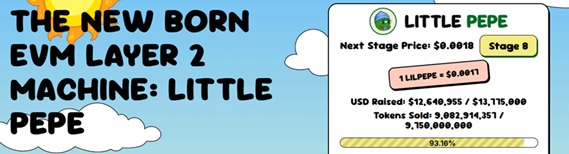
While Solana impresses with its institutional momentum, Little Pepe (LILPEPE) is captivating retail investors and early-stage believers with a completely different value proposition. As of writing, LILPEPE is in Stage 8 of its presale, priced at $0.0017 with over $12.6 million raised and 93.16% of tokens sold. The next stage will raise the price to $0.0018, moving closer to the official listing price of $0.003.

What makes LILPEPE different from other meme coins like DOGE or SHIB is its infrastructure. It’s not just a token—it’s a full Layer 2 blockchain designed exclusively for meme coins and meme-driven applications. It aims to solve some of the meme coin sector’s biggest issues:

  • Sniper bot protection during launches
  • Ultra-low fees and fast finality
  • A built-in meme coin Launchpad for new projects
  • No transaction taxes or stealth dev wallets

Little Pepe’s Layer 2 chain offers the speed and scalability of modern blockchains while being tailor-made for meme culture. It also provides meme creators with a safe and efficient ecosystem to build, trade, and grow communities without the usual risks of rug pulls, contract exploits, or unfair launches.

CoinMarketCap Listing and $777,000 Giveaway Fueling Buzz

Adding more fuel to the fire, Little Pepe was recently listed on CoinMarketCap, giving the project significant visibility and establishing trust with early adopters. With thousands now tracking the token and a growing waitlist forming on top centralized exchanges, market watchers are calling it one of the most anticipated meme coin launches of the year. Even more enticing is the ongoing $777,000 giveaway, where 10 lucky participants will win $77,000 worth of LILPEPE tokens each. To qualify, users must contribute at least $100 to the presale on LittlePepe.com and complete simple promotional tasks. This incentive structure is attracting a wave of new participants eager to lock in early gains while maximizing their exposure to the upcoming listing.

Could LILPEPE Be the Next DOGE or PEPE, on Steroids?

If Dogecoin, with no real utility, hit a $90 billion market cap, and PEPE surged to a multibillion valuation just off meme power, LILPEPE’s potential looks even stronger. It’s launching with infrastructure, security features, fair launch standards, and a utility-focused ecosystem for meme developers. Once it lists at $0.003, even a move to just $0.03 would deliver a 10x return for Stage 8 participants. And in a viral bull market where meme coins trend again, a move beyond $0.10 isn’t out of the question, especially with institutional support rumored for upcoming CEX listings.

Conclusion: Two Different Paths, Same Destination, Massive Gains

Solana demonstrates specific technical indicators alongside institutional adoption which suggest a short-to-medium term price target of $400. It seems as though the ecosystem is flourishing; the breakout is underpinned by strong volume as well as sentiment metrics. Meanwhile, Little Pepe is the sleeper hit preparing for liftoff. With over $12.6 million raised, a growing ecosystem, and CoinMarketCap validation, this project could be the meme coin moonshot of 2025. Serious investors are watching closely, and those who act before the listing may be among the biggest winners of the next meme season.


For more information about Little Pepe (LILPEPE) visit the links below:

Website: https://littlepepe.com

Whitepaper: https://littlepepe.com/whitepaper.pdf

Telegram: https://t.me/littlepepetoken

Twitter/X: https://x.com/littlepepetoken

Aligning Business Goals with Development Consulting Solutions

0

Want to accelerate your business growth but stuck on where to start?

Every business owner dreams of hitting those ambitious revenue targets and expanding into new markets. But here’s the thing…

Most companies are spinning their wheels trying to figure out growth strategies on their own. They’re wasting time, money, and missing massive opportunities while their competitors race ahead.

Here’s the problem:

Without a clear roadmap and expert guidance, businesses often invest in the wrong areas, target the wrong customers, and burn through resources faster than they can generate returns.

That’s where business development consulting comes in.

What you’ll discover:

  • Why Most Businesses Struggle with Growth Planning
  • The Real Impact of Professional Development Consulting
  • How to Choose the Right Consulting Approach
  • Making Your Investment Pay Off Long-Term

Why Most Businesses Struggle with Growth Planning

Here’s something that might surprise you…

42% of consultants struggle with converting prospects into clients. If the experts are having trouble with business development, imagine how challenging it is for regular business owners.

Most companies make the same costly mistakes:

  • They focus on tactics instead of strategy
  • They chase every opportunity without a clear filter
  • They don’t understand their true competitive advantages
  • They lack the systems to scale effectively

Want to know the best part about professional business development consulting? It eliminates these blind spots completely.

A good consultant brings an outside perspective that cuts through internal biases and politics. They’ve seen what works across different industries and can spot patterns you might miss.

The Real Impact of Professional Development Consulting

The numbers don’t lie when it comes to consulting ROI.

Companies that invest in professional help to select the highest impact business development programs see dramatic improvements. 87% of organizations report that executive coaching and consulting deliver high returns on investment.

But here’s what most people don’t realize…

The consulting industry is absolutely exploding. With over 700,000 consulting businesses operating worldwide, the market is projected to reach $1320.94 billion by 2026.

Why the massive growth? Simple.

Businesses are finally understanding that expert guidance isn’t a luxury—it’s a necessity for survival and growth.

Revenue Growth That Actually Matters

Real business development consulting doesn’t just give you feel-good strategies. It delivers measurable results:

  • Lead Generation: Increase qualified leads by 50-200% within the first quarter
  • Conversion Optimization: Better sales processes that convert more prospects
  • Market Expansion: Strategic guidance for entering new markets profitably
  • Operational Efficiency: Streamlined processes that free up resources

The consulting firms getting the best results focus on one thing: aligning every recommendation with your specific business goals.

What Makes the Difference?

Here’s the secret sauce that separates great business development consulting from the rest…

Industry-Specific Expertise: Generic advice doesn’t work. You need consultants who understand your market, your customers, and your unique challenges.

Proven Track Records: Look for consultants with documented success stories in businesses similar to yours. Case studies and testimonials tell the real story.

Systems and Processes: The best consultants don’t just give advice—they help you build systems that continue working long after they’re gone.

How to Choose the Right Consulting Approach

Not all business development consulting is created equal.

There are three main approaches, and picking the wrong one can cost you months of progress:

The Strategic Planning Approach

Perfect for businesses that know they want to grow but aren’t sure which direction to go. These consultants help you:

  • Define clear, measurable growth objectives
  • Identify your most profitable opportunities
  • Create detailed action plans with timelines
  • Establish tracking systems to measure progress

The Implementation-Focused Approach

Best for companies that have strategies but struggle with execution. These consultants roll up their sleeves and help you:

  • Build sales and marketing systems
  • Train your team on new processes
  • Set up tracking and optimization systems
  • Troubleshoot problems as they arise

The Hybrid Approach

This combines strategic planning with hands-on implementation. It’s typically the most expensive option, but also delivers the fastest results for businesses serious about transformation.

Red Flags to Watch Out For

Before you hire anyone, watch for these warning signs:

  • Vague promises without specific timelines or metrics
  • One-size-fits-all solutions that don’t account for your unique situation
  • Lack of industry experience in your specific market
  • No clear measurement system for tracking results

Remember, good consultants should be confident enough in their approach to tie their success to your results.

Making Your Investment Pay Off Long-Term

Here’s what most business owners get wrong about consulting…

They treat it like a one-time expense instead of an investment in their company’s future. The businesses that get the biggest returns approach consulting strategically.

Setting Realistic Expectations

Professional business development consulting typically shows results in phases:

Months 1-3: Foundation building, strategy development, initial system implementation
Months 4-6: Process optimization, team training, early results measurement Months 7-12: Scaling successful initiatives, refining systems, long-term planning.

The key is understanding that real transformation takes time, but the results compound over years.

Measuring Success Properly

Don’t just look at revenue increases. Track these metrics too:

  • Customer Acquisition Cost: Are you getting customers more efficiently?
  • Customer Lifetime Value: Are your new customers more valuable long-term?
  • Employee Productivity: Are your teams working more effectively?
  • Market Share: Are you gaining ground on competitors?

Making It Sustainable

The best consulting engagements end with your team fully capable of continuing the work independently. Look for consultants who:

  • Document all processes and systems clearly
  • Train your internal team thoroughly
  • Provide ongoing support and guidance
  • Help you build internal capabilities

This approach ensures that your investment continues paying dividends long after the consulting engagement ends.

Building Your Growth Engine

Smart businesses understand that growth doesn’t happen by accident.

It requires intentional strategy, expert execution, and continuous optimization. Business development consulting provides all three when done correctly.

The companies that consistently outperform their competition have one thing in common: they invest in professional guidance to accelerate their growth and avoid costly mistakes.

Whether you’re looking to break into new markets, optimize your sales process, or scale your operations, the right consulting partner can compress years of trial and error into months of focused progress.

Maximizing Your Results

Here’s how to get the most value from any business development consulting engagement:

Be Completely Transparent: Share your real numbers, challenges, and goals.

Commit to Implementation: The best strategies require execution. Ensure you have resources to implement recommendations.

Track Everything: Establish baseline metrics before starting to measure real impact.

Stay Engaged: Successful consulting relationships involve regular communication and feedback.

Wrapping It All Together

Business development consulting isn’t about hiring someone to do the work for you.

It’s about partnering with experts who can show you the fastest path to your goals while helping you avoid the expensive mistakes that derail most growth initiatives.

The businesses thriving in today’s competitive landscape understand this simple truth: professional guidance isn’t an expense—it’s one of the highest-ROI investments you can make.

With the consulting industry growing at 7.9% annually and more companies recognizing the value of expert guidance, the question isn’t whether you need professional help.

The question is whether you can afford to keep trying to figure it out alone while your competitors pull ahead.

Smart business owners make the call. They invest in proven systems, expert guidance, and strategic direction that transforms companies from struggling survivors into market leaders.

The choice is yours. Keep spinning your wheels, or accelerate growth with professional expertise that delivers results.

Extra Value Is Upstream: Move Upstream And Win Your Market [video]

0

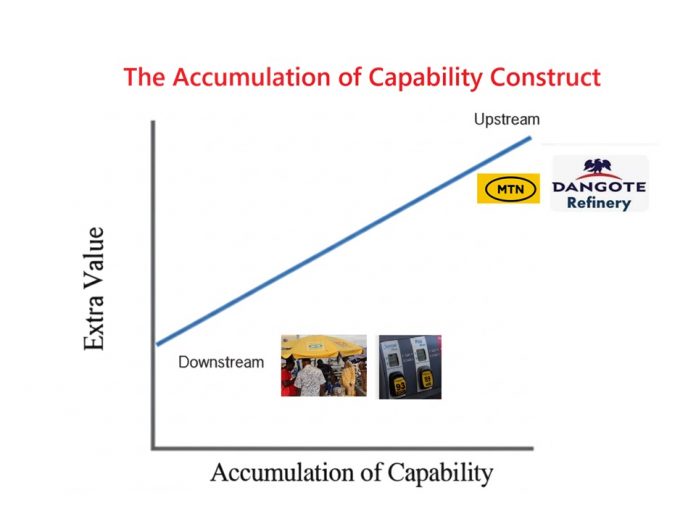
The accumulation of capability is a fundamental principle for companies to succeed and address market frictions. In our contemporary innovation-driven economy, the accumulation of capability has emerged as a central construct in driving business growth and national competitiveness.

Here, capability is not just about acquiring tools or infrastructure but about building deep, technical know-how, human capital, and organizational learning. Firms that progressively accumulate capabilities—especially upstream in the value chain—create greater leverage to capture extra value and dominate their industries.

This construct also informs strategic policymaking. Nations and companies that invest in upstream capabilities—such as research, design, and advanced manufacturing—tend to earn higher returns than those stuck in downstream activities like basic assembly or retailing. The Tekedia insights urge African businesses and leaders to rethink their positioning: true economic transformation will only come when we systematically move from consumption to production, and from importing knowledge to developing capabilities internally. Ultimately, value is not merely in participating, but in mastering and owning critical capabilities.

Within the accumulation of capability construct, it is essential to prioritize playing in the upstream segment (think of MTN, Dangote Refinery) over the downstream (recharge card seller, fuel station) because that is where the highest value is created and captured. Upstream activities—such as product design, core technology development, and intellectual property creation—enable firms and nations to set standards, control pricing, and shape market dynamics.

In contrast, downstream operations like distribution and basic customer service often face commoditization and thin margins. As Tekedia emphasizes, those who dominate upstream define the rules for those downstream, making upstream participation not just strategic but necessary for sustainable competitive advantage and long-term wealth creation.

Move upstream and win in your market.

OpenAI Doubles Revenue, Projects $12.7bn by Year-End Amid Heavy Cash Burn and Massive Funding Round

0

OpenAI, the artificial intelligence firm behind ChatGPT, has more than doubled its revenue in the first seven months of 2025, reaching an annualized figure of $12 billion. That marks a sharp leap from previous figures and cements OpenAI’s status as one of the fastest-growing private technology companies globally.

The company is currently generating about $1 billion in monthly revenue, according to The Information, which cited a source familiar with the matter.

The firm has been lining up investors for the second $30 billion portion of its funding round, the report said, adding that shareholders Sequoia Capital and Tiger Global Management are investing hundreds of millions of dollars in the round.

OpenAI’s Story So Far

Driving OpenAI’s revenue spike is the explosive growth of ChatGPT, its flagship generative AI product. Weekly active users have soared to 700 million, reflecting widespread global adoption across consumer and enterprise segments. This momentum supports the company’s ambitious projection to end 2025 with $12.7 billion in revenue, nearly triple its 2024 earnings. Analysts attribute this anticipated growth to deepening enterprise integration and expanding developer use cases, bolstered by API access and custom GPTs.

Cash Burn Escalates to $8 Billion

However, OpenAI’s financial expansion is mirrored by a steep rise in its spending. The company has raised its projected 2025 cash burn to $8 billion, up from $7 billion earlier in the year. The increased estimate stems from soaring investment in compute infrastructure, research and development, and operational scaling, all of which are essential to maintaining its edge in the intensifying AI arms race.

While the strategy is capital-intensive and carries financial risk, it aligns with broader industry patterns where leading AI firms are prioritizing long-term technological dominance over immediate profit.

A Historic $40 Billion Funding Round

To sustain its expansion and infrastructure push, OpenAI in March closed the largest private tech funding round in history, raising $40 billion at a $300 billion valuation. That makes OpenAI the third most valuable private tech company globally, behind SpaceX ($350 billion) and neck-and-neck with ByteDance.

The massive round is being raised in two stages: a $10 billion tranche led by SoftBank (with $7.5 billion) and other institutional backers; and a second $30 billion portion is still in progress.

As of July, OpenAI had secured $7.5 billion in commitments for the second tranche from investors excluding SoftBank. Among those backing the round are Sequoia Capital and Tiger Global Management, both of whom are investing hundreds of millions of dollars and have backed OpenAI since its Series E in 2023.

SoftBank: Largest Backer with $32 Billion Commitment

SoftBank has emerged as OpenAI’s largest single investor, committing a total of $32 billion since autumn 2024. Its contribution accounts for 75% of the $40 billion round. However, the full amount is contingent on OpenAI transitioning to a for-profit structure by December 31, 2025. Should the company fail to meet that condition, SoftBank’s total investment could be reduced to $20 billion, introducing a significant funding risk.

Other heavyweight investors include Microsoft, Coatue Management, Thrive Capital, Nvidia, Altimeter Capital, Andreessen Horowitz, and Founders Fund. Microsoft, a core partner since 2019, provides essential cloud infrastructure. Nvidia’s participation reflects the company’s dependency on cutting-edge GPU technology to train and run its models.

Since its founding in 2015, OpenAI has raised $63.92 billion across 11 rounds from 54 investors, including institutional giants like Goldman Sachs, Fidelity Investments, JPMorgan Chase, and angel investor Reid Hoffman.

Infrastructure Push: Stargate, Oracle, and Microsoft

OpenAI’s infrastructure ambitions are encapsulated in the massive “Stargate” project, a $500 billion data center initiative being jointly developed with SoftBank. The goal is to add 10GW of computing power across the United States over the next four years. However, tensions have reportedly emerged between the two over project direction and site selection, with OpenAI CEO Sam Altman separately pursuing other data center ventures.

The company is also part of a joint initiative with Oracle and SoftBank, announced in January 2025, to pump $40 billion into AI infrastructure by year-end, beginning with an initial $10 billion investment.

At the same time, OpenAI’s partnership with Microsoft—once seen as unshakeable—is reportedly showing signs of strain. Friction has emerged over strategic priorities and control, especially as OpenAI seeks more independence despite Microsoft’s significant investment and infrastructure support.

Corporate Structure and Elon Musk’s Legal Challenge

OpenAI’s hybrid capped-profit model, introduced in 2019, has come under scrutiny as the company inches toward a more commercial posture. Elon Musk, a co-founder, has legally challenged what he views as OpenAI’s betrayal of its nonprofit mission.

To resolve such tensions and unlock SoftBank’s full $30 billion commitment, OpenAI in May proposed a new governance structure: converting its for-profit arm into a Public Benefit Corporation (PBC), while its nonprofit entity retains control. Regulatory approval from attorneys general in California and Delaware is required by early 2026 for the restructuring to go through.

But Musk’s litigation and regulatory hesitancy could jeopardize the process, leaving billions in potential funding on the table.

Leadership Reshuffle and Viral Growth Metrics

In July, OpenAI made key leadership changes. CEO Sam Altman stepped back from daily operations to focus on long-term research and product innovation, signaling a shift toward deep R&D. The company’s user growth continues to break records, adding 1 million users in just one hour in March 2025. Between February and March, its weekly user base rose from 400 million to 500 million, and now sits at 700 million.

Competitive Landscape and Market Outlook

OpenAI is operating in a crowded and accelerating AI market, facing fierce competition from Google DeepMind, Amazon’s Bedrock, Anthropic’s Claude, and Perplexity. The global generative AI sector is projected to surpass $1 trillion in revenue within the next decade. OpenAI’s aggressive investment in compute infrastructure and continued rollout of advanced models is aimed at dominating this space, but it remains highly dependent on external funding.

While OpenAI’s $12 billion revenue figure is eye-catching, it remains unverified by independent auditors. The company has also declined to provide public comment, raising transparency concerns. Its projected $8 billion cash burn for 2025, set against anticipated revenue of $12.7 billion, implies a razor-thin operational buffer.