DD
MM
YYYY

PAGES

DD
MM
YYYY

spot_img

PAGES

Home Blog Page 81

Polymarket Briefly Claiming #1 Spot on IOS US App Sports Category is Symbolic

0

Polymarket’s iOS app surged to #1 in the free Sports category on the US App Store, briefly overtaking giants like FanDuel Sportsbook and Casino, DraftKings Sportsbook and Casino, ESPN, TikTok, and Amazon.

By the next day, it dipped to #3, but the climb was meteoric: from a beta release in late November to top spot in under a week, racking up 29k ratings at 4.8 stars.

Polymarket’s CEO, Shayne Coplan, summed it up perfectly on X: “that was quicker than expected” with a screenshot of the ranking. Coplan’s interview aired the day before, positioning Polymarket as “the most accurate thing we have as mankind right now” for predictions. The timing? Perfect for sports season hype.

US beta launch is currently limited to sports-only markets with fiat integration no full crypto yet, but it’s already live for testing. Recent App Store updates polished UX for in-game trading, tighter spreads, and bigger payouts than traditional sportsbooks—no house edge, just peer-to-peer markets.

X lit up with posts celebrating the win, from degens calling it the “prediction market supercycle” to analysts noting $11B in sports volume 95% of recent activity. Rivals like Kalshi are feeling the heat too. Polymarket isn’t just betting—it’s a live sentiment tracker for games, elections, and beyond, with USDC-collateralized outcomes for trust.

As the full US relaunch nears— geopolitics, news, and culture markets incoming, this #1 spot shows mainstream adoption is here. Sports contracts alone drove massive volume in November, and with pro-crypto vibes in the air, expect global charts next.

Polymarket’s rapid climb to #1 in the US App Store’s free sports category—surpassing established players like FanDuel, DraftKings, ESPN, TikTok, and Amazon—signals explosive early adoption during its beta phase.

With 29,000 ratings averaging 4.8 stars just days after launch, this isn’t fleeting hype; it’s proof that users crave its peer-to-peer model over traditional sportsbooks’ house edges and limits.

The surge, timed perfectly with Shayne Coplan’s 60 Minutes feature calling it “the most accurate thing we have as mankind right now,” has amplified visibility, drawing in non-crypto natives via fiat onboarding and live in-game trading.

Expect sustained top-10 rankings through NFL/NBA seasons, with sports now accounting for 95% of its $11B+ November volume. This milestone positions prediction markets as a legitimate disruptor to the $100B+ US sports betting industry, blending crypto’s transparency with mainstream usability.

Unlike sportsbooks, Polymarket’s USDC-collateralized contracts offer no house take just 2% fees, real-time probability shifts driven by crowd wisdom, and instant cash-outs—turning passive betting into active trading.

As full US relaunch nears expanding beyond sports to geopolitics, news, and culture, it could capture 10-20% market share by 2027, especially with pro-crypto policies under the incoming administration easing CFTC hurdles.

Globally, app store dominance hints at borderless expansion, though blocklists like Switzerland’s underscore regulatory fragmentation. Traditional operators face existential threats as Polymarket exposes their “scam”-like vig 5-10% margins.

DraftKings and FanDuel are already piloting prediction-style features, while PrizePicks’ integration funnels millions into Polymarket contracts. Rivals like Kalshi valued at $11B post-$1B raise are accelerating blockchain bets, but Polymarket’s sports focus gives it an edge in fan engagement.

Leagues are onboarding fast—UFC as exclusive partner video nearing 100M views, NHL first major NA league, Yahoo Finance for odds tickers, Google/Meta integrations. This could standardize prediction markets in broadcasts, boosting ad revenue via real-time sentiment data.

Markets as “crowd-sourced oracles” outperform polls/ESPN by aggregating skin-in-the-game insights, feeding AI tools for scouting and simulations. Intercontinental Exchange’s $2B investment valuing Polymarket at $8B turns probabilities into tradable assets, like a “people’s Bloomberg.”

The pro-innovation Trump admin with Trump Jr. advising fast-tracks CFTC approvals, but states like Tennessee decry it as a “threat” to gambling revenue, pushing Supreme Court battles over federal vs. state jurisdiction.

Internationally, grey markets (e.g., India) thrive, but bans risk fragmentation. For users, it’s empowering—no KYC for global access, but volatility demands savvy trading.

Prediction markets like Polymarket democratize information, making “truth” a market signal over media spin—ideal for sports’ emotional, real-time drama. It accelerates crypto’s mainstreaming first #1 app, blending Web3 with daily habits, but critics warn of gambling addiction risks without safeguards.

Ultimately, this cements sports as prediction’s killer app, paving for a “supercycle” where fans don’t just bet—they shape narratives. if regulators don’t clip its wings. If you’re diving in, grab the app for live NFL/NBA trades—it’s already proving markets beat polls and sportsbooks.
A Look At Sony Bank’s USD-Backed Stablecoin Initiative

0

Sony Bank, the digital banking arm of Sony Financial Group a subsidiary of Sony Group Corporation, has announced plans to issue a US dollar-pegged stablecoin targeted primarily at the US market.

The move is part of Sony’s broader push into Web3 technologies and aims to streamline payments within its entertainment ecosystem, including gaming— PlayStation Store purchases and in-game items, anime streaming via Crunchyroll, subscriptions, music, movies, and digital commerce.

This could reduce reliance on high-fee credit card networks, which currently dominate Sony’s payment flows, and enable faster, cheaper cross-border settlements—especially relevant since the US accounts for over 30% of Sony Group’s external revenue.

As early as fiscal year 2026 starting April 2026, pending US regulatory approvals. The stablecoin will be fully backed 1:1 by US dollars held in reserves, ensuring price stability unlike volatile cryptocurrencies like Bitcoin.

Sony Bank is collaborating with Bastion, a US-based stablecoin infrastructure provider backed by investors including Coinbase Ventures, a16z crypto, Samsung Next, and Sony’s own Innovation Fund. Bastion will handle issuance, custody, reserve management, and compliance.

In October 2025, Sony Bank applied to the US Office of the Comptroller of the Currency (OCC) for a national trust bank charter to establish a dedicated subsidiary potentially named Connectia Trust for stablecoin operations.

The application is under review, facilitated by the GENIUS Act passed in July 2025, which provides a clearer framework for regulated USD-backed stablecoins. This builds on Sony’s prior Web3 efforts, such as launching a yen-pegged stablecoin proof-of-concept in April 2024 with Polygon Labs and SettleMint, and accepting USDC payments on Sony Electronics’ Singapore store via Crypto.com Pay.

Sony Financial Group was spun off and listed on the Tokyo Stock Exchange in September 2025 to focus more sharply on fintech innovations like this. Seamless, low-cost payments for digital content without crypto volatility risks, potentially integrating directly into PlayStation wallets or apps.

For Sony: Cuts transaction fees, improves treasury operations like inter-company settlements, and keeps spending within its ecosystem—aligning with the stablecoin market’s projected growth to $1.9 trillion by 2030 per Citi estimates.

This is a major mainstream adoption signal, following similar moves by tech giants. It positions Sony alongside players like Tether (USDT) and Circle (USDC) but with a regulated, enterprise-focused twist. However, challenges include ongoing US regulatory scrutiny on corporate-issued stablecoins risks to dollar hegemony and money laundering, as seen in past cases like Meta’s Diem project.

Sony Bank has not yet responded to media inquiries for further comment, but the partnership with Bastion was officially confirmed via their channels. This development underscores how entertainment and finance are converging via blockchain, potentially transforming how billions interact with digital media.

Sony Bank and Bastion Partnership

The partnership between Sony Bank a subsidiary of Sony Financial Group and Bastion, a U.S.-based stablecoin infrastructure provider, was officially announced on December 1, 2025, marking a significant step in Sony’s Web3 expansion.

Bastion has been designated as Sony Bank’s exclusive (sole) provider for the issuance, reserve management, custody, and overall infrastructure of a new USD-pegged stablecoin, slated for launch as early as fiscal year 2026.

This collaboration leverages Bastion’s regulated platform to ensure compliance, scalability, and seamless integration into Sony’s entertainment ecosystem, targeting U.S. consumers who represent over 30% of Sony Group’s external revenue.

Bastion will handle end-to-end stablecoin operations, including:Issuance and Redemption: Secure minting and burning of tokens, backed 1:1 by USD reserves cash and short-term U.S. Treasury bonds.

Oversight of collateral to maintain peg stability, with built-in yield generation on idle reserves to optimize Sony’s treasury. Bankruptcy-remote storage via regulated entities, ensuring user funds are protected and compliant with U.S. standards.

White-label solutions for wallets, on/off-ramps, cards, and yield products, allowing Sony to brand the stablecoin while Bastion manages the tech backend. This setup allows Sony to focus on consumer-facing applications without building proprietary blockchain tech from scratch, reducing development time by an estimated 12-18 months.

The stablecoin is expected to operate on Sony’s Ethereum Layer 2 network, Soneium launched January 2025, for low-cost, high-speed settlements. Bastion’s platform supports interoperability with major chains, enabling cross-border efficiency for Sony’s global operations.

Sony Bank applied for a U.S. national trust bank charter from the Office of the Comptroller of the Currency (OCC) in October 2025, aiming to create a subsidiary tentatively “Connectia Trust” for stablecoin activities. This aligns with the GENIUS Act signed July 2025, which clarifies rules for USD-backed stablecoins.

Bastion operates under a New York Department of Financial Services (NYDFS) trust charter via its Dibbs Trust Company subsidiary, providing money transmitter licenses (MSL/MTL) and built-in KYC/AML compliance.

This minimizes regulatory hurdles for Sony, addressing concerns like FDIC insurance gaps raised by groups such as the Independent Community Bankers of America (ICBA). The partnership aims to create “programmable money” for Sony’s ecosystem, reducing reliance on high-fee credit card networks potentially saving Sony up to $200 million annually in fees and enabling faster inter-company settlements.

Kazuhito Hadano, CEO of Sony Ventures Corporation, emphasized: “Together [Sony and Bastion] will bring stablecoins to the mass market and set the tone for enterprise adoption of digital assets.”

Nass Eddequiouaq, Bastion’s Head of Partnerships, highlighted the dual focus on internal efficiency and consumer convenience. In September 2025, Sony Innovation Fund joined Bastion’s $14.6 million strategic funding round, led by Coinbase Ventures, alongside a16z crypto, Samsung Next, and Hashed.

This investment underscores mutual alignment, positioning Bastion as a trusted partner for regulated, enterprise-grade stablecoins—similar to alternatives like Paxos but tailored for branded, white-label issuance.

Bastion’s platform is designed for institutions avoiding speculative crypto risks, emphasizing compliance and scalability to handle high-volume payments.

This deal positions Sony as a bridge between traditional entertainment and blockchain, joining trends like Stripe’s stablecoin integrations and the $306 billion stablecoin market projected to hit $1.9 trillion by 2030.

For Bastion, it’s validation of its “stablecoin-as-a-service” model, attracting more enterprises wary of building in-house. Early X reactions praise the regulatory focus and potential for mainstream gaming payments, with users noting it could “unlock new possibilities in digital finance.”

Challenges remain, including OCC approval delays and ICBA concerns over consumer protections, but the GENIUS Act provides a favorable tailwind. Overall, this partnership signals accelerating corporate stablecoin adoption, blending fiat stability with blockchain efficiency.

Coinbase Reports 19% Surge in Government and Law Enforcement Data Requests, as Myriad and Trust Wallet Announce Partnership

0

Coinbase released its latest transparency report, revealing a record-high 12,716 government and law enforcement information requests for user data during the period from October 2024 to September 2025.

This represents a 19% increase compared to the previous 12-month cycle, underscoring growing global regulatory scrutiny on cryptocurrency platforms amid rising adoption and concerns over illicit activities.

The United States accounted for 5,444 requests about 43% of the total, maintaining its position as the top source since 2022. However, non-U.S. requests rose to 53% of the overall volume—a new high—driven by a 200 basis point increase year-over-year.

This shift highlights expanding surveillance efforts beyond U.S. borders. France led the surge with 1,114 requests, a massive 111% increase from the prior year, reflecting heightened EU focus on anti-money laundering (AML) under frameworks like MiCA.

This leap positioned France as the second-largest source of such requests globally, trailing only Germany among non-U.S. jurisdictions. This marks a 111% rise from approximately 527 requests in the October 2023–September 2024 cycle.

France’s requests accounted for about 8.8% of Coinbase’s overall 12,716 global requests, contributing significantly to the 53% non-U.S. share—a record high, up 200 basis points from the previous year.

These figures reflect received requests only; Coinbase notes that not all lead to responses, as each is vetted for legal validity, with only minimal or aggregated data disclosed when required.

The increase aligns with France’s intensifying regulatory and enforcement focus on cryptocurrencies, particularly around anti-money laundering (AML) and counter-terrorism financing (CTF). France, as a MiCA frontrunner, has ramped up oversight since the regulation’s full rollout in late 2024.

MiCA mandates stricter AML screening for crypto service providers (CSPs) like Coinbase, which operates under a French entity. This has led to heightened investigations into suspicious transactions, with authorities like the Autorité de Contrôle Prudentiel et de Résolution (ACPR) and Tracfin (anti-money laundering unit) issuing more subpoenas and court orders.

The surge coincides with MiCA’s emphasis on transaction traceability, prompting a wave of data demands tied to cross-border flows. French prosecutors have escalated probes into crypto-linked illicit activities.

For instance the ongoing judicial investigations into platforms like Binance for alleged money laundering tied to drug trafficking across the EU which spilled over to broader ecosystem scrutiny.

While not directly targeting Coinbase, these cases have increased inter-agency collaboration, boosting requests to compliant exchanges like Coinbase for user transaction histories.

National efforts to combat crypto-fueled organized crime, including ransomware and sanctions evasion, with France reporting a 25% rise in crypto-related AML alerts in 2025 per Tracfin data.

The exchange faced a €21.5 million fine from Ireland’s Central Bank in November 2025 for AML failures involving over $202 billion in transactions, but France’s ACPR has similarly intensified on-site inspections of CSPs ahead of MiCA licensing renewals.

Additionally, a May 2025 Coinbase data breach exposed 69,461 users’ details with $400 million in damages may have prompted French authorities to seek verification data amid privacy concerns.

Rising crypto adoption in Europe, 17% of French adults holding digital assets per 2025 surveys has amplified illicit use cases, fueling ~95% of requests linked to criminal probes like search warrants and emergency disclosures.

This surge underscores France’s pivot toward “regulated innovation,” balancing crypto growth with robust surveillance. For Coinbase users in France and EU-wide via passporting, it means heightened compliance burdens, potentially delaying transactions or requiring enhanced KYC.

Privacy advocates warn it could deter adoption, pushing users toward decentralized alternatives, while Coinbase reiterates its “no direct access” policy and per-request reviews.

As MiCA evolves, expect France’s trend to influence other EU states, with non-U.S. requests projected to exceed 60% by 2026. Germany: 1,210 requests, down 5% year-over-year. United Kingdom: Up 16%, contributing to the top six countries U.S., Germany, UK, France, Spain, Australia that made up ~80% of all requests.

Spain: +27%. Moldova saw a 5.7x jump, while South Korea’s requests plummeted 67%. Approximately 95% were linked to criminal investigations, including subpoenas, court orders, search warrants, and emergency disclosures.

Coinbase emphasized that it reviews each request individually for validity and scope, providing only the minimum required data—often anonymized or aggregated—and does not grant governments direct system access.

This uptick occurs against a backdrop of regulatory challenges for Coinbase, including a €21.5 million fine from Ireland’s Central Bank in November 2025 for AML screening failures affecting over $202 billion in transactions, and a May 2025 data breach exposing details of 69,461 customers resulting in estimated $400 million in damages.

Despite these issues, the exchange’s Q3 2025 revenue hit $1.9 billion up 58% YoY, signaling robust business growth. The trend raises privacy concerns for crypto users, as centralized exchanges like Coinbase must comply with legal obligations to maintain licenses.

Experts note it exemplifies how user data on such platforms is “one subpoena away” from government access, potentially spurring interest in self-custody solutions. For global users, including in emerging markets like Africa, it signals spillover effects from stricter policies in major jurisdictions, impacting cross-border crypto flows.

As crypto integrates further into traditional finance, expect continued escalation in such demands unless privacy-enhancing technologies gain traction.

Myriad and Trust Wallet Announce Partnership

Myriad Markets, a leading Web3 prediction market protocol, announced a partnership with Trust Wallet, the world’s largest self-custody wallet with over 200 million users.

This collaboration introduces the first-ever native in-wallet prediction market experience, allowing users to trade on real-world events—like crypto prices, politics, sports, and more—directly within the Trust Wallet app without needing to switch to external platforms.

Users access Myriad’s markets via a new “Predictions” tab in Trust Wallet’s Swaps section. With one click, they can place “yes” or “no” positions on event outcomes using their existing assets.

The process is designed for speed—trades execute in seconds, emphasizing seamless, self-custodial access. The launch coincides with Myriad surpassing $100 million in cumulative trading volume, a 10x increase over the past three months.

This includes over 400,000 active traders, 6.3 million trades, and 7.3 million transactions, fueled by its recent deployment on BNB Chain for lower fees and broader liquidity. Trust Wallet plans to integrate additional platforms like Kalshi and Polymarket into the Predictions hub, turning it into a one-stop gateway for tokenized real-world outcomes.

Myriad will anchor initial categories, providing infrastructure and popular markets. Farokh Sarmad, President and Co-Founder of Myriad: “Myriad Markets being the first ever Prediction Market integrated natively inside of a wallet marks a huge moment for this asset class.

Trust Wallet is where tens of millions of people begin and manage their crypto experience, so bringing Myriad directly into that flow makes on-chain predictions accessible in a way the industry has never seen before. We are honoured to partner and to move this industry forward together.”

Eowyn Chen, CEO of Trust Wallet: “People shouldn’t need five apps to express what they think will happen next. Wallets are becoming the home for all kinds of trading—not just tokens, but also information, opinions, and expectations. Our vision is to unlock access safely and give users the simplest way to participate in these emerging markets.”

Ilan Hazan, COO and Co-Founder of Myriad: “Being the first platform to launch within Predictions highlights the strength of the community and ecosystem behind Myriad. We are committed to building the most accessible and transparent environment for event-driven contracts, and this integration is an important step toward that vision.”

This partnership democratizes prediction markets by embedding them into everyday crypto tools, reducing friction and boosting adoption. Myriad, which has achieved explosive growth with minimal marketing spend, positions itself as a media-rooted protocol linking markets to news and video content via partners like Decrypt and Rug Radio.

Looking ahead, expect multichain expansions, enhanced oracles for event resolution, and U.S. regulatory alignment. The crypto community on X is buzzing about it, with users highlighting the ease for sports betting and sentiment-tracking markets like “Crypto Winter Is Coming?” resolving “Yes” if BTC drops to $35K, ETH to $1K, and alts lose major cap by Feb 2026.

Early sentiment leans “No,” reflecting optimism amid the bull run. If you’re a Trust Wallet user, update your app and check the Predictions tab to dive in. This feels like a pivotal step toward mainstream Web3 trading—watch for volume spikes as word spreads.

Ethereum, DOGE, and SHIB Could All Pump—But Ozak AI Prediction Points to the Next Real 100x Winner

0

Crypto markets are coming into a renewed phase of power as capital rotates back into foremost altcoins and investor sentiment improves across the board. Ethereum, Dogecoin, and Shiba Inu are all displaying sturdy setups for potential breakouts, with technical structures, liquidity levels, and network momentum aligning for a promising rally.

Yet even as these popular assets gear up for meaningful gains, analysts widely agree that Ozak AI is the project with the steepest long-term trajectory. With early-stage pricing, deep AI-native infrastructure, and accelerating global demand, Ozak AI is increasingly viewed as the next real 100x contender of the upcoming cycle.

Ethereum Builds Toward a Strong Bullish Continuation

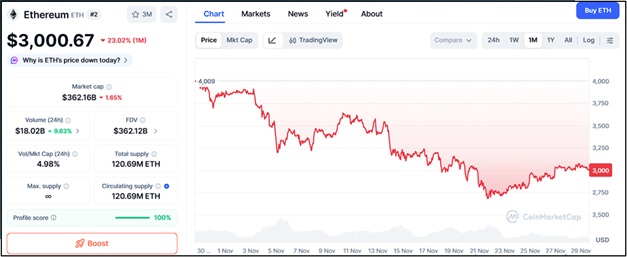
Ethereum (ETH), trading around $3,000, continues to bolster structurally as network interest rises and institutional adoption grows. ETH maintains reliable aid at $2,925, $2,785, and $2,640, zones in which buyers always acquire at some stage in market pullbacks. These levels highlight the confidence surrounding Ethereum’s function as the backbone of DeFi, tokenization, and Layer-2 scaling ecosystems.

For Ethereum to extend into its next major upside move, it must break resistance at $3,115, $3,260, and $3,410. Historically, when ETH clears these thresholds, it enters sustained, multi-week expansions driven by increasing transactional activity and rising staking demand. Ethereum is widely expected to push much higher during the next cycle, but its large market cap limits its ability to deliver anything close to a 50x–100x multiplier.

Dogecoin Shows Renewed Strength as Meme Liquidity Returns

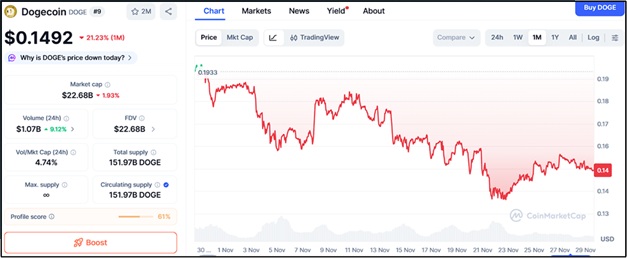
Dogecoin (DOGE), buying and selling close to $0.1492, is gaining momentum again as the meme-coin hypothesis reawakens throughout the marketplace. DOGE maintains to hold strong support at $0.1451, $0.1386, and $0.1324, levels that reflect strong network-pushed accumulation and renewed hobby within the meme coin.

For DOGE to interrupt into a deeper uptrend, it needs to push above resistance at $0.1563, $0.1641, and $0.1745. Clearing these stages has traditionally brought about fast movements fueled by way of social sentiment spikes, celeb mentions, and retail-driven inflows. While Dogecoin may supply powerful short-term pumps—probably even a multi-x rally—its dependence on sentiment and its market length obviously limit its long-term multiplier potential.

Shiba Inu Prepares for Another Upside Attempt

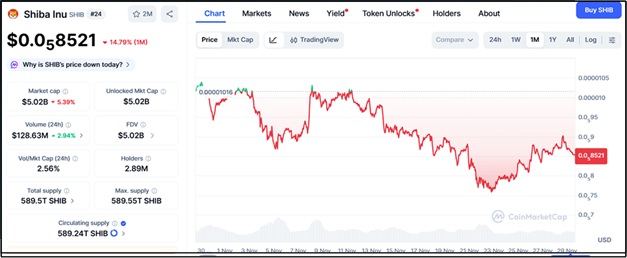
Shiba Inu (SHIB), hovering around $0.000008521, is likewise displaying renewed energy as Shibarium improvement expands and retail investors return to high-volatility property. SHIB sits firmly above aid at $0.00000826, $0.00000795, and $0.00000768, zones wherein the market continually steps in to build up.

For SHIB to accelerate into a breakout, it must clear resistance at $0.00000882, $0.00000910, and $0.00000942. Once SHIB flips these zones, it often experiences sharp, sentiment-driven expansions. Analysts believe SHIB could produce a strong rally in the next phase of the cycle—but, like DOGE, its large established valuation limits its odds of achieving exponential returns.

Ozak AI Emerges as the Most Powerful Long-Term 100x Project

While Ethereum, DOGE, and SHIB may all pump strongly, Ozak AI (OZ) is the project capturing the most attention for long-term exponential gains. Unlike meme coins or large-cap platforms, Ozak AI is built on real, scalable AI-native infrastructure designed to upgrade Web3 intelligence, trading, analysis, and automation.

Ozak AI integrates millisecond-speed prediction agents capable of real-time market scanning, cross-chain analytics engines monitoring multiple networks simultaneously, lightning-fast 30 ms trading signals via HIVE, and autonomous SINT-powered AI agents capable of executing tasks, trades, and voice-driven commands. This positions Ozak AI as a next-generation intelligence layer rather than a speculative token.

Because Ozak AI is still early-stage, with a small initial valuation and massive real-world demand, analysts believe its growth curve is far steeper than any major altcoin. It sits at the core of the rapidly accelerating AI revolution—a sector expected to become one of the defining technological forces of the decade.

Presale Momentum Confirms Ozak AI’s Explosive Potential

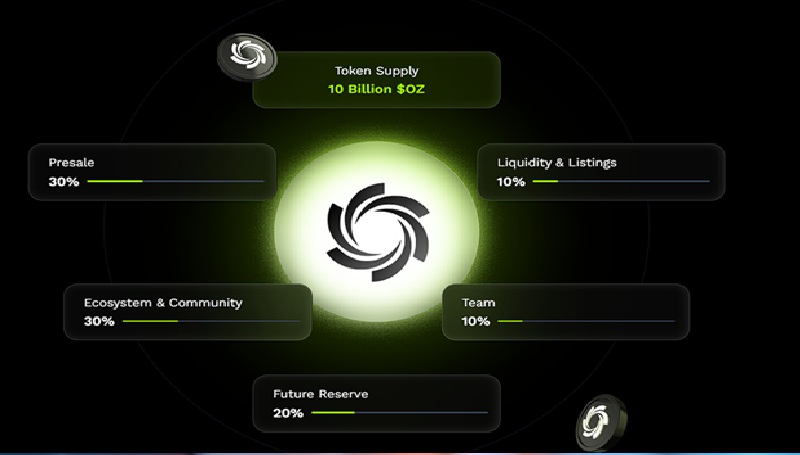
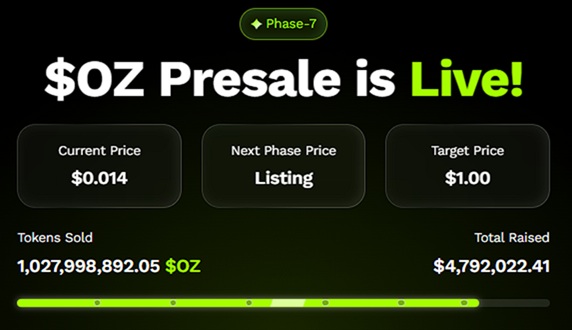
The Ozak AI presale reinforces its 100x potential, with over $4.7 million raised and more than 1 million tokens sold. This level of early global demand mirrors the early patterns of past bull-market leaders that went on to deliver extraordinary gains. Because Ozak AI offers real utility, not just hype, analysts see its multiplier potential as significantly higher than that of ETH, DOGE, and SHIB.

Ethereum, Dogecoin, and Shiba Inu are all showing strong signs of upcoming growth, supported by robust technical structures, improving sentiment, and strengthening ecosystem fundamentals. Each could deliver meaningful gains in the next cycle.

But Ozak AI stands apart as the most promising 100x candidate, driven by real AI-native utility, early-stage affordability, and explosive presale traction. As AI becomes the dominant force shaping the future of Web3, Ozak AI is emerging as one of the most compelling long-term opportunities in the entire market.

About Ozak AI

Ozak AI is a blockchain-based crypto assignment that provides a generation platform that specializes in predictive AI and superior information analytics for financial markets. Through machine gaining knowledge of algorithms and decentralized network technology, Ozak AI permits real-time, correct, and actionable insights to assist crypto fanatics and businesses in making the proper selections.


For more, visit:

Website: https://ozak.ai/

Telegram: https://t.me/OzakAGI

Twitter: https://x.com/ozakagi


Vanguard Will Allow Clients to Buy Crypto ETFs Starting Today

0

Vanguard, the world’s second-largest asset manager with over $11 trillion in assets under management, announced on December 1, 2025, that it will begin allowing its brokerage clients to trade select cryptocurrency ETFs and mutual funds starting today, December 3, 2025.

This marks a significant reversal from its long-held skepticism toward digital assets, which it previously viewed as too volatile and speculative for long-term portfolios.

Clients can now access regulated ETFs and mutual funds that primarily hold cryptocurrencies like Bitcoin (BTC), Ether (ETH), XRP, and Solana (SOL). High-risk assets, such as those tied to meme coins, remain restricted.

This applies to self-directed brokerage and IRA accounts on Vanguard’s U.S. platform, opening the door for its 50 million+ clients to invest in these products without needing to leave the ecosystem. Vanguard cited the ETFs’ performance through recent market volatility and improved operational processes as factors in the decision.

However, the firm has no plans to launch its own crypto products and will only facilitate third-party funds, similar to how it handles commodities like gold. The move comes amid strong demand for crypto ETFs, with spot Bitcoin ETFs alone amassing billions in assets since their 2024 debut.

Analysts expect this could drive tens of billions in new inflows, intensifying competition with rivals like BlackRock and Fidelity. This shift reflects broader mainstream adoption of crypto in traditional finance, potentially boosting liquidity and investor participation.

Vanguard’s policy shift, effective today, is already rippling through markets. Bitcoin surged about 6% in early U.S. trading on December 2, 2025, reflecting immediate optimism, though sentiment remains in “Fear” territory amid recent volatility.

Ethereum, XRP, and Solana also saw gains of 7-8%, but analysts caution this could be a fragile bounce, with potential retests of Bitcoin lows around $80,000 if leverage cascades trigger further liquidations.

Initial ETF inflows may be modest as Vanguard’s conservative clients often in retirement accounts place orders gradually, but even 0.1-0.2% allocation from its $11 trillion AUM could inject $11-22 billion—dwarfing the $25 billion seen in spot Bitcoin ETFs’ first month in 2024.

This move democratizes crypto access for Vanguard’s 50 million+ clients, many previously locked out due to platform restrictions. It channels “sticky” capital—retirement funds and passive allocations—into regulated products, potentially adding tens of billions in sustained demand over months.

If 0.5% of assets shift a conservative estimate for diversification, that’s $55 billion, exceeding BlackRock’s IBIT peak of $100 billion earlier this year. Crypto ETFs, tested through 2024-2025 volatility, now integrate seamlessly into traditional portfolios, akin to gold or commodities.

This could accelerate ETF approvals for other assets and draw sidelined institutions. Enhanced trading volumes reduce spreads and volatility, benefiting spot markets for BTC, ETH, XRP, and SOL. While Bitcoin captures most flows as the “commodity” play, XRP and SOL ETFs could see disproportionate gains from targeted demand, though altcoin season remains elusive.

Competitive and Strategic Shifts in FinanceVanguard’s reversal—driven by client pressure and new CEO Salim Ramji’s BlackRock background—signals TradFi’s capitulation. It pressures holdouts like State Street to follow, intensifying rivalry with BlackRock IBIT at $70-80 billion and Fidelity.

Vanguard won’t launch its own products or support meme coins/high-risk funds, focusing on third-party regulated options to align with its low-cost ethos. This hybrid model bridges crypto’s innovation with TradFi’s stability, potentially eroding direct holdings due to ETF fees of 0.2-0.5% but expanding the pie overall.

Fresh inflows could fuel rallies, but a macro downturn (e.g., U.S. debt expansion or tariff risks) might trigger outsized sell-offs from new, less experienced investors. Aligns with Fed stablecoin rules and QT’s end, but lingering uncertainties persist.

ETF issuers like BlackRock win big on AUM; direct crypto holders may face relative underperformance; traditional bonds could see outflows. This cements crypto’s evolution from speculative fringe to core asset class, unlocking structural inflows that compound over years.

Monitor ETF flow data this week for early signals—expect Bitcoin to lead, with alts following if sentiment flips to “Greed.”