DD
MM
YYYY

PAGES

DD
MM
YYYY

spot_img

PAGES

Home Blog Page 831

The Imperative for a Unified CAC and Trademark System: A Review of Sanofi and KPMG Case

0
CAC

The vibrant entrepreneurial spirit in Nigeria, fueled by a booming youth population and increasing access to technology, has led to a surge in new businesses. However, this growth often comes with a significant challenge: the pervasive issue of brand confusion stemming from a disconnect between the Corporate Affairs Commission (CAC) and the Trademarks Registry. It’s a problem that extends beyond mere inconvenience, often resulting in costly legal battles, tarnished reputations, and stifled innovation.

The Legal Framework

Nigeria’s business landscape is governed by several key pieces of legislation, primarily the Trademarks Act (Cap T13 LFN 2004, as amended) and the Companies and Allied Matters Act (CAMA) 2020. While both aim to foster a fair and orderly business environment, their siloed operations create loopholes that exploit well-meaning businesses.

The Trademarks Act is the primary legislation for protecting unique brand identifiers. Section 11 of the Act, for instance, explicitly disallows the registration of a mark if its use “would, because of its being likely to deceive or cause confusion or otherwise, be disentitled to protection in a court of justice.” This provision underscores the principle that a trademark must be distinctive and not infringe on existing rights.

On the other hand, CAMA 2020, the foundational law for company and business name registration, has made commendable strides in addressing this historical disconnect. Crucially, Section 30(4) of CAMA 2020 empowers the CAC to direct a company to change its name if it discovers that the name is identical to a registered trademark and was registered without the trademark owner’s consent. Furthermore, Section 857 of CAMA 2020 provides a robust mechanism for challenging company/business name registrations before the CAC’s Administrative Procedure Committee (APC) if the name is:

  • Identical to a name associated with an applicant who has goodwill.
  • Sufficiently similar to such a name that its use in Nigeria would be likely to mislead by suggesting a connection between the company and the applicant.
  • In the opinion of the Commission, it would violate or conflict with any existing trademark or business name registered in Nigeria.

This latter provision, particularly, gives teeth to trademark owners, allowing them to proactively prevent or rectify instances of name squatting or unintentional duplication.

Real-World Consequences: The SANOFI Case

The implications of this disconnect are not theoretical; they are real. A particularly illuminating and recent example is the Federal High Court judgment in Sanofi S.A. v. Sanofi Integrated Services Ltd. & 3 Ors., delivered in August 2023. This landmark ruling underscores the very issues at the heart of the CAC-Trademark Registry disconnect.

In this case, Sanofi S.A., a French multinational pharmaceutical company with long-standing registered trademarks for “SANOFI” in Nigeria, discovered that several local entities had registered company names incorporating its trademark (e.g., Sanofi Integrated Services Limited, Sanofi Nigeria Enterprises Limited, and Sanofi Nigerian Enterprise). Despite Sanofi’s trademark pre-dating these company registrations, the lack of an integrated system allowed such registrations to occur.

Sanofi was compelled to pursue legal action, initially lodging a complaint with the CAC, which directed the infringing companies to change their names under the provisions of CAMA 2020. When these companies failed to comply, Sanofi proceeded to the Federal High Court. The Court, in upholding the CAC’s directive, decisively ruled in favour of Sanofi S.A., ordering the cancellation and/or change of the infringing company names and even awarding damages. Justice J. Omotosho’s judgment affirmed that a validly registered trademark takes precedence over a later-registered company name, especially when it causes confusion.

This case serves as a stark reminder of the time, cost, and reputational damage that can arise from such conflicts, even with the improved provisions of CAMA 2020. While it demonstrates the increasing effectiveness of legal recourse, it also highlights the reactive nature of the current system, where trademark owners must actively pursue litigation to enforce their rights, rather than being protected by a preventive digital framework.

Real-World Consequences: The KPMG Case

The implications of this disconnect are not theoretical; they are playing out in real-time within Nigeria’s legal landscape. A particularly illuminating and most recent example is the ongoing legal battle between KPMG Nigeria and KPMG Professional Services.

As reported on July 23, 2025 by Punch, KPMG Professional Services announced its appeal against a July 10, 2025, judgment by the Court of Appeal in Lagos. This judgment directed the Corporate Affairs Commission (CAC) to remove “KPMG Professional Services” from its register due to its similarity with the established audit, tax, and consulting firm, KPMG Nigeria.

The dispute dates back to 2002 when KPMG Nigeria (which includes entities like KPMG Audit registered in 1969 and KPMG Tax Consultants in 1990) filed an originating summons challenging the CAC’s registration of a new entity named “KPMG Professional Services.” KPMG Nigeria argued that the registration was deceptively similar to its long-established identity.

While a Federal High Court initially dismissed KPMG Nigeria’s suit in 2005, citing an alleged merger, the Court of Appeal in its recent ruling on July 10, 2025, overturned that decision. Justice Abdullahi Mahmud Bayero, delivering the unanimous decision, emphasised that KPMG Nigeria was the first to register its business entities. The appellate court rejected the notion of a merger based on insufficient and unsubstantiated evidence, stating that only a formal merger agreement could determine its scope. Crucially, the Appeal Court held that the CAC acted contrary to CAMA by allowing a similar name to be registered without first removing the earlier existing names from the registry. This points directly to the systemic failure of the CAC in cross-referencing and preventing name conflicts.

Despite the Appeal Court’s directive for deregistration and a perpetual injunction against KPMG Professional Services operating under that name, KPMG Professional Services has appealed to the Supreme Court and filed for a stay of execution, assuring its clients it will continue operations. This development, still unfolding, highlights the protracted and costly nature of resolving such name disputes in Nigeria’s current system. It serves as a stark reminder of the time, cost, and reputational damage that can arise from such conflicts.

When a Trademark is Hijacked as a Company Name

A significant procedural issue arises when a company possesses a duly registered trademark, but another entity proceeds to register that identical or confusingly similar mark as its company name with the CAC. In such a scenario, the trademark owner is not necessarily suing for the infringement of their own company name, but rather for the infringement of their trademark rights by the unauthorised use of that trademark as a company name.

The legal action in such a case primarily grounds itself in trademark infringement under the Trademarks Act and leveraging the provisions of CAMA 2020 that address conflicting names. Key procedural considerations include:

  1. Jurisdiction of the Federal High Court: Trademark infringement actions, whether or not they involve a company name, fall exclusively within the jurisdiction of the Federal High Court in Nigeria. This is crucial for the trademark owner to bear in mind when initiating legal proceedings.
  2. Establishing Trademark Ownership and Goodwill: The trademark owner must prove that they possess a validly registered trademark that pre-dates the conflicting company name registration (unless the company name was registered in bad faith). They also need to demonstrate existing goodwill and reputation associated with their trademark. This is vital for both trademark infringement and an action for “passing off,” which is a common law tort designed to protect the goodwill of a business from misrepresentation.
  3. Demonstrating Likelihood of Confusion or Deception: The core of a trademark infringement claim, even when the infringing mark is used as a company name, is proving that the defendant’s use of the name is “likely to deceive or cause confusion” in the minds of the public. This does not require proof of actual deception, only a likelihood.
  4. Targeting the CAC’s Role: While the primary target of the suit is the infringing company, the trademark owner can also join the CAC as a party to the suit. This is particularly relevant when seeking orders for the CAC to deregister or amend the conflicting company name, as seen in the KPMG case where the Appeal Court directed the CAC to act.
  5. Reliefs Sought: Beyond injunctions (to stop the use of the name) and damages for losses incurred (e.g., lost sales, damage to reputation), the trademark owner can seek specific orders for the CAC to:
  • Direct the change of the infringing company’s name under Section 30(4) of CAMA 2020.
  • Deregister the infringing company name if compliance with a name change directive is not met.
  • Rectify the register of companies to reflect the removal or alteration of the conflicting name.
  1. “Passing Off” Action: Even if the trademark is unregistered, or as an alternative claim, a trademark owner can pursue an action for “passing off.” This tort protects the goodwill of a business even without a registered trademark, provided the claimant can demonstrate:
  • Goodwill or reputation in their goods or services.
  • A misrepresentation by the defendant, leading the public to believe the defendant’s goods/services are those of the claimant.
  • Resultant damage or likelihood of damage.

Seeking Redress: The Current Avenues

For a business whose existing trademark or company name has been registered by another, the following avenues for redress are available:

  1. Cease and Desist Letter: A formal notice to the infringing company demanding the cessation of the use of the conflicting name. This often serves as a preliminary step to avoid litigation.
  2. Complaint to the Corporate Affairs Commission (CAC): Leveraging the provisions of CAMA 2020, particularly Section 30(4), a formal complaint can be lodged with the CAC, requesting them to direct the offending company to change its name.
  3. Administrative Procedure Committee (APC): Under Section 857 of CAMA 2020, the trademark proprietor can formally object to the company registration before the CAC’s Administrative Procedure Committee (APC), which functions as an internal tribunal for such disputes.
  4. Federal High Court Action: As a last resort, an action can be instituted at the Federal High Court for trademark infringement. This can result in injunctions preventing further use of the infringing name, and claims for damages incurred due to the confusion or loss of goodwill. The KPMG case underscores the effectiveness of this judicial route, albeit a long and resource-intensive one.

Why must there be synergy between Trademark Registry and CAC

The current state of Nigeria’s trademark registry, largely reliant on physical index cards in file cabinets, is a significant bottleneck. This analogue approach makes comprehensive searches difficult, prone to errors, and utterly inefficient. The solution lies in a robust, interconnected digital infrastructure.

Consider the United States Patent and Trademark Office (USPTO) or the European Union Intellectual Property Office (EUIPO). Both operate highly sophisticated online databases that allow for comprehensive trademark searches. Their systems are designed to minimise overlaps by integrating trademark data with business registration information, where feasible. This proactive approach significantly reduces instances of conflicting registrations from the outset.

For Nigeria, the benefits of digitising the Trademark Registry and linking it directly with the CAC portal are immense:

  • Preventive Mechanism: A unified online platform could automatically cross-reference proposed company names with existing trademarks, preventing conflicting registrations before they occur. As seen with the KPMG case, such a system would have flagged the similarity immediately and prevented the initial registration, saving years of litigation.
  • Enhanced Efficiency: Instantaneous searches and registrations would streamline processes, drastically reducing the time it takes to get a business or trademark registered.
  • Data Integrity and Accuracy: Digital databases are less prone to errors and misfilings inherent in manual, paper-based systems.
  • Ease of Enforcement: With all data readily accessible online, identifying and proving infringement would become significantly simpler, strengthening intellectual property rights enforcement.
  • Investor Confidence: A modern, transparent, and efficient IP registration system signals a mature business environment, attracting both local and foreign investment.

Conclusion

The legislative framework in Nigeria, particularly with the advancements in CAMA 2020, has laid a stronger foundation for protecting intellectual property. However, laws are only as effective as their implementation. The ongoing KPMG dispute serves as a potent, real-time illustration of the administrative hurdles and the reactive nature of intellectual property protection in Nigeria due to the disconnect between the CAC and the Trademark Registry.

It is time for a concerted effort to fully digitise the Trademark Registry and establish a seamless, real-time interface with the CAC portal. This synergy would not only prevent the confusion of existing trademarks being registered as company names and vice versa, but also foster a more transparent, efficient, and investor-friendly business landscape in Nigeria. The future of brand protection and business growth in Nigeria hinges on this crucial digital convergence.
U.S. Lawmakers Introduce New Copyright and Privacy Bill that Will Criminalize Training AI On Copyrighted Content

0

U.S. Senators Josh Hawley (R-Mo.) and Richard Blumenthal (D-Conn.) have introduced a bipartisan bill aimed at confronting what they call a “historic theft” of intellectual property and personal data by artificial intelligence firms.

The AI Accountability and Personal Data Protection Act, introduced this week, would make it illegal for AI companies to train their models on copyrighted content or personal information without explicit consent, and grant individuals the right to sue for unauthorized use.

“AI companies are robbing the American people blind while leaving artists, writers, and other creators with zero recourse,” Hawley said. “It’s time for Congress to give the American worker their day in court.”

The proposed law would significantly alter how generative AI firms such as OpenAI, Meta, Google, Anthropic, and others operate, requiring full disclosure about data usage, strict consent protocols, and legal pathways for creators and individuals to claim damages or block further misuse. The bill also mandates that firms identify which third parties receive data, if any, and allows for financial penalties and injunctive relief.

Blumenthal, co-sponsor of the legislation, said the law is urgently needed to halt the unchecked collection and monetization of people’s private and creative data.

“Tech companies must be held accountable — and liable legally — when they breach consumer privacy, collecting, monetizing or sharing personal information without express consent,” he said.

Courts Siding with AI Companies Intensifies Demand for Legislation

The bipartisan proposal comes amid a growing wave of lawsuits against AI companies — and a growing pattern of court rulings that have largely sided with the tech firms on fair use grounds. Legal experts say the legislation responds to a widening frustration among authors, musicians, publishers, and other content creators who argue that the courts have been too lenient in interpreting copyright law in the age of machine learning.

In June 2024, a federal judge in San Francisco ruled that Anthropic’s use of copyrighted books to train its Claude AI models was “highly transformative,” meaning the firm could claim protection under the fair use doctrine. While the court acknowledged concerns about “direct infringement” in storing full copies of copyrighted books, it stopped short of penalizing Anthropic for the training process itself. The final judgment on damages and potential remedies is still pending.

Similarly, Meta has also found support in court. Authors, including Richard Kadrey and Christopher Golden, sued the company, alleging their books were used without consent to train Meta’s LLaMA models. In that case, the court also deemed the training process as transformative, making it likely to fall under fair use, though the judge left open the possibility that retaining full versions of copyrighted texts in a training dataset might still incur liability, depending on how they are used or stored.

These rulings have raised concerns in creative industries. Many believe that the fair use doctrine, as currently interpreted, was never intended to cover the mass ingestion of copyrighted materials to build commercial AI products — and that the courts are allowing tech companies to circumvent copyright protections that would apply in any other context.

Landmark Legal Precedents Fueling Debate

In one of the few legal victories for rights holders, Thomson Reuters sued Ross Intelligence, alleging that Ross used its proprietary Westlaw legal headnotes to build an AI legal research assistant. The federal court agreed, ruling that Ross had infringed on Thomson Reuters’ copyrighted material, a decision widely viewed as a watershed moment for legal AI accountability. That case is currently in the damages phase.

The New York Times, too, filed a landmark lawsuit in December 2023 against OpenAI and Microsoft, accusing the companies of using its archived journalism — including paywalled content — to train GPT-4 and other models. While the case is ongoing, early filings suggest OpenAI will also argue that its use of content is transformative and protected under fair use, continuing a trend that lawmakers say shows the urgent need for new rules.

Meanwhile, musicians, screenwriters, and visual artists have echoed similar concerns in suits and congressional hearings, pointing to the wholesale scraping of social media posts, lyrics, and images as raw material for AI model training — all without compensation.

Legislation as the Next Battlefield

Given the legal momentum favoring AI developers, some lawmakers from both sides of the aisle argue that legislation is now the only reliable path forward to protect American creators.

“This bipartisan legislation would finally empower working Americans who now find their livelihoods in the crosshairs of Big Tech’s lawlessness,” Hawley said.

The bill is expected to face stiff opposition from the tech industry, which has long maintained that scraping public data for AI training is not only legal but essential for innovation and competitiveness. Companies are also likely to point to existing rulings as validation of their data practices.

Whether the Hawley-Blumenthal bill becomes law or serves as a catalyst for broader AI regulation, it signals a sharp turn in Washington’s posture toward Silicon Valley — one that places authors, journalists, artists, and everyday citizens back at the center of the conversation over ownership and control in the AI era.

Square’s Bitcoin Payments Push Could Be A Pivotal Step For Crypto Adoption

0

Square, a unit of Block, Inc., has started onboarding merchants to accept Bitcoin payments via its point-of-sale terminals, with a full rollout planned by 2026. The feature uses the Lightning Network for fast, low-cost transactions, allowing merchants to either hold Bitcoin or convert it to fiat instantly to avoid volatility. Customers can pay by scanning a QR code, with Square handling real-time exchange rates and confirmations. This builds on Square’s 2024 Bitcoin Conversions feature, which lets merchants convert up to 10% of daily sales into Bitcoin via Cash App.

The initiative, led by Bitcoin advocate Jack Dorsey, aims to integrate cryptocurrency into everyday commerce, potentially reaching over 4 million Square merchants. However, adoption faces challenges, as some customers prefer traditional payment methods, and merchants may be unfamiliar with Bitcoin.  Square’s integration of Bitcoin payments into its vast network of over 4 million merchants could significantly boost cryptocurrency’s use in everyday transactions.

By leveraging the Lightning Network, which enables fast and low-cost transactions, Square is addressing key barriers to Bitcoin’s practical use, potentially making it a viable alternative to traditional payment systems. Merchants can choose to hold Bitcoin or convert it to fiat instantly, mitigating volatility risks. This flexibility could attract businesses interested in diversifying revenue streams or tapping into the growing crypto user base. The ability to convert up to 10% of sales into Bitcoin via Cash App also offers merchants exposure to potential Bitcoin price appreciation.

The QR-code-based payment system simplifies Bitcoin transactions, but widespread adoption depends on consumer willingness to use cryptocurrency over familiar options like credit cards or mobile apps. Square’s seamless integration could encourage crypto-curious customers, especially younger demographics, to experiment with Bitcoin payments. As a major player in payments, Square’s move could pressure competitors like PayPal or Stripe to accelerate their crypto offerings, further legitimizing Bitcoin.

However, increased adoption may draw regulatory scrutiny, particularly around anti-money laundering (AML) and know-your-customer (KYC) compliance, which could complicate implementation. Widespread merchant adoption could strengthen Bitcoin’s network by increasing transaction volume and liquidity on the Lightning Network. This could drive further development of Bitcoin infrastructure, but it also risks centralizing influence with large players like Square, potentially conflicting with Bitcoin’s decentralized ethos.

Small businesses and tech-savvy merchants may embrace Bitcoin payments to attract crypto users and reduce reliance on high-fee card networks. Early adopters could gain a competitive edge in markets with crypto enthusiasts. Many merchants, especially those unfamiliar with cryptocurrency, may resist due to perceived complexity, volatility, or low customer demand. The learning curve and setup costs could deter smaller businesses with tight margins.

Bitcoin holders and crypto advocates will likely welcome the option, as it expands real-world use cases and reduces reliance on exchanges for spending. Most customers may stick to conventional payment methods due to familiarity, ease, or lack of trust in Bitcoin’s stability. Limited crypto ownership (only ~3% of U.S. adults hold Bitcoin, per 2023 Pew Research) could slow adoption.

Regions with higher crypto adoption (e.g., urban areas, tech hubs) may see faster uptake, deepening economic divides with less crypto-literate regions. In developing economies, where Square operates less but Bitcoin’s low-cost transactions could be transformative, adoption may lag due to infrastructure or regulatory hurdles. Bitcoin maximalists, like Jack Dorsey, view this as a step toward financial sovereignty and decentralization, aligning with Square’s broader Bitcoin initiatives (e.g., TBD’s decentralized exchange).

Critics argue that Bitcoin’s volatility, energy use, and regulatory risks make it impractical for mainstream commerce, favoring stablecoins or centralized digital currencies. Square’s Bitcoin payments push could be a pivotal step for crypto adoption, bridging the gap between niche and mainstream use. However, the divide between crypto-savvy and traditional merchants/consumers, coupled with regulatory and educational barriers, will likely create uneven adoption.

Implications of Telegram’s Built-in TON Wallet for U.S. Users

0

Telegram has launched its built-in TON Wallet for its 87 million U.S. users, enabling them to send, receive, and manage cryptocurrencies like Toncoin, USDT, and other TON-based tokens directly within the app. The self-custodial wallet, developed by The Open Platform (TOP) on The Open Network (TON) blockchain, supports peer-to-peer transfers, token swaps, staking, and zero-fee crypto purchases via MoonPay. It also offers on- and off-ramps through debit cards and connects to decentralized apps via Telegram’s Mini Apps ecosystem.

The U.S. rollout, which began on July 22, 2025, follows over 100 million global wallet activations in 2024 but was delayed due to regulatory uncertainty. The wallet uses a split-key backup system tied to the user’s Telegram account and email, eliminating the need for seed phrases. This move could challenge platforms like Cash App and Coinbase by integrating crypto into a mainstream messaging app.

Integrating a crypto wallet into Telegram, a platform with 87 million U.S. users, lowers the barrier to entry for cryptocurrency use. Non-tech-savvy users can now engage with crypto without needing separate apps like Coinbase or MetaMask. Telegram’s massive user base could drive significant adoption of Toncoin and other TON-based tokens, potentially rivaling established platforms like Cash App or Venmo for peer-to-peer transactions.

Features like zero-fee purchases, token swaps, and Mini Apps integration make crypto transactions as intuitive as sending a message, which could normalize digital currencies in everyday use.  Platforms like Coinbase, Binance, and Kraken may face competition as Telegram offers a one-stop solution for buying, storing, and using crypto within a familiar app. The wallet’s P2P transfer capabilities could compete with services like PayPal, Venmo, or Cash App, especially if transaction fees remain low or zero.

By connecting to TON’s decentralized apps, Telegram positions itself as a hub for DeFi and Web3, potentially drawing users away from other blockchain ecosystems like Ethereum or Solana. The U.S. rollout, delayed by regulatory concerns, may attract attention from the SEC and other agencies, especially given Telegram’s past legal battles (e.g., the 2020 SEC settlement over TON’s initial launch).

The self-custodial model and email-based key system may raise questions about security, anti-money laundering (AML), and know-your-customer (KYC) compliance, particularly for large-scale transactions. A successful rollout could encourage other messaging apps (e.g., WhatsApp, Signal) to integrate crypto wallets, prompting regulators to clarify rules for such integrations.

The wallet could enable underbanked U.S. users to access digital financial services, especially in communities with limited banking infrastructure. While self-custodial, the wallet’s reliance on Telegram’s ecosystem raises questions about data privacy, given the platform’s history of controversial data practices. With 100 million global wallet activations, the U.S. launch could accelerate TON’s growth, positioning it as a major blockchain player and boosting Toncoin’s market relevance.

Early crypto adopters, familiar with wallets like MetaMask, may view Telegram’s wallet as less decentralized due to its reliance on a centralized app and simplified key management. They might prefer more control over their private keys. Non-crypto natives are likely to embrace the wallet’s simplicity, driving broader adoption but potentially creating a divide in expectations around security and decentralization.

Those favoring innovation may see this as a step toward financial freedom and decentralization, especially with self-custodial features. Concerns about money laundering, fraud, and consumer protection could lead to stricter oversight, creating tension between innovation and compliance. Wealthy users may use the wallet for speculative investments or DeFi, while underbanked users might leverage it for basic transactions, highlighting disparities in financial goals and access.

Urban users with better internet access and tech literacy may adopt the wallet faster, while rural users could lag, exacerbating digital divides. Telegram’s wallet could fragment the crypto market, with users split between TON’s ecosystem and rival blockchains like Ethereum or Solana. This could lead to a “walled garden” effect, where users are locked into TON-based services.

Telegram’s TON Wallet could reshape the U.S. crypto landscape by making digital currencies more accessible and challenging established players. However, it also amplifies divides between tech-savvy and mainstream users, regulatory perspectives, economic classes, and competing platforms. Its success will depend on balancing ease of use with security, navigating regulatory hurdles, and addressing privacy concerns, all while leveraging Telegram’s vast user base to drive adoption.

What If You’re One Click Away from the 7 Best Meme Coins to Invest in Now? Meow or Never

0

What if the biggest meme coin win of the year is already happening, and you’re just scrolling past it? While most traders are distracted by familiar names or chasing pump-and-dump charts, a select few are locking in gains before the crowd wakes up. June 2025 has flipped the meme coin game on its head. From mooing degenerates to comeback pups and digital companions, the space is buzzing. But it’s not just about memes anymore, it’s about presale mechanics, APYs, referral power, and narrative-driven value. And right now, one project is checking every box while still flying under most radars.

TrollerCat is mid-leap through its Stage 14 presale, backed by over $400,000 raised and delivering more than 1833.4% ROI to early believers so far. Alongside coins like Moo Deng, Shiba Inu, and AI Companions, it’s part of a new wave proving that meme coins with structure and hype can still dominate. But with only a 9.96% price increase to Stage 15, delays could mean paying more for the same tokens, or worse, missing the ride. If you’re hunting the best meme coins to invest in now, the claws are already out.

1. Troller Cat ($TCAT)

This isn’t your average meme coin, it’s a history lesson disguised as a financial uprising. Troller Cat is trolling its way through a 26-stage Trollercat presale, with each phase nodding to a notorious internet hoax. Right now, we’re riding Stage 14: The Balloon Boy Hoax, a tribute to the viral 2009 moment that fooled millions into thinking a kid had floated away in a homemade balloon. The twist? No kid in sight, just media mayhem. In true trolling fashion, Troller Cat reimagines that chaos, cheekily drifting above the market with a price tag that’s already surged from $0.00000500 to $0.00009667, marking a 1833.4% ROI with 449.19% more upside before hitting its final listing price of $0.0005309.

But this cat’s claws go deeper than jokes. With 69% APY staking during presale, a KYC-verified and audited structure, and an upcoming deflationary Game Center, Trollercat fuses satire with real mechanics. It’s not just vibing on Twitter, it’s backed by real tokenomics and an active, engaged community. Ethereum-backed and meme-forward, Troller Cat is proving that trolling isn’t just fun, it’s bankable. And at this stage? You’re still early enough to pounce.

Referral Program

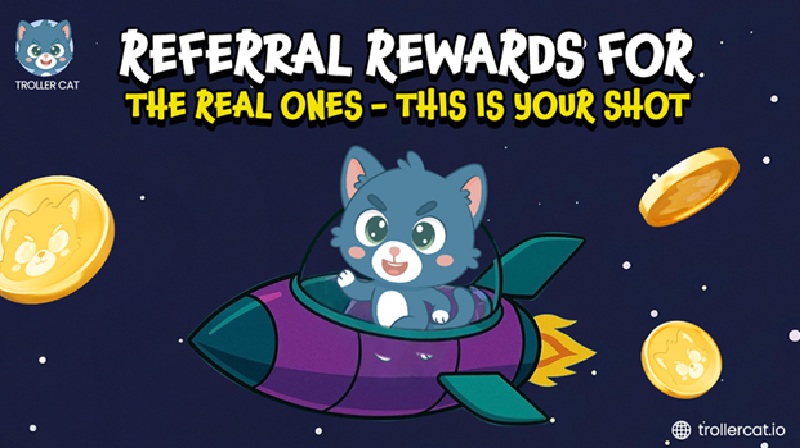
Don’t just invest, bring your pack with you. The Troller Cat referral system rewards social cats with a 10% bonus for both the sharer and the newcomer. All you need is a $25+ buy-in to unlock your custom code. Track your earnings live with a smooth dashboard that shows every bonus stacking in real time.

Now imagine throwing in $30,000 at this stage. That nets you around 310 million TCAT at Stage 14 pricing. By launch, that could easily swell to $164,688, even before staking and referrals. That’s a potential six-figure bag for simply hopping in now and sending the link to a couple of friends. For those ready to troll the market and their social circles? This system rewards both.

Why This Coin Made It to the List: Troller Cat’s presale is a masterclass in meme-powered growth with actual mechanics underneath. With 69% staking, a viral referral loop, and a price still leagues below listing, it’s one of the best meme coins to invest in now, before it bolts into Stage 15.

2. Moo Deng ($MOODENG)

Moo Deng is crypto’s answer to farmyard absurdity. It’s a bullish meme wrapped in cow jokes, but don’t let the silliness fool you. Underneath the playful branding is a serious roadmap: cross-chain integration, low supply, and consistent liquidity updates. The devs lean hard into memes, launching hilarious explainer videos, TikTok campaigns, and even meme-based DAO proposals.

Their Telegram community is constantly mooing out updates, and holders feel more like cult members than investors, in a good way. This token is pumping not just on vibes, but on clever mechanics and weekly engagement rewards.

Why This Coin Made It to the List: It blends chaos and structure, branding and utility, making Moo Deng one of the best meme coins to invest in now if you like your tokens loud and proud.

3. Shiba Inu ($SHIB)

SHIB’s bark is officially back. Once thought to be past its peak, Shiba Inu has reemerged with bold moves: Layer-2 upgrades, ecosystem expansions, and stronger burn mechanisms. No longer just Doge’s little cousin, SHIB is establishing its own kingdom, with DeFi bridges, metaverse plays, and revamped NFTs on the horizon.

Its community remains one of the strongest in crypto, with grassroots campaigns that rival corporate ad budgets. This coin didn’t just survive the bear market, it’s sharpening its teeth for the next bull.

Why This Coin Made It to the List: Shiba’s proving meme coins can mature and scale. That kind of comeback story earns it a seat among the best meme coins to invest in now.

4. Fartcoin ($FARTCOIN)

What smells like profits? Fartcoin. Launched as a joke, this gas-powered project has turned heads with a solid roadmap and a laugh-out-loud community. “Silent but deadly” token burns, pun-driven partnerships, and a toilet-themed game in beta testing keep this token fun and functional.

FARTCOIN also maintains weekly community contests and NFTs that are, well, exactly what you think they are. Surprisingly, devs are doxed and liquidity is locked, making this a meme coin that doesn’t stink financially.

Why This Coin Made It to the List: It delivers shock value and sustainability, planting it squarely in the best meme coins to invest in now list.

5. AI Companions ($AIC)

AI Companions is what happens when chatbots, NFTs, and crypto degeneracy collide. You don’t just invest, you adopt a sentient NFT waifu or brobot with customizable personalities. Built on a social engagement model, users bond with AI tokens that evolve based on interactions.

Beyond novelty, there’s utility too: AIC plans to integrate their bots into games, trading dashboards, and even Discord channels. Imagine yelling at your PnL bot, and it actually yells back. That’s the AIC experience.

Why This Coin Made It to the List: It’s weird, innovative, and sticky, exactly what qualifies as one of the best meme coins to invest in now.

6. Degen ($DEGEN)

Every crypto trader worth their salt has embraced their inner degen, and this coin turns that identity into a badge of honor. DEGEN fuels on-chain gambling bots, casino-style game integrations, and hype-based token swaps.

The devs aren’t even pretending to be serious, and that’s the appeal. It’s full tilt, all in, YOLO investing wrapped into a token that doesn’t hide its intentions. Weekly “degen raids” are a thing, and new holders are rewarded for risky plays.

Why This Coin Made It to the List: It’s high-risk, high-energy, and totally on-brand for crypto’s craziest corner. One of the best meme coins to invest in now if you’re fearless.

7. Osaka Protocol ($OSAK)

Osaka Protocol is the mystery box of the meme coin world. Minimal info, maximum speculation. What began as an anonymous experiment has transformed into a cult-like movement with an ultra-loyal base. It’s been mooning on nothing but cryptic tweets, fragmented roadmaps, and deep Twitter lore.

This coin’s trajectory makes zero sense, and that’s the point. Speculators thrive here, and early entries have already seen ridiculous gains on pure hype.

Why This Coin Made It to the List: It’s unpredictable, exciting, and fast-moving, all the ingredients for one of the best meme coins to invest in now.

Conclusion

Based on the latest research, the best meme coins to invest in now include Troller Cat, Moo Deng, Shiba Inu, and AI Companions. Each of these projects brings a different kind of value, whether it’s nostalgia-fueled communities, cross-chain memetics, or experimental utilities. But none of them are operating on the same playbook as Troller Cat. With 69% APY staking, a deflationary play-to-earn Game Center, and a referral system that rewards every investor who shares the opportunity, Trollercat is executing on multiple fronts. It’s not just a token, it’s a meme economy with legs (and claws).

Stage 14 still offers serious upside for anyone who gets in before the next price jump. With a live presale, a growing army of holders, and real-time ROI already tracking above 1800%, the potential here isn’t speculative, it’s measurable. As other meme coins chase trends, Troller Cat is trolling its way to the top, stage by stage, troll by troll. For traders looking to ride the next wave instead of watching from the sidelines, this is the moment.

Buy now before this cat claws its way out of reach.

For More Information:

Website: https://www.trollercat.io/

Buy Now: https://www.trollercat.io/buy-now/

X: https://x.com/trollercat_

FAQs

  1. How much can I earn by buying Troller Cat at Stage 14?
     A $30,000 investment at this stage could be worth over $164,000 by the time TCAT lists publicly.
  2. What makes the referral program so effective?
     Investors get 10% bonuses for bringing friends, and the system auto-tracks all earnings via dashboard.
  3. Is Moo Deng a serious coin or just a meme?
     It’s both, great branding, low supply, and strong engagement are pushing it up the charts.
  4. Why are meme coins still mooning in 2025?
     They’re no longer just jokes, many now combine humor with real utility, community, and ROI.
  5. What happens after the Troller Cat presale ends?
     Staking unlocks, Game Center ads go live, and the token begins monthly burn cycles post-launch.

Glossary

  • Presale: Early coin sale before public trading, usually at a discount
  • APY: Annual return from staking tokens
  • Referral Program: System that rewards users for inviting others
  • KYC: Identity verification step for legal compliance
  • Play-to-Earn: Games where players earn crypto rewards
  • Burn Mechanism: Reducing token supply to increase value
  • Listing Price: Final launch price on exchanges

Alt Text for Publishers

best meme coins to invest in now, meme coin presale 2025, Troller Cat Stage 14, Trollercat referral rewards, top meme coins June 2025, 69% staking meme token, crypto ROI meme coin, Trollercat price prediction, Balloon Boy hoax meme coin, Trollercat Game Center.