DD
MM
YYYY

PAGES

DD
MM
YYYY

spot_img

PAGES

Home Blog Page 849

Coinbase’s Support For JITOSOL and MPLX Strengthens Solana’s DeFi and NFT Ecosystems

0

Coinbase has added support for Jito Staked SOL (JITOSOL) and Metaplex (MPLX) on the Solana network (SPL token standard), with trading starting July 24, 2025, after 9 AM PT, subject to liquidity conditions. JITOSOL, issued by the Jito Foundation, enables staking SOL without locking it, enhancing its DeFi utility. MPLX powers the Metaplex protocol for Solana-based NFTs and governance.

Trading pairs include JITOSOL-USD and MPLX-USD, but transfers are restricted to SPL-compatible addresses to avoid fund loss. Deposits are open in supported regions, with trading phased in based on liquidity. Market reactions have been mixed, with JITOSOL showing bullish sentiment but oversold signals, and MPLX facing bearish MACD indicators despite NFT market interest.

As a liquid staking token, JITOSOL allows users to stake SOL while maintaining flexibility for DeFi applications. Its listing on Coinbase, a major exchange, boosts accessibility, potentially increasing adoption and liquidity. This could drive more capital into Solana’s DeFi ecosystem, as users can now trade JITOSOL-USD pairs with ease.

MPLX: As the governance token for Metaplex, a key protocol for Solana-based NFTs, MPLX’s listing enhances its visibility and trading volume. This could attract NFT creators and collectors to Coinbase, strengthening Solana’s NFT market position. MPLX bearish signals from MACD indicators contrast with growing interest in Solana’s NFT ecosystem. The listing may spark speculative trading, but sustained price growth depends on broader NFT market trends and Metaplex’s adoption.

The listings reinforce Solana’s position as a leading layer-1 blockchain, competing with Ethereum in DeFi and NFTs. JITOSOL’s liquid staking model could draw institutional and retail investors seeking yield without locking assets, while MPLX’s role in NFT governance aligns with Solana’s push for scalable, low-cost NFT solutions. Coinbase’s restriction on transfers to SPL-compatible addresses underscores the technical divide between Solana’s ecosystem and other blockchains.

Users unfamiliar with Solana’s SPL token standard risk losing funds if they send tokens to incompatible wallets, highlighting the need for better user education. JITOSOL bullish sentiment (e.g., “bullish breakout” posts on X) contrasts with cautious technical indicators (oversold RSI). This divide suggests a split between short-term traders chasing momentum and long-term investors wary of volatility.

Coinbase’s user base includes retail traders and institutional investors. Retail users may be drawn to JITOSOL for its staking rewards and MPLX for NFT speculation, while institutions might prioritize JITOSOL for its DeFi integration and liquidity. This creates a divide in trading strategies and risk tolerance. The SPL token restriction highlights a technical divide between Solana and other blockchains like Ethereum. Users accustomed to ERC-20 tokens may face a learning curve, potentially limiting cross-chain adoption.

The listings amplify Solana’s ecosystem but expose a divide in user readiness. Newcomers may struggle with Solana’s wallet requirements or the nuances of liquid staking and NFT governance, while experienced crypto users can capitalize on these opportunities. Coinbase’s phased trading rollout (based on liquidity) further divides early adopters from latecomers who may face higher volatility.

Coinbase’s support for JITOSOL and MPLX strengthens Solana’s DeFi and NFT ecosystems, enhancing liquidity and adoption. However, the divide between bullish sentiment and cautious technical indicators, retail vs. institutional priorities, and Solana’s technical uniqueness vs. broader crypto compatibility creates both opportunities and challenges. Users should approach trading with caution, ensuring they use SPL-compatible wallets and monitor market signals closely.

Centricity in Agentic AI Workplace: Four-Vector Model for Organizing AI Agents [podcast]

0

Today, at Tekedia Institute, we publish the four-vector model for Organizing AI Agents in companies. It is explained in my latest podcast.

The summary:

This podcast emphasizes that AI is a transformative force requiring a strategic approach to its integration into organizations. The core idea revolves around the “centricity” for AI agent development, advocating for a centralized AI infrastructure that supports all organizational functions. This centralized approach, akin to Meta’s technology stack, ensures efficient resource utilization and rapid improvements across the board.

Ndubuisi introduces a “four-vector model” as a framework for organizing the deployment of AI agents. These vectors—customers, employees, technologists/engineers, and partners/suppliers—represent the critical stakeholders and functions that AI must influence to drive organizational efficiency and productivity in the market.

Yes, by focusing AI agent development around these four areas, organizations can create a cohesive and impactful AI strategy. The model suggests that within each of these major vectors, there will be “micro-agents” working in concert, leading to a highly optimized and responsive organization.

Podcast VideoSign-up at Blucera and check Tekedia Daily podcast category under Training module.

BlockDAG’s NO VESTING PASS in 24 Hrs as TRX Eyes $0.50 & Aave News Approves Kraken Deal

0

The crypto space is taking sharp turns this week. The most recent Aave news confirms a key DAO decision, approving Kraken-supported Ink Foundation to release a revamped version of Aave V3. This project could introduce new revenue-sharing options. Meanwhile, the Tron (TRX) technical outlook stays strong as TRX continues holding major EMAs and signals a potential move to $0.50.

However, the spotlight now shifts to BlockDAG (BDAG), where the NO VESTING PASS is shaking up the usual presale structure. With over $350 million raised, 24.3 billion BDAG coins sold, and a projected 3025% ROI, BlockDAG is positioning itself as the best crypto coin to buy right now.

Kraken’s Ink Foundation Gains Access to Aave’s Code for Institutional Lending

A significant update in Aave news is the DAO’s approval allowing Kraken-backed Ink Foundation to launch a custom version of Aave V3. Ink will build a centralized lending platform using Aave’s code.

The DAO also approved a six-month support window, with revenue sharing set through a 5% reserve factor. During this time, Ink won’t be allowed to work with other lending protocols. Liquidity incentives are set to target $250 million. Aave V3 continues to operate across 17 blockchains, including Ethereum and Base.

Tron Price Outlook: EMA Support Points to Higher Targets

The Tron (TRX) technical outlook remains favorable, as prices stay above both the 100-day and 200-day exponential moving averages, which are still trending upward. TRX gained strength after its rally earlier in 2024 and has now broken past the extended consolidation near $0.28.

If support around the 100 EMA holds, analysts expect TRX to push toward the $0.50 to $0.60 range. However, if it breaks below this level, the next support lies at the 200 EMA, near $0.28. This would serve as a key test for the current trend’s momentum.

BlockDAG’s NO VESTING PASS Reshapes the Final Stage of the Presale

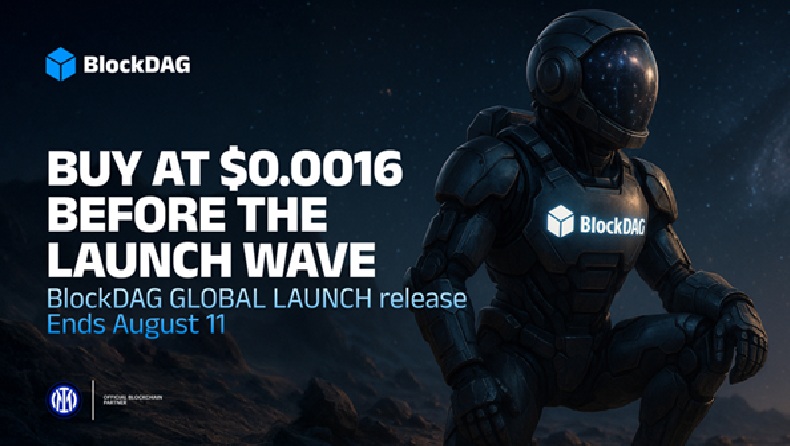
With the presale reaching its highest momentum yet, BlockDAG has introduced a key strategic move, the NO VESTING PASS. This isn’t just a bonus offer, it’s a major part of the broader BlockDAG GLOBAL LAUNCH Release. Under this campaign, the BDAG price remains fixed at $0.0016 until August 11.

Once the deadline passes, the price will resume its regular batch increases. The NO VESTING PASS has been live for just 10 days, and now only 1 day remains before it ends.

So, what makes it unique? Buyers who take advantage of the current $0.0016 price during this offer will receive full access to their BDAG holdings once the coin launches at $0.05, no lockups, no phased releases. On top of that, holders gain a projected ROI of 3,025%.

This offer bypasses traditional vesting mechanisms, giving participants immediate liquidity at launch. Since Batch 1, the presale has already surged 2,660%, with over $350 million raised and 24.3 billion BDAG sold.

At this scale, the NO VESTING PASS isn’t just a limited-time incentive, it marks a major shift in how presales are executed. BlockDAG is closing its presale chapter with a clear message: this final phase is about straightforward access, maximum flexibility, and proven traction.

BDAG Tops the List of the Best Crypto Coin to Buy Now

The Aave news signals major updates in how lending protocols are licensed and monetized. The Tron (TRX) technical outlook shows firm support and price growth potential. Still, both rely on execution and market sentiment.

BlockDAG, on the other hand, is offering something more direct: $350 million raised, 24.3 billion coins sold, and a NO VESTING PASS that unlocks at launch with zero delays. The 3025% ROI and real liquidity access give BlockDAG a unique edge.

In a market full of speculation, BlockDAG offers certainty. That’s what makes it the best crypto coin to buy today.

Presale: https://purchase.blockdag.network

Website: https://blockdag.network

Telegram: https://t.me/blockDAGnetworkOfficial

Discord: https://discord.gg/Q7BxghMVyu

Magic Eden Has Introduced A Variable Quantity Bitcoin Runes Swaps Feature

0

Magic Eden has introduced a variable quantity Bitcoin Runes swaps feature, allowing users to trade any amount of Runes for Bitcoin (BTC) or vice versa without being restricted to predefined lot sizes. This feature, powered by aggregated liquidity from SatsTerminal, offers improved pricing and a seamless trading experience. Users can access this through Magic Eden’s onchain orderbook, with Full Mempool Protection ensuring secure and efficient transactions.

The swaps are non-custodial, meaning users retain control of their assets throughout the process. This update eliminates the need for lot-based trading, making Runes swaps more flexible and accessible for both small and large trades. This flexibility makes the Runes ecosystem more accessible to retail traders and smaller investors who may not have the capital to purchase entire lots, previously a barrier to entry. By lowering the entry barrier, Magic Eden’s platform encourages broader participation, potentially increasing trading volume and user adoption. This aligns with Magic Eden’s goal of simplifying the trading experience, making it more intuitive for both new and experienced users.

The feature introduces more liquidity to the Runes market by enabling seamless trading without the need to split or combine lots manually. This is particularly beneficial for larger traders (“whales”) who can now execute high-volume trades with fewer clicks, attracting more significant players to the ecosystem. Increased liquidity fosters a healthier and more competitive market, potentially stabilizing prices and reducing slippage (the difference between expected and executed trade prices).

Magic Eden’s dominance, with 75.94% of Runes trading volume, suggests it is well-positioned to drive this liquidity surge. The swaps feature, built on Magic Eden’s onchain orderbook with Full Mempool Protection, ensures secure and transparent transactions while simplifying the process to a few clicks. Users can set their desired BTC amount or Runes quantity, and the platform finds the best quote within a specified price tolerance.

A streamlined user experience reduces friction, making Runes trading comparable to DeFi platforms on Ethereum or Solana. This could attract users from other blockchains, enhancing Magic Eden’s position as a leading marketplace for Bitcoin-based assets. Runes, as a fungible token standard on Bitcoin, are designed to minimize network congestion compared to predecessors like BRC-20, leveraging Bitcoin’s UTXO model for efficiency. Variable quantity swaps further amplify this by enabling a thriving meme coin and DeFi ecosystem on Bitcoin.

The feature supports Bitcoin’s evolution into a hub for DeFi and meme coins, with tokens like DOG•GO•TO•THE•MOON and PUPS•WORLD•PEACE seeing significant price gains. This could drive further innovation, such as cross-chain swaps and Lightning Network integration, enhancing Bitcoin’s utility beyond a store of value. The use of an onchain orderbook (not an automated market maker) and Full Mempool Protection ensures trades are executed transparently on the Bitcoin blockchain, reducing risks like failed transactions or network congestion.

Retail traders may face higher slippage for less liquid Runes due to the “head effect,” where liquidity is concentrated in a few popular tokens. This could create a divide where smaller traders struggle to access favorable prices for less popular Runes, while whales dominate high-liquidity markets. The feature requires users to have a compatible Bitcoin wallet like Magic Eden Wallet and a basic understanding of Runes and the Bitcoin network. New users or those unfamiliar with Web3 wallets may face a learning curve, creating a divide between tech-savvy early adopters and newcomers.

Magic Eden’s user-friendly interface mitigates this to some extent, but educational resources and wallet setup support will be crucial to bridge this gap. Without widespread adoption, the Runes ecosystem risks remaining niche, limiting its potential to rival Ethereum or Solana-based DeFi. Magic Eden’s dominance in Runes trading (75.94% market share) compared to competitors like OKX (17.58%) and UniSat (1.70%) creates a divide between platforms. Smaller marketplaces may struggle to compete, leading to a centralized trading hub despite the decentralized nature of Runes.

This concentration could stifle competition, potentially leading to higher fees or reduced innovation from smaller platforms. However, Magic Eden’s investment in features like swaps and analytics may continue to drive user preference, reinforcing its market lead. The Runes market shows a “strong head effect,” with liquidity concentrated in top tokens like DOG•GO•TO•THE•MOON. Less popular Runes may have lower liquidity, making them harder to trade efficiently.

Traders focusing on niche Runes may face challenges like high slippage or limited trading opportunities, creating a divide between mainstream and obscure tokens. This could discourage diversity in the Runes ecosystem unless liquidity is improved for smaller projects. Variable quantity swaps strengthen Bitcoin’s DeFi ecosystem, but it still lags behind Ethereum and Solana in terms of trading experience and infrastructure. The clunky nature of Bitcoin’s onchain trading compared to other chains highlights a technological divide.

While Magic Eden’s feature is a step forward, broader improvements (e.g., BIP-420’s OP_CAT proposal) are needed to bring Bitcoin’s trading experience closer to Ethereum’s or Solana’s. This divide may persist until Bitcoin’s infrastructure matures, potentially limiting Runes’ mainstream adoption. Magic Eden’s variable quantity Bitcoin Runes swaps enhance accessibility, liquidity, and user experience, positioning Runes as a key player in Bitcoin’s evolving DeFi and meme coin ecosystem.

However, the feature also highlights divides in market access, liquidity distribution, and technological maturity. By addressing these challenges through education, incentives, and infrastructure improvements, Magic Eden and the Runes Protocol can drive broader adoption and strengthen Bitcoin’s role in decentralized finance.

Nigeria Receives N1.95 Trillion in Direct Remittances in 2024 – CBN Report

0

Nigeria recorded a total of N1.95 trillion in direct remittances in 2024, according to data from the Central Bank of Nigeria (CBN) analyzed by BudgIT.

These substantial inflows had a significant impact on the country’s international payments landscape, even as broader economic challenges persisted.

Data revealed that between December 2023 and December 2024, May 2024 saw the highest monthly direct remittance at N355.4 billion, followed by N270.5 billion in June and N230.2 billion in September. Conversely, the lowest monthly figures were N38.4 billion in December 2023 and N39.1 billion in February 2024.

Despite the inflow, Nigeria’s balance of payments reflects a worrying trend. In 2024, the country recorded $ 5.72 trillion in international repayments, which included $ 994.21 billion in Letters of Credit and $ 4.72 trillion in debt service payments—covering both interest and principal repayments on external loans. Letters of Credit, commonly used in international trade, serve as a financial guarantee from Nigerian banks to foreign sellers.

The significant disparity between inflows and outflows underscores the continued strain on Nigeria’s external financial position. The net effect has exacerbated pressure on the naira, which has seen sharp depreciation due to persistent foreign exchange demand outweighing supply.

Although direct remittances represent a critical inflow, they are insufficient to balance Nigeria’s growing external obligations. On a more optimistic note, total remittance inflows—encompassing all formal channels—rose to $20.93 billion in 2024, an 8.9% year-on-year increase. This marks a sharp recovery from the deficits of $3.34 billion in 2023 and $3.32 billion in 2022, making 2024 the best remittance year since 2019, when inflows stood at $23.80 billion.

According to the World Bank, Nigeria’s remittance peak over the past decade was $24.31 billion in 2018, with the lowest recorded in 2020 at $17.21 billion. The 2024 rebound was attributed to macroeconomic reforms, improved trade dynamics, and growing investor confidence. The CBN noted that IMTO inflows alone surged by 43.5% to $4.73 billion, up from $3.30 billion in 2023.

Under the current CBN Governor, Olayemi Cardoso, who assumed office in September 2023, when the nation was grappling with forex scarcity, the apex bank has focused on ensuring that International Money Transfer Operators (IMTOs), operating in the country, are allowed to play a role that would lead to a significant increase in remittance flows.

Fast forward to April 2025, the CBN broke a new record under Cardoso with Dollar inflows. The apex bank revealed that remittance flows into the Nigerian economy rose by nine per cent to $20.98 billion, the highest level in five years under the current leadership of Olayemi Cardoso.

Cardoso noted that the improvement in remittances was due to economic reforms, stating that there was a remarkable increase in monthly inflows from $250 million in 2024 to $600 million by September of that year. He revealed that more Nigerians abroad are choosing official and formal channels to remit funds due to CBN policies that have reformed remittance platforms.

The CBN governor further stressed that the recent stabilization of the FX market and growth in key sectors are indicators of economic recovery. He reiterated that increased remittances and a more stable macroeconomic climate would support economic progress.

Nigeria’s status as a top remittance destination remains firm, reflecting the strength and engagement of its diaspora. However, without broader economic reforms and diversified revenue sources, the country’s reliance on remittance inflows alone will not be sufficient to stabilize its external financial position.

At the continental level, Africa received over $95 billion in remittances in 2024, with Nigeria, Egypt, and Morocco ranking as the top beneficiaries. The Africa Finance Corporation (AFC), in its State of Africa’s Infrastructure Report 2025, described the surge in remittances as a pivotal shift—strengthening formal financial ties between African economies and their diasporas and signaling a gradual reversal of long-standing capital flight trends.