
DD
MM
YYYY

PAGES

DD
MM
YYYY

spot_img

PAGES

Home Blog Page 880

Abia Secures $263.8m Infrastructure Package from AfDB, IsDB, and FG to Overhaul Aba and Umuahia

0

Abia State has secured a landmark $263.8 million financing deal from the African Development Bank (AfDB), the Islamic Development Bank (IsDB), and the Federal Government of Nigeria to tackle decades-old urban infrastructure decay in Aba and Umuahia, the state’s two largest cities.

The funding, which was formally announced by AfDB on Wednesday, follows the official launch of the Abia State Integrated Infrastructure Development Project held on July 11, 2025.

Described by Governor Alex Otti as a “defining moment” in the state’s development trajectory, the project aims to deliver modern, climate-resilient infrastructure that will transform urban mobility, improve public health, and stimulate inclusive economic growth.

According to the AfDB’s statement, the total financing package includes $115 million from the Bank itself, split between $100 million from its ADB sovereign window and $15 million from the Canada-AfDB Climate Fund. The Islamic Development Bank is contributing $125 million, while Nigeria’s Federal Government is backing the project with $23.8 million in counterpart funding.

A Comprehensive Overhaul of Urban Infrastructure

The initiative marks one of the largest multilaterally backed urban renewal projects in the state’s history. It will see the rehabilitation of more than 248 kilometers of roads in Aba and Umuahia—two cities whose deteriorating road networks have long undermined commerce, mobility, and quality of life. Additionally, the project will address critical erosion sites, including restoration work at two major locations that have threatened residential areas and road infrastructure.

Solid waste management, another longstanding problem in both cities, is also central to the project. Authorities plan to attract private sector investment through public-private partnerships (PPPs) to overhaul how waste is collected, processed, and disposed of, reducing public health risks and environmental degradation.

AfDB emphasized that the project goes beyond hard infrastructure to include institutional reforms, capacity-building, and community-level engagement, especially for women and young people. The social development component includes:

  • Over 3,000 temporary jobs during the construction phase
  • 1,000 permanent jobs, half reserved for youth
  • Training programs and skills development for entrepreneurs
  • Support for women-led businesses
  • HIV/AIDS awareness campaigns
  • Resettlement support for affected residents
  • Stronger financial oversight systems to prevent misuse of funds
  • Addressing Decades of Neglect

The development comes as both Aba and Umuahia continue to grapple with the consequences of chronic infrastructure neglect and underinvestment. In Aba, poor road networks, unmanaged flooding, and waste overflow have crippled the city’s long-standing reputation as an industrial and commercial hub. Umuahia, despite serving as the state capital, has faced similar challenges, with limited urban infrastructure failing to meet the needs of a growing population.

According to AfDB, the project is strategically designed to reverse these trends by modernizing infrastructure “in a way that boosts economic productivity, strengthens climate resilience, and improves living standards for all residents.”

The Bank’s Nigeria Country Department and sector teams will offer technical support and strict implementation oversight, ensuring compliance with environmental, social, and procurement standards throughout the lifecycle of the project.

Otti, who came into office pledging to rebuild Abia from the ground up, said the project aligns with his administration’s commitment to transparency, accountability, and results-driven governance.

The deal is also significant in the context of Nigeria’s broader infrastructure financing outlook. With state governments often constrained by mounting debt and limited internally generated revenue, multilateral development financing—especially with concessional terms and climate funds attached—is seen as a critical pathway to closing infrastructure gaps without plunging states into unsustainable borrowing.

Experts say the Abia model could become a reference point for other subnational governments seeking to mobilize external funding through transparent planning, demonstrable political will, and credible partnerships.

Project implementation is expected to begin in phases before the end of 2025, with procurement already underway for roadworks and erosion control. A project delivery team made up of representatives from the state government, AfDB, IsDB, and the Federal Ministry of Finance will coordinate execution and monitor key milestones.

In the months ahead, the project is also expected to roll out community engagement forums to sensitize residents on environmental safety, waste disposal practices, and upcoming construction timelines.

If successfully delivered, the Abia State Integrated Infrastructure Development Project is projected to become a cornerstone of the state’s economic revival, unlocking long-stalled potential in manufacturing, trade, and services, especially in Aba, a city with deep roots in industrial production and informal enterprise.

For a state long overshadowed by stories of neglect, this $263.8 million lifeline is expected to boost Abia’s ongoing new narrative.

Cardano Price Prediction: If Cardano Can Replicate Its Last 7 Day Cycle It Will Be A $1 Crypto, What Is The Likelihood?

0

Cardano (ADA) has sparked optimism once again. Its bullish signals are fueling discussions about whether a $1 milestone is next. With strong fundamentals and technical indicators aligning, many investors are now calling ADA one of the best crypto to buy now. One project also catching fire alongside ADA is Remittix, a new payment-based altcoin raising over $16.2 million.

Cardano Price Prediction: ADA Forms a Bullish Double Bottom

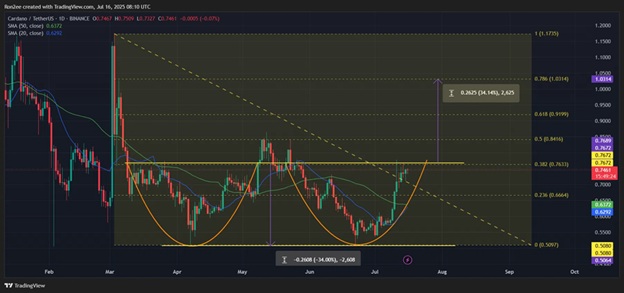
Cardano open interest has surged, with 1.68 billion ADA now committed to trades across major platforms. This jump suggests increasing confidence from both retail and institutional traders. According to CoinGlass, ADA recently broke above the $0.74 resistance and is now holding firm around $0.76.

source: TradingView

Analyst Mr. Banana believes Cardano is not just heading for $1, but could reach a new all-time high near $5. He argues that ADA’s current technical setup, particularly its double-bottom pattern between $0.50 and $0.76, reflects the same breakout formation that led to its last bull run. With Emurgo announcing the Cardano Card, which lets holders earn yield and spend ADA directly, utility has entered the conversation. This tool could improve ADA’s real-world appeal, positioning it among top altcoins with practical uses.

Why A 100% ADA Price Move Is Still On The Table

Despite being 76% down from its all-time high of $3.10, ADA has shown surprising strength in July. Its 7-day rally before the recent pullback added over 20% to its price. If Cardano repeats that performance, a breakout to $1 becomes a realistic short-term target.

Technical traders are especially focused on the neckline resistance at $0.76. A strong flip of this level to support would open the path to $0.90 and potentially the key psychological level of $1. Investors searching for crypto with real utility, early stage crypto investment, or next 100x crypto are keeping a close eye on ADA and newer players in the space.

Remittix: Gaining Ground As A Fintech Powerhouse

While Cardano fights for the $1 level, Remittix is quietly becoming the top crypto under $1 for 2025. Designed for global payments, RTX offers cross-chain transactions, staking, and fiat on-ramps in a single token. Here’s why analysts love Remittix right now:

  • Real merchant plug-ins already being tested on-chain
  • Token staking rewards offer passive income to holders
  • Over $16.2 million raised as hype builds toward $18M soft cap
  • Mobile wallet with real-time FX is set for Q3 rollout
  • Active integrations for freelancers and global remittance corridors.

With a 50% bonus still available and its $250,000 giveaway live, Remittix is standing out in a crowded altcoin field.

Will ADA Hit $1 Before RTX Hits $0.20?

Cardano’s price prediction continues to trend bullish, especially if the current cycle repeats itself. However, with Remittix seeing faster adoption and a lower entry price, some traders believe it offers even more upside in this market. Whether you’re looking at Cardano or chasing the best DeFi projects 2025, both ADA and RTX are worth keeping on your radar.

Discover the future of PayFi with Remittix by checking out their presale here:

Website: https://remittix.io/

Socials: https://linktr.ee/remittix

$250K Giveaway: https://gleam.io/competitions/nz84L-250000-remittix-giveaway

Vanguard’s MSTR Holdings Creates A Paradox That Exposes Its Clients To Bitcoin

0

Vanguard, a $10 trillion asset management giant known for its skepticism toward Bitcoin, has become the largest shareholder in MicroStrategy (MSTR), holding over 20 million shares, or nearly 8% of the company’s Class A common stock, valued at approximately $9.26 billion. This is ironic because Vanguard has consistently criticized Bitcoin as a “speculative” and “immature asset class” with “no inherent economic value,” even blocking Bitcoin ETFs from its platform in 2024.

MicroStrategy, now often referred to as “Strategy,” is the world’s largest corporate holder of Bitcoin, with over 601,550 BTC worth around $73 billion, acquired through debt and equity financing under Michael Saylor’s leadership. Its stock has surged over 3,400% since adopting its Bitcoin treasury strategy in 2020, far outpacing Bitcoin’s 1,000% and the S&P 500’s 115% growth in the same period.

Vanguard’s stake isn’t a deliberate endorsement of Bitcoin but a byproduct of its passive index fund strategy. MicroStrategy’s inclusion in the Nasdaq 100 forced Vanguard’s index funds, like the $1.4 trillion Total Stock Market Index Fund (VITSX) with 5.7 million shares ($2.6 billion) and the Vanguard Extended Market Index Fund (VIEIX) with 3 million shares, to buy MSTR stock. Even some actively managed Vanguard funds, like VSEQX and VFMO, hold MSTR shares due to quantitative models, not a shift in Vanguard’s crypto stance.

This situation highlights a contradiction: Vanguard’s clients gain indirect Bitcoin exposure through MSTR, despite the firm’s anti-crypto rhetoric. Analyst Roxanna Islam noted, “This shows how embedded crypto has become in traditional indexes and client portfolios, sometimes without many even realizing it.” Michael Saylor views Vanguard’s stake as validation of Bitcoin’s growing institutional acceptance.

Meanwhile, Bloomberg’s Eric Balchunas quipped, “God has a sense of humor,” pointing out that Vanguard’s index fund philosophy—owning all stocks in an index, regardless of personal views—forces it into this position. The irony is amplified by posts on X, where users like @Barchart and @joemccann mock Vanguard’s predicament, noting the disconnect between its public stance and its massive MSTR holdings. Critics like VanEck’s Matthew Sigel have called this “institutional dementia,” highlighting the tension between Vanguard’s ideology and the realities of passive investing.

In short, Vanguard’s role as MicroStrategy’s top shareholder stems from its rigid adherence to index tracking, not a change of heart on Bitcoin, exposing its clients to crypto’s volatility despite its vocal opposition.

Vanguard’s $9.26 billion stake in MSTR, a company with over $73 billion in Bitcoin holdings, gives its index fund investors significant indirect exposure to Bitcoin’s price movements. Since MSTR’s stock is highly correlated with Bitcoin’s performance, Vanguard’s clients, including retail investors in funds like VITSX, are effectively tied to crypto volatility, contradicting Vanguard’s anti-Bitcoin stance. This could lead to unexpected risk or reward for investors unaware of MSTR’s Bitcoin-heavy strategy.

Vanguard’s public criticism of Bitcoin as speculative and valueless is undermined by its massive MSTR holdings. This could spark backlash from clients or analysts who see hypocrisy in Vanguard profiting from Bitcoin’s rise via MSTR while blocking Bitcoin ETFs. Posts on X, like those from @joemccann, already highlight this irony, potentially damaging Vanguard’s credibility among crypto-skeptic investors or pushing it to reconsider its crypto policies.

Michael Saylor and pro-Bitcoin advocates view Vanguard’s stake as a sign of Bitcoin’s growing mainstream legitimacy, even if unintentional. MSTR’s inclusion in the Nasdaq 100 and Vanguard’s subsequent investment signal that Bitcoin-linked assets are becoming unavoidable in traditional finance, potentially encouraging other institutional investors to explore crypto exposure.

Vanguard’s situation underscores the limitations of passive index investing. By mechanically tracking indices like the Nasdaq 100, Vanguard is forced to hold assets that conflict with its investment philosophy. This could prompt debates about whether index funds should have mechanisms to exclude certain stocks or whether such exclusions violate the passive investing ethos.

MSTR’s outsized Bitcoin holdings and its stock’s 3,400% surge since 2020 could draw regulatory attention, especially if its valuation is seen as a proxy for Bitcoin speculation. Vanguard’s significant stake might amplify calls for clearer regulations on corporate crypto holdings or their impact on index funds, affecting how firms like Vanguard manage such exposures.

As Vanguard’s clients realize their Bitcoin exposure through MSTR, they may push for direct crypto investment options, like spot Bitcoin ETFs, which Vanguard currently blocks. This could pressure Vanguard to soften its stance or risk losing clients to competitors offering crypto products.

Vanguard’s MSTR holdings create a paradox that exposes its clients to Bitcoin’s volatility, challenges its anti-crypto rhetoric, and highlights the complexities of passive investing. It may also bolster Bitcoin’s institutional credibility while prompting broader discussions about crypto’s role in traditional portfolios.

Former OpenAI CTO Mira Murati’s Thinking Machines Secures $2bn to Build “Collaborative General Intelligence”

0

Former OpenAI chief technology officer – and briefly interim CEO – Mira Murati has vaulted back into the spotlight, announcing that her new venture, Thinking Machines Lab, has closed a stunning $2 billion funding round only five months after launch.

The deal, one of the largest first round financings ever raised by a technology start up, places an early valuation of roughly $12 billion on a company that has yet to ship a product.

Andreessen Horowitz led the round, joined by a marquee roster of strategic investors that include Nvidia, AMD, Accel, ServiceNow, Cisco, and trading powerhouse Jane Street. The combination of deep pocketed venture capital and top tier chip makers gives Murati both the cash and the compute supply she will need to compete in an increasingly GPU constrained market.

Murati left OpenAI last September after helping steer the organization through its most turbulent period, including Sam Altman’s brief ouster and reinstatement. She incorporated Thinking Machines in February, quietly hiring dozens of ex OpenAI and Google researchers. Nearly two thirds of the fledgling team are said to be alumni of frontier model projects such as GPT 4, Gemini, and Llama.

In her first public post since February, Murati framed the start up’s mission as building “multimodal, collaborative general intelligence” that interacts with users through speech, vision, and shared context. The technology, she insisted, should “serve as an extension of individual agency” and be distributed as widely and equitably as possible.

To underscore that philosophy, Thinking Machines’ first product, scheduled to debut within the next couple of months, will include a significant open-source component. Murati also pledged to publish the lab’s “best science” so external researchers can study the safety and capabilities of its forthcoming models.

The funding round highlights the breakneck pace – and shifting norms – of AI investing. U.S. startups have already raised more than $160 billion in the first half of 2025, with roughly two thirds of the total flowing into artificial intelligence companies. Venture firms now routinely back pre revenue, pre product ventures at multibillion dollar valuations if those companies can demonstrate star talent and a credible plan to secure hardware.

Investors say Murati’s track record at OpenAI – where she oversaw the launch of ChatGPT, DALL E, and key safety initiatives – makes Thinking Machines a blue-chip wager despite its early stage. For Nvidia and AMD, both desperate to lock in next generation AI customers, the stake offers guaranteed demand for their newest accelerators. The alliance also ensures Murati a reliable GPU pipeline at a time when supply constraints are beginning to slow some competitors.

Thinking Machines joins a growing club of AI labs founded by former OpenAI executives. Anthropic, co run by another OpenAI veteran, recently raised a similar war chest and has positioned itself as a safety-first alternative to its former parent. Ilya Sutskever’s Safe Superintelligence, launched in June, has adopted an ultra-stealth approach focused exclusively on research. With such well-resourced players vying for talent and hardware, the battle for artificial general intelligence mindshare is intensifying.

Murati’s strategy is to differentiate between openness and user agency. Where OpenAI and Anthropic have moved toward more guarded release cycles, Thinking Machines is promising a hybrid model: proprietary systems that can be integrated into commercial applications, and parallel open-source releases aimed at academics and smaller startups. If successful, the approach could help defuse mounting criticism that frontier model research is consolidating into a handful of opaque, privately controlled silos.

For now, the spotlight shifts to the company’s forthcoming debut product, which Murati says will showcase multimodal reasoning and conversational abilities aligned with how people naturally interact. If the software delivers on its promise – and if Thinking Machines can scale safely – Murati’s return may prove to be one of the most consequential second acts in the short but explosive history of generative AI.

Moniepoint Named Among World’s Top Fintech Companies by CNBC

0

Moniepoint, one of Africa’s foremost business payments and digital banking platforms, has been recognized by CNBC and Statista as one of the world’s top 300 fintech companies. This recognition underscores Moniepoint’s pivotal role in expanding access to financial services across the continent.

This prestigious ranking by CNBC spans seven fintech market segments, honoring established and emerging players. The list was curated through in-depth research, evaluating key metrics such as revenue growth, transaction volume, capital raised, and workforce size to identify the fintechs driving global innovation and impact.

Moniepoint was named in the Payments category, which comprises companies providing payment services, gateways, and solutions that enable transactions between businesses and individuals—online and offline.

The fintech was placed alongside a distinguished group of industry leaders such as MyFawry, Interswitch, Mastercard, and Palmpay, recognized for strong financial performance in 2023 and 2024. Notably, Moniepoint’s recent accolade follows the company’s milestones and commitment to innovation and widening access to the formal financial system.

Speaking on the recognition, Tosin Eniolorunda, Group CEO of Moniepoint Inc., said,

“It is an honour to be named as one of the world’s top fintech companies by CNBC. Moniepoint’s inclusion in this prestigious, authoritative list is a testament to the hard work and success of the entire team and highlights our emergence as a key player shaping the future of fintech worldwide. As we continue to scale, we remain committed to driving global financial inclusion and widening access to economic opportunities for Africans everywhere transforming lives and livelihoods.”

Moniepoint’s recent recognition by CNBC among the world’s top fintech companies comes after it was recognized by TIME, among the 100 Most Influential Companies list for 2025 last month. The debut on the prestigious list underscores the fintech growing influence in advancing financial inclusion and powering small businesses across the continent.

This CNBC recognition adds to a string of recent accolades for the company:

  • It has been featured for three consecutive years by the Financial Times as one of Africa’s fastest-growing companies.
  • It was also included in the CB Insights Fintech 100 list, showcasing the most promising private fintechs globally.

Founded in 2015 by Tosin Eniolorunda and Felix Ike, Moniepoint (formerly TeamApt Inc.) has become a transformative force in Africa’s financial ecosystem. By offering a comprehensive suite of digital banking, credit, payments, and business tools, the company serves over 10 million customers and processes more than one billion transactions monthly, with volumes exceeding $22 billion. Its POS terminals are ubiquitous, handling the majority of Nigeria’s POS transactions with a low transaction decline rate and instant reversals for failed payments, making it a preferred choice for merchants.

In October 2024, Moniepoint raised $110 million in a Series C funding round led by Development Partners International (DPI), with participation from Google’s Africa Investment Fund, Verod Capital, Light rock, and Visa, valuing the company above $1 billion and earning it unicorn status. The fintech has recently expanded its reach to the international African diaspora through MonieWorld, a platform offering seamless remittance and digital financial services starting with the UK—marking its first venture outside the African continent.

CNBC’s global fintech list aims to spotlight the top players in the rapidly evolving fintech industry, offering insights for readers, investors, and stakeholders into the companies that are redefining financial services across banking, digital assets, payments, and beyond. Moniepoint’s inclusion reinforces its stature as a trailblazer in fintech innovation, both in Africa and globally.