

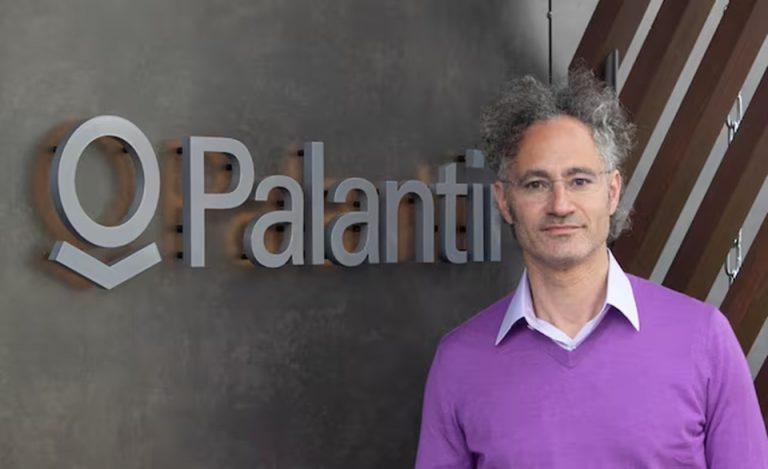
November has been an unforgiving month for Palantir Technologies, the Denver-based analytics powerhouse that has become a poster child for the artificial intelligence boom.
Shares of the software company dropped 16%, marking their steepest decline since August 2023, as investors fled AI-linked equities amid soaring valuation concerns. Yet the selloff tells only part of the story. Behind the numbers lies a clash of market sentiment, contrarian investing, and the precarious balance between hype and fundamentals in the AI sector.
Palantir entered November on a high. The company reported third-quarter revenue of $1 billion for the second consecutive quarter, surpassing Wall Street expectations. It had a strong earnings beat, showcasing a growing roster of government and commercial clients, and continued momentum in its AI offerings. But the celebrations were short-lived. Despite the robust performance, the stock’s post-earnings selloff reflected investor anxiety over Palantir’s sky-high valuation—trading at roughly 233 times forward earnings, far above peers like Nvidia at 38 times or Alphabet at 30 times.
Register for Tekedia Mini-MBA edition 20 (June 8 – Sept 5, 2026).
Register for Tekedia AI in Business Masterclass.
Join Tekedia Capital Syndicate and co-invest in great global startups.
Register for Tekedia AI Lab.
Wall Street analysts didn’t hold back talking about this backdrop. Jefferies described Palantir’s valuation as “extreme,” warning clients that other AI-linked names like Microsoft or Snowflake offered a better risk-reward profile. RBC Capital Markets highlighted the company’s “increasingly concentrated growth profile,” a nod to its reliance on a relatively narrow base of contracts. Deutsche Bank added that the stock’s multiple was “very difficult to wrap our heads around.” Collectively, these warnings amplified fears that Palantir’s meteoric rise could collide with market reality.
Then came the high-profile short. Michael Burry, famed for calling the 2008 housing crisis and later immortalized in The Big Short, revealed positions against Palantir and AI chipmaker Nvidia. Burry, known for contrarian bets and dramatic predictions, criticized AI hyperscalers for inflating earnings, sending ripples through an already jittery investor base.
But appearing twice in one week on CNBC, Palantir CEO Alex Karp called Burry’s actions “egregious” and accused him of market manipulation, famously declaring, “The idea that chips and ontology is what you want to short is bats— crazy.”

Amid the turbulence, Palantir continued to rack up wins. The company inked a multiyear deal with consulting giant PwC to accelerate AI adoption in the U.K., and secured an agreement with aircraft engine maintenance firm FTAI. These contracts underscore that, on the ground, Palantir is executing its strategy and expanding its footprint. Yet, in a market obsessed with multiples and momentum, even tangible achievements struggle to offset valuation anxieties.
The selloff at Palantir mirrors broader turbulence across AI stocks in November. Nvidia fell more than 12%, while Microsoft and Amazon dropped roughly 5% each. Even the quantum computing sector, long touted as the next frontier, saw significant declines: Rigetti Computing and D-Wave Quantum shed over a third of their market value. Only tech giants like Apple and Alphabet emerged unscathed among the so-called “Magnificent 7.”
The message from the market is understood to be that investors are recalibrating expectations, seeking evidence that hype is translating into sustainable profits.

Palantir’s predicament also highlights a generational tension in technology investing. On one hand, the company positions itself as a democratizer of advanced analytics, giving ordinary investors and companies access to tools that were once the exclusive domain of elite venture capitalists in Silicon Valley.
Karp framed this mission in a recent letter to shareholders: “Please turn on the conventional television and see how unhappy those that didn’t invest in us are. Enjoy, get some popcorn. They’re crying. We are every day making this company better, and we’re doing it for this nation, for allied countries.”
On the other hand, the market is demanding discipline and predictability, wary of valuations untethered from short-term profitability.
Palantir’s revenue growth and contract wins suggest a company executing on strategy, yet its extreme valuation and exposure to AI hype make it highly sensitive to investor sentiment, underlining a juxtaposition. The presence of a contrarian investor like Burry—one who has historically shaken markets with prescient bets—adds a layer of uncertainty few stocks experience. For Palantir, every earnings report, deal announcement, or executive commentary now carries amplified significance.
Looking ahead, Palantir’s challenge is not technological but psychological, prompting questions such as: Can it sustain growth and continue executing contracts while navigating a market that has grown increasingly skeptical of AI exuberance? Will valuation pressures force a period of consolidation, or can the company’s expanding product suite and government ties justify the lofty multiple?
For investors, the situation is a study in contrasts: a company at the cutting edge of AI and analytics, yet tethered to a stock price that has become a lightning rod for debate over the future of tech investing.
In many ways, November’s turbulence is emblematic of the AI market itself—a sector filled with promise and peril, innovation and speculation, growth and scrutiny. Palantir may have the technology, contracts, and ambition to shape the AI landscape, but it also faces the humbling reality that in today’s market, perception is just as powerful as performance.