

Nigerian influencers across business, social, and political spheres frequently use Facebook, LinkedIn and Twitter to comment on a range of issues affecting the nation. But what kind of positions do they actually hold? Are they supportive, critical, or neutral about the socio-economic and political issues they raise?
Analysis of influencer-generated content by Infoprations’ team offers valuable insight. By examining posts made by business, social, and political influencers across the FALIT platforms, the data reveals a striking trend. The overwhelming majority of influencers, regardless of their domain, adopt a position of criticism. A far smaller percentage offer support, while a notable segment, particularly in the business sector, opt for neutrality or refrain from expressing a clear opinion.
The Critical Majority
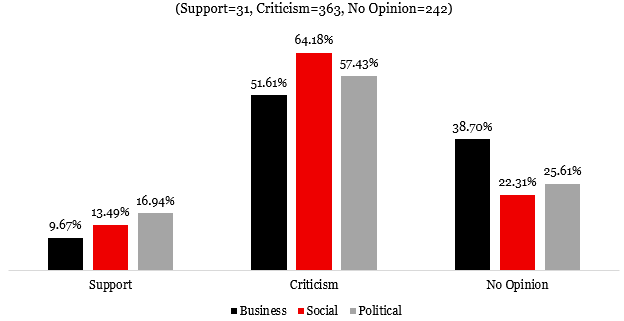
The most dominant disposition across all influencer categories is criticism. Social influencers lead the charge with 64.18% of their posts expressing disapproval or concern about social, economic, or governance-related issues. Political influencers follow with 57.43%, and business influencers contribute 51.61% of critical content.
Register for Tekedia Mini-MBA edition 20 (June 8 – Sept 5, 2026).
Register for Tekedia AI in Business Masterclass.
Join Tekedia Capital Syndicate and co-invest in great global startups.
Register for Tekedia AI Lab.
Exhibit 1: Variety of position
This trend reflects a broader pattern of dissatisfaction and distrust in public institutions, policies, and leadership. Social influencers often serve as cultural commentators and watchdogs, amplifying public frustration and societal grievances. Their high level of criticism underscores their role in holding leaders accountable and pushing for social change. Political influencers, too, use these platforms to critique opposing ideologies, challenge government inefficiencies, and advance alternative political narratives.
Even in the business category, which is typically more reserved, over half of the posts lean critical. This suggests that business voices are not insulated from the country’s challenges and are increasingly speaking out on matters such as economic instability, regulatory uncertainty, and corruption.

Support is Scarce
Supportive content is surprisingly low across all sectors. Only 9.67 percent of business influencers expressed support for the topics they raised, while social influencers followed with 13.49 percent. Political influencers were the most supportive, yet still only 16.94 percent of their posts took a positive stance.
This limited support may reflect the general sentiment within the country. When policy decisions or social developments are viewed as ineffective or misaligned with public needs, influencers are unlikely to offer endorsement. For political influencers, the relatively higher level of support may stem from partisan affiliations or loyalty to political figures. However, even among them, support is clearly the minority position.
The lack of supportive discourse also signals a missed opportunity for government agencies, policymakers, and institutions. When even influential voices hesitate to offer commendation, it raises questions about the visibility, credibility, and impact of positive initiatives. It suggests a gap in public engagement strategies and the need for more inclusive, transparent governance.

Neutrality and Strategic Silence
A significant number of influencers also refrain from taking a clear stance, opting instead for neutral or observational posts. Business influencers are the most reserved in this regard, with 38.70% of their posts reflecting no opinion. Political influencers posted neutrally 25.61% of the time, while social influencers did so in only 22.31% of cases.
This pattern is particularly telling in the business sphere. Business influencers often navigate complex relationships with clients, regulators, and the broader public. Remaining neutral or silent allows them to maintain professional credibility without alienating stakeholders. It also reflects the strategic positioning of business leaders who prefer not to engage directly in politically sensitive debates.
Neutrality among political influencers may suggest cautious political messaging, especially in an environment where statements can be easily misinterpreted or weaponized. Social influencers, whose brand often thrives on emotional and ethical engagement, are least likely to remain silent.
What This Means for the Future of Public Discourse
The FALIT platforms have evolved into important venues for civic engagement in Nigeria. Influencers play a crucial role in shaping narratives, spotlighting issues, and mobilizing public sentiment. The predominance of criticism across all sectors is not merely reactive. It reflects a maturing digital public sphere where expectations are high, and tolerance for failure is low.
However, this critical mass also calls for introspection. While criticism drives accountability, the near absence of supportive voices might lead to a one-sided discourse that overlooks progress or underrepresents nuance. The growing neutrality in the business community raises questions about whether certain sectors are disengaging from important national conversations to protect interests.
As Nigeria continues to navigate complex social and economic challenges, understanding these attitudinal dispositions is vital. Policymakers, activists, and communicators must learn to interpret digital signals from influencers not just as commentary, but as indicators of where trust lies, where engagement is needed, and where new narratives must be built.
Editor’s Note: This article is a product of Infoprations’ Communicative Strategies of Nigerian Influencers Project, 2025. The team includes Abdulazeez Sikiru Zikirullah, Moshood Sodiq Opeyemi, Bello Opeyemi Zakariyha, and Oni Oluwaseun.