

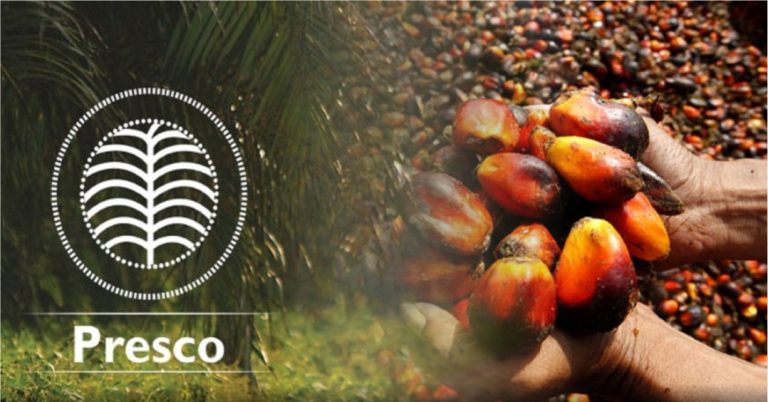
Presco Plc’s 2025 full-year numbers tell the story of an agro-industrial company that has moved decisively into a higher earnings bracket, leveraging scale, pricing power, and regional expansion to deliver one of the strongest performances on the Nigerian Exchange in the past year.
The palm oil producer reported a profit before tax of N178.56 billion for the year ended December 31, 2025, a 57.3% jump from N113.53 billion in 2024, according to its unaudited financial statements filed with the Exchange on January 30, 2026. That growth came despite sharply higher costs, rising finance charges, and a more volatile operating environment, underscoring how far Presco’s earnings capacity has expanded.
At the heart of the performance was revenue, which surged by nearly 60% to N331.19 billion from N207.50 billion a year earlier. Almost all of that came from crude and refined palm oil sales, which contributed N330.94 billion, highlighting how central Presco’s vertically integrated palm oil value chain has become to its growth story. Higher volumes, firmer pricing, and increased refining output combined to lift top-line performance, even as inflation continued to push up input costs.
Register for Tekedia Mini-MBA edition 20 (June 8 – Sept 5, 2026).
Register for Tekedia AI in Business Masterclass.
Join Tekedia Capital Syndicate and co-invest in great global startups.
Register for Tekedia AI Lab.
The strength of the year was particularly evident in the final quarter. After a softer third quarter that reflected seasonal factors and cost pressures, Presco posted a sharp rebound in the last three months of the year, effectively carrying full-year earnings. That late surge helped cement management’s confidence to propose a N72 billion dividend, reinforcing the company’s standing as one of the Exchange’s most consistent and generous dividend payers.
Operationally, the numbers point to strong leverage. Operating profit before finance costs rose by 70.1% to N214.39 billion, compared with N126.10 billion in 2024. Gross profit climbed 63.1% year on year to N228.21 billion. These gains show that Presco was able to grow earnings faster than costs, even as inflation, logistics challenges, and currency pressures continued to weigh on Nigerian manufacturers.
Net profitability was even more striking. Profit after tax jumped by 76.7% to N138.12 billion from N78.10 billion, pushing basic earnings per share to N134.38, up from N74.01 in the prior year. For equity investors, this combination of earnings growth and dividend expansion has significantly altered Presco’s valuation profile, shifting it from a steady agro-industrial stock into a clear high-growth income play.

That said, 2025 was not without pressure points. Costs rose sharply as the company expanded capacity and deepened its regional footprint. Cost of sales increased by 81.7% to N102.98 billion, reflecting higher fertilizer prices, energy costs, and general inflation across agricultural inputs. Administrative expenses rose by 48.8% to N53.72 billion, while selling and distribution costs nearly tripled to N4.02 billion as Presco invested more heavily in logistics, market development, and workforce expansion.
Finance costs were one of the fastest-growing line items, climbing to N43.62 billion from N12.79 billion in 2024. This jump was driven by higher borrowings, used largely to fund expansion projects and acquisitions. While this weighed on net margins, the impact was cushioned by strong operating cash flows and the sheer scale of earnings growth during the year.
The balance sheet expansion in 2025 was just as dramatic as the income statement. Total assets ballooned to N833.40 billion from N475.10 billion a year earlier, reflecting both organic growth and strategic transactions. A major driver was Presco’s decision to acquire the remaining minority stake in Ghana Oil Palm Development Company, taking its ownership from 52% to 100%. That move not only simplified the group structure but also gave Presco full control over one of West Africa’s key palm oil assets.

Current assets more than tripled, pointing to higher inventories, receivables, and cash balances as operations scaled up. Shareholders’ equity surged to N426.66 billion from N211.20 billion, supported by retained earnings and fresh capital raised through a rights issue. The capital raise strengthened financial flexibility, giving Presco room to invest in plantations, mills, and refining capacity without over-stretching its balance sheet.
Borrowings more than doubled to N18.04 billion from N8.90 billion, contributing to higher liabilities and explaining part of the rise in finance costs. Even so, leverage remains modest relative to earnings, suggesting the company still has headroom to fund further expansion if needed.
Geographically, Presco’s expansion across West Africa is beginning to show up in the numbers. Full control of Ghana Oil Palm enhances regional scale and positions the group to tap export markets more aggressively, particularly in Europe, where demand for sustainably sourced palm oil remains strong. This regional footprint also provides some insulation against localized shocks in Nigeria, although it exposes the company to broader currency and regulatory risks.
The dividend story remains central for shareholders. The proposed N72 billion dividend for 2025 marks another step up in payouts, following N42 billion paid for the 2024 financial year and roughly N26.3 billion distributed in 2023. Over three years, Presco has more than doubled its dividend payout, mirroring the rapid expansion of its profit base and reinforcing its reputation as a reliable income stock.
Overall, Presco’s 2025 results show a company that has successfully scaled its operations at a time when many manufacturers are struggling with costs and demand uncertainty. The challenge ahead will be sustaining this momentum as rising finance costs, ongoing inflationary pressures, and the execution risks that come with regional expansion will test management in 2026.
Still, with a stronger balance sheet, expanding assets, and a proven ability to convert growth into cash returns for shareholders, Presco enters 2026 from a position of strength rather than defense.