

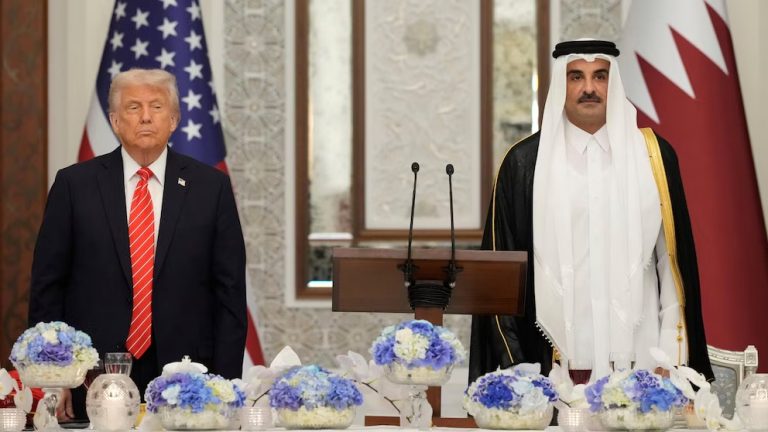
President Donald J. Trump has secured a $1.2 trillion economic commitment from Qatar, announced by the White House on May 14, 2025. The deal spans aviation, energy, technology, and defense, including a $96 billion Qatar Airways order for 210 Boeing 777X and 787 jets, $1 billion for quantum technology and workforce development, and agreements involving Qatar Energy and McDermott.
This is part of nearly $2 trillion in U.S. deals from Trump’s Middle East trip. However, some sources, like Bloomberg, report a lower figure of $243.5 billion, suggesting possible discrepancies in the total value. As economic “commitments” may not always translate to finalized investments. The $1.2 trillion economic commitment from Qatar to the U.S., carries significant implications for both nations and highlights a polarized divide in perception and impact.
The deal includes a $96 billion Qatar Airways order for 210 Boeing aircraft (777X and 787), potentially creating or sustaining thousands of jobs in the U.S. aerospace sector. Additional investments in energy (Qatar Energy) and technology ($1 billion for quantum tech and workforce development) could further stimulate job growth in high-tech and energy industries. If realized, the $1.2 trillion commitment strengthens U.S.-Qatar trade ties, positioning the U.S. as a preferred destination for Qatari capital. This could diversify U.S. economic partnerships beyond traditional allies.
Register for Tekedia Mini-MBA edition 20 (June 8 – Sept 5, 2026).
Register for Tekedia AI in Business Masterclass.
Join Tekedia Capital Syndicate and co-invest in great global startups.
Register for Tekedia AI Lab.
Investments in aviation, defense, and quantum technology signal long-term growth in strategic industries, potentially enhancing U.S. technological and military competitiveness. The deal reinforces Qatar’s role as a key U.S. ally in the Middle East, home to the Al Udeid Air Base, a critical hub for U.S. military operations. This could counterbalance influence from rivals like China or Russia in the region. Trump’s ability to secure such a massive deal during his Middle East trip (totaling nearly $2 trillion in commitments) bolsters U.S. diplomatic leverage, potentially reshaping Gulf state alignments.
Qatar Energy’s involvement suggests expanded LNG or oil-related projects, which could stabilize U.S. energy markets or enhance export capacity. The $1 billion quantum technology investment could position the U.S. as a leader in this emerging field, with applications in cybersecurity, AI, and defense. Economic “commitments” are not guaranteed. Past high-profile deals, like Saudi Arabia’s 2017 pledges, have often fallen short of promised figures. Bloomberg’s lower estimate of $243.5 billion suggests potential exaggeration or miscommunication.
Heavy reliance on Qatari investment could raise concerns about foreign influence over U.S. industries, particularly in defense and technology. Benefits may concentrate in specific sectors (e.g., aerospace, tech) or regions, potentially exacerbating domestic economic divides. Supporters view this as a triumph of Trump’s deal-making prowess, showcasing his ability to secure historic investments that Biden’s administration couldn’t. They argue it validates his “America First” economic strategy, bringing jobs and global respect to the U.S. Social media posts on X, like those from TheCalvinCooli, amplify this, framing Trump as a master negotiator outshining predecessors.

Critics question the deal’s legitimacy, citing discrepancies (e.g., Bloomberg’s $243.5 billion vs. $1.2 trillion) and Trump’s history of overstating economic wins. Some, like Noonz, express skepticism on X, warning of potential foreign influence or unfulfilled promises. Democrats may argue it prioritizes Gulf state interests over domestic issues like healthcare or infrastructure.
Workers in aerospace (e.g., Boeing employees), energy, and tech may see direct gains, while other sectors (e.g., retail, agriculture) may feel sidelined. Rural and industrial heartland communities might benefit less than urban tech hubs, deepening regional disparities. Large corporations like Boeing and McDermott stand to gain significantly, but the trickle-down effect to workers is uncertain. Unions may demand guarantees that jobs created are high-quality and sustainable.
Nationalists celebrate the deal as a win for U.S. economic sovereignty, while globalists warn of over-dependence on authoritarian states like Qatar, which faces criticism for human rights issues. This tension fuels debates about aligning with Gulf monarchies. Allies like the EU or Japan may view this as a U.S. pivot toward Gulf wealth, potentially sidelining traditional partnerships. Israel, a key U.S. ally, might welcome Qatar’s economic alignment as a stabilizing factor.

China and Russia may see this as a U.S. attempt to lock in Middle Eastern capital, prompting them to counter with their own regional investments. The Qatar deal could reshape U.S. economic and geopolitical landscapes, driving growth in strategic sectors and strengthening Middle East ties.
However, its success hinges on execution, transparency, and equitable distribution of benefits. The divide—between political factions, economic classes, and global perspectives—reflects deeper tensions about Trump’s leadership, foreign investment, and America’s role in the world.