

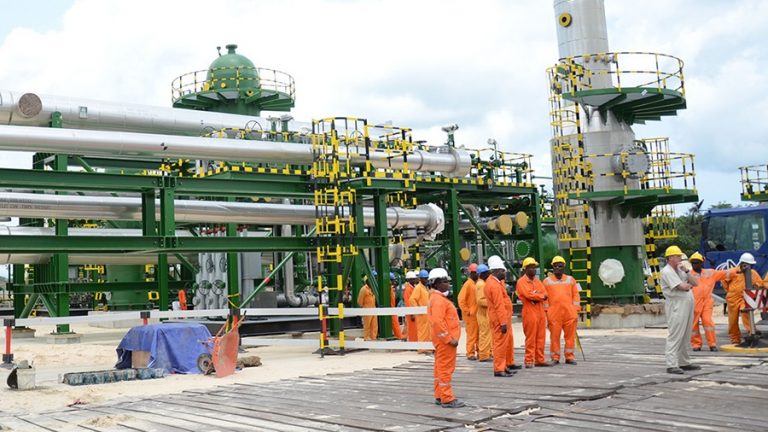
The escalating Middle East conflict has triggered a cascade of precautionary shutdowns across critical oil and gas infrastructure, with Saudi Arabia’s state-owned Aramco halting operations at its flagship 550,000 barrels per day (bpd) Ras Tanura refinery on Monday, following a drone strike by Iran.
The attack, part of a third consecutive day of regional assaults, has also led to suspensions in Iraqi Kurdistan, Israeli offshore gas fields, and Iranian export facilities, throttling global supply and pushing Brent crude futures up roughly 10% to over $82 per barrel, the highest level since mid-2025.
Ras Tanura, located on Saudi Arabia’s Gulf coast, forms part of a vital energy complex that includes a major crude export terminal. Two drones were intercepted at the site, with debris causing a limited fire but no reported injuries, according to the Saudi defense ministry. Aramco described the shutdown as a precautionary measure, with some units idled but no disruption to domestic petroleum supplies, as confirmed by the energy ministry via state news agency SPA.
Register for Tekedia Mini-MBA edition 20 (June 8 – Sept 5, 2026).
Register for Tekedia AI in Business Masterclass.
Join Tekedia Capital Syndicate and co-invest in great global startups.
Register for Tekedia AI Lab.
The facility has been targeted before, including by Yemen’s Iran-aligned Houthis in 2021 and in the 2019 Abqaiq/Khurais attacks that temporarily halved Saudi production. The broader wave of strikes has amplified supply shock fears. In Iraqi Kurdistan — exporting 200,000 bpd via pipeline to Turkey’s Ceyhan port in February — operators including DNO, Gulf Keystone Petroleum, Dana Gas, and HKN Energy have halted production as a precaution, with no damage reported.
Offshore Israel, Chevron temporarily shut the Leviathan gas field (under expansion to ~21 billion cubic meters/year as part of a $35 billion Egypt export deal) and the Tamar field. Energean also idled its production vessel serving smaller fields. In Iran, explosions targeted Kharg Island — processing 90% of the country’s crude exports — on Saturday. Iran pumps ~3.3 million bpd of crude plus 1.3 million bpd of condensate, representing ~4.5% of global supply.
The full impact on Iranian facilities remains unclear amid the ongoing conflict.

Shipping through the Strait of Hormuz, the critical chokepoint handling ~20% of global oil and a similar share of LNG, has ground to a near-halt after Sunday’s attacks on vessels in the area. Around 200 ships dropped anchor to avoid risks, and ship insurers have cancelled war risk cover, causing freight rates to surge.
An extended closure would exacerbate supply shortages, forcing Asia, sourcing 60% of its oil from the Middle East, to tap stockpiles and curtail refinery runs. India, importing 85% of its crude (4.2 million bpd), is particularly exposed. Roughly half of India’s imports transit the strait, per Nomura.
Rystad Energy’s Pankaj Srivastava warned: “Even a few dollars’ increase in prices can materially affect [India’s] energy economics. Rising prices will weigh on the balance of payments and could put further pressure on the rupee.”

Morgan Stanley estimates every sustained $10/bbl oil price rise could shave 20–30 basis points off Asia’s GDP growth, with India vulnerable due to its wide oil/gas balance. The current account deficit (1.2% of GDP) would widen by ~50 basis points per $10/bbl increase.
Opportunity for Nigerian Dangote Refinery?
Some energy analysts believe the Ras Tanura shutdown and broader disruptions could open export opportunities for Nigeria’s Dangote Refinery — Africa’s largest, with capacity exceeding 650,000 bpd in 2026. The refinery has ramped up output beyond Nigeria’s domestic petrol demand, with a 65 million liters daily offtake deal signaling export ambitions.
Dangote could fill gaps in global markets seeking alternatives to Middle East supplies, particularly sweet (low-sulfur) grades like Nigeria’s Bonny Light, now trading above $73 per barrel and forecast to exceed $80.
However, Nigeria’s chronic crude supply deficits — production averaged 1.48 million bpd in January, below OPEC+ quotas — remain a major challenge. Dangote imported 9–10 million barrels monthly in mid-2025 to sustain operations amid domestic shortages.
What Lies Ahead?
A prolonged Middle East crisis could boost Nigerian exports, with experts estimating an extra $1.3 billion in crude sales for Nigeria in March alone. This would provide a revenue windfall, exceeding the 2026 budget’s $64.85/bbl assumption, but resolving upstream supply issues is essential for Dangote to capitalize fully.
The conflict’s duration remains uncertain. Trump told The Daily Mail on Sunday that U.S.-Israeli action could continue for weeks. Iran’s security chief, Ali Larijani, posted on X that Tehran has no plans to negotiate. An extended Strait disruption would push prices higher, force Asia to draw stockpiles, and curtail refinery runs — risking shortages in China and India.
The International Energy Agency requires members to hold 90 days of net import stocks, providing a buffer, but prolonged shutdowns could test global resilience.
The situation remains highly fluid, with potential for both further upside in oil prices and sharp corrections if tensions ease rapidly.