

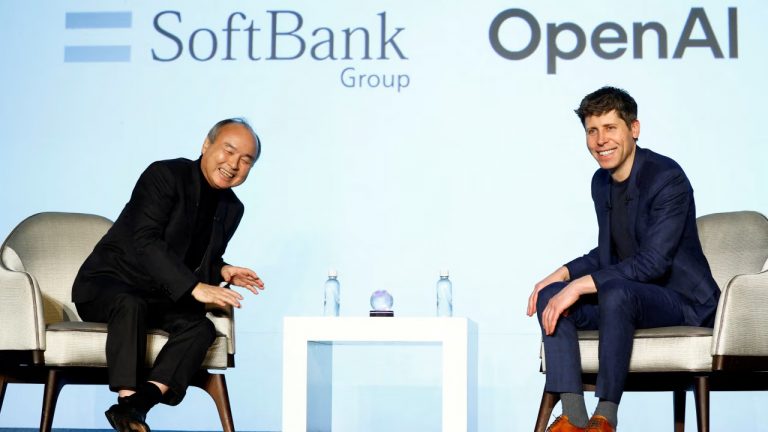
SoftBank Group, the Japanese conglomerate led by billionaire CEO Masayoshi Son, is in a high-stakes sprint to fulfill a remaining $22.5 billion funding commitment to OpenAI by the end of 2025, leveraging a mix of asset divestitures, untapped borrowing facilities, and operational streamlining.
This aggressive maneuver, disclosed to Reuters by sources close to the matter, highlights the intensifying capital requirements in the artificial intelligence sector, where skyrocketing valuations and ambitious infrastructure projects are reshaping global tech investment landscapes.
The commitment forms part of a larger $30 billion pledge announced in April 2025, when SoftBank invested an initial $7.5 billion at OpenAI’s then-$300 billion valuation. OpenAI, the San Francisco-based pioneer behind ChatGPT, anticipates receiving the balance by December 31 as per contractual terms, despite not yet having the funds in hand. The infusion is contingent on OpenAI’s successful transition to a for-profit structure, achieved in October 2025—a move that positions the company for potential future public offerings amid its rapid growth.
Register for Tekedia Mini-MBA edition 20 (June 8 – Sept 5, 2026).
Register for Tekedia AI in Business Masterclass.
Join Tekedia Capital Syndicate and co-invest in great global startups.
Register for Tekedia AI Lab.
Son, known for his bold bets through SoftBank’s Vision Funds, has framed this as a cornerstone of his vision to transform SoftBank into the “world’s No. 1 ASI (Artificial Superintelligence) Platform Provider,” as outlined in the company’s 2025 annual report. In a recent investor address, Son explained his decision to divest from high-performing assets like Nvidia, stating, “I didn’t want to sell a single share of NVDA, but I needed the money to invest in OpenAI and other opportunities. When superintelligence comes, at least 10% of global GDP will be replaced by AI and AI robots.”
This philosophy underpins SoftBank’s pivot toward AI dominance, even as it scales back broader dealmaking: Vision Fund investments now require Son’s personal approval for any deal over $50 million, effectively pausing non-AI activities. To marshal the necessary capital, SoftBank has executed several high-profile sales. It offloaded its entire $5.8 billion stake in Nvidia, the AI chip leader whose shares have surged amid the sector’s boom, and divested $4.8 billion in T-Mobile US holdings, retaining a 4% stake valued at approximately $11 billion as of September 30, 2025. Workforce reductions have also been implemented to conserve cash.
Looking ahead, the company is eyeing a partial exit from its investment in Didi Global, China’s ride-hailing giant, which is preparing for a Hong Kong relisting after a 2021 U.S. delisting due to regulatory pressures. A significant liquidity source lies in undrawn margin loans backed by SoftBank’s controlling stake in Arm Holdings, the British chip designer whose shares have tripled since its 2023 IPO.

SoftBank recently expanded this facility by $6.5 billion, bringing total undrawn capacity to $11.5 billion. As of September 30, SoftBank reported parent-level cash reserves of ¥4.2 trillion ($27.16 billion), providing additional flexibility alongside potential corporate bonds or bridge loans.
These mechanisms show the strain on even well-capitalized players in funding AI’s capital-intensive future. The urgency aligns with OpenAI’s escalating operational needs. Facing “code red” internal directives from CEO Sam Altman to enhance ChatGPT amid competition from Google’s Gemini—which has grown 3x faster in user engagement—OpenAI requires vast resources for model training and deployment. Altman has outlined ambitions for 30 gigawatts of computing capacity at a cost of $1.4 trillion, with goals to add 1 gigawatt weekly, each carrying a $40 billion price tag.
Current annualized revenue stands at around $20 billion, with profitability eyed for 2030, creating a yawning funding gap. Central to this is the Stargate project, a $500 billion joint venture announced in January 2025 between OpenAI, Oracle, SoftBank, and others to build U.S.-centric AI data centers. By July, Oracle committed to 4.5 gigawatts of additional capacity, and in September, five new sites were revealed, putting Stargate on track to meet its 10-gigawatt target by year-end.

The initiative, starting with a flagship facility in Abilene, Texas, aims to counter geopolitical risks, including U.S.-China tech tensions, and support national AI ambitions. Michigan was selected in November for a multi-billion-dollar site, with construction slated for early 2026. SoftBank’s involvement extends to a November 2025 joint venture with OpenAI, “SB OAI Japan,” focused on “Crystal Intelligence” for corporate transformation.
This deal comes amid a broader AI investment frenzy. OpenAI’s valuation has ballooned, with recent talks—potentially involving Amazon—pushing it toward $830-900 billion, tripling from April and yielding substantial paper gains for early backers like SoftBank. However, concerns mount over an “AI bubble”: hefty capital outlays by hyperscalers like Meta (committing unprecedented sums to data centers) raise questions about returns if adoption lags.
SoftBank’s history adds scrutiny—its Vision Fund, once valued at $100 billion, has faced losses from bets like WeWork, though AI-focused recoveries via Arm and others have bolstered its recovery. Market reactions have been mixed. SoftBank shares dipped modestly post-announcement, reflecting investor wariness over leverage, but analysts point to potential upsides.
Meanwhile, SoftBank continues selective AI investments, including in startups like Sierra and Skild AI—the latter potentially raising over $1 billion at a $14 billion valuation with Nvidia’s involvement.