

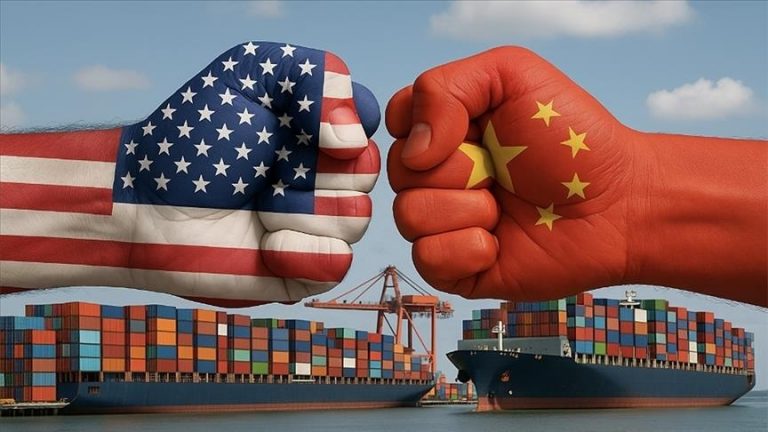
The escalating U.S.-China trade war in 2025, driven by reciprocal tariffs and non-tariff disputes, has far-reaching implications across economic, geopolitical, and social spheres. The WTO estimates an 80% drop in U.S.-China merchandise trade, contributing to a 1.5% decline in global trade. Global GDP growth is projected to slow to 2.2% in 2025.
U.S. imports are expected to fall by $800 billion (23%), raising costs for consumers and businesses reliant on Chinese goods. Tariffs are projected to cost U.S. households $1,243 annually and reduce after-tax income by 1.2%. U.S. companies face supply chain disruptions, particularly in electronics, automotive, and pharmaceuticals, with higher input costs squeezing profit margins.
China’s Economic Resilience
China is diversifying trade partners (e.g., Vietnam, Malaysia) and boosting domestic consumption, reducing U.S. export reliance from 19.8% in 2018 to 12.8% in 2023. Restrictions on critical mineral exports to the U.S. strengthen China’s leverage in tech and renewable energy sectors. Tariff announcements have triggered sharp market reactions, with gold prices surging 3.5% per ounce and cryptocurrencies like Bitcoin rising 2.2% on April 20, 2025.
Register for Tekedia Mini-MBA edition 20 (June 8 – Sept 5, 2026).
Register for Tekedia AI in Business Masterclass.
Join Tekedia Capital Syndicate and co-invest in great global startups.
Register for Tekedia AI Lab.
U.S. stock indices face downward pressure as firms report higher costs and reduced competitiveness. The trade war risks splitting the global economy into U.S.- and China-led blocs, forcing countries like Japan, South Korea, and ASEAN nations to pick sides. China’s diplomatic outreach is pulling Southeast Asia closer, while U.S. tariffs on allies strain relations, weakening its global influence.
Heightened U.S.-China Tensions
Trade disputes are spilling into military and diplomatic arenas, particularly over Taiwan and the South China Sea. China’s export restrictions on critical minerals escalate strategic competition in technology and green energy. Trump’s tariffs on allies (e.g., 25% on Japan, 35% on South Korea) alienate key partners, undermining U.S. efforts to isolate China.
The EU and Canada, facing U.S. tariffs, are exploring retaliatory measures, complicating multilateral trade negotiations. Rising consumer prices fuel inflation concerns, potentially eroding public support for Trump’s trade policies despite his “America First” rhetoric. Job creation in U.S. manufacturing (e.g., steel, aluminum) is offset by losses in retail, agriculture, and tech due to higher costs and reduced exports.

China’s Domestic Stability
China’s leadership is leveraging nationalist sentiment to rally domestic support, framing U.S. tariffs as an attack on sovereignty. Economic slowdown risks social unrest, but Beijing’s pivot to domestic markets and state subsidies mitigates some pressures. Companies are relocating production to countries like Vietnam, India, and Mexico, reshaping global supply chains. This shift creates opportunities for emerging economies but disrupts communities reliant on manufacturing in both the U.S. and China.
The trade war is hastening U.S.-China economic decoupling, with both nations prioritizing self-sufficiency in critical sectors like semiconductors and AI. This reduces interdependence but increases costs and inefficiencies, potentially stifling innovation. Trump’s tariff-heavy approach undermines the WTO, as unilateral actions bypass dispute resolution mechanisms.

A fragmented trade system could lead to persistent global economic instability. The trade war entrenches U.S.-China rivalry, with both nations investing heavily in strategic industries and military capabilities. Escalation risks broader conflict, particularly in flashpoints like Taiwan or cybersecurity.
The U.S.-China trade war is reshaping the global economic and geopolitical landscape, with significant costs for both nations and ripple effects worldwide. While Trump aims to reduce trade deficits and boost U.S. manufacturing, the immediate costs to consumers, strained alliances, and risk of broader conflict pose substantial challenges. China’s resilience and strategic countermeasures suggest a prolonged standoff, with no clear resolution in sight.