

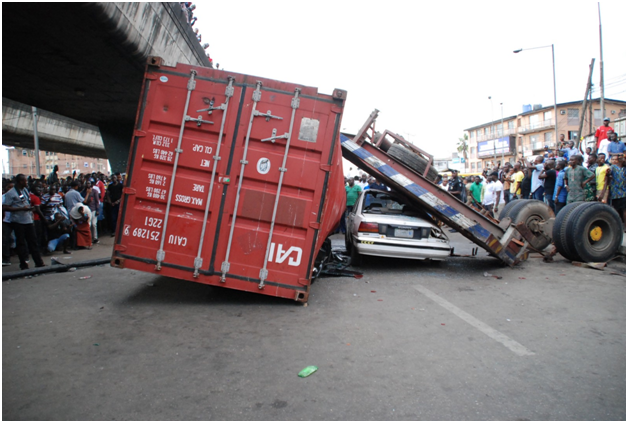
Freight is the engine of Nigeria’s economy. Every day thousands of tankers and articulated trucks travel from Lagos ports to the far north, carrying cement, fuel and food to markets that keep the country supplied. Beneath this movement lies a recurring tragedy of avoidable deaths. Our analysis of harmonised review of reports from Punch and The Guardian covering 2019 to 2025 reveals more than two dozen serious truck crashes, hundreds of fatalities and an urgent call for reform.
The Data Reveal an Alarming Pattern
Collating incidents from the two national newspapers shows at least thirty significant crashes over six years. Early cases such as the September 2019 Nasarawa Eggon–Akwanga cement truck collision that killed eleven people drew attention but little systemic change. February 2021 brought the death of three tricycle occupants in Kwara after a tipper truck lost control. Lagos remains a recurring hotspot: a container truck toppled from the Ojuelegba bridge in January 2023 killing nine passengers, while April and May 2023 saw multiple fatalities in Ogun on the busy Epe–Ijebu-Ode and Abeokuta–Lagos corridors.
The later years are marked by mass casualty events. More than 140 people perished in Majia, Jigawa in October 2024 when a fuel tanker exploded as locals scooped petrol. Only three months later, a petrol truck accident in Dikko, Niger claimed eighty-six lives. Enugu–Onitsha Expressway has witnessed repeated disasters, including eighteen deaths in January 2025 and six more in February. July 2025 brought another twenty-one deaths on the Zaria–Kano Expressway. These figures underscore how quickly a routine trip can turn into a calamity when mechanical failure, poor road design and human behaviour intersect.
Register for Tekedia Mini-MBA edition 20 (June 8 – Sept 5, 2026).
Register for Tekedia AI in Business Masterclass.
Join Tekedia Capital Syndicate and co-invest in great global startups.
Register for Tekedia AI Lab.
Factors Driving Recurrent Disasters
Repeated themes emerge across reports. Mechanical deficiencies are rampant. Brake failure and bald tires recur in Federal Road Safety Corps statements, suggesting gaps in inspection regimes. Infrastructure limitations compound the risk. Narrow bridges, eroded shoulders and pothole-ridden stretches on trunk roads reduce driver reaction time. Enforcement is inconsistent. Weight limits and speed regulations are routinely flouted, particularly at night when oversight thins. Human behaviour adds a lethal element. Fuel scooping after spills transforms manageable incidents into infernos, claiming dozens of lives in minutes.
Geography influences severity. Lagos and Ogun corridors see frequent low-fatality crashes linked to congestion and container instability. Northern and central states tend to record fewer incidents but suffer catastrophic losses when tankers collide with passenger buses or overturn near settlements.
Building a Culture of Safety
Thoughtful leadership requires moving beyond statistics to prevention. Strengthening vehicle standards is foundational. Annual road-worthiness tests for heavy vehicles must be digital, tamper-proof and enforced with roadside spot checks. Telematics can support real-time monitoring. Speed governors and GPS tracking tied to a national control centre would allow regulators and fleet owners to intervene before a reckless driver becomes a headline.

Corridor modernisation is equally important. Lagos–Ibadan, Zaria–Kano and Enugu–Onitsha roads need freight-specific lanes, durable guardrails and clear signage. Bridges such as Ojuelegba require physical barriers to prevent containers from toppling. Emergency response capacity must be expanded with well-equipped fire units and trained personnel who can handle volatile cargo.
Public engagement is vital. Campaigns that treat fuel scooping as a lethal act, not an opportunity, should be embedded in community dialogues and school curricula. Survivors’ testimonies from Jigawa and Niger tragedies can shift perceptions. Insurance incentives can nudge haulage firms to prioritise driver training, maintenance schedules and fatigue management.
Turning Tragedy into Transformation
Trucks will remain central to Nigeria’s supply chain, yet the current human toll is indefensible. Each fatality represents a parent, child or wage earner lost. The harmonised record of crashes shows the cost of inertia. Data transparency must become a norm, with every major crash logged in an open-access registry for researchers, insurers and civil society.

Leadership at federal and state levels, in collaboration with the haulage industry, can redefine expectations. Enforcing standards, investing in safer infrastructure and cultivating a public that rejects risky practices will bend the fatality curve downward. The country’s roads can shift from corridors of grief to channels of growth when evidence guides policy and accountability is shared by government, business and communities.
Nigeria’s economic future depends on efficient freight, yet prosperity cannot rest on preventable loss of life. In order to move beyond cycles of condolence into an era of safer and smart transport, our analyst notes that Nigeria needs to embrace data driven reforms and valuing every life on the highway.