

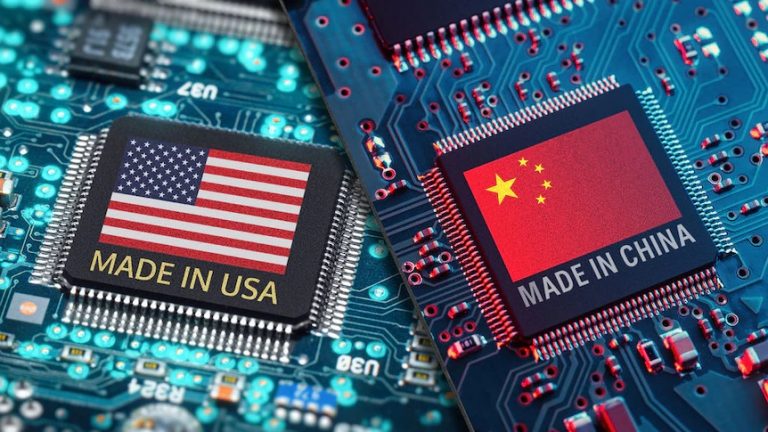
President Donald Trump on Wednesday said his administration will impose a 100% tariff on all imported semiconductors and chips, ramping up pressure on global technology and manufacturing giants to shift production to the United States.
The measure marks Trump’s most aggressive trade stance yet in his effort to localize advanced manufacturing, especially in critical sectors like AI, electronics, and defense infrastructure.
“We’re going to be putting a very large tariff on chips and semiconductors,” Trump declared from the Oval Office. “But the good news for companies like Apple is if you’re building in the United States or have committed to build… there will be no charge.”
Register for Tekedia Mini-MBA edition 20 (June 8 – Sept 5, 2026).
Register for Tekedia AI in Business Masterclass.
Join Tekedia Capital Syndicate and co-invest in great global startups.
Register for Tekedia AI Lab.
“So in other words, we’ll be putting a tariff on of approximately 100% on chips and semiconductors.”
The president emphasized that the tariffs would not apply to companies with significant U.S.-based manufacturing operations, but did not clarify what qualifies a firm for this exemption. It remains unclear whether current investments or future pledges would be enough, or how much domestic manufacturing would be considered sufficient to bypass the new duties.
The announcement follows a growing wave of concerns that the U.S. supply chain is dangerously reliant on foreign-made chips — particularly from Asia — at a time when semiconductors are foundational to everything from smartphones and satellites to electric vehicles and artificial intelligence systems.

Several of the world’s leading chipmakers, including Taiwan Semiconductor Manufacturing Company (TSMC), Nvidia, GlobalFoundries, and Texas Instruments, have already begun expanding their U.S. presence, hoping to qualify for both subsidies under the CHIPs Act and protection from Trump’s looming tariffs.
- Apple, which Trump singled out as an example, has committed to invest an additional $100 billion in U.S. operations over the next four years. That’s on top of its previously pledged $500 billion.
- TSMC has pledged $165 billion toward U.S.-based fabs, including its facility in Arizona.
- Nvidia, now the world’s most valuable company, says it will invest $500 billion in U.S. AI infrastructure by 2029.
- GlobalFoundries committed $16 billion in June to boost semiconductor production at its New York and Vermont facilities.
- Texas Instruments recently announced $60 billion in upgrades to seven U.S. chip fabrication plants, supplying major customers like Apple, Ford, Nvidia, Medtronic, and SpaceX.
- The Semiconductor Industry Association reports that over 130 chip-related projects worth a combined $600 billion have been announced in the U.S. since 2020, signaling strong momentum toward reshoring advanced manufacturing.
However, most of these projects are still under construction or early-stage development, with only a handful of new fabs currently operational. Building a semiconductor plant typically takes three to five years, raising concerns that tariffs imposed before those projects go live could disrupt supply chains or inflate costs for American companies still dependent on global imports.
Tariffs, CHIPs Act, and Strategic Leverage
Wednesday’s announcement builds on earlier hints Trump made on Tuesday during his CNBC appearance, where he said the tariffs would be rolled out imminently. The decision also appears to be timed strategically as part of the broader Section 232 investigation launched in April, which probes the national security risks tied to America’s semiconductor import reliance.

While the CHIPs and Science Act of 2022 already provided $52 billion in federal incentives to bring chipmaking back to U.S. soil, Trump’s latest move underscores his administration’s shift from carrots to sticks — from subsidies to penalties.
This approach is aimed not only at compelling multinationals to “build where they sell”, but also to reduce U.S. vulnerability in a world increasingly shaped by geopolitical tensions and AI arms races.
Yet, experts warn that such drastic tariffs, especially at 100%, could raise prices for consumer electronics, strain smaller U.S. firms, and provoke retaliation from major trading partners. The administration has not released a formal framework explaining enforcement mechanisms or how it will verify whether a company’s “commitment to build” in the U.S. is credible enough to warrant exemption.
With the semiconductor sector already in flux due to AI-driven demand, shifting supply chains, and growing regulatory uncertainty, Trump’s tariff bombshell may further complicate business planning.
While the administration portrays the policy as a wake-up call to foreign and domestic firms alike, critics argue that the lack of clarity and absence of a measured rollout strategy may undermine its effectiveness.
Still, with companies like Apple, TSMC, Nvidia, and others racing to deepen their roots in the U.S., it’s clear that the global chip race is entering a new chapter.