

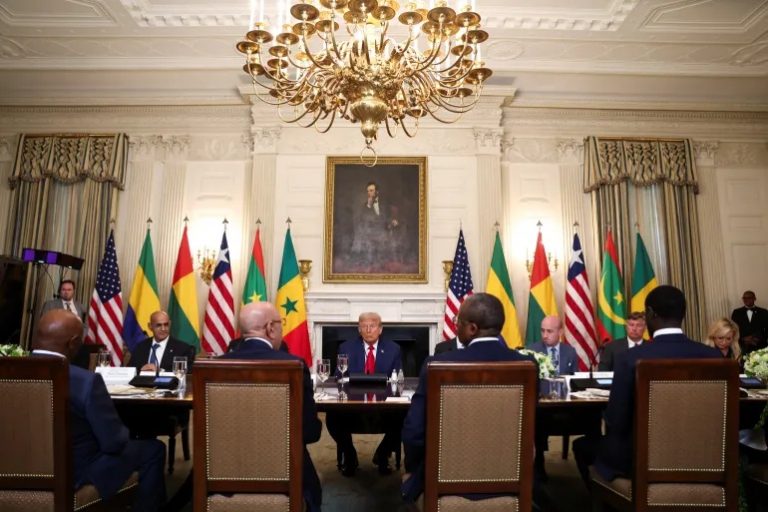
President Donald Trump on Wednesday hosted the leaders of five West African nations at the White House, promising a new era of economic partnership based on trade, not charity.
The meeting marked a symbolic turning point in U.S.-Africa relations—coming just months after the Trump administration shuttered the U.S. Agency for International Development (USAID), accusing it of waste, regime meddling, and links to foreign destabilization.
The shift also comes as key African voices, including WTO Director-General Ngozi Okonjo-Iweala and African Development Bank President Akinwumi Adesina, have urged the continent to end its reliance on foreign aid and forge a path defined by investment and trade.
Register for Tekedia Mini-MBA edition 20 (June 8 – Sept 5, 2026).
Register for Tekedia AI in Business Masterclass.
Join Tekedia Capital Syndicate and co-invest in great global startups.
Register for Tekedia AI Lab.
“We have closed the USAID group to eliminate waste, fraud and abuse,” Trump said Wednesday. “And we’re working tirelessly to forge new economic opportunities involving both the United States and many African nations.”
The five invited nations—Liberia, Senegal, Mauritania, Gabon, and Guinea-Bissau—represent only a fraction of U.S.-Africa trade volume, but carry outsized geopolitical importance. Some sit atop critical minerals needed for U.S. supply chains; others are strategic transit routes in the West African subregion. All have suffered setbacks from recent U.S. aid cuts and shifting global alliances.
End of USAID and What It Signifies
Earlier this year, the Trump administration disbanded USAID, ending nearly six decades of U.S.-led development assistance abroad. While some hailed the move as overdue reform, it also drew fire from critics and rights groups who warned that cutting health and food programs in fragile states could lead to “millions of preventable deaths.”

Trump and his allies, however, justified the move with damning claims: that USAID had long served as a covert political arm for regime change operations and influence campaigns abroad—particularly under Democratic administrations. According to sources close to the administration, some U.S. intelligence officials alleged the agency had funded civil society groups later implicated in political unrest, while also channeling money to entities linked to extremist financing in conflict zones.
Praise for Peace, Pitch for Resources
In their speeches, the West African presidents responded with flattery and opportunism. Each leader praised Trump for helping broker a recent ceasefire between Rwanda and the Democratic Republic of Congo, which the U.S. hopes will unlock access to rare minerals in eastern Congo—a region known for cobalt, gold, and tantalum.
Mauritanian President Mohamed Ould Ghazouani listed his country’s mineral bounty, including rare earths and uranium, while signaling openness to U.S. investment.

“We have lithium, manganese, the kind of resources needed for the energy transition,” he said. “And we are ready to do business.”
Liberian President Joseph Boakai, whose country has historically been the most aid-dependent in Africa, expressed “optimism” about the new partnership model. Liberia once relied on U.S. assistance equal to 2.6% of its gross national income—more than any other country in the world, according to the Center for Global Development.
By placing trade at the center of U.S.-Africa ties, Trump appears to be echoing calls for Africa to quit depending on aid — though critics warn his approach is more transactional than transformational.
A Calculated Move Amid Tariff Diplomacy and Travel Bans
Wednesday’s meeting also took place against the backdrop of escalating U.S. tariff diplomacy. The Trump administration is preparing to enforce higher trade tariffs against several developing nations starting August 1. Although none of the five West African nations present at the summit are currently listed among those targeted, analysts see their inclusion at the White House as a calculated attempt to court allies rich in resources and willing to play ball.
Notably, the same countries—Gabon, Senegal, Liberia, and Mauritania—are among those reportedly being considered for inclusion in an expanded travel ban.
Trump made clear that he sees trade not just as commerce, but as leverage. “You guys are going to fight, we’re not going to trade,” he told the African leaders. “And we seem to be quite successful in doing that.”
His comments drew polite silence from the guests, but one could sense the recalibration of relations underfoot.
The Trump administration argues that aid, as practiced before, undermined local agency and enabled corruption.
“We are likely to see a trend where African countries will seek to leverage resources such as critical minerals, or infrastructure such as ports, to attract US commercial entities in order to maintain favorable relations with the current US administration,” said Beverly Ochieng, an analyst at Control Risks, a security consulting firm.
“Each of the African leaders sought to leverage natural resources in exchange for US financial and security investments, and appeared to view the U.S. intervention in the Democratic Republic of Congo as a model to further cooperation,” Ochieng added.
Whether this ushers in a new model of African empowerment or merely shifts the terms of dependency is a debate just beginning to unfold.