

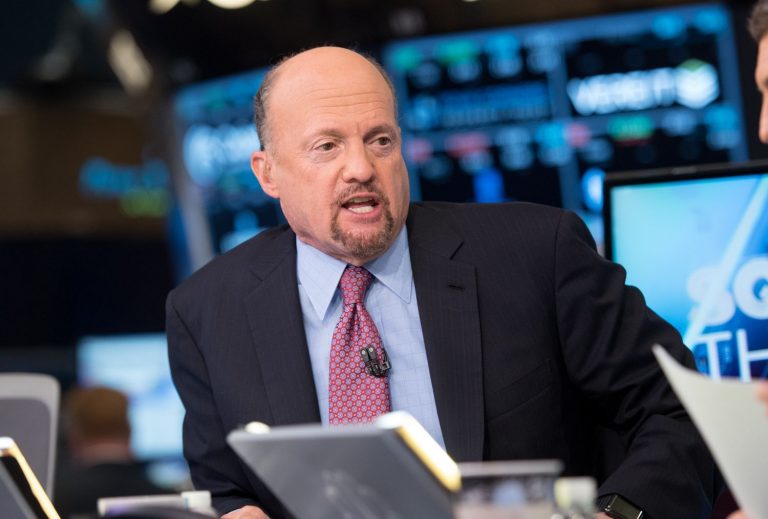
CNBC’s Jim Cramer said Monday that President Donald Trump’s new arrangement with semiconductor giants Nvidia and AMD is far from unprecedented, likening it to past instances where the U.S. government took financial stakes in private companies.
Under the deal, confirmed by the White House, Nvidia and AMD will hand over 15% of their revenue from sales to China directly to the U.S. Treasury in exchange for licenses to export certain advanced chips to the country. The Financial Times first reported the agreement, which follows months of escalating restrictions on high-tech exports to China.
The arrangement marks a sharp turn in policy. The Trump administration had previously moved to block chip exports over national security concerns, prompting warnings from industry leaders that the U.S. risked ceding a lucrative $50 billion artificial intelligence market to foreign competitors. Nvidia CEO Jensen Huang had been among the most vocal critics of the restrictions, urging Washington to find a compromise.
Register for Tekedia Mini-MBA edition 20 (June 8 – Sept 5, 2026).
Register for Tekedia AI in Business Masterclass.
Join Tekedia Capital Syndicate and co-invest in great global startups.
Register for Tekedia AI Lab.
Just last week, Trump imposed a 100% tariff on all semiconductor and chip imports — except those produced in the United States. Monday’s deal effectively exempts Nvidia and AMD from the full force of those tariffs, provided they share a slice of their China revenue with the government.
Cramer described the agreement as “basically just another form of tariff,” but one that might be more palatable to both industry and taxpayers.
“There’s nothing novel at all about taking a 15% cut,” he said on CNBC. “It’s not like Trump’s collecting this money personally… that 15% goes straight to the Treasury.”

While acknowledging “an element of pay-to-play” in the arrangement, Cramer said the policy was “benign” compared to other forms of government intervention in business. He pointed to historical precedents, such as the federal government’s investment in Chrysler during its 1979 near-bankruptcy and the capital injections into major U.S. banks during the 2008–09 financial crisis, both of which ultimately generated profits for the Treasury.
To Cramer, the most important aspect is not the revenue-sharing clause but the fact that the administration is allowing chipmakers to re-enter the Chinese market.
“The government intervened where it shouldn’t have, and then it changed course to do the right thing,” he said. “Wring your hands all you want, but this chip deal is good for the taxpayer and good for Nvidia and AMD. If the chipmakers aren’t complaining, why should we?”

The Trump–Nvidia–AMD deal follows Trump’s recent policy shift toward fostering “strategic cooperation” among U.S. tech leaders to counter China’s aggressive push into AI and semiconductor technology. In 2023, the Biden administration strongly supported the CHIPS and Science Act, providing billions in subsidies to domestic semiconductor production. That effort intensified in early 2025, following Beijing’s expansion of its own AI chip programs and increased subsidies for Chinese manufacturers.
In January 2025, Trump convened a closed-door meeting with Nvidia CEO Jensen Huang and AMD CEO Lisa Su at the White House. Sources familiar with the talks said Trump pitched a revenue-sharing model as a way to prevent U.S. firms from exhausting resources in cutthroat competition while Chinese rivals benefit. Under the arrangement, Nvidia and AMD will maintain separate R&D pipelines but will collaborate on certain AI chip projects, particularly those targeting defense, space, and high-performance data centers.
The deal underscores the Trump administration’s willingness to use unconventional trade and industrial policies to reshape the global technology supply chain while maintaining a focus on domestic manufacturing and revenue generation for the federal government. It also signals a more transactional approach to U.S.–China tech relations — one that could have ripple effects for other industries navigating between geopolitical tension and market opportunity.