

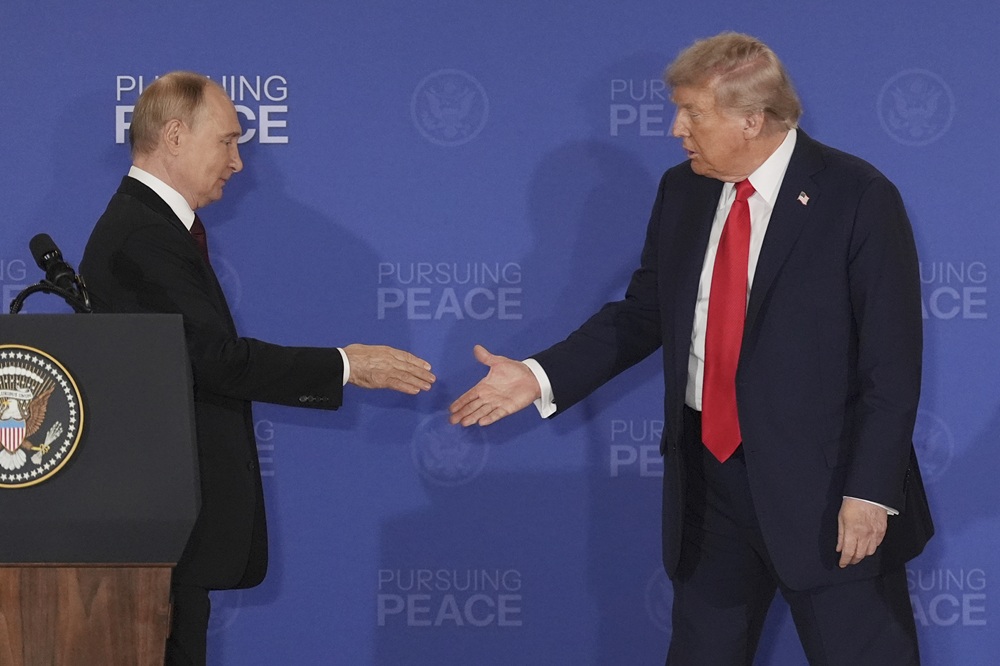
U.S. President Donald Trump’s long-anticipated summit with Russian President Vladimir Putin ended Friday without a ceasefire deal in Ukraine, setting off unease in European capitals and sparking renewed debate over America’s role in the war.
Trump struck a confident tone after the hours-long meeting, telling his supporters on social media that the talks “went very well.” But his refusal to push for a ceasefire immediately, opting instead to emphasize a broader “Peace Agreement,” underscored the fault lines between Washington, Kyiv, and European leaders.
“It was determined by all that the best way to end the horrific war between Russia and Ukraine is to go directly to a Peace Agreement, which would end the war, and not a mere Ceasefire Agreement, which often times do not hold up,” Trump wrote.
Register for Tekedia Mini-MBA edition 20 (June 8 – Sept 5, 2026).
Register for Tekedia AI in Business Masterclass.
Join Tekedia Capital Syndicate and co-invest in great global startups.
Register for Tekedia AI Lab.
The framing marks a sharp contrast with Ukraine and its allies in Europe, who view a ceasefire as an urgent necessity to stop the bloodshed while paving the way toward longer-term peace. European leaders released a joint statement insisting that “it will be up to Ukraine to make decisions on its territory” and warning that without a ceasefire, Russia retains the upper hand on the battlefield.
Ukrainian President Volodymyr Zelenskyy, excluded from the summit, responded cautiously but said he plans to meet Trump in Washington on Monday to “discuss all the details regarding ending the killings and the war.” Trump, in turn, suggested that if progress is made with Zelenskyy, he would then move toward a second meeting with Putin.
The summit also reignited a familiar debate in Europe about Trump’s approach to Russia. Since his first term in office, Trump has been accused by critics of showing unusual deference to Putin. His questioning of NATO’s value, coupled with repeated threats to reduce U.S. commitments to the alliance, has unsettled European leaders who see Washington as indispensable in countering Moscow’s aggression.

At the same time, Trump has often argued that Europe relies too heavily on American defense spending and has pushed allies to shoulder more of the burden. His latest diplomatic overture to Putin deepens the perception among some European capitals that the U.S. president is willing to cut side deals with Moscow, even if it sidelines NATO unity or Kyiv’s priorities.
Moscow seized on this moment to project victory. Putin described the talks as “very frank, meaningful and, in my opinion, this brings us closer to the necessary decisions.” Russian senator Andrei Klishas went further, declaring that “a new European and international security architecture is on the agenda and everyone must accept it.”
For Trump, the summit fits into his longstanding pattern of pursuing personal diplomacy with strongmen—whether with Putin, North Korea’s Kim Jong-un, or China’s Xi Jinping—arguing that direct leader-to-leader engagement can achieve breakthroughs where traditional diplomacy stalls. His critics, however, warn that such a strategy risks legitimizing adversaries while undermining alliances built over decades.

The stakes are particularly high in Ukraine. Without a ceasefire, Russia retains room to expand its territorial grip and test the resolve of Europe’s sanctions regime. European leaders vowed to keep the pressure on Moscow: As long as the killing in Ukraine continues, we stand ready to uphold the pressure on Russia, they said, promising to strengthen sanctions until “there is a just and lasting peace.”
The outcome of the summit means the war continues for now. Trump is betting that his personal brand of dealmaking can deliver what months of Western pressure and battlefield struggles have not: a negotiated peace. Whether that gamble pays off or deepens divisions within the West will become clearer after his meeting with Zelenskyy in Washington.