

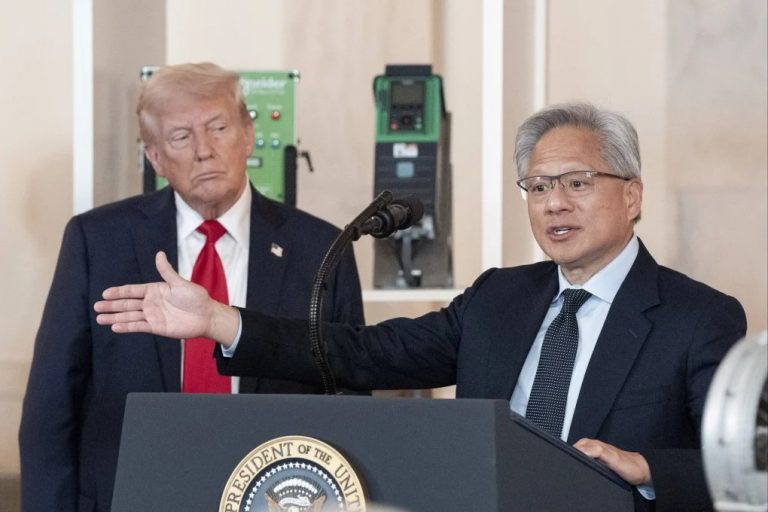
President Donald Trump said Monday he would be open to allowing Nvidia to sell a reduced-performance version of its most advanced artificial intelligence chip to China, in what could become a second high-profile revenue-sharing deal between Washington and a leading U.S. semiconductor firm.
Trump said he would consider approving exports of Nvidia’s cutting-edge Blackwell processors to China if the company could engineer a version that is 30% to 50% less powerful than the original.
“It’s possible I’d make a deal” on a “somewhat enhanced — in a negative way — Blackwell” processor, Trump said. “In other words, take 30% to 50% off of it.”
Register for Tekedia Mini-MBA edition 20 (June 8 – Sept 5, 2026).
Register for Tekedia AI in Business Masterclass.
Join Tekedia Capital Syndicate and co-invest in great global startups.
Register for Tekedia AI Lab.
The statement came as Trump confirmed a separate, unprecedented arrangement with Nvidia that will allow the company to sell its less-advanced H20 AI chip to China if it pays 15% of revenue from those sales to the U.S. government. Advanced Micro Devices Inc. (AMD) will be subject to the same 15% revenue-sharing requirement for its China-targeted Instinct MI308 chip, according to a person familiar with the matter.
Trump said he had initially demanded a 20% cut of Nvidia’s China sales before CEO Jensen Huang negotiated it down to 15% during a meeting at the White House on Friday.
“I said, ‘listen, I want 20% if I’m going to approve this for you, for the country,’” Trump told reporters.

Calling the H20 an “old chip that China already has” and “obsolete,” Trump compared it to the Blackwell, which he described as “super-duper advanced” and unmatched globally.
“That’s the latest and the greatest in the world. Nobody has it. They won’t have it for five years,” Trump said.
He reiterated that any Blackwell exports to China would require “significant downgrades” in performance before being considered.

U.S. export controls on advanced chips are aimed at preventing China from acquiring technology that could enable it to surpass the U.S. in AI capabilities — a development many officials consider a national security risk. Trump said China already possesses chips with similar capabilities to the H20, adding that Huawei has a comparable product.
Nvidia CEO Huang has argued that it is in America’s strategic interest for Chinese AI developers to use U.S.-made chips, warning that blocking access entirely could accelerate the growth of China’s domestic semiconductor industry.
“He’s selling essentially an old chip,” Trump said, downplaying the H20’s potential to enhance Chinese AI capacity.
The H20, a China-specific variant of Nvidia’s H100 and H200 chips, was developed after the Biden administration’s 2023 export restrictions. Its performance has been deliberately reduced to comply with U.S. rules. In April, the Trump administration required a license for H20 exports, effectively cutting Nvidia off from the Chinese market. Huang later said the company had anticipated $8 billion in H20 sales for the July quarter before shipments were halted.
A Potential Precedent in Trade and Tech Policy
The revenue-sharing arrangement for the H20 and the possibility of a similar one for the Blackwell marks a shift in U.S. export policy, blending national security restrictions with direct fiscal benefit. Trump has framed these deals as ways to ensure America gets a “payout” in exchange for concessions on trade.
Experts say such agreements could set a precedent for future tech exports, particularly in strategic sectors like semiconductors, aerospace, and quantum computing. The U.S. could both limit the performance of exported products and capture a share of the revenue stream by imposing a percentage levy on high-value technology sales to China.
While the approach offers a mechanism to keep U.S. firms competitive in China without granting access to their most advanced capabilities, it could also undermine the strict rationale for export controls if overused.
Nvidia and AMD have both seen their China revenues decline sharply under tightened U.S. export rules. Although Washington has recently issued licenses for certain downgraded chips, these products are often comparable to existing Chinese offerings, raising questions about their appeal in the market.
A scaled-down Blackwell, if approved, could improve Nvidia’s position with Chinese customers and recapture lost sales, but it would also become a bargaining chip in broader U.S.–China trade and technology negotiations.
The timing is significant: Beijing is pressing for eased export curbs on high-bandwidth memory (HBM) chips as part of ongoing trade talks, reportedly seeking to include such concessions in a deal ahead of a potential Trump–Xi Jinping summit. HBM chips are critical for AI training and data processing, making them a parallel flashpoint alongside the Blackwell debate.
Trump hinted that Huang would return to the White House soon to discuss the Blackwell issue further.
“I think he’s coming to see me again about that, but that will be a unenhanced version of the big one,” Trump said.
If the deal scales, the government will be deriving more 15% revenue from Nvidia’s Blackwell exports to China.